
Guide for manufacturers and suppliers
EcoVadis and Customer Security Questionnaires: What US Manufacturers Need to Know
A large customer has asked you to "complete EcoVadis" or fill in a long sustainability and security questionnaire. This guide explains what EcoVadis actually is, why customers ask, what the EU rules do and do not require of a US supplier, and which parts your IT team can help you prove.
Last reviewed by Preferred Data Corporation

Who this guide is for
- US manufacturers and distributors whose customers have asked for an EcoVadis rating, a sustainability scorecard or a signed supplier code of conduct.
- Quality, sales and office managers who have been handed a supplier questionnaire and need to know who should answer what.
- Owners deciding whether the time and subscription cost are worth it to keep a customer.
If no customer has asked for it, you do not need an EcoVadis rating. It is voluntary, so the decision is a business one.
What is EcoVadis?
EcoVadis is a company that rates other companies on sustainability. The rated company answers a questionnaire and uploads documents as evidence, and EcoVadis analysts score it from 0 to 100 overall and for each of four themes (EcoVadis methodology). EcoVadis says it has rated more than 175,000 companies in more than 180 countries (EcoVadis).
| Theme | Criteria EcoVadis looks at | Who usually owns it |
|---|---|---|
| Environment | Energy use and greenhouse gases; water; biodiversity; air pollution; materials, chemicals and waste; product use; product end-of-life; customer health and safety; environmental services and advocacy | Operations, plant or EHS manager |
| Labor and Human Rights | Employee health and safety; working conditions; social dialogue; career management and training; child labor, forced labor and human trafficking; discrimination and harassment; external stakeholder human rights | HR and safety |
| Ethics | Corruption; anticompetitive practices; responsible information management | Leadership and legal, with IT for information management |
| Sustainable Procurement | Supplier environmental practices; supplier social practices | Purchasing |
It is a paid service. The rated company buys an annual subscription, and the fee depends on company size and the plan chosen (EcoVadis plans and pricing).
It is not a certification and not a government requirement. EcoVadis says its medals and badges "should not be understood as certification or an endorsement," and a rating is valid for 12 months from publication (EcoVadis methodology).
Scores fall into five bands: Insufficient (0 to 24), Partial (25 to 44), Good (45 to 64), Advanced (65 to 84) and Outstanding (85 to 100) (EcoVadis methodology).
Key takeaway: EcoVadis is a customer-driven rating. Treat it like a customer audit, not like a license to operate.
Why are customers asking suppliers for EcoVadis?
Large buyers use ratings like EcoVadis to check their supply chains, and EcoVadis ratings are typically requested by customers' procurement teams (EcoVadis). For a supplier, the practical reason to take part is keeping or winning that customer's business.
Electronics and technology buyers often ask suppliers to follow the Responsible Business Alliance (RBA) Code of Conduct instead of, or as well as, a rating. Version 8.0 of the code covers labor, health and safety, environment, ethics and management systems, and asks companies that adopt it to require at least their next-tier suppliers to acknowledge and implement it. Its ethics section includes privacy: complying with privacy and information security laws whenever personal information is collected, stored, processed and shared (RBA Code of Conduct).
Many large customers also send their own security questionnaire asking how you protect their drawings, data and accounts. The same kind of evidence answers most of them: a written policy, proof that it is followed, and records.
Does EU law require my US company to have an EcoVadis rating?
No law requires an EcoVadis rating. The EU's Corporate Sustainability Due Diligence Directive (CSDDD) applies to very large companies, and the Omnibus I directive, published in the EU's Official Journal on February 26, 2026, narrowed it to EU companies with more than 5,000 employees and more than EUR 1.5 billion in worldwide turnover, and to non-EU companies with more than EUR 1.5 billion in turnover in the EU (Latham & Watkins; Directive (EU) 2026/470). Companies in scope must comply from July 26, 2029.
In-scope companies take a risk-based approach and give priority to impacts linked to their direct business partners. They should ask business partners with fewer than 5,000 employees for information only as a last resort, and keep any request "targeted, reasonable and proportionate" (Clifford Chance).
So for a typical US supplier the pressure does not come from the law directly. It comes from customers, some in scope and some simply wanting the assurance, who write ratings and codes of conduct into their supplier requirements and contracts.
Key takeaway: Answer to your customer and your contract, not to headlines about EU law. If a contract cites the CSDDD, check with your attorney.
What does EcoVadis accept as evidence?
EcoVadis scores your management system in three layers: written policies, the actions that carry them out, and reported results (EcoVadis methodology). A document only counts if it meets EcoVadis's eligibility rules, and EcoVadis says it screens out documents prepared just for the assessment that do not reflect a real management system.
Expectations are lighter for smaller companies: EcoVadis scores extra small (1 to 25 employees) and small (26 to 99 employees) companies with adjusted formulas (EcoVadis methodology).
The practical lesson: an undated policy written the week before the assessment, with no owner and no proof it is followed, earns little. A shorter policy that is dated, approved and backed by records earns more.
- Formalized: an official document that is part of how you actually run the business.
- Complete: the whole document, not an excerpt.
- Credible: clearly identifiable as your company's.
- Dated: it shows an issue or review date.
- Readable: PDF, Word, Excel, JPG or PNG under 30 MB, with real text rather than a scanned photo.
Which parts of EcoVadis and supplier questionnaires can IT help with?
IT can supply the evidence for responsible information management under the Ethics theme, for retiring old computers and drives under Environment, and for document control across every theme, and it can make IT purchasing part of your sustainable procurement story. These are concrete, provable items a well-run IT function already produces.
| Requirement area | What IT can provide | Example evidence |
|---|---|---|
| Ethics: responsible information management | Information security and data protection policies, and the controls behind them | Dated information security policy, multi-factor authentication coverage, security training records, incident response plan |
| Environment: materials, chemicals and waste | A documented process for retiring computers, drives and batteries | Certificates of recycling and of data destruction from a certified electronics recycler |
| Every theme: document control | One controlled place for policies, with owners, versions and review dates | Policy library showing approval and review history |
| Sustainable Procurement | IT buying that asks vendors about their own practices | IT vendor list with the security and sustainability questions asked at purchase |
| Customer security questionnaires | Clear answers on how you protect customer data and accounts | Written policies, multi-factor authentication, tested backups, access reviews |
For old equipment, the EPA points businesses to electronics recyclers certified to the R2 or e-Stewards standards, both of which require third-party audits (EPA). Ask for a certificate of recycling and, for drives, a record of data destruction that follows NIST SP 800-88, the federal guide to wiping and destroying storage media (NIST SP 800-88 Rev. 2).
In North Carolina, discarded computer equipment is banned from landfills, and lithium-ion batteries join the ban on December 1, 2026 (N.C. Gen. Stat. 130A-309.10).
If you do not have a written information security policy yet, our free Information Security Policy generator gives you a dated, plain-English starting point.
Which parts need HR, legal or a sustainability advisor?
Most of EcoVadis is not an IT job. Labor and human rights, health and safety, anti-corruption, fair competition and environmental programs such as energy, emissions and water need owners in HR, safety, leadership, legal and operations, and sometimes a sustainability consultant.
Preferred Data covers the IT and data security side: the policies, the controls behind them, the records and a documented process for retiring equipment. We do not run HR, labor, anti-corruption or environmental programs, and we will tell you when a question belongs with someone else.
Key takeaway: Split the questionnaire by owner on day one. It is the fastest way to finish.
Where to start
5 practical next steps, in order.
Read exactly what the customer asked for
Is it an EcoVadis rating, a code of conduct to sign or their own questionnaire? Note the deadline and whether they expect a minimum score.
Split the questions by owner
IT, HR, safety, purchasing, finance and leadership. Give each owner the criteria table above so they know their part.
Gather what already exists before writing anything new
Policies, certificates, training records, safety logs and recycling certificates. Add an owner and a date to anything missing one.
Close the information security gaps
A dated information security policy, multi-factor authentication on email and remote access, security training and a documented equipment disposal process cover most IT questions.
Put the renewal on the calendar
An EcoVadis rating is valid for 12 months, so plan the next one now and keep evidence current all year.
Free tools and templates
Free policy templates, tools and checklists from our resource library that help you answer customer and supplier requirements.
Policy templates
 Policy templateInformation Security PolicyEstablish the core security program every insurer, auditor and customer now asks about: data classification, access control, patching, encryption, logging and vendor risk.
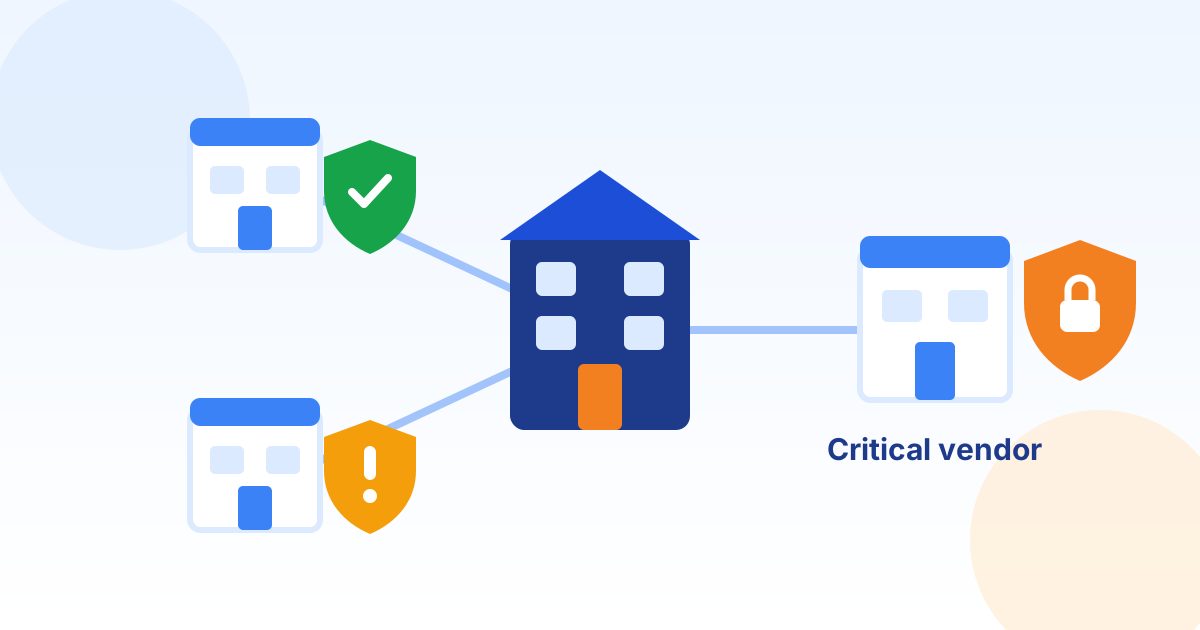 Policy templateVendor Risk Management PolicyChoose and monitor the vendors that hold your data or reach your systems: a vendor list, simple risk tiers, security questions, contract clauses, remote access rules and a clean exit.
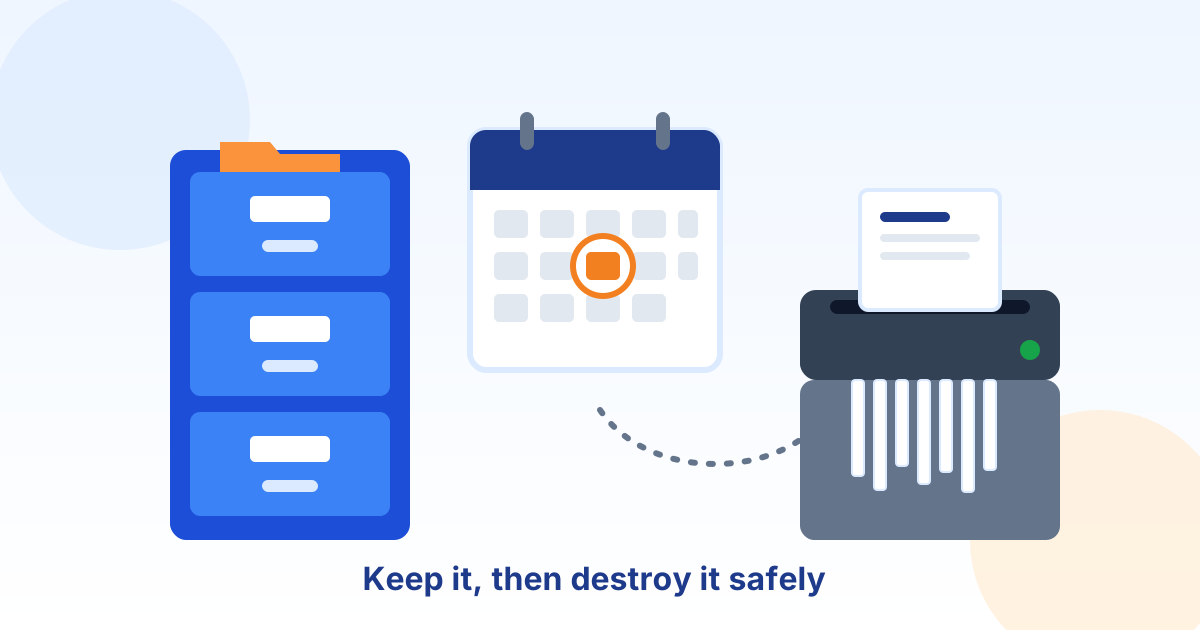 Policy templateData Retention and Destruction PolicyDecide what records to keep and for how long, with a sensible default schedule, legal holds, and secure destruction of paper and devices following NIST SP 800-88.
 Policy templateData Protection and Privacy PolicySet internal rules for the personal and confidential data you hold: collect less, limit access, share carefully with vendors, handle requests, and respond to a breach under North Carolina law.
 Policy templateIT Asset Disposal PolicyRetire old computers, phones, servers and copiers safely: track every device, wipe or destroy data to NIST SP 800-88, get certificates of destruction, and recycle through certified recyclers.
 Policy templateIT Supplier Code of ConductSet clear expectations for the companies you buy IT from: security, data protection, ethics, labor and environmental basics, take-back and recycling, and your right to ask for evidence.
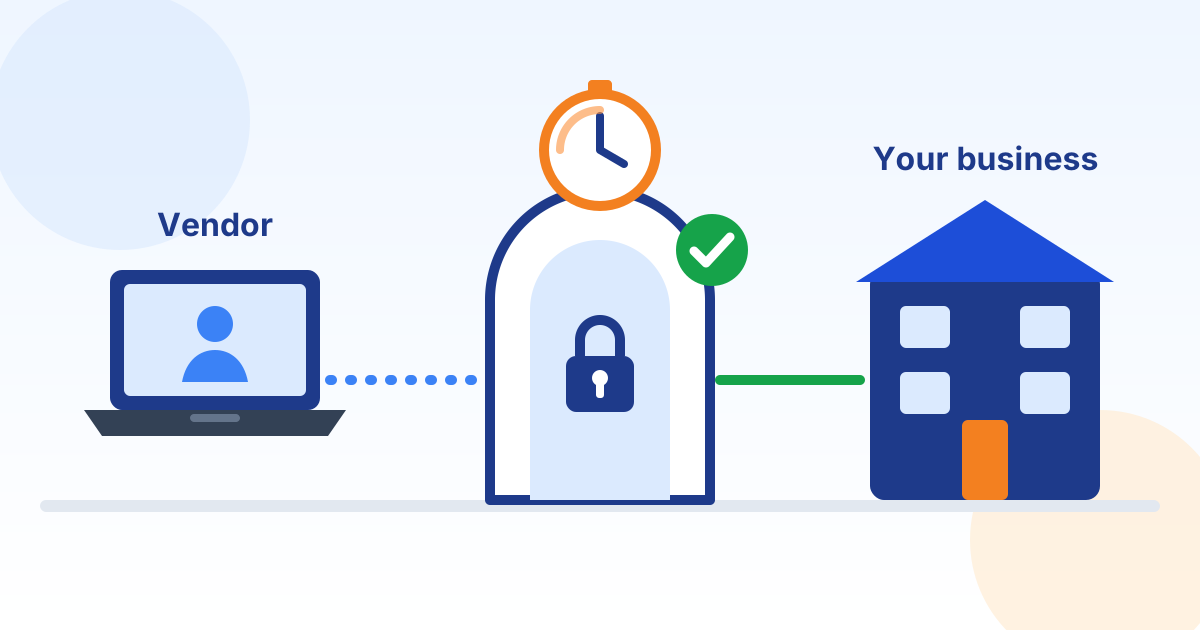 Policy templateVendor Remote Access PolicyControl how vendors, machine builders, software suppliers and IT providers connect in: approved tools only, a named account and MFA for every technician, access switched on per session, logged sessions and quick removal.
Checklists

Reference

Reading list
The articles from our blog that go deeper on this topic, picked and grouped so you can read them in order.
Supplier and vendor risk
The security evidence customers ask for
Frequently asked questions
Is EcoVadis a certification?
No. EcoVadis says its medals and badges should not be understood as a certification or an endorsement (EcoVadis methodology). It is a rating of your sustainability management system, valid for 12 months.
Is EcoVadis required by law?
No. It is a customer requirement, not a legal one. The EU due diligence law now applies only to very large companies, from July 26, 2029, and tells them to limit information requests to smaller partners (Clifford Chance).
How much does an EcoVadis rating cost?
EcoVadis charges an annual subscription that depends on company size, location and plan, and shows the price once you enter those details (EcoVadis plans and pricing). Budget for internal time as well: gathering and formalizing evidence is usually the bigger effort.
Are small suppliers judged the same way as big companies?
No. EcoVadis adjusts its scoring for size, with lighter expectations for extra small companies (1 to 25 employees) and small companies (26 to 99 employees) (EcoVadis methodology).
What is the Responsible Business Alliance Code of Conduct?
It is a code of conduct that started in the electronics industry and covers labor, health and safety, environment, ethics and management systems. Companies that adopt it are expected to require at least their next-tier suppliers to acknowledge and implement it (RBA).
Can better IT improve an EcoVadis score?
It can strengthen the evidence for responsible information management and equipment disposal, and keep every policy dated and controlled so documents count. It cannot replace HR, safety, ethics or environmental programs.
How can Preferred Data help?
We help manufacturers put together the IT and data security evidence customers ask for: written policies, multi-factor authentication, training records, backups and a documented equipment disposal process, through our cybersecurity and managed IT services. Call (336) 886-3282.
Sources
- EcoVadis Sustainability Rating methodology disclosure document
- EcoVadis: How it works
- EcoVadis: Plans and pricing
- Directive (EU) 2026/470 (Omnibus I), Official Journal of the EU
- Latham & Watkins: EU Sustainability Omnibus published in the Official Journal
- Clifford Chance: Omnibus I concludes CSDDD and CSRD reforms
- Responsible Business Alliance Code of Conduct
- U.S. EPA: Certified electronics recyclers
- NIST SP 800-88 Rev. 2, Guidelines for Media Sanitization
- N.C. Gen. Stat. 130A-309.10, solid waste disposal bans
How Preferred Data can help
Need help with the IT side of a supplier questionnaire?
Send us the questions. We will tell you which ones are IT questions, what evidence you already have and what is missing, in plain English.
Preferred Data Corporation, in business since 1987 and headquartered in High Point, NC. 1208 Eastchester Drive, Suite 131, High Point, NC 27265