
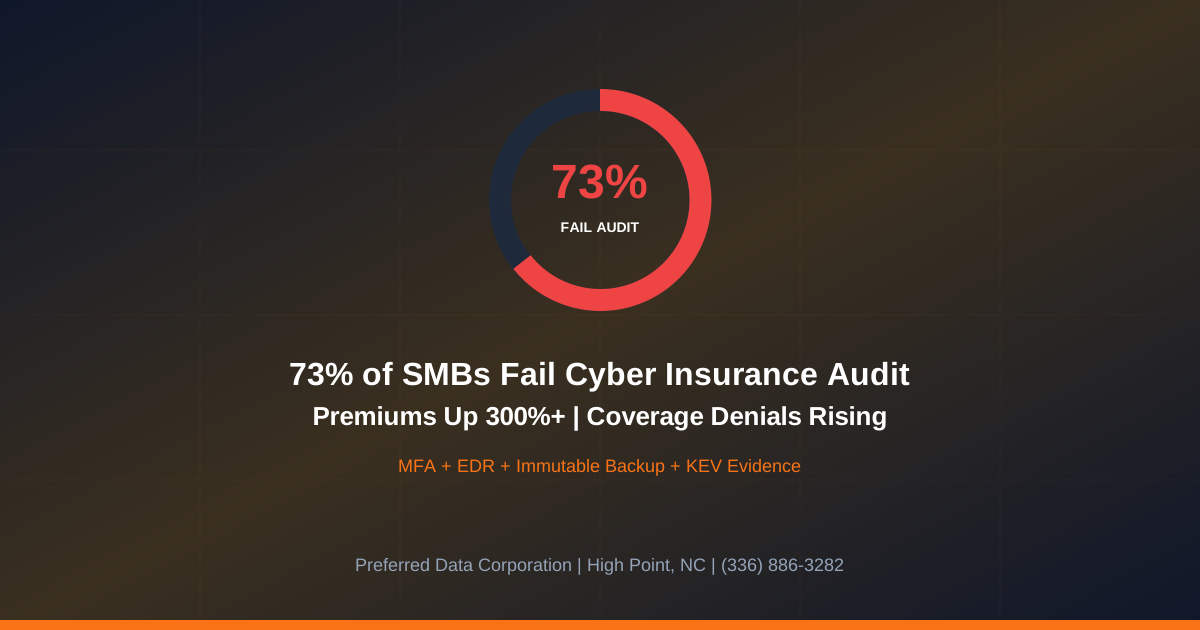
TL;DR: The causes of a failed cyber insurance assessment are predictable: missing MFA, no EDR, untested immutable backups, no documented patching cadence, no incident response retainer, and no governance evidence. For NC small businesses, the fix is operational and well within reach.
Key takeaway: Cyber insurance is now an audit, not a check-the-box product. The SMBs that get coverage at workable premiums in 2026 are the ones running a managed cybersecurity program with documented MFA, EDR, immutable backup, KEV remediation, security awareness training, and incident response readiness, before they fill out the application.
Worried your renewal application will be denied or repriced? Preferred Data Corporation runs managed cybersecurity programs with insurance evidence packs for NC small businesses. Call (336) 886-3282 or request a cyber insurance readiness review.
Why do SMBs fail cyber insurance audits in 2026?
Because the underwriting model materially changed. Per the HUB Tech 2026 SMB readiness guide, carriers now operate more like security auditors than insurers.
Per the 2026 DBIR, vulnerability exploitation is now the #1 initial access vector at 31% of breaches, only 26% of CISA KEV-listed critical vulnerabilities were fully remediated, and the median time to fully resolve them rose to 43 days.
Per BP Innovations' 2026 readiness piece, Fairdinkum's 2026 SMB brief, and the Alpha Computer Group 2026 brief, the failure pattern is consistent.
What controls do carriers actually require in 2026?
Multi-factor authentication everywhere, EDR/MDR on every endpoint, immutable offsite backup with tested restores, security awareness training with certificates, documented patching cadence, and an incident response plan with a named partner. Per the cited 2026 broker reports, the baseline checklist is:
| Control | 2026 minimum | Why insurers care |
|---|---|---|
| Multi-factor authentication | Every user, every system, phish-resistant for admins | Stops credential-only attacks |
| EDR/MDR | Every endpoint, tamper protection on, 24/7 monitoring | Catches post-exploitation |
| Backups | Immutable, offsite, tested quarterly | Defeats ransomware encryption |
| Patching | KEV-rate cadence, evidenced | Closes #1 breach vector |
| Email security | Advanced phishing + impersonation protection | Stops BEC and AI phishing |
| Security awareness training | Annual, certificate per user | Reduces human-error claims |
| Incident response | Documented plan, named partner, retainer | Bounds claim size |
| Vendor risk management | Inventory + due diligence | Per DBIR, 30%+ breaches via third party |
| Access control | Least privilege, joiner/mover/leaver process | Reduces insider blast radius |
| Asset inventory | Endpoints, servers, SaaS, identities | Cannot defend what is unknown |
Per the Velocity Technology Group brief and Prescient Solutions 2026 SMB checklist, backups must specifically be stored offsite or air-gapped, immutable so they cannot be altered or deleted, and tested on a recurring schedule.
What does failing a cyber insurance audit actually cost?
Per Symmetric Group's 2026 brief, businesses that delay action often face higher premiums, limited coverage options, or outright denial.
Quotable definition: A failed cyber insurance audit in 2026 is any application or renewal outcome in which the insured cannot evidence MFA enforcement, EDR/MDR coverage, immutable tested backups, KEV-rate patching, security awareness training, and a documented incident response plan with a named partner, resulting in coverage denial, a premium increase, or material exclusions.
What should an NC small business do this quarter?
Build a managed cybersecurity program before you fill out the application.
- Run a gap assessment against the 10-control 2026 baseline. A managed services partner or vCIO can deliver this in 1-2 weeks.
- Close MFA gaps first. Every user, every system. Phish-resistant MFA (FIDO2 / passkeys) for admins, finance, and HR. SMS MFA is no longer adequate.
- Deploy EDR/MDR with tamper protection in block mode. Defender for Business, SentinelOne, CrowdStrike Falcon, Sophos Intercept X, or equivalent. 24/7 SOC coverage is the 2026 baseline.
- Move backups to immutable offsite storage and test restores. Veeam, Datto, Cohesity, AWS Backup, Azure Backup, or equivalent. Run a documented restore drill at least quarterly.
- Build a KEV-rate patching program. Inventory internet-exposed assets, automate patching, document evidence. The 2026 DBIR makes this a top-tier underwriting question.
- Document everything. Acceptable use policy, incident response plan, vendor risk register, asset inventory, access reviews, change management log. Underwriters now read these documents.
- Sign an incident response retainer. A named partner with a 1-hour SLA materially reduces claim size.
- Train every user annually with certificate evidence. KnowBe4, Hoxhunt, or equivalent. Track completion at the user level.
Need this assessed and built for your business? Call (336) 886-3282 or contact Preferred Data Corporation for a cyber insurance readiness review.
Why is this a managed-program problem, not a one-time fix?
Because the underwriting questionnaire renews every year and the threat landscape moves faster than the in-house calendar. Per the 2026 Verizon DBIR, Guardz's June 2026 MSP threat report, and ConnectWise's 2026 MSP Threat Report, the SMB attack surface now spans endpoint, identity, email, cloud, supply chain, and AI agents. The 24/7 multi-domain operations function that satisfies underwriters cannot be sustained by a single in-house generalist.
For a Piedmont Triad SMB, the right answer is a managed cybersecurity program from an MSP that runs the control stack, produces the evidence pack for the underwriter, and partners on incident response. Preferred Data Corporation has served North Carolina businesses since 1987, from our High Point headquarters and on-site across the Piedmont Triad, Charlotte, Greensboro, Raleigh, and Winston-Salem.
PDC supports this through managed cybersecurity, managed IT services, and data protection and backup.
Frequently Asked Questions
Is MFA on email enough, or do we need it everywhere?
Everywhere. Per the Velocity Technology Group 2026 SMB checklist and Prescient Solutions checklist, MFA is now expected on every user account, every administrative interface, every VPN, every remote access path, and every cloud tenant. Phish-resistant MFA (FIDO2 / passkeys) is increasingly expected for privileged accounts.
What is "immutable" backup and why does it matter?
Backup data that cannot be altered or deleted once written, even by an attacker with administrative credentials. Per Velocity Technology Group's brief, immutable backup is now a baseline cyber insurance requirement. The technology options include S3 Object Lock, Azure Immutable Blob Storage, Veeam Hardened Repository, and Datto Immutable Cloud.
Can we self-attest controls, or do we need third-party evidence?
Increasingly, carriers ask for third-party evidence: penetration test summaries, MSP attestation letters, EDR/MDR vendor reports, backup restore drill logs, and security awareness training completion reports. Self-attestation alone is now common cause for additional underwriter questions and slower binding.
Related Resources
- Managed Cybersecurity Services for NC Businesses - 2026 cyber insurance baseline
- Managed IT Services for NC Businesses - Patching, RMM, vCIO governance
- Data Protection and Backup Services - Immutable offsite backup
- Cyber Insurance Application Readiness: NC SMB 2026 Guide - Prior-quarter baseline
- DBIR 2026 Remediation Paradox NC SMB 43-Day Patch Gap - KEV-rate patching evidence
- Contact Preferred Data Corporation - Cyber insurance readiness review