
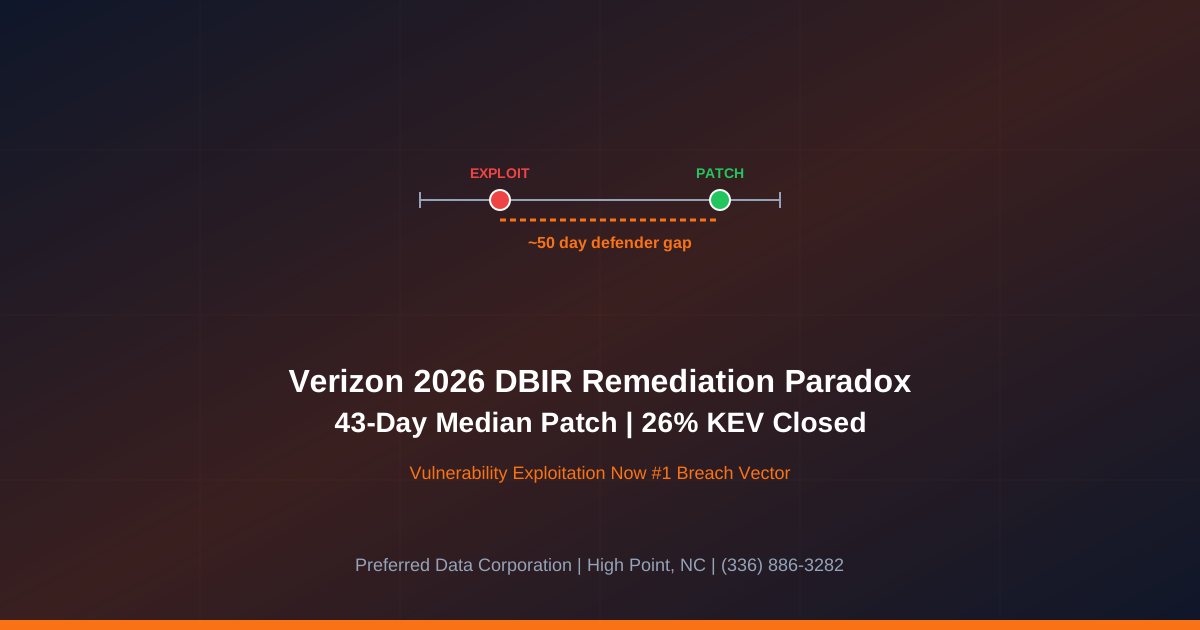
TL;DR: The Verizon 2026 Data Breach Investigations Report documents a structural defender failure called the Remediation Paradox: the median time to patch a vulnerability rose from 32 days to 43 days, full CISA KEV remediation dropped from 38% to 26%, and exploitation now precedes patch availability by roughly 50 days on average. For NC small businesses, that math is unforgiving: if attackers exploit a flaw before the patch even ships and the typical SMB takes another 43 days after that, every internet-exposed asset has a multi-week exposure window per release cycle. The fix is risk-based, automated, and managed patching, not faster effort by the same in-house team.
Key takeaway: Patch fatigue is now a board-level risk. The SMBs that survive 2026-2027 are the ones that adopt risk-based, automated patching with 24/7 monitoring and KEV-rate cadence, not the ones that try to do more of the same work faster.
Worried your patch posture would not survive an audit or a claim? Preferred Data Corporation runs managed patching with KEV-rate cadence for NC small businesses. Call (336) 886-3282 or request a patch posture review.
What is the Remediation Paradox in the 2026 Verizon DBIR?
It is the gap between attacker exploitation speed and defender patching speed, and that gap is now negative. Per the 2026 Verizon Data Breach Investigations Report and Security Boulevard's analysis, vulnerability exploitation became the leading initial access vector at 31% of breaches (overtaking credential abuse at 13%), median patch time rose from 32 days to 43 days, and full remediation of CISA Known Exploited Vulnerabilities dropped from 38% to 26%. The "defender buffer" (days between patch release and median exploitation) crashed from +2 days in 2022 to -33 days in 2024 and -50 days in 2025. Exploitation now precedes patch availability by roughly seven weeks on average.
Three facts make this a top-priority issue for SMBs:
- Volume is overwhelming defenders. The median number of KEV vulnerabilities organizations had to patch rose from 11 in 2024 to 16 in 2025, a roughly 50% increase. More tools and more scanners did not help; the work scaled faster than the team.
- AI is compressing attacker timelines. Per Help Net Security, AI-assisted exploit development is shortening time from CVE disclosure to in-the-wild exploitation from weeks to hours.
- Insurance and CMMC now key off KEV. Cyber insurers and CMMC reviewers increasingly treat missed KEV entries as a denial-of-coverage trigger.
For NC small businesses with internet-exposed firewalls, VPNs, web servers, and management consoles, that combination is exactly the attack pattern producing breaches in 2026.
Why did patch times get worse, not better?
Because the defender stack scaled by adding scanners, not by removing work. Per the 2026 DBIR analysis from CISO Platform, most organizations are patching more advisories, running more scanners, buying more tools, and generating more tickets. The vulnerability volume is rising faster than the team can absorb. SMBs are particularly exposed because the existing in-house generalist or small team cannot run a continuous, risk-prioritized, automated patching program in parallel with help desk, onboarding, and project work.
| 2022 baseline | 2025 reality | Why it changed |
|---|---|---|
| Defender buffer +2 days | Defender buffer -50 days | AI-assisted exploit dev, public PoCs in hours |
| Median patch time 32 days | Median patch time 43 days | Higher CVE volume, more scanners, more tickets |
| KEV full remediation 38% | KEV full remediation 26% | Volume outpaces team capacity |
| Credentials #1 access vector | Vulnerabilities #1 (31%) | MFA helped credentials; patching did not scale |
The pattern matters because the answer is not "patch faster manually." It is to restructure the program around risk-based automation and 24/7 coverage, the kind of program that an in-house generalist cannot economically run alone.
What does this mean for NC small businesses in practice?
If you patch in 43 days and exploitation starts inside hours of disclosure, every public-facing asset has a multi-week window per release cycle where an attacker can walk in. The cost of one successful intrusion (downtime, ransom, data exposure, insurance claim, customer churn) routinely exceeds the entire cybersecurity budget for the year. The 2026 Verizon DBIR found 96% of ransomware victims for which size was known were SMBs, and the 2026 BlackFog State of Ransomware report confirms SMBs remain the dominant victim profile.
For a Piedmont Triad small business, the exposure stacks:
- Edge appliances first. Fortinet, SonicWall, Palo Alto, Cisco, Ivanti, Citrix have all shipped critical, exploited CVEs in the last 12 months. KEV entries are now arriving monthly.
- Authentication second. Identity systems (M365, SSO, VPN) are the second-most exploited surface, and the storm-infostealer session theft pattern means even MFA-protected accounts can be hijacked via cookie theft.
- SaaS third. Third-party breach involvement jumped 60% per the DBIR, with attackers entering through CRM, marketing, payroll, and analytics platforms that SMBs already pay for.
The defense pattern that works is risk-based patching, KEV-rate cadence, 24/7 monitoring, and EDR/MDR running in block mode with tamper protection.
Quotable definition: The 2026 Verizon DBIR Remediation Paradox is the structural gap between attacker exploitation speed (now roughly 50 days ahead of patch availability on average) and defender patching speed (median 43 days, KEV full remediation just 26%), producing a multi-week exposure window per release cycle for the typical SMB.
What should an NC small business do this quarter?
Run a risk-based patching program, not a calendar-based one. The fix is operational, not theoretical.
- Inventory the external attack surface. Every internet-exposed asset (firewall, VPN, web server, RDP, management UI, exposed SaaS console). You cannot patch what you do not know exists.
- Adopt KEV-rate cadence for external assets. Every CISA KEV entry that touches your stack patches inside the published deadline, with on-call coverage to do it after hours when needed.
- Automate the rest. Endpoints, servers, applications, browsers, M365 patches on a managed RMM/MDM with reboot windows. Manual patching of 100+ endpoints is not viable in 2026.
- Add behavior-based EDR/MDR with tamper protection. Catch the post-exploitation activity that always slips through patching delays.
- Document for insurance and CMMC. Patch evidence, KEV closure times, exception list with risk acceptance. Underwriters and CMMC assessors now expect this in writing.
- Treat patching as a managed program. This is the function that most clearly justifies an MSP in 2026, because spreading the cost of automation and 24/7 coverage across many clients is the only way to economically run KEV-rate cadence at SMB scale.
Need this restructured for your business? Call (336) 886-3282 or contact Preferred Data Corporation for a patch posture review.
Why is this a managed problem, not a single-tool problem?
Because the attacker side scaled faster than the defender side, and the gap is widening. The 2026 Verizon DBIR, Tenable's analysis, Veracode's reading, and Dataprise's modern exposure management framing all converge on the same recommendation: shift from periodic scanning and ticket-driven patching to continuous, risk-based, automated exposure management with 24/7 coverage. That stack (scanners plus EDR/MDR plus SOC plus RMM plus vCIO governance) is the kind of program that runs economically across many clients but not inside one SMB alone.
For a Piedmont Triad small business, the answer is clear. Pick a managed partner that runs KEV-rate patching, evidences it for cyber insurance and CMMC, and bundles it with the EDR/MDR and SOC coverage that catches what patching delays let through. Preferred Data Corporation has delivered that managed protection to North Carolina small businesses since 1987, from our High Point headquarters and on-site across the Piedmont Triad, Charlotte, Greensboro, Raleigh, and Winston-Salem.
PDC supports this through managed cybersecurity, managed IT services, and network and infrastructure.
Frequently Asked Questions
What is the Verizon 2026 DBIR?
The 2026 Data Breach Investigations Report is Verizon's annual analysis of real-world breach and incident data. The 2026 edition analyzed over 31,000 security incidents and roughly 22,000 confirmed breaches across 145 countries. It is widely cited by cyber insurers, regulators, and CMMC assessors as the baseline data source for SMB and enterprise breach trends.
Why did vulnerability exploitation become the #1 breach vector?
Because MFA materially reduced credential success rates while exploit development sped up. Per SecurityWeek's coverage and watchTowr's reading, vulnerability exploitation now drives 31% of all initial access events versus 13% for credential abuse. AI-assisted exploit dev compressed disclosure-to-exploitation timelines from weeks to hours, while median patch times stretched in the opposite direction.
How fast do we actually need to patch?
For CISA KEV entries on internet-exposed assets, inside the published federal deadline (typically 14-21 days), and faster if a workable exploit is public. For other internet-exposed assets, inside 14-30 days. For internal endpoints and servers, 30-60 days is acceptable if you have EDR/MDR with tamper protection. Annual or quarterly patching cycles are no longer defensible in 2026.
Does our cyber insurance care about KEV remediation?
Yes. Cyber insurance applications commonly ask about patching, EDR/MDR coverage, MFA enforcement, and incident response readiness, and a documented KEV remediation cadence is a clear answer to the patching question.
Can we keep doing patching in-house?
For very small businesses (under 25 endpoints) with no internet-exposed services beyond M365 and a single firewall, possibly. For everything else, the math of KEV-rate cadence plus EDR/MDR plus 24/7 SOC plus documented evidence does not work for a single in-house generalist. The structural answer for 25-500 person NC SMBs is a managed program from an MSP that runs the stack across many clients.
Related Resources
- Managed Cybersecurity Services for NC Businesses - KEV-rate patching, EDR/MDR, 24/7 SOC
- Managed IT Services for NC Businesses - Patching, monitoring, vCIO governance
- Network and Infrastructure Services - Edge appliance hardening
- Verizon 2026 DBIR: Vulnerability Exploitation Now #1 - Headline finding deep dive
- PAN-OS CVE-2026-0257 VPN Bypass NC SMB Action Plan - Live example of the paradox
- Contact Preferred Data Corporation - Patch posture review for NC small businesses