
TL;DR: The NIST Cybersecurity Framework (CSF) 2.0 provides the most widely adopted security blueprint for US businesses, and its new Govern function is critical for addressing AI-powered threats. With 87% of organizations reporting AI-driven attacks and 97% of breached organizations lacking proper AI governance, North Carolina businesses of every size need to align their cybersecurity programs with CSF 2.0 to defend against threats that move from access to data theft in under 72 minutes.
Critical takeaway: NIST CSF 2.0 added the Govern function specifically to address organizational cybersecurity leadership and strategy, which is exactly what AI threats demand. Organizations with AI-powered defenses detect threats 80 days faster and save $1.9 million per breach, making framework adoption both a security and financial imperative.
Need help implementing NIST CSF 2.0? Contact Preferred Data Corporation at (336) 886-3282 for a cybersecurity framework assessment. Serving High Point, Greensboro, Charlotte, Raleigh, and all of North Carolina for over 39 years.
What Is NIST CSF 2.0 and Why Does It Matter for NC Businesses?
The NIST Cybersecurity Framework 2.0, released by the National Institute of Standards and Technology, is the most widely used cybersecurity framework in the United States. Unlike regulatory mandates that apply to specific industries, CSF 2.0 is voluntary and applicable to organizations of all sizes and sectors. For small and mid-size businesses across North Carolina, from manufacturers in High Point to professional services firms in Charlotte, CSF 2.0 provides a practical, risk-based approach to cybersecurity that scales to your needs and budget.
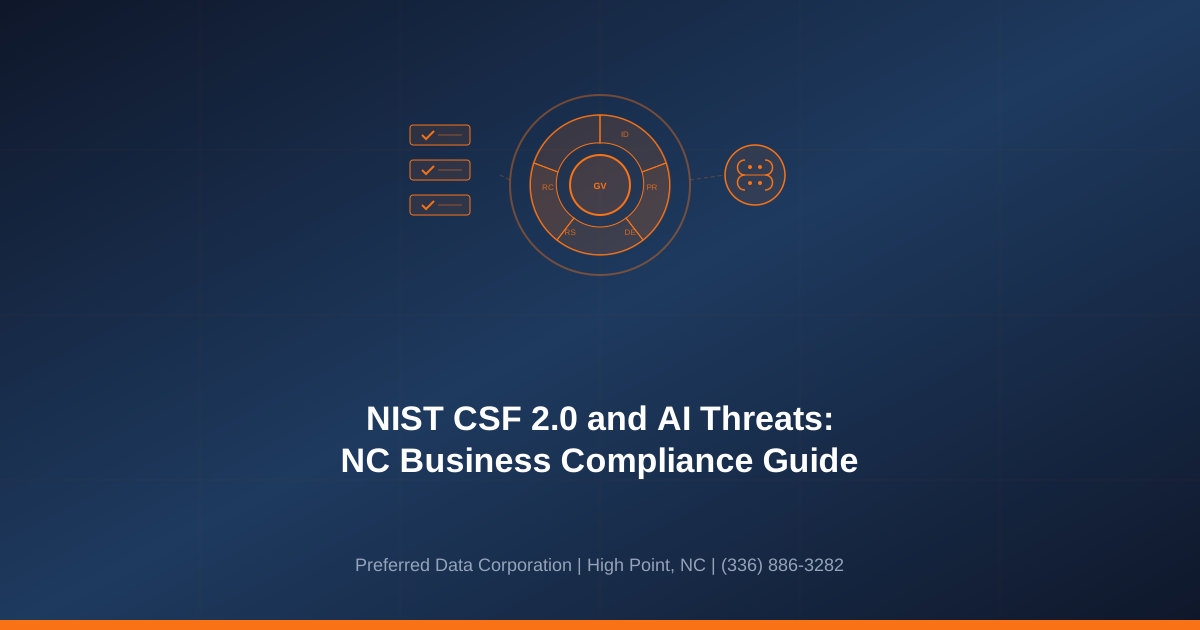
CSF 2.0 represents a significant evolution from the original 2014 framework. The most important change is the addition of a sixth core function, Govern, which sits at the center of the framework and addresses organizational cybersecurity leadership, strategy, and risk management. This addition is directly relevant to AI threats because 97% of organizations that experienced AI-related breaches lacked proper AI governance at the time of the incident.
The framework organizes cybersecurity activities into six functions: Govern, Identify, Protect, Detect, Respond, and Recover. Each function contains categories and subcategories that map to specific security outcomes. For businesses in the Piedmont Triad, Winston-Salem, and across the state, CSF 2.0 provides a common language for discussing cybersecurity with leadership, vendors, insurers, and partners.
With 94% of SMBs using managed service providers in 2026, many North Carolina businesses implement CSF 2.0 through their MSP relationship. The framework helps structure conversations about security investments, measure progress over time, and demonstrate due diligence to stakeholders and insurers.
How Does the New Govern Function Address AI Threats?
The Govern function is the centerpiece of CSF 2.0 and directly addresses the governance gaps that AI threats exploit. It encompasses organizational context, risk management strategy, roles and responsibilities, policy, oversight, and cybersecurity supply chain risk management. For a small business in Greensboro or a manufacturer in Durham, implementing Govern means establishing leadership accountability for cybersecurity decisions.
AI governance specifically fits within the Govern function because it requires organizational-level decisions about AI use policies, AI threat monitoring, and AI-related risk acceptance. With only 51% of SMBs having AI security policies despite 83% acknowledging that AI has increased the threat level, the governance gap is the primary weakness that leads to breaches. CSF 2.0's Govern function provides a structured approach to closing this gap.
| Govern Subcategory | Traditional Focus | AI-Era Enhancement |
|---|---|---|
| Organizational Context | Business objectives, risk appetite | AI impact on business model and risk profile |
| Risk Management Strategy | Standard risk frameworks | AI-specific risk scenarios and thresholds |
| Roles & Responsibilities | CISO, IT team roles | AI governance roles, AI ethics oversight |
| Policy | Security policies | AI acceptable use, AI data handling policies |
| Oversight | Board reporting | AI risk reporting, AI incident metrics |
| Supply Chain Risk | Vendor security reviews | AI supply chain risks, third-party AI tools |
For businesses in High Point, Charlotte, Raleigh, and across North Carolina, implementing Govern starts with simple steps: assign a person responsible for cybersecurity decisions, define acceptable risk levels, establish policies for AI tool use, and create a regular cadence for security reviews with leadership.
How Should NC Businesses Implement the Identify Function Against AI Risks?
The Identify function helps organizations understand their cybersecurity risk by cataloging assets, identifying vulnerabilities, and assessing threats. In the AI era, this function requires expanded scope because AI has introduced new asset categories (AI models, training data), new vulnerabilities (AI-specific attack surfaces), and dramatically accelerated threat timelines.
Start by maintaining a current inventory of all technology assets, including hardware, software, data, and network connections. For manufacturers in the Piedmont Triad with OT systems, this inventory must include industrial control systems, PLCs, and IoT devices. For professional services firms in Raleigh or Charlotte, the inventory should cover cloud services, mobile devices, and third-party software platforms. Every asset is a potential target for AI-powered attacks.
Conduct risk assessments that specifically account for AI threat scenarios. Anthropic's Claude Mythos discovered thousands of zero-day vulnerabilities across every major operating system, demonstrating that even well-maintained systems contain exploitable flaws. Your risk assessment should assume that AI can discover and exploit vulnerabilities in your systems faster than traditional methods, and calculate risk accordingly.
Map your data flows to understand where sensitive information resides and moves. AI-powered data exfiltration can target the most valuable information in your systems within minutes. Knowing where your critical data lives, from customer records to financial systems to intellectual property, is the foundation for protecting it. Use the cybersecurity assessment tool to start this process.
What Does the Protect Function Look Like in the AI Era?
The Protect function implements safeguards to ensure delivery of critical services. In the AI era, these safeguards must operate at machine speed because AI attacks do not wait for human intervention. The Protect function covers identity management, awareness training, data security, platform security, and technology infrastructure resilience.
Identity management is the first line of defense. MFA blocks 99.9% of automated attacks according to Microsoft, making it the single highest-impact control you can implement. Every user account in your organization, from the CEO to temporary contractors, should require MFA. For businesses in Winston-Salem, Durham, and across North Carolina, implementing MFA across all systems is the fastest path to measurable risk reduction.
Security awareness training must evolve beyond annual compliance exercises. AI phishing achieves 54-78% open rates because it is personalized, contextual, and professionally crafted. Monthly phishing simulations using AI-generated content, combined with immediate coaching for employees who click, build the muscle memory needed to resist sophisticated attacks. With 43% of cyberattacks targeting small businesses, every employee is a potential target and a potential defender.
Data security under the Protect function requires encryption at rest and in transit, data classification, access controls based on the principle of least privilege, and data loss prevention (DLP) monitoring. For North Carolina businesses handling sensitive client, patient, or financial data, these controls are both a security best practice and a potential legal requirement.
Deploy endpoint protection with AI-powered threat detection on every device that connects to your network. Traditional antivirus that relies on known threat signatures cannot detect the novel malware that AI generates. Modern endpoint detection and response (EDR) solutions analyze behavioral patterns to identify threats regardless of whether they have been seen before.
Strengthen your Protect controls today. Schedule a cybersecurity assessment with Preferred Data Corporation - call (336) 886-3282. BBB A+ rated with 20+ year average client retention.
How Do the Detect and Respond Functions Counter AI-Speed Attacks?
The Detect function establishes the ability to identify cybersecurity events in a timely manner, and the Respond function defines how to manage detected incidents. AI has compressed attack timelines so dramatically that these two functions must now operate in near-real-time. When attackers move from access to data theft in under 72 minutes, detection that takes hours and response that takes days is functionally equivalent to no detection at all.
Organizations with AI-powered defenses detect threats 80 days faster than those without, according to IBM's Cost of a Data Breach Report. This speed advantage translates directly into financial savings of $1.9 million per breach. For businesses across North Carolina, deploying AI-enhanced security monitoring is the most effective way to match the speed of AI-powered attacks.
Implement continuous monitoring through a Security Information and Event Management (SIEM) system enhanced with AI analytics. This system correlates events across your network, endpoints, email, and cloud services to identify attack patterns that individual tools miss. For small businesses in High Point or Greensboro, managed SIEM services from a managed IT provider provide enterprise-grade detection without the cost of building an in-house security operations center.
Your incident response plan should define clear procedures for common scenarios: ransomware, data exfiltration, business email compromise, and insider threats. Each scenario should specify who is notified, what systems are isolated, how evidence is preserved, and how business operations continue during response. Practice the plan through tabletop exercises at least quarterly. With 75% of SMBs unable to continue operating after ransomware, response readiness is a survival requirement.
What Does the Recover Function Require for AI-Era Resilience?
The Recover function ensures that your organization can restore capabilities after a cybersecurity incident. AI-era resilience requires going beyond traditional backup and restore to include comprehensive recovery planning that accounts for the speed and sophistication of modern attacks.
Maintain robust backup systems that follow the 3-2-1 rule: three copies of critical data, on two different types of media, with one copy stored off-site or in a separate cloud environment. Critically, at least one backup copy must be immutable or air-gapped, meaning it cannot be encrypted or deleted by ransomware that has compromised your production systems. Test backup restoration regularly; a backup that cannot be restored is not a backup.
Recovery time objectives (RTOs) and recovery point objectives (RPOs) should be defined for every critical system. How long can your High Point manufacturing operation, your Charlotte law firm, or your Raleigh medical practice operate without its primary systems? How much data can you afford to lose? These answers drive your backup frequency, infrastructure investment, and recovery procedures.
Communication plans are essential for recovery. Define how you will communicate with employees, clients, partners, and regulators during and after an incident. For professional services firms, client communication may be legally mandated. For manufacturers, supply chain partner notification may be contractually required. Plan these communications before an incident occurs.
How Can NC Businesses Start Implementing NIST CSF 2.0 Today?
Begin with a current-state assessment that maps your existing security practices to the CSF 2.0 framework. Many businesses in the Piedmont Triad, Charlotte, and the Research Triangle discover that they already have many framework elements in place but lack the documentation and governance structure to make them effective. The cybersecurity assessment tool can help identify your starting point.
Prioritize implementation based on risk. Not all CSF categories carry equal weight for every organization. A manufacturer in Greensboro may prioritize Protect and Detect functions for OT systems, while a law firm in Durham may prioritize Identity Management and Data Security. Your risk assessment should drive your investment priorities.
Partner with a managed cybersecurity provider experienced in NIST CSF implementation for small and mid-size businesses. With 94% of SMBs using managed service providers, the expertise and economies of scale that a qualified MSP provides make framework adoption practical for businesses of any size. Preferred Data Corporation helps North Carolina businesses implement CSF 2.0 with practical, right-sized solutions from our High Point headquarters.
Document your progress and review it regularly with organizational leadership. CSF 2.0 is not a one-time project but an ongoing program that evolves with your business and the threat landscape. With AI threats advancing continuously, your cybersecurity program must advance alongside them.
Ready to implement NIST CSF 2.0? Contact Preferred Data Corporation at (336) 886-3282 for a framework assessment and cybersecurity services. Serving High Point, Greensboro, Charlotte, Raleigh, Winston-Salem, Durham, and all of North Carolina.
Frequently Asked Questions
Is NIST CSF 2.0 mandatory for NC businesses?
NIST CSF 2.0 is voluntary for most private-sector businesses. However, many industries reference or require CSF alignment through contracts, regulations, or insurance requirements. Federal contractors must comply with NIST frameworks. Cyber insurance applications increasingly reference CSF controls. Even where not mandated, CSF adoption demonstrates due diligence and can reduce legal liability after a breach.
How long does it take to implement NIST CSF 2.0?
Initial CSF implementation for a small to mid-size business typically takes 3-9 months, depending on current security maturity. The framework is designed for incremental adoption, so you can start with the highest-priority areas and expand over time. Full maturity across all six functions is an ongoing process that evolves with your business and the threat landscape.
What does NIST CSF 2.0 cost to implement?
Implementation costs vary based on current security posture and organizational complexity. Small businesses may invest $15,000-$50,000 in initial gap remediation plus $2,000-$8,000 monthly for ongoing managed security. These costs are substantially lower than the average AI breach cost of $254,445 and the potential business closure that follows, as 60% of breached SMBs close within six months.
How does CSF 2.0 differ from the original NIST CSF?
The most significant change is the addition of the Govern function, which places cybersecurity leadership and strategy at the center of the framework. CSF 2.0 also expanded guidance for supply chain risk management, added explicit references to emerging threats, and improved integration with other NIST frameworks and international standards. The framework now applies explicitly to organizations of all sizes, not just critical infrastructure.
Can small businesses use NIST CSF 2.0?
Absolutely. CSF 2.0 was specifically updated to serve organizations of all sizes, including small businesses. The framework is flexible and allows organizations to implement controls proportional to their risk, resources, and complexity. Small businesses in North Carolina can start with basic implementations and mature over time. Partnering with a managed IT provider experienced in CSF makes adoption practical.
How does NIST CSF 2.0 help with cyber insurance?
Many cyber insurance applications and renewal questionnaires align with CSF categories. Demonstrating CSF alignment can help secure coverage, reduce premiums, and avoid claim denials. Insurers increasingly require specific controls like MFA, endpoint protection, and backup testing, all of which map directly to CSF subcategories. A CSF-aligned security program provides documented evidence of due diligence.
What is the relationship between NIST CSF and CMMC?
CMMC Level 2 maps to NIST SP 800-171, which is a more prescriptive standard than CSF but shares many concepts. CSF 2.0 provides a broader risk management framework that encompasses the more specific requirements of NIST 800-171/CMMC. Defense contractors should implement CSF 2.0 as their overall framework and use CMMC requirements for specific CUI protection.
How often should I reassess against NIST CSF 2.0?
Conduct formal CSF assessments annually, with continuous monitoring of key metrics throughout the year. Review and update your assessment whenever significant changes occur: new systems, business acquisitions, major security incidents, or significant changes in the threat landscape. With AI threats evolving rapidly, quarterly reviews of high-risk areas are recommended.