
Guide for defense suppliers
CMMC for North Carolina Defense Suppliers, in Plain English
If your shop makes parts, drawings or services that end up in a Department of Defense contract, CMMC is the program that checks you protect the government's information. This guide explains what it is, which level applies to you, what changed in 2026 and what to do first, without the jargon.
Last reviewed by Preferred Data Corporation
Who this guide is for
- Owners and managers of North Carolina machine shops, fabricators and other suppliers that sell to defense primes or to the Department of Defense.
- Subcontractors whose customer has asked about CMMC, DFARS 7012 or an "SPRS score".
- Office and operations managers who have been told to "get us compliant" and want to know where to start.
If you sell only commercial off-the-shelf products and never receive government drawings or contract information, the CMMC rule excludes that work (32 CFR 170.3). Confirm with your prime or contracting officer.
What is CMMC, in plain words?
CMMC is the Defense Department's way of checking that the companies in its supply chain protect two kinds of information: Federal Contract Information (FCI) and Controlled Unclassified Information (CUI). It sets three levels of requirements and says who checks each one, the company itself or an outside assessor. The rules are in 32 CFR Part 170, which took effect on December 16, 2024 (Federal Register).
Federal Contract Information is information the government provides or creates under a contract that is not meant for the public. Information already public and simple payment details do not count (FAR 52.204-21).
Controlled Unclassified Information is more sensitive: information the government says must be protected even though it is not classified (National Archives CUI program). For a manufacturer it is often technical drawings, specifications or export-controlled data that come with the job. It should be marked as CUI, but markings are not always consistent, a problem defense officials acknowledged in September 2026 (DefenseScoop).
CMMC applies to prime contractors and to subcontractors at every tier that handle FCI or CUI on their own computers, and primes must pass the requirement down to their subcontractors (32 CFR 170.23).
Key takeaway: If you never touch FCI or CUI, CMMC does not apply to that work. If you do, the level you need depends on which kind you touch.
Which CMMC level applies to my company?
Most small suppliers need Level 1 or Level 2. Level 1 is for companies that handle only FCI. Level 2 is for companies that handle CUI. Level 3 covers a small number of the most sensitive programs and is checked by government assessors.
| Question | Level 1 | Level 2 | Level 3 |
|---|---|---|---|
| What information | Federal Contract Information (FCI) only | Controlled Unclassified Information (CUI) | CUI on the most sensitive programs |
| How many requirements | 15 basic safeguards from FAR 52.204-21 | 110 requirements from NIST SP 800-171 Rev. 2 | Level 2 plus 24 requirements from NIST SP 800-172 |
| Who checks | You, with a self-assessment | You (Level 2 Self) or an authorized outside assessor called a C3PAO (Level 2 C3PAO), as the contract says | Government assessors (DCMA DIBCAC) |
| How often | Every year | Every three years, plus a yearly affirmation | Every three years, plus a yearly affirmation |
| Open items allowed? | No. All 15 must be met | Some, if you score at least 80 percent, closed within 180 days | Some, if you score at least 80 percent, closed within 180 days |
Your contract or your prime's purchase order should say which level and which type of assessment is required. A subcontractor that handles CUI needs at least Level 2 (Self), and Level 2 (C3PAO) when the prime's contract requires that (32 CFR 170.23).
After every assessment, and every year after that, a senior person at your company called the "affirming official" must confirm in the government's Supplier Performance Risk System (SPRS) that you still meet the requirements (32 CFR 170.22).
What changed with CMMC in 2025 and 2026?
CMMC began appearing in defense contracts on November 10, 2025, when the rule that adds it to contracts took effect (Federal Register). On July 13, 2026 the Department of Defense, which now also uses the name Department of War, suspended Phase 2, the stage that from November 10, 2026 would have required outside certification for many CUI contracts (Latham & Watkins). On September 3, 2026 it made the pause binding on contracting officers through a formal class deviation (DoD Class Deviation 2026-O0025, Revision 3; summary from Redspin).
The department started a 60-day reform review (Washington Technology) and received more than 1,100 responses from industry (DefenseScoop). The task force delivered its report to the department's Chief Information Officer on September 11, 2026, and as of late September 2026 it had not been made public (Covington & Burling).
The department's CIO has said security needs to be "continuous" rather than a "point-in-time check" (DefenseScoop). Nobody outside the department knows yet what the reformed program will look like, so plan for the security work either way.
- Paused: outside C3PAO certification and government assessments as a condition of winning a contract. New requirements may ask only for Level 1 (Self) or Level 2 (Self) (Latham & Watkins).
- Still required: Level 1 and Level 2 self-assessments, SPRS scores, yearly affirmations and flowing the requirements down to subcontractors (Latham & Watkins).
- Still required: the DFARS 252.204-7012 contract clause, which requires the NIST SP 800-171 controls and reporting cyber incidents to the Defense Department within 72 hours of discovery (DFARS 252.204-7012).
- Still in force: the CMMC rule itself. The pause changes what contracts ask for, not the rule in 32 CFR Part 170 (Redspin).
Key takeaway: The pause removed the outside audit for now. It did not remove the security work, the self-assessment or your responsibility for what you report.
What is an SPRS score, and why does it matter?
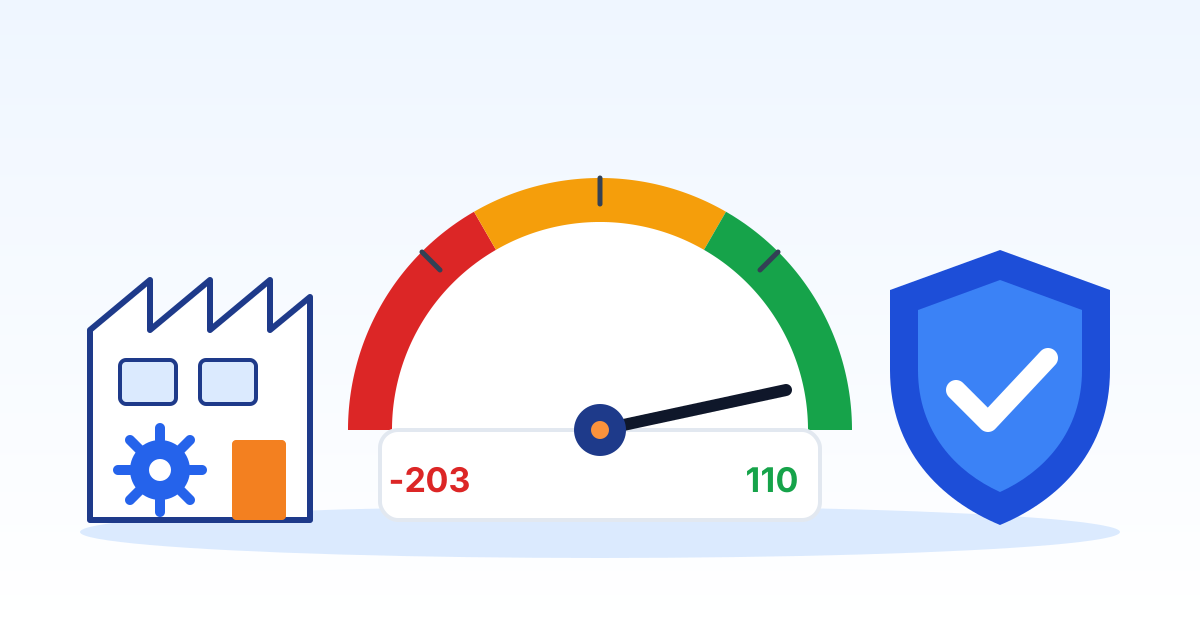
SPRS, the Supplier Performance Risk System, is the Defense Department database where contractors post their security self-assessment results. For NIST SP 800-171 the score starts at 110, one point per requirement, and points come off for each requirement you have not met, so a company with many gaps can end up below zero (32 CFR 170.24). The possible range runs from -203 to 110 (U.S. Department of Justice).
Each missing requirement costs 1, 3 or 5 points depending on how much harm the gap could cause. For example, having no multi-factor authentication, a second check such as a code on your phone, costs 5 points; having it only for remote and administrator accounts costs 3 (32 CFR 170.24).
An honest score matters more than a high one. In March 2025 a defense contractor agreed to pay $4.6 million to settle claims that it reported a score of 104 when an outside consultant had calculated -142, and was slow to correct it (U.S. Department of Justice).
The free tools section further down this page includes an SPRS score calculator and policy templates that map to CMMC requirements, so you can see roughly where you stand before you talk to anyone.
Key takeaway: Report the score you actually have, keep the evidence behind it, and update it when things change.
How much does CMMC cost a small company?
The Defense Department's own estimates for a small company, assuming the security controls are already in place, are about $5,977 a year for a Level 1 self-assessment, about $37,196 per three-year cycle for a Level 2 self-assessment and about $104,670 per three-year cycle for Level 2 certification by an outside assessor (CMMC final rule, Federal Register). For most shops the bigger cost is the work to meet the requirements in the first place, which those estimates leave out.
| Assessment | Estimated cost | How often |
|---|---|---|
| Level 1 self-assessment | About $5,977 | Every year |
| Level 2 self-assessment | About $37,196 | Per three-year cycle |
| Level 2 certification by a C3PAO (paused for new requirements as of September 2026) | About $104,670 | Per three-year cycle |
The government's figures assume a small company hires outside help for planning and paperwork, and that the controls already exist (Federal Register). They do not include buying or setting up the security itself, such as multi-factor authentication, encrypted email, monitoring or a separate secure area for CUI.
What the security work costs depends on how many people, computers and systems touch CUI. Keeping CUI in a small, separate environment, often called an enclave, can shrink what has to be protected. Ask any provider for a written, itemized quote before work starts.
Key takeaway: Budget for the security work first. The assessment is usually the smaller line item.
What happens if we ignore CMMC?
When a contract requires a CMMC status, you cannot be awarded it without that status posted in SPRS and affirmed by a senior official (32 CFR 170.15 and 170.16). Inaccurate statements about your security can also lead to False Claims Act cases, which the Justice Department continues to pursue (Latham & Watkins).
Primes are required to flow CMMC down to subcontractors that handle FCI or CUI (32 CFR 170.23), and DFARS 7012 down to those that handle CUI (DFARS 252.204-7012), so a supplier that cannot show its status can lose work even while the Phase 2 audit is paused.
Where to start
5 practical next steps, in order.
Find out what information you actually receive
Look at your contracts, purchase orders and drawings. Do they mention DFARS 252.204-7012, CMMC, FCI or CUI, or carry CUI markings? That tells you whether you need Level 1 or Level 2.
Ask your prime or contracting officer which level they expect
Get the level and the assessment type in writing. Primes have to pass the requirement down to you, so they should be able to tell you.
Do an honest self-assessment and post it in SPRS
Check each requirement against what you really do today, write a system security plan that describes your setup, and post the result. Update it whenever things change.
Fix the five-point gaps first
Multi-factor authentication, malware protection, fixing known software flaws, security awareness training, audit logs and an incident response plan are among the 5-point items (32 CFR 170.24). Closing them moves your score fastest and cuts real risk.
Write it down and keep the evidence
Policies, training records and logs are what a customer, an assessor or an investigator will ask for. Keep the evidence behind each assessment for six years (32 CFR 170.15 to 170.18).
Free tools and templates
Free tools, policy templates and checklists from our resource library that help with CMMC and NIST SP 800-171 work.
Free tools
Policy templates
 Policy templateInformation Security PolicyEstablish the core security program every insurer, auditor and customer now asks about: data classification, access control, patching, encryption, logging and vendor risk.
 Policy templateIncident Response PlanKnow exactly who does what in the first hours of a ransomware attack, data breach or business email compromise, including who to call and which notification clocks start.
 Policy templateAccess Control PolicyGive people only the access they need, protect every sign-in with MFA, keep admin accounts separate, review access every quarter and remove it the moment someone leaves.
 Policy templateSecurity Awareness Training PolicyDecide who gets cybersecurity training, when, how phishing tests work, and which training records you keep for insurers and customer questionnaires.
 Policy templateSystem Security Plan (SSP) StarterA starter System Security Plan for defense contractors that handle CUI, organized by the 14 NIST SP 800-171 families, with a plan of action and milestones (POA&M) section and the CMMC rules that apply to it.
Reference

Reading list
The articles from our blog that go deeper on this topic, picked and grouped so you can read them in order.
Start with the basics
Protecting CUI
Costs and the 2026 changes
Frequently asked questions
Is CMMC still required after the July 2026 pause?
Partly. Outside certification is paused for new requirements, but Level 1 and Level 2 self-assessments, SPRS scores, yearly affirmations and the DFARS 7012 security rules still apply (Latham & Watkins). The CMMC rule itself was not repealed.
Do subcontractors need CMMC?
Yes, if they handle FCI or CUI for a defense contract. Prime contractors must flow the requirement down to subcontractors at every tier, and a subcontractor handling CUI needs at least Level 2 (Self) (32 CFR 170.23).
What is the difference between CMMC Level 1 and Level 2?
Level 1 covers basic Federal Contract Information with 15 safeguards and a yearly self-assessment. Level 2 covers Controlled Unclassified Information with 110 NIST SP 800-171 requirements, assessed every three years and affirmed every year.
Can we do the CMMC assessment ourselves?
For Level 1, always. For Level 2, yes when the contract asks for Level 2 (Self), which is all new requirements may ask for while the pause lasts. Many small companies still get help with scoring and documentation so the result is accurate.
What is a good SPRS score?
110 means every requirement is met. A conditional Level 2 status with a plan for open items needs a score of at least 80 percent of the maximum, and with few exceptions only 1-point items can stay open, closed within 180 days (32 CFR 170.21). An accurate score matters more than a high one.
Does CMMC apply to commercial off-the-shelf products?
No. Contracts exclusively for commercial off-the-shelf (COTS) items are excluded, and so are purchases at or below the micro-purchase threshold (32 CFR 170.3).
How can Preferred Data help with CMMC?
We help suppliers work out which level applies, run an honest self-assessment, fix the gaps and keep the evidence organized, as part of our cybersecurity and managed IT services. Start with our CMMC intake form or call (336) 886-3282.
Sources
- 32 CFR Part 170, CMMC Program (eCFR)
- CMMC Program final rule, Federal Register, October 15, 2024
- DFARS rule adding CMMC to contracts, Federal Register, September 10, 2025
- FAR 52.204-21, Basic Safeguarding
- DFARS 252.204-7012, Safeguarding Covered Defense Information
- National Archives: About CUI
- Latham & Watkins: DOD suspension of CMMC Phase 2 (July 30, 2026)
- Washington Technology: DOD suspends CMMC Phase 2 (July 2026)
- DoD Class Deviation 2026-O0025, Revision 3 (September 3, 2026)
- Redspin: Class Deviation Revision 3 explained
- Covington & Burling: CMMC reform task force updates (September 2026)
- DefenseScoop: Pentagon reviews industry feedback on CMMC reform
- U.S. Department of Justice: MORSECORP settlement (March 26, 2025)
How Preferred Data can help
Not sure which CMMC level applies to you?
Tell us what your customers are asking for. A Preferred Data engineer will help you read the contract language, check where you stand and plan the work, in plain English.
Preferred Data Corporation, in business since 1987 and headquartered in High Point, NC. 1208 Eastchester Drive, Suite 131, High Point, NC 27265