
Guide for business owners
North Carolina Data Breach Notification Law: A Plain-English Guide
If someone steals personal information your business keeps about North Carolina residents, state law may require you to tell those people and the NC Attorney General. This guide explains, in plain English, who the law covers, what counts as personal information and a breach, who to notify, how fast, and what the notice has to say.
Last reviewed by Preferred Data Corporation
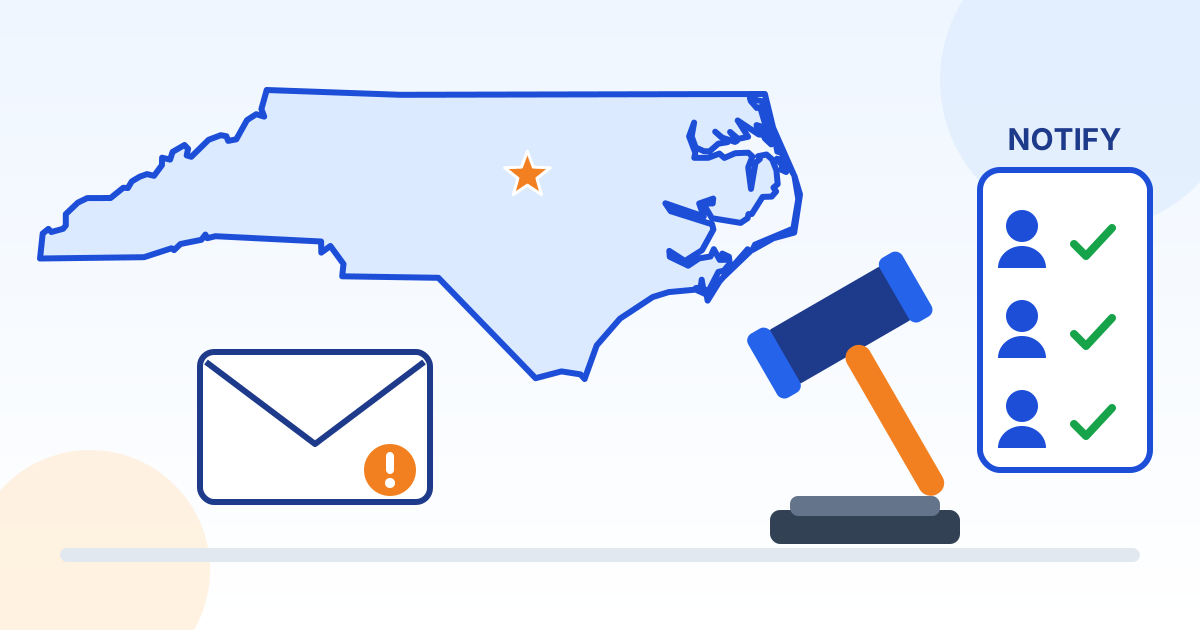
Who this guide is for
- Owners and office managers of North Carolina businesses that keep customer or employee records, such as Social Security, driver's license or bank account numbers.
- Anyone writing an incident response plan who needs to know who gets told, and when, after a breach.
- Businesses outside North Carolina with customers or employees who live here.
If you think a breach is happening right now, start with the first 24 hours checklist and call your attorney, then come back to this guide.
Does North Carolina's breach law apply to my business?
Very likely, if your business owns or licenses personal information, as the law defines it, about North Carolina residents. The notice rule covers any business that owns or licenses personal information of North Carolina residents, or that does business in North Carolina and owns or licenses personal information, in any form, "whether computerized, paper, or otherwise" (N.C. Gen. Stat. 75-65). "Business" includes sole proprietorships, partnerships, corporations and associations, whether or not they make a profit, but not government agencies (N.C. Gen. Stat. 75-61).
If you hold personal information for someone else, for example as a payroll service, an IT provider or a software vendor, the duty is different: you must notify the owner of the information "immediately following discovery of the breach," and the owner then notifies the people affected (N.C. Gen. Stat. 75-65).
Banks and credit unions that follow specific federal breach guidance are treated as complying with this section (N.C. Gen. Stat. 75-65). For everyone else, the rest of this guide applies.
What counts as personal information under North Carolina law?
Personal information means a person's first name or first initial and last name together with "identifying information," such as a Social Security, driver's license or passport number, a bank account, credit card or debit card number, a PIN, biometric data or fingerprints (N.C. Gen. Stat. 75-61, N.C. Gen. Stat. 14-113.20). A name alone, or a number alone, is not personal information.
| Counts when combined with a name | Does not count for breach notice |
|---|---|
| Social Security or employer taxpayer identification numbers | Publicly available directories a person agreed to be listed in (name, address, phone) |
| Driver's license, State ID card or passport numbers | Information lawfully available to the public from government records |
| Checking, savings, credit card and debit card numbers, and PINs | Email addresses, internet account numbers or user names, unless they would let someone into a financial account |
| Digital signatures, biometric data and fingerprints | Passwords and a parent's maiden name, unless they would let someone into a financial account |
| Any other number or information that can be used to access a person's financial resources | A name on its own, with no identifying information |
The exclusions in the right-hand column come from two places: the definition of personal information (N.C. Gen. Stat. 75-61) and a list of items that do not count for the breach notice rule unless they would permit access to a person's financial account or resources (N.C. Gen. Stat. 75-65).
What is a "security breach" under North Carolina law?
A security breach is unauthorized access to and acquisition of unencrypted and unredacted records containing personal information, where illegal use has occurred or is reasonably likely, or that creates a material risk of harm to a consumer (N.C. Gen. Stat. 75-61). Encrypted data counts too if the key or password to unlock it was also taken. "Redacted" means no more than the last four digits of a number can be read.
- Paper counts. A stolen box of employee files can be a breach, just like a hacked server.
- A good-faith look by an employee or agent for a legitimate business purpose is not a breach, as long as the information is not misused or disclosed further.
- Ransomware can be a breach. Many gangs copy data before they lock it, so the question is whether personal information was acquired, not just whether files were locked. See our ransomware guide.
- Encryption helps here. Data that was encrypted, with the key kept safe, generally falls outside the definition.
Key takeaway: Whether an incident is a legal "breach" is a judgment call that turns on the facts. Make it with your attorney, and write down how you decided.
Who do we have to notify after a breach in North Carolina?
Up to four groups, depending on the facts: the affected people, the Consumer Protection Division of the NC Attorney General's Office, the nationwide consumer reporting agencies when more than 1,000 people are notified at one time, and, if you hold data for another company, that company (N.C. Gen. Stat. 75-65). The NC Department of Justice provides an online form for reporting a breach.
| Who | When the law requires it | Timing |
|---|---|---|
| Affected people | After a security breach of personal information you own or license | Without unreasonable delay |
| NC Attorney General's Consumer Protection Division | Whenever you notify affected people | Without unreasonable delay |
| Nationwide consumer reporting agencies (the credit bureaus) | When you notify more than 1,000 people at one time | Without unreasonable delay |
| The owner of the data | When you hold personal information you do not own or license | Immediately after discovery |
The report to the Attorney General must cover the nature of the breach, the number of people affected, the steps taken to investigate it and prevent another one, and the timing, distribution and content of your notice (N.C. Gen. Stat. 75-65). The Department of Justice says it reviews every notice and may investigate whether the organization had reasonable safeguards in place and responded appropriately (NC DOJ).
Those reports add up. The Department counted a record 2,349 breaches in 2025 affecting 9,275,938 North Carolinians, with hacking behind 77 percent of the breaches and phishing behind 16 percent (NC DOJ 2025 Data Breach Report). The Department notes that many people were affected by more than one breach, so that total is not a count of different people. For more of the North Carolina numbers, see our North Carolina Small Business Cyber Risk Report 2026.
How quickly do we have to send breach notices in North Carolina?
North Carolina does not set a number of days. Notice must go out "without unreasonable delay," allowing for law enforcement's needs and the steps needed to find contact information, work out the scope of the breach and restore the security of your systems (N.C. Gen. Stat. 75-65). Other laws that may also apply to you do set fixed deadlines, such as 30 days for the FTC notice under the Safeguards Rule and 60 days under HIPAA (see below).
Law enforcement can ask you to wait. Notice must be delayed if a law enforcement agency tells you it could impede a criminal investigation or national or homeland security, as long as the request is in writing or you write it down at the time, with the officer's name and agency. Once the agency says notice will no longer interfere, you must send it without unreasonable delay (N.C. Gen. Stat. 75-65).
Key takeaway: "Without unreasonable delay" is not permission to wait. Start the clock the day you discover the breach and keep a dated record of every step.
What must a North Carolina breach notice say?
The notice must be clear and conspicuous and include seven things (N.C. Gen. Stat. 75-65). You can send it in writing, by email to people who agreed to receive notices electronically, or by phone if you reach the person directly.
Substitute notice is allowed only in limited cases: when individual notice would cost more than $250,000, when more than 500,000 people are affected, or for people you have no contact information or consent for. It means email where you have addresses, a conspicuous notice on your website, and notice to major statewide media (N.C. Gen. Stat. 75-65).
To have these steps written down before you need them, start from the free data breach notification procedure template, which follows North Carolina rules by default and is built to be worked through with your attorney.
- A general description of what happened.
- The type of personal information involved.
- What your business has done to protect the information from further unauthorized access.
- A phone number people can call for more information and help, if you have one.
- Advice to stay alert by reviewing account statements and monitoring free credit reports.
- The toll-free numbers and addresses of the major consumer reporting agencies.
- The toll-free numbers, addresses and websites of the Federal Trade Commission and the NC Attorney General's Office, with a statement that people can get information from them about preventing identity theft.
Does North Carolina require a written policy for throwing away records?
Yes. Any business that does business in North Carolina or keeps personal information of a North Carolina resident must take reasonable measures to protect that information when it is disposed of, including burning, pulverizing or shredding papers, destroying or erasing electronic media, and describing its disposal procedures as official policy in writing (N.C. Gen. Stat. 75-64).
You may hire a records destruction company, but only after due diligence, such as reviewing an independent audit, checking references or reviewing its security policies, and under a written contract you monitor (N.C. Gen. Stat. 75-64). Financial institutions, health insurers and health care facilities, and consumer reporting agencies that comply with their own federal rules are exempt.
Free templates make this quick: a data retention and destruction policy for paper and files, and an IT asset disposal policy for old computers, drives and phones.
What other breach notice laws might apply to us?
North Carolina's law is often only one of several. Federal rules add their own deadlines for health care and for many non-bank financial businesses, and every state has a breach notice law of its own: the FTC notes that all states, the District of Columbia, Puerto Rico and the Virgin Islands have one (FTC Data Breach Response guide).
| Law | Who it covers | Key notice duty |
|---|---|---|
| HIPAA Breach Notification Rule (45 CFR Part 164, Subpart D) | Health care providers, health plans and clearinghouses (covered entities) and their business associates | Notify affected people without unreasonable delay and within 60 calendar days; notify HHS and, for more than 500 residents of a state, prominent media |
| FTC Safeguards Rule (16 CFR 314.4(j)) | Non-bank financial businesses under FTC rules, such as tax preparers, mortgage brokers and some auto dealers that lease vehicles | Notify the FTC as soon as possible and no later than 30 days after discovery when unencrypted information of 500 or more consumers is acquired |
| Other states' breach laws | Businesses with customers or employees who live in those states | Each state has its own rules on what must be in a notice, and the details differ, so check with your attorney |
Under HIPAA, a breach affecting 500 or more people is reported to HHS at the same time as the individual notices, and smaller breaches are logged and reported within 60 days after the end of the calendar year. Business associates must tell the covered entity within 60 days of discovery (45 CFR Part 164, Subpart D).
The FTC notice under the Safeguards Rule took effect May 13, 2024, and is filed on a form on the FTC's website (16 CFR 314.4 and 16 CFR 314.5). The rule's definition of a financial institution lists examples such as tax preparation services, mortgage brokers and auto dealers that lease vehicles for more than 90 days (16 CFR 314.2). If you are covered, a written information security program is the core document the rule expects.
Contracts and insurance policies can add duties too, such as telling a customer within a set number of hours or calling your insurer before you hire a response firm. Our cyber insurance guide covers the insurance side.
What happens if a business does not follow the breach law?
A violation of North Carolina's breach notice section is a violation of G.S. 75-1.1, the state's law against unfair and deceptive trade practices, and any waiver of these rules is void (N.C. Gen. Stat. 75-65). An individual can sue only if they were injured by the violation. The same applies to the disposal rule in 75-64.
The NC Department of Justice says that when necessary it takes legal action to hold companies responsible and make them strengthen their practices (NC DOJ). Ask your attorney what that exposure means for your business.
Where to start
5 practical next steps, in order.
List the personal information you keep
Write down where Social Security, driver's license, bank and card numbers live, on paper and in systems, and who can get to them. You cannot protect or report on what you have not found.
Encrypt it and shrink it
Encrypt laptops, servers and backups that hold personal information, and delete what you no longer need using a written data retention and destruction policy. Our cybersecurity services can help.
Put notice steps in your incident plan
Add who decides whether an incident is a breach, who contacts your attorney and insurer, and how you will reach affected people, using the free incident response plan template.
Write down how you handle personal data
Use the free data protection and privacy policy template, and a written information security program if you are a financial business under the FTC Safeguards Rule.
Pick your attorney before you need one
Know which attorney you will call about breach notice, and keep the number with your printed incident plan.
Free tools and templates
Free policy templates, checklists and research from our resource library for protecting personal information and responding when it is exposed.
Policy templates
 Policy templateInformation Security PolicyEstablish the core security program every insurer, auditor and customer now asks about: data classification, access control, patching, encryption, logging and vendor risk.
 Policy templateWISP (FTC Safeguards Rule)A written information security program built for the FTC Safeguards Rule, for tax preparers, CPA firms, mortgage brokers, auto dealers that finance and other businesses the law treats as financial institutions.
 Policy templateVendor Risk Management PolicyChoose and monitor the vendors that hold your data or reach your systems: a vendor list, simple risk tiers, security questions, contract clauses, remote access rules and a clean exit.
 Policy templateData Retention and Destruction PolicyDecide what records to keep and for how long, with a sensible default schedule, legal holds, and secure destruction of paper and devices following NIST SP 800-88.
 Policy templateData Protection and Privacy PolicySet internal rules for the personal and confidential data you hold: collect less, limit access, share carefully with vendors, handle requests, and respond to a breach under North Carolina law.
 Policy templateIT Asset Disposal PolicyRetire old computers, phones, servers and copiers safely: track every device, wipe or destroy data to NIST SP 800-88, get certificates of destruction, and recycle through certified recyclers.
 Policy templateIncident Response PlaybooksStep-by-step playbooks for email account takeover, vendor or IT provider compromise, insider data theft, malware, misdirected data and website attacks, built to work with your incident response plan.
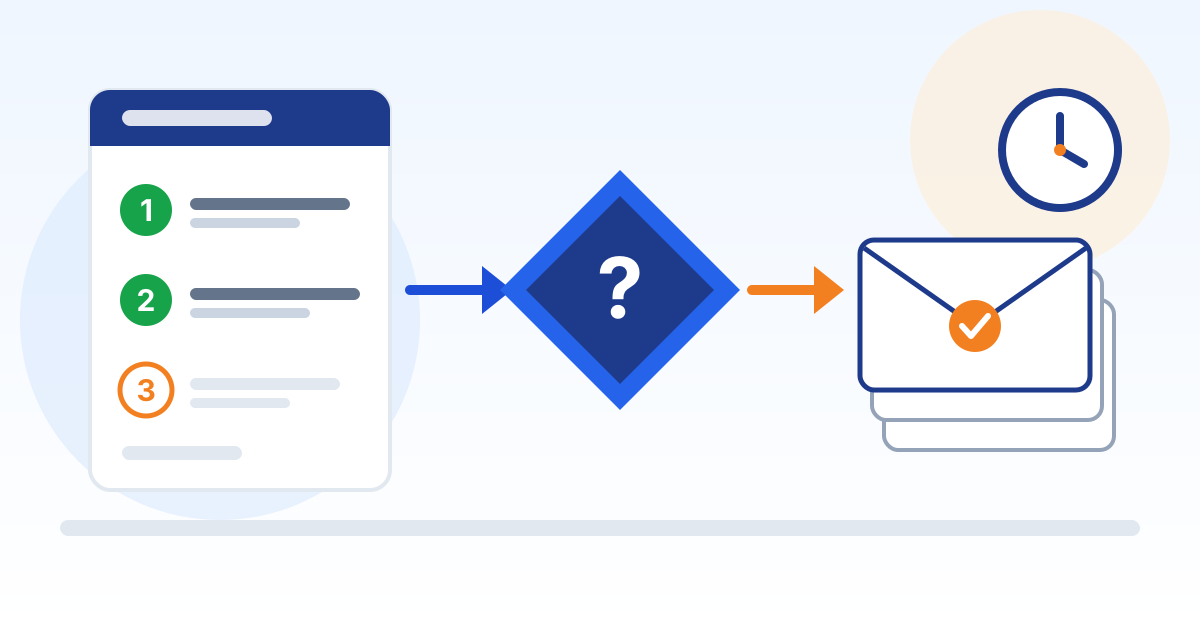 Policy templateBreach Notification ProcedureDecide with your breach counsel whether an incident legally requires notice, then notify the right people with the right content: North Carolina rules by default, with HIPAA, FTC, DFARS and multistate steps when they apply.
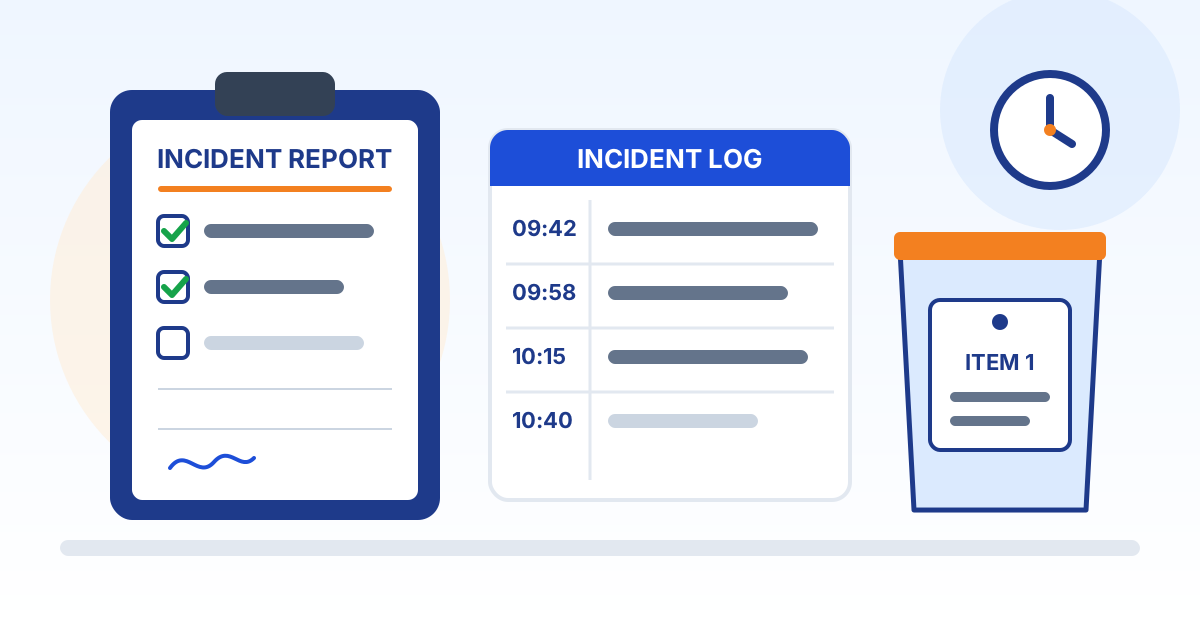 Policy templateIncident Report FormThe forms to fill in during a cyber incident: an initial report, triage sheet, timestamped log, evidence and chain of custody register, decision log, notification tracker, cost tracker and closure summary.
Checklists
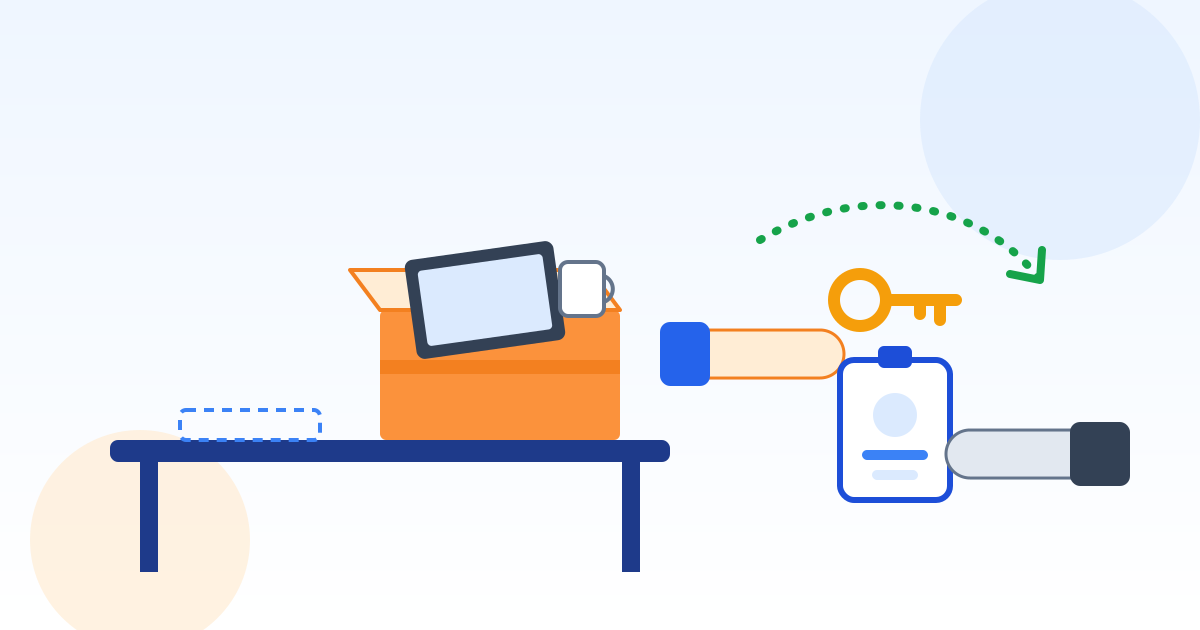 ChecklistEmployee offboarding IT checklistEverything to revoke, recover and transfer when someone leaves: accounts, MFA, shared passwords, email, devices, keys and licenses.
 ChecklistEcoVadis IT evidence checklistThe IT and data security documents to gather before an EcoVadis assessment or a large customer’s security questionnaire.
Reports
Reference

Reading list
The articles from our blog that go deeper on this topic, picked and grouped so you can read them in order.
Notice duties and federal rules
Planning your response
Frequently asked questions
How many days do we have to report a data breach in North Carolina?
North Carolina does not set a number of days. Notices must go out "without unreasonable delay," with allowances for law enforcement and for working out the scope of the breach (N.C. Gen. Stat. 75-65). Other laws, such as HIPAA (60 days) or the FTC Safeguards Rule (30 days for the FTC notice), may set a fixed deadline that applies to you as well.
Do we have to tell the NC Attorney General about a breach?
Yes, whenever you notify affected people under the state law. The report goes to the Consumer Protection Division of the Attorney General's Office (N.C. Gen. Stat. 75-65), and the NC Department of Justice provides an online form for it.
Is a ransomware attack a data breach?
It can be. If criminals accessed and took personal information that was not encrypted, and misuse has happened, is reasonably likely or creates a material risk of harm, it meets North Carolina's definition (N.C. Gen. Stat. 75-61). Because many gangs copy data before locking it, have your attorney review every ransomware incident.
Does the law cover paper records?
Yes. The notice duty covers personal information "in any form (whether computerized, paper, or otherwise)" (N.C. Gen. Stat. 75-65), and the disposal rule requires shredding, burning or pulverizing papers with personal information (N.C. Gen. Stat. 75-64).
We are based in another state. Does North Carolina law still apply?
It can. The notice rule covers any business that owns or licenses personal information of North Carolina residents, not only businesses based here (N.C. Gen. Stat. 75-65). Your home state's law, and the laws of other states where affected people live, may apply too.
Is encrypted data exempt from breach notice?
Generally, yes, as long as the key was not taken with it. The definition covers unencrypted and unredacted records, and encrypted records only when the confidential process or key was also acquired (N.C. Gen. Stat. 75-61). That makes encryption well worth doing before anything goes wrong.
How can Preferred Data help?
We are not a law firm and do not give legal advice. We help businesses find and encrypt personal information, lock down access, keep backups safe and investigate what happened after an incident, so you and your attorney have the facts. See our cybersecurity, backup and managed IT services, or call (336) 886-3282.
Sources
- N.C. Gen. Stat. 75-61, Definitions
- N.C. Gen. Stat. 75-64, Destruction of personal information records
- N.C. Gen. Stat. 75-65, Protection from security breaches
- N.C. Gen. Stat. 14-113.20, Identity theft (identifying information)
- NC Department of Justice: 2025 Data Breach Report
- NC Department of Justice: Report a Security Breach
- 16 CFR 314.4, FTC Safeguards Rule elements, including notice to the FTC (eCFR)
- 16 CFR 314.5, FTC Safeguards Rule effective date of the notice requirement (eCFR)
- 16 CFR 314.2, FTC Safeguards Rule definitions (eCFR)
- 45 CFR Part 164, Subpart D, HIPAA breach notification (eCFR)
- FTC: Data Breach Response, A Guide for Business
How Preferred Data can help
Want to be ready before a breach, not after?
We will help you find where personal information lives, encrypt it, tighten who can reach it and build the incident plan your attorney will want to see.
Preferred Data Corporation, in business since 1987 and headquartered in High Point, NC. 1208 Eastchester Drive, Suite 131, High Point, NC 27265