
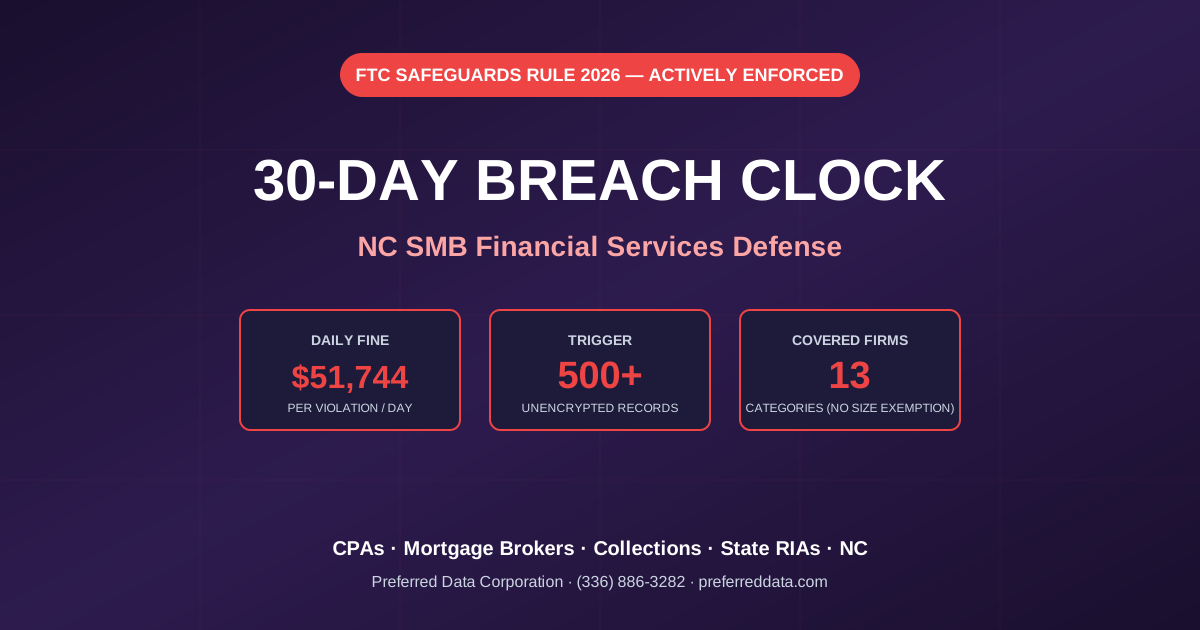
TL;DR: The FTC Safeguards Rule's 30-day breach notification requirement is fully in effect, and 2026 enforcement is active with fines reaching $51,744 per day per violation (Alphacis 2026 compliance brief, FTC notification requirement notice). The rule covers 13 categories of non-banking financial institutions including tax preparers, mortgage brokers, collection agencies, wire transfer agents, check cashers, and non-SEC-registered investment advisors — none of which are exempt because they are small (FTC Safeguards Rule guidance). North Carolina SMBs in these categories need MFA, encryption at rest, access logging, a designated qualified individual, an incident response plan, and a working 30-day notification workflow now — not after the next phishing email lands.
Key takeaway: "Significantly engaged in financial activities" is defined broadly, has no small-business size carve-out, and is being actively enforced. The cheapest path to compliance is to treat the Safeguards Rule as your operating security baseline, not as a once-a-year audit project — because the day you breach is the day the 30-day clock starts.
Need to confirm your NC tax, mortgage, collections, or advisory firm is FTC Safeguards Rule compliant? Preferred Data Corporation provides managed IT, cybersecurity, and incident response sized for NC financial services SMBs. Call (336) 886-3282 or request a Safeguards Rule readiness review.
What is the FTC Safeguards Rule and what does the 30-day notification require?
The Safeguards Rule, issued under the Gramm-Leach-Bliley Act, requires non-banking financial institutions to maintain a written information security program with specific technical controls, and — since the 2023 amendments took effect — to notify the FTC of qualifying security breaches within 30 days. Per the FTC's Safeguards Rule guidance page and the FTC's 2024 notification-requirement notice, the rule's structure is:
- Who is covered: Any business "significantly engaged in financial activities" not regulated by a federal banking regulator. The FTC's list specifically names 13 categories (more below).
- What controls are required: A written information security program, MFA for access to customer data, encryption of customer data at rest and in transit, a qualified individual to oversee the program, access logging, employee training, annual risk assessment, incident response plan, and vendor oversight.
- When notification is required: Within 30 days of discovering a "notification event" — defined as a security breach involving the unauthorized acquisition of unencrypted customer information of 500 or more consumers.
- How notification is filed: Via the FTC's Safeguards Rule Security Event Reporting Form.
- Penalty exposure: Per Alphacis's 2026 enforcement brief, fines reach $51,744 per day per violation in 2026 (inflation-adjusted from the statutory baseline).
Which NC SMBs are covered by the Safeguards Rule?
Any NC small business that meets one of the 13 categories the FTC names — most of which are not what owners think of as "banks." Per the FTC Safeguards Rule guidance and the FTC's GLBA business guidance page, the covered categories include:
| Category | Common NC SMB examples |
|---|---|
| Mortgage lenders | Independent NC mortgage shops, brokers |
| Mortgage brokers | NC residential mortgage brokers |
| Payday lenders | NC consumer finance storefronts |
| Finance companies | Equipment finance, auto-title lenders |
| Account servicers | Loan servicing operations |
| Check cashers | Storefront check-cashing operations |
| Wire transferors | Money services businesses |
| Collection agencies | NC debt collection firms |
| Credit counselors | Nonprofit and for-profit credit counseling |
| Other financial advisors | Tax planning, debt management |
| Tax preparation firms | NC CPA firms preparing returns, H&R Block-style preparers |
| Non-federally insured credit unions | State-chartered credit unions outside NCUA |
| Non-SEC-registered investment advisors | State-registered RIAs |
No size-based exemption. Per Strategic Micro Systems' 2026 compliance write-up, small firms get the same technical requirements as large firms — the rule scales obligations to risk, not headcount.
Quotable definition: The FTC Safeguards Rule is the federal small business cybersecurity standard for non-banking financial firms — a CPA, a mortgage broker, and a collection agency all run under the same control framework, and all face the same 30-day breach clock.
What does "unauthorized acquisition of 500 unencrypted records" actually mean?
It means the moment you find evidence that someone outside the firm got, downloaded, exfiltrated, or could reasonably have copied a database, file, email archive, or laptop containing 500+ consumers' unencrypted personal data — the 30-day FTC notification clock starts. Per Constangy's Safeguards Rule alert and Alston & Bird's breach notification analysis, the operative concepts are:
- "Acquisition" not "access." The FTC's standard is acquisition. If logs show data was downloaded, exfiltrated, or copied — that is acquisition. Mere unauthorized viewing is a closer call.
- "Unencrypted." Records encrypted at rest with strong cryptography and an attacker who did not also acquire the key are generally outside the notification trigger.
- "500 consumers." Counted as natural persons, not records or rows. One consumer with 50 records counts as one.
- "Customer information." Defined broadly under GLBA. Tax returns, mortgage applications, loan applications, collection account histories, social security numbers, financial-account numbers — all qualify.
The 30-day clock starts at discovery, not at confirmation. Per Carlton Fields' Regulation S-P amendment guidance (the SEC's parallel small-firm rule), regulators have been consistent that the clock does not pause while you investigate.
What technical controls does the rule require?
Nine controls that map cleanly onto a managed cybersecurity baseline. Per the FTC Safeguards Rule guidance and SBS Cyber's Safeguards Rule explainer, the required controls are:
- Written information security program owned by a designated qualified individual.
- Risk assessment — annual, documented, and tied to the actual data and systems the firm uses.
- Access controls — least-privilege access, periodic review, removal on departure.
- Inventory of customer information — what data, where it lives, who can touch it.
- Encryption — at rest and in transit, for customer data.
- MFA — required for any access to customer data, including remote and admin access.
- Secure development — for any in-house software handling customer data.
- Monitoring and logging — sufficient to detect a breach in time to notify within 30 days.
- Incident response plan — written, tested, and updated annually.
Plus: employee training, vendor oversight, and an annual report to the board (or owner) from the qualified individual.
| Control | Common NC SMB gap | PDC service that closes it |
|---|---|---|
| Written ISP | None or copied-from-template | Managed cybersecurity program build |
| MFA on customer data | Email MFA only, none on file shares | Managed IT MFA enforcement |
| Encryption at rest | None on file servers or laptops | Managed cybersecurity full-disk + DLP |
| Access logging | Logs not retained or reviewed | Managed cybersecurity SIEM/MDR |
| Incident response plan | None or untested | Managed cybersecurity IR retainer |
| Qualified individual | None designated | Fractional CISO or vCIO via PDC |
| Vendor oversight | No documented review | Managed IT vendor-risk program |
Need help mapping your firm's actual controls against the Safeguards Rule's nine required controls? Call (336) 886-3282 or book a Safeguards Rule gap assessment.
What does a 30-day breach notification workflow look like for an NC SMB?
A pre-built, pre-tested set of steps that survives a panicked Tuesday morning. Per the FTC Security Event Reporting Form requirements and the broader incident-response literature, the realistic workflow is:
- Day 0 (Discovery): Detection by SIEM, EDR, MDR, third-party tip, or law enforcement. Designated qualified individual notified. Internal IR retainer activated.
- Days 1-3 (Containment + Counsel): Affected systems isolated. Outside breach coach engaged. Insurance carrier notified. Preservation of forensic evidence.
- Days 3-10 (Scope): Forensic determination of who, what, when, how, and how many records. Encryption status verified. Customer count confirmed.
- Days 10-20 (Notification Decision): If 500+ unencrypted customer records acquired → notification required. If under threshold or encrypted → document the determination.
- Days 15-30 (Filing): Submit Security Event Reporting Form to FTC. Parallel state notifications (NC has its own breach notification law). Customer notifications drafted.
- Day 30+: Post-incident review. Updates to the written ISP. Board/owner reporting per the Safeguards Rule annual report requirement.
The IR retainer is the most-skipped control among NC SMB financial-services firms — and the one that turns a 30-day clock from "hard" to "impossible."
What should an NC tax, mortgage, advisory, or collections SMB do in the next 60 days?
Run a four-step compliance sprint that ties the Safeguards Rule to your existing IT spend instead of bolting on a parallel program. The plan:
- Confirm coverage and designate the qualified individual (week 1). Verify the firm is in one of the 13 covered categories. Designate a qualified individual (owner, CFO, or fractional CISO via PDC's managed cybersecurity practice).
- Inventory customer data and gap-assess controls (week 1-4). Walk where customer data lives — file shares, email, CRM, loan origination system, tax-prep software, document portals. Run the Safeguards Rule gap assessment against each.
- Close the top gaps and document the rest (week 4-8). MFA on every system that touches customer data. Encryption at rest on file servers and laptops. Access logs centralized to a SIEM or MDR. Incident response plan written, tested with a tabletop, and stored where the qualified individual can find it at 2 AM.
- Wire the 30-day notification workflow (week 8-12). Decide IR partner. Sign the IR retainer. Confirm breach-coach counsel and insurance carrier. Build the FTC Security Event Reporting Form playbook so a panicked Tuesday morning has a checklist, not a brainstorming session.
Key takeaway: The Safeguards Rule rewards firms that build the program before the breach. A documented program with MFA, encryption, logging, and an IR retainer pays for itself the first time it shaves the customer count, the notification trigger, or the regulatory fine.
How does Preferred Data Corporation help NC financial services SMBs comply?
PDC has been an NC small business's IT and cybersecurity partner since 1987, with deep experience in the financial services categories the FTC Safeguards Rule covers — NC tax preparers, mortgage brokers, collection agencies, and state-registered investment advisors. We bring four things to the Safeguards Rule conversation:
- Managed IT services: Predictable monthly support for the workstations, file shares, loan-origination, tax-prep, and document-portal systems that the Safeguards Rule sits on top of — with MFA, patching, and identity hygiene baked in.
- Managed cybersecurity services: Designated qualified-individual coverage, written information security program, encryption at rest, access logging via SIEM/MDR, and 24/7 monitoring sized for NC financial-services SMB budgets.
- Backup and data protection: Tested, immutable backup and recovery for customer information, including ransomware-resilient restore that prevents a backup compromise from turning into a notification event.
- Network infrastructure: Segmented networks that isolate customer-data systems from general-purpose user devices and limit blast radius when something goes wrong.
For NC mortgage brokers in High Point and the Piedmont Triad, NC tax-prep firms in Greensboro and Winston-Salem, and NC collection agencies and state-registered RIAs in Charlotte and Raleigh, the Safeguards Rule is now a baseline operating standard. PDC's financial-services team will scope the IT, cybersecurity, and incident response work needed to make the 30-day clock survivable.
Ready to make sure your NC financial services SMB is Safeguards Rule ready? Call (336) 886-3282 or book a Safeguards Rule gap assessment.
Frequently Asked Questions
Does the FTC Safeguards Rule apply to my CPA firm?
If your firm prepares tax returns or provides financial planning, you are generally a "tax preparation firm" or "other financial advisor" under the Safeguards Rule. Per the FTC Safeguards Rule business guidance, there is no size-based exemption. NC CPA firms preparing 1040s for clients are covered.
What is the smallest firm that has been fined under the rule?
Per Alphacis's 2026 enforcement brief and the FTC's enforcement actions page, enforcement actions in 2025-2026 have included community-sized firms in the auto-finance and tax-prep categories. Daily-fine math reaches $51,744 per violation per day in 2026, and the FTC counts each missing control as a separate violation.
Is encryption alone enough to avoid notification?
Strong encryption of data at rest, with the key not also acquired by the attacker, generally takes the event out of the "unencrypted" notification trigger. Per SBS Cyber's Safeguards Rule analysis, the firm still owes itself an incident review and may face state-law obligations even if the FTC notification trigger does not apply.
How does the Safeguards Rule interact with the NC breach notification statute?
They stack. The FTC notification covers the federal regulator. NC's Identity Theft Protection Act (NCGS § 75-65) covers customer notification at the state level. Some breaches require both, on different timelines. The firm's incident response plan should address both — not just one.
Can I use a vendor or MSP to satisfy the "qualified individual" requirement?
Yes, with caveats. Per the FTC Safeguards Rule guidance, the qualified individual can be an employee, an affiliate, or a service provider — but the firm remains responsible. PDC offers fractional CISO/qualified-individual coverage as part of managed cybersecurity engagements.
What is a realistic budget for Safeguards Rule compliance at a 10-50 person NC firm?
It depends on starting point, but a typical NC SMB financial services firm moving from "ad hoc" to "compliant" runs a one-time program-build cost in the low five figures plus an ongoing managed cybersecurity subscription in the $1,500-$5,000/month range. Per the broader 2026 SMB cybersecurity benchmark data (see our SBA 7(a) NC SMB financing playbook for the 4-8% of revenue IT/cyber spend trend), the cost is well below the $51,744/day fine exposure.
Related Resources
- Managed Cybersecurity Services - Qualified individual, MFA, encryption, MDR, IR retainer
- Managed IT Services for NC Businesses - Predictable support for tax-prep, mortgage, and advisory systems
- Backup and Data Protection - Immutable, ransomware-resilient backup for customer data
- Network Infrastructure Services - Segmented networks that limit breach blast radius
- CFPB 1071 Effective June 30, 2026: NC SMB Lending Impact - Companion lending compliance update
- SBA 7(a) at 9% June 2026: NC SMB Tech Financing Playbook - Companion lending economy review
- Contact Preferred Data Corporation - Safeguards Rule readiness review for NC SMBs