
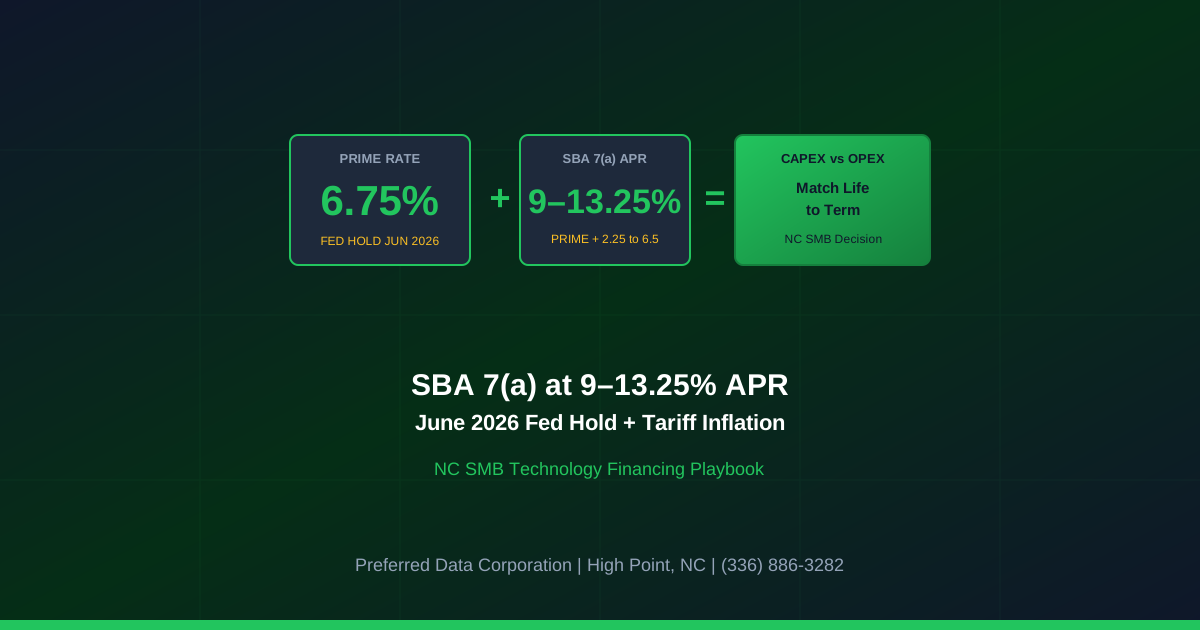
TL;DR: The Federal Reserve has held the federal funds target range at 3.50%-3.75% through January, March, April, and June 16-17, 2026 FOMC meetings, leaving the Prime Rate at 6.75% effective December 10, 2025. SBA 7(a) variable rates currently run 9.00%-13.25% APR (Prime + 2.25% to Prime + 6.5%, depending on loan size). With tariffs at 8-10x their start-of-2025 levels and persistent inflation, NC small businesses need a disciplined technology-financing playbook that pairs the right capital structure with the right kind of IT investment.
Key takeaway: Not every IT investment belongs on a 9% SBA loan. Hardware refresh and on-prem build-outs that depreciate over 5-7 years can pencil out at SBA 7(a) rates. Managed services, cybersecurity, and cloud migrations belong in opex where the ROI is operational, not financed. Get the capital structure wrong and the same tech investment that helps a competitor wins becomes a margin drag for you.
Need help structuring your NC SMB's 2026 technology spend against current SBA rates? Preferred Data Corporation runs IT budgeting, ROI modeling, and managed-services structuring for NC small businesses. Call (336) 886-3282 or request a technology financing review.
What are SBA 7(a) and 504 loan rates in June 2026?
SBA 7(a) variable rates range from 9.00% to 13.25% APR, and SBA 504 fixed rates are typically in the high-6% to mid-7% range. Per Bay Street Lending's June 2026 rate guide, NerdWallet's June 2026 SBA rate review, and Merchant Maverick's June 2026 update, the current ranges are:
- SBA 7(a) variable, > $250,000, 10+ year term: Prime + 2.25% = 9.00% APR (best case for strong-credit borrowers)
- SBA 7(a) variable, $50,001-$250,000: Prime + 3.75% = 10.50% APR
- SBA 7(a) variable, $50,000 or less: Prime + 6.50% = 13.25% APR
- SBA 7(a) fixed-rate cap: Prime + 5.0% to + 8.0% depending on loan size = 11.75% to 14.75% APR
- SBA 504 (CDC portion): Typically high-6% to mid-7% APR fixed for 10, 20, or 25-year terms (real estate, owner-occupied facilities, fixed equipment)
- SBA Express: Prime + 4.5% to + 6.5% = 11.25% to 13.25% APR
Three structural points NC SMBs should anchor on:
- Prime has been stuck at 6.75% since December 2025. Per GoSBA Loans' prime-rate tracker and Federal Reserve meeting outcomes, the Fed has held at four consecutive meetings. Futures markets price in 1-2 cuts later in 2026, but inflation and tariff data drive the timing.
- The cost gap between Prime + 2.25% and Prime + 6.5% is large. A $500,000 SBA 7(a) at 9% over 10 years vs a $50,000 SBA 7(a) at 13.25% over 7 years is a 4.25-point spread that materially changes ROI math.
- Tariff inflation pressures both sides of the loan-vs-spend decision. Per the US Chamber of Commerce's 2026 small business outlook and Q2 2026 SBI inflation reporting, 53% of small businesses cite inflation as a top concern.
When does SBA debt make sense for an NC SMB technology investment?
When the asset is depreciable, when the useful life matches the loan term, and when the ROI exceeds the after-tax cost of capital. Per the SBA 7(a) and 504 program guides, NerdWallet's SBA loan use-case analysis, and Clarify Capital's 2026 SBA guidance, the technology investments that pencil out at 9-11% APR are:
- Owner-occupied facility build-out with structured cabling, electrical, and HVAC (SBA 504). 20-25-year amortization matches the asset life. SBA 504 fixed rates beat any commercial mortgage on equivalent terms.
- Server room, network closet, UPS, and core switch refresh (SBA 7(a) or 504). 5-7 year asset life. Fits a 10-year SBA 7(a) or a 504 equipment loan.
- Manufacturing-floor MES, SCADA, and OT hardware (SBA 7(a) or 504). Equipment with 7-10+ year life paired with the productivity case for the line.
- Acquisition financing for an MSP or IT shop being absorbed (SBA 7(a) M&A). PDC has run M&A advisory engagements for NC SMBs structuring SBA-financed roll-ups.
| Investment type | Useful life | Right capital structure | Why |
|---|---|---|---|
| Owner-occupied facility, HVAC, electrical | 20-25 years | SBA 504 fixed | Lowest fixed rate, longest term |
| Server room, network core, MES hardware | 5-10 years | SBA 7(a) or SBA 504 equipment | Asset depreciates; SBA term matches |
| Laptop and desktop fleet refresh | 3-5 years | Lease or short-term equipment loan | SBA term outlives the asset |
| Managed IT services subscription | N/A — opex | Operating expense | No asset to amortize; pay-as-you-use |
| Managed cybersecurity (MDR, EDR, MFA) | N/A — opex | Operating expense | Subscription model; CSO-as-a-service |
| Cloud migration project (one-time labor) | 1-2 year benefit lag | Cash flow or revolving line | Short payback; not a depreciable asset |
| AI transformation pilot | 6-18 month proof-of-value | Cash flow or revolving line | Outcome is uncertain; don't 10-year-finance a pilot |
| Cybersecurity insurance premium | Annual | Operating expense | Underwriting changes annually |
When does technology spend belong in opex, not SBA debt?
When the asset is intangible, the value is operational, or the consumption is subscription-based. Per the FASB ASC 350-40 guidance on cloud computing arrangements and QuickBooks' 2026 SBA loan guidance, the technology categories that belong in operating expense are:
- Managed IT, managed cybersecurity, MDR, and EDR subscriptions. These pay for ongoing service, not a depreciable asset. Financing 10 years of monitoring at 9% APR is paying interest on a perishable.
- Cloud computing (SaaS, PaaS, IaaS) consumption. Per FASB ASC 350-40, hosting arrangements without a software license are operating expense.
- Microsoft 365, Copilot, Lindy, n8n, and similar SaaS licenses. Subscription-based; no equity in the underlying asset.
- Cyber insurance premiums and assessment fees. Recurring, underwriting-driven, and annually re-priced.
- Training, certifications, and policy work. Soft-dollar investments without a balance-sheet asset.
- One-time professional services projects with sub-2-year payback. Pay from cash flow; do not amortize over 7-10 years.
Quotable definition: The capital structure decision for NC SMB technology spend reduces to a useful-life-vs-term match. If the asset depreciates over years, SBA debt at 9-11% can beat opportunity cost. If the spend is subscription, intangible, or one-time, opex preserves balance-sheet flexibility and avoids paying 9% APR for ongoing service.
Need someone to model your 2026 IT capex vs opex split before the next budget cycle? Call (336) 886-3282 or book a technology financing review.
What should an NC small business do in the next 60 days?
Run a four-step plan to align technology spend with capital structure and current rates. The plan:
- Inventory current technology spend by category (week 1-2). Break out: hardware refresh, cloud subscriptions, managed services, cybersecurity, professional services, AI pilots. Per the NSBA 2026 Small Business Health Index and US Chamber Q2 2026 small business outlook, most NC SMBs are spending 4-8% of revenue on IT and cybersecurity in 2026, up from 3-5% in 2023.
- Model the depreciation and payback for each line (week 2-3). Hardware and facility build-outs get amortization tables. Subscriptions and services stay in opex. AI pilots get explicit go/no-go gates at 6, 12, and 18 months.
- Match capital structure to asset life (week 3-4). Per the SBA 504 program guide and the 7(a) program guide, use SBA 504 for owner-occupied real estate and long-life equipment, SBA 7(a) for medium-term equipment and acquisitions, lease financing for fleet laptops, and cash flow for short-payback projects.
- Re-bid managed services every 24-36 months (week 4-8). Per the Channel Futures 2026 MSP pricing data and the TBI / Avant 2026 SMB IT spending surveys, managed-services pricing has compressed in some segments and inflated in others. Re-bid keeps the opex line honest against market rates without paying 9% APR to lock in a five-year contract.
Key takeaway: Inventory + depreciation modeling + capital-structure match + re-bid cadence = a disciplined NC SMB technology plan that survives a 6.75% prime rate and a tariff-inflation environment.
How does Preferred Data Corporation help NC SMBs make the capex/opex call?
PDC has been an NC small business's IT and business advisor since 1987. We bring four things to the technology financing decision:
- Managed IT services: Predictable monthly opex pricing for help desk, patching, monitoring, and user management — no need to finance the consumption of a managed service.
- Managed cybersecurity services: Subscription MDR, EDR, MFA, and 24/7 monitoring sized for SMB budgets, with cyber insurance evidence packaging at no incremental cost.
- Hardware procurement: Vendor-neutral hardware sourcing with leasing, financing, and SBA-eligibility guidance for server, network core, MES, and facility build-outs.
- M&A advisory: SBA 7(a) structuring for NC SMB acquisitions, target due diligence, and post-close IT integration — for owners using SBA debt to grow rather than to refresh.
For NC manufacturers in High Point and the Piedmont Triad budgeting for the next OT hardware refresh, NC distributors in Greensboro and Winston-Salem deciding between a CRM build and a CRM subscription, and NC professional services firms in Charlotte and Raleigh modeling AI pilot ROI, the capital-structure call is a 30-minute conversation that prevents years of paying 9% APR on the wrong line item.
Ready to make sure your 2026 NC SMB technology plan pencils out at current SBA rates? Call (336) 886-3282 or book a technology financing review.
Frequently Asked Questions
Did the Fed change rates at the June 16-17, 2026 FOMC meeting?
The Fed held the federal funds target range at 3.50%-3.75% for the fourth consecutive meeting. Per Federal Reserve meeting outcomes and GoSBA Loans' prime-rate tracker, Prime remains at 6.75%, and SBA variable-rate loans price off Prime + a spread set by the SBA. Markets are pricing 1-2 cuts later in 2026, but timing depends on inflation and labor data.
What is the cheapest SBA loan rate I can realistically get for technology spend?
Per Bay Street Lending's June 2026 rate guide and NerdWallet's June 2026 rate analysis, the realistic floor is around 9.00%-9.25% APR — Prime + 2.25% — on loans over $250,000 with FICO 720+, two-plus years in business, $500k+ revenue, and tangible collateral. SBA 504 fixed rates for owner-occupied real estate and long-life equipment can come in slightly lower in the high-6% to mid-7% range.
Can I use an SBA 7(a) to finance managed IT services?
You can, but it usually does not pencil out. Per the SBA 7(a) program guide and QuickBooks' 2026 SBA guidance, 7(a) proceeds can fund working capital, including services. Whether that is a good idea is a different question: paying 9-13% APR to finance the consumption of a recurring subscription compounds the cost rather than smoothing it.
What is the difference between SBA 7(a) and SBA 504 for technology?
SBA 7(a) is general-purpose, variable-rate, prime-based. SBA 504 is for fixed assets — owner-occupied commercial real estate and long-life equipment — typically fixed-rate, with a CDC + bank participation structure. Per the SBA 504 program guide, 504 is the better tool for a facility build-out, a server room, a manufacturing line, or fixed plant equipment. 7(a) is the better tool for working capital, mixed-use, or M&A.
How do tariffs affect my tech budget?
Per the US Chamber Q2 2026 small business outlook and US Chamber Q2 2026 SBI reporting, tariffs are 8-10x higher than start-of-2025 levels and continue to pressure input costs across IT hardware. Server, switch, laptop, and printer pricing has trended up. NC SMBs should plan procurement timing around vendor announcements and avoid back-loading capex into the final quarter when tariff-driven supply tightening peaks.
Is now the right time to take out an SBA loan for a technology project?
It depends on the project's payback period, the asset's useful life, and the opportunity cost of waiting. Per Clarify Capital's 2026 SBA guidance, the realistic best case is Prime + 2.25% = 9% APR, and waiting six months for a potential rate cut saves 25-50 basis points only if the project does not generate ROI in the interim. PDC's advisory team works through the IRR-vs-WACC math on a case-by-case basis.
Related Resources
- Managed IT Services for NC Businesses - Predictable opex pricing for help desk, patching, and monitoring
- Managed Cybersecurity Services - Subscription MDR, EDR, MFA sized for SMB budgets
- Hardware Procurement Services - Vendor-neutral sourcing with financing guidance
- Mergers and Acquisitions Advisory - SBA 7(a) structuring for NC SMB acquisitions
- SBA 7(a) and 504 Combined $10M Loan Limit: NC Technology Funding - Companion SBA program update
- US Chamber Q2 2026 SBI Inflation 53%: NC SMB Margin Defense - Companion inflation-impact write-up
- Contact Preferred Data Corporation - Technology financing review for NC SMBs