
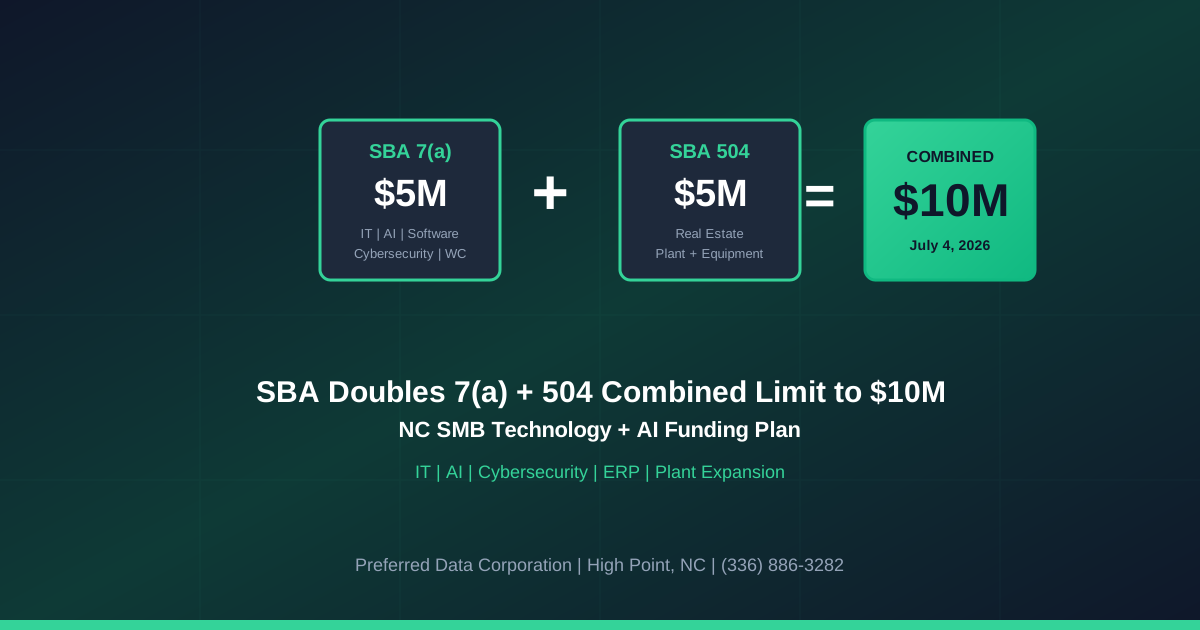
TL;DR: Per the SBA's May 18, 2026 announcement, eligible small businesses can combine SBA 7(a) and 504 loans for up to $10 million in cumulative SBA-backed financing - $5 million in each program - effective July 4, 2026. Small manufacturers can continue to take multiple project-tied 504 loans on top of $5 million in 7(a). For NC manufacturers, distributors, and professional services firms planning IT modernization, cybersecurity upgrades, ERP migrations, AI rollouts, or building-and-equipment expansion, this is the single biggest change in SMB financing capacity in agency history. The technology investment plan should be ready before the July 4 effective date.
Key takeaway: The $10 million combined cap is not just a real estate number. SBA 7(a) loans cover software, equipment, IT infrastructure, cybersecurity tooling, and working capital. NC SMBs with a documented multi-year technology roadmap can now finance the entire transformation under one SBA umbrella instead of fragmenting it across vendor financing and cash.
Need a technology investment plan that lines up with the July 4, 2026 SBA limit? Preferred Data Corporation builds technology and AI roadmaps for NC small businesses since 1987. Call (336) 886-3282 or request a technology roadmap session.
What changed in SBA financing on May 18, 2026?
The SBA announced that on July 4, 2026, eligible borrowers can combine 7(a) and 504 loans for a cumulative total of $10 million in SBA-backed financing, up from $5 million. Per the SBA's announcement and coverage from America's Credit Unions, the structure is:
- $5 million maximum 7(a). SBA 7(a) loans cover working capital, equipment, technology, software, machinery, real estate, and refinance of existing debt.
- $5 million maximum 504. SBA 504 loans cover fixed-asset projects: owner-occupied real estate, large equipment, and infrastructure.
- $10 million cumulative cap. Where a borrower qualifies for both, the cumulative SBA-backed exposure can now reach $10 million.
- Small manufacturer carve-out. Per the SBA announcement, small manufacturers can continue to take an unlimited number of project-tied 504 loans on top of their $5 million 7(a) ceiling, as long as each 504 loan is tied to a distinct project.
- Effective date. July 4, 2026 - the highest maximum SBA financing offering in agency history per the SBA press release.
Three implications NC SMB owners should know:
- Technology is eligible inside 7(a). Per Biz2Credit's analysis, SBA 7(a) loans can finance AI software, IT infrastructure, cybersecurity tooling, ERP licenses, and managed-service contracts. The new cap doubles the runway for an SMB whose modernization is multi-year.
- Manufacturers are favored. The carve-out for small manufacturers reflects federal policy to reshore production. NC's manufacturing base in the Piedmont Triad, Charlotte, and Greensboro is squarely in the target population.
- Combination is qualification-gated. Per NerdWallet's coverage, most SMBs will not actually use the full $10 million; the cap matters most for SMBs with a real expansion plan, a real manufacturer carve-out, or a real acquisition pipeline.
How does the AI for Main Street Act intersect with the new SBA cap?
The AI for Main Street Act was signed in early 2026 and directs the SBA to build AI literacy and adoption resources for small businesses through SBDCs, SCORE, Women's Business Centers, and Veteran Business Outreach Centers. Per FedScoop's coverage of the House passage, the Act does not provide direct AI grants to SMBs - it builds education and counseling capacity.
Three intersections between the AI for Main Street Act and the new $10 million SBA cap:
- Education builds the loan-readiness baseline. SBA counseling, SBDC AI advising, and SCORE mentoring make NC SMBs better candidates for SBA financing because the AI investment thesis is sharper.
- 7(a) finances the AI rollout. SMBs can finance AI software, AI consulting, AI integration, and AI-related IT infrastructure inside a 7(a) loan. The new $5 million 7(a) ceiling plus $5 million 504 ceiling gives NC SMBs room to fund both the AI program and the facility/equipment expansion it supports.
- Federal program window matters. Per Capital Infusion's analysis, federal AI programs ramp through late 2026 and early 2027. NC SMBs that align an SBA-funded AI rollout to the same window get both the financing capacity and the federal education infrastructure on the same timeline.
What can an NC small business actually finance under the new SBA cap?
A broad mix of fixed-asset and operating investments. The five highest-value NC SMB technology uses of an expanded SBA facility:
| Use case | Financing program | Why it fits |
|---|---|---|
| IT infrastructure refresh (servers, switches, Wi-Fi, endpoints) | 7(a) | Multi-year working capital + equipment |
| Managed cybersecurity program (EDR, SOC, KEV-rate patching, CMMC controls) | 7(a) | Operating capital for managed-services contracts |
| ERP modernization (cloud ERP, integration, data migration) | 7(a) | Software + implementation + change management |
| AI Transformation rollout (Copilot, custom agents, governance) | 7(a) | Software + consulting + training |
| Plant expansion + OT/IT integration (real estate + machinery + IT) | 504 + 7(a) | Real estate via 504, integration/IT via 7(a) |
For an NC manufacturer in High Point planning to acquire a new building, add OT/IT integration, deploy a new ERP, and stand up a managed cybersecurity program, the new combined cap can sit a $5 million 504 for real estate and a $5 million 7(a) for everything else under one SBA-backed umbrella.
Why does this matter for NC manufacturers specifically?
Because NC's manufacturing base is concentrated in industries where federal policy is actively encouraging investment, the small-manufacturer 504 carve-out is meaningful, and the technology-modernization gap is largest. Per the North Carolina Department of Commerce manufacturing data, manufacturing remains one of the state's largest employment sectors, especially in the Piedmont Triad.
Three specific NC manufacturer angles:
- Reshoring and expansion. NC manufacturers responding to tariff-driven reshoring need real estate (504) plus equipment plus IT (7(a)). The new cap doubles the runway.
- OT/IT integration. Per the federal NIST Manufacturing Extension Partnership program, NC manufacturers continue to underinvest in plant-floor IT integration. SBA 7(a) financing applied to OT/IT integration is a textbook use case.
- CMMC readiness for defense contractors. NC defense contractors face the CMMC June 16, 2026 framework deadline. The capital required for managed cybersecurity, segmentation, and assessment readiness can be financed inside 7(a) instead of pulled from working capital.
Quotable definition: The new SBA cumulative limit allows eligible small businesses to combine an SBA 7(a) loan (up to $5 million) with an SBA 504 loan (up to $5 million) for a total of up to $10 million in SBA-backed financing, with small manufacturers eligible for additional project-tied 504 loans, effective July 4, 2026.
What should an NC small business do this week?
Run a three-step plan and start the conversations with both a lender and a technology advisor before July 4, 2026. Loan readiness and a defensible technology roadmap are the two prerequisites; both take 30-60 days to build.
- Build a 24-36 month technology roadmap (week 1-3). Document every IT, cybersecurity, AI, ERP, and infrastructure investment over the next two to three years, with a price tag, a vendor, and a measurable business outcome. The roadmap is the document an SBA lender uses to size the 7(a) request.
- Map roadmap items to 7(a) vs 504 (week 3-4). Real estate, large equipment, and owner-occupied facility expansion go to 504. Software, managed services, integration, training, and working capital go to 7(a). Document the split in writing.
- Open the conversation with an SBA-preferred lender (week 4-6). Per SBA's preferred lender program, SBA-preferred lenders can underwrite 7(a) and 504 in parallel. The earlier the SMB engages, the higher the chance of clean July 4 funding.
Key takeaway: The technology roadmap is the document that converts the $10 million ceiling into actual funded modernization. Without a documented roadmap, the cap is theoretical. With one, NC SMBs unlock multi-year technology transformation under SBA financing terms.
How does Preferred Data Corporation help NC SMBs use the new SBA cap?
PDC builds technology and AI roadmaps that NC small businesses can take to SBA-preferred lenders as the documentation backbone of a 7(a) or combined 7(a)/504 request. We bring three things to the SBA cap conversation:
- AI Transformation: Multi-year AI roadmap with measurable productivity outcomes, governance baseline, and adoption KPIs - the kind of documentation an SBA lender expects to see for AI-related 7(a) financing.
- Managed IT services: IT infrastructure assessment, modernization roadmap, vendor pricing, and total cost of ownership analysis - the documentation backbone for the IT portion of a 7(a) request.
- M&A Advisory: For NC SMBs considering acquisition under the new cap, IT due diligence, integration planning, and post-close technology consolidation - directly relevant to the larger combined facility the new cap unlocks.
For NC manufacturers in High Point and the Piedmont Triad planning expansion, NC distributors in Greensboro and Winston-Salem modernizing ERPs, and NC professional services firms in Charlotte and Raleigh rolling out AI, the July 4, 2026 SBA cap is the financing event that aligns with the technology event.
Ready to build the technology roadmap that takes to your SBA lender? Call (336) 886-3282 or book a technology roadmap session.
Frequently Asked Questions
What is the new SBA cumulative loan limit effective July 4, 2026?
Per the SBA's May 18, 2026 announcement, eligible small businesses can combine SBA 7(a) and 504 loans for up to $10 million in cumulative SBA-backed financing - $5 million in each program. This doubles the previous $5 million cumulative cap and represents the highest maximum SBA financing offering in agency history.
Can SBA 7(a) loans finance IT, AI, and cybersecurity investments?
Yes. Per Biz2Credit's coverage of SBA loans for technology, SBA 7(a) loans can finance AI software, IT infrastructure, cybersecurity tooling, ERP licenses, managed-service contracts, and working capital that supports technology adoption. The new $5 million 7(a) ceiling materially increases the runway for multi-year technology programs.
What is the small manufacturer carve-out under the new SBA rule?
Per the SBA announcement, small manufacturers can continue to take an unlimited number of project-tied 504 loans on top of their $5 million 7(a) ceiling, as long as each 504 loan is tied to a distinct fixed-asset project. For NC manufacturers planning multiple expansion or modernization projects, this is a meaningful capacity expansion.
Does the AI for Main Street Act give NC SMBs direct AI grants?
No. Per FedScoop's coverage and Capital Infusion's analysis, the Act builds AI counseling and education capacity through SBDCs, SCORE, Women's Business Centers, and Veteran Business Outreach Centers. It does not provide direct cash grants to SMBs for AI tools. SBA 7(a) loans remain the primary financing path for AI rollouts.
What documentation does an NC SMB need to qualify for a 7(a)/504 combined facility?
A documented multi-year technology and capital plan, three years of financial statements, debt schedule, ownership and personal financial statements, and a sources-and-uses statement that maps the financing to 7(a)-eligible vs 504-eligible uses. A technology roadmap from an MSP or vCIO is increasingly part of the package for technology-heavy SBA requests.
When should an NC SMB engage an SBA-preferred lender?
For July 4, 2026 funding, NC SMBs should be in conversation with an SBA-preferred lender by mid-June and have documentation ready by early July. SBA underwriting cycles run 30-90 days depending on lender, file completeness, and program. Starting earlier is always better.
Related Resources
- AI Transformation Services for NC Businesses - AI roadmap and adoption KPIs
- Managed IT Services for NC Businesses - IT modernization roadmap and TCO
- M&A Advisory Services for NC Businesses - Acquisition-related technology due diligence
- AI for Main Street Act: 65% NC SMBs Fear Regulation 2026 - Federal AI policy context
- 2026 Tax Breaks: Deduct IT and AI Investments NC SMB - Companion tax-incentive playbook
- Contact Preferred Data Corporation - Technology roadmap session for NC SMBs