
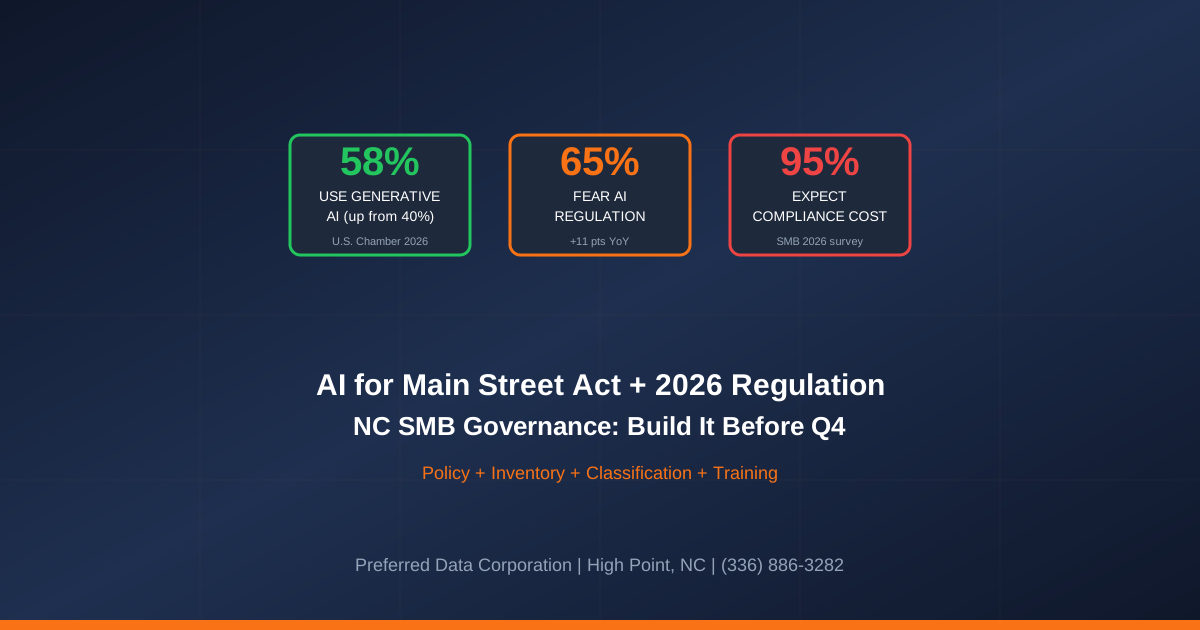
TL;DR: The AI for Main Street Act and the broader 2026 regulatory wave have created a paradox: 58% of small businesses now use generative AI (up from 40% in 2024), but 65% are concerned that new AI regulations could harm operations, and 95% expect compliance challenges. The SMBs that win are the ones that build a simple AI governance program now (acceptable use policy, vendor inventory, data classification, risk register) so they can keep adopting AI confidently while regulation lands. The fix is operational, not legal.
Key takeaway: AI regulation in 2026 is no longer hypothetical. The SMBs that thrive are running a managed AI governance program with clear policies, vendor inventory, data classification, and human-in-the-loop controls, before a state attorney general, federal agency, or customer audit forces the question.
Worried your team is using AI without policy or guardrails? Preferred Data Corporation runs managed AI governance and strategy for NC small businesses. Call (336) 886-3282 or request an AI readiness review.
What is the AI for Main Street Act and why does it matter for small businesses?
It is a 2026 federal initiative designed to accelerate small-business AI adoption with funding, training, and infrastructure attached, paired with new regulatory and reporting expectations. Per Adventure PPC's analysis of the AI for Main Street Act tipping point, the legislation arrives at the precise moment when the cost of not adopting AI has crossed the threshold of the cost of adopting it. Combined with the broader 2026 regulatory environment (state AI laws in California, Colorado, Texas, and others, plus federal agency guidance), it represents the first concrete federal stance on SMB AI.
The signal for NC small businesses:
- 58% of SMBs use generative AI in 2026, up from 40% in 2024 per U.S. Chamber of Commerce data cited by the Small Business & Entrepreneurship Council.
- 89% of small businesses leverage AI in some form per the Intuit & ICIC survey, most commonly to automate repetitive tasks.
- 65% express concern that new AI regulations could harm operations (up 11 points YoY), and 95% expect compliance challenges per the Capsule CRM 2026 SMB AI adoption brief and adjacent surveys.
- 63% of SMBs are actively using AI tools, 83% of those are seeing measurable results, with business owners reporting a median of 5 hours per week saved.
The pattern is clear: adoption is well past the tipping point, regulation is catching up, and SMBs that build governance now will keep their adoption velocity while SMBs that wait will burn cycles on retroactive cleanup.
Why are 65% of SMBs concerned about AI regulation?
Because the regulatory landscape is fragmented, fast-moving, and difficult to interpret without dedicated counsel. Per SBE Council coverage and adjacent 2026 surveys, the top SMB concerns are:
- Uncertainty about requirements. State AI laws differ. Federal guidance is evolving. International (EU AI Act) extraterritorial reach affects SMBs with EU customers.
- Data privacy and customer data handling. Most generative AI tools process customer data through external models. The data flow, retention, and reuse story is unclear to many SMBs.
- Compliance cost. Per OECD's December 2025 SMB AI report, 61% of SMBs cite cost as the primary barrier to AI adoption, with regulatory uncertainty amplifying it.
- Liability for AI outputs. Customer-facing AI (chatbots, sales assistants, content generation) creates new liability surfaces: defamation, discrimination, false advertising, and copyright.
- Workforce impact. Per Kenosha.com's coverage of 2026 AI research, workforce skill gaps and confidence remain top barriers.
| AI risk surface | What SMBs worry about | Practical 2026 mitigation |
|---|---|---|
| Data leakage | Customer data flowing to external models | Acceptable use policy + approved vendors only |
| Hallucination / errors | Wrong information in customer-facing output | Human-in-the-loop for external content |
| Liability | False advertising, defamation, IP claims | Vendor risk review + contract language |
| Workforce | Skill gaps, job-loss fear | Training + clear role for human judgment |
| Shadow AI | Employees using unsanctioned tools | Inventory + monitoring + policy |
| Regulation | State / federal / EU compliance | Risk register + counsel review on changes |
What does the AI adoption-regulation gap mean for NC small businesses?
It means there is a 12-18 month window to build governance while regulation lands. Per the Federal Reserve's April 2026 report on small business AI adoption and adjacent SBE Council coverage, NC small businesses are at or above the national adoption rate for generative AI. For Piedmont Triad SMBs, the right answer is to keep adoption velocity while putting a minimum viable governance program in place.
Three structural reasons to act this quarter:
- State regulators are moving faster than Congress. California's automated decisionmaking rules, Colorado's AI Act, and adjacent state laws will affect NC SMBs with multi-state customers and employees.
- Customer audits already ask about AI. Manufacturing supply chains, defense contractors (CMMC), healthcare (HIPAA), and finance (SOC 2) now ask for AI governance evidence as part of vendor due diligence.
- Cyber insurance is catching up. 2026 cyber insurance applications increasingly ask whether the SMB uses generative AI, how customer data flows, and what governance is in place.
Quotable definition: An SMB AI governance program in 2026 is the minimum set of policies, inventories, and controls (acceptable use policy, vendor inventory, data classification, risk register, human-in-the-loop checkpoints, and incident response addendum) that allow a small business to keep adopting AI confidently while regulation lands.
What should an NC small business do this quarter?
Build a minimum viable AI governance program in 30-60 days. The work is operational, not legal, and most SMBs can finish it with vCIO partnership.
- Inventory AI use across the business. Every tool: ChatGPT, Microsoft Copilot, Gemini, Claude, Notion AI, Jasper, sales platforms with embedded AI, marketing platforms, customer support, recruiting tools, HR tools. Capture the data each tool sees.
- Classify your data. Public, internal, confidential, regulated (PII, PHI, payment, CUI / CMMC). Decide which classes are allowed in which tools.
- Write a one-page acceptable use policy. "We use these approved tools. We do not paste these data classes into them. Customer-facing output gets human review. Errors get reported." Most SMBs can ship this in a week with vCIO help.
- Pick approved vendors with contracts. Microsoft Copilot, Google Gemini, ChatGPT Enterprise, and adjacent business-tier AI tools have enterprise contracts with data-use commitments. Use them. Avoid pasting customer or financial data into consumer-tier tools.
- Add human-in-the-loop checkpoints. Customer-facing content, contract language, financial advice, hiring decisions, and pricing changes get human review.
- Train every user on the policy. Annually with certificate evidence. Same cadence as security awareness training.
- Add AI to the risk register and incident response plan. What does an AI incident look like? Who responds? How do we notify the customer?
- Schedule a quarterly review. Regulation moves fast. The SMB AI governance program is a living document.
Need this scoped and built for your business? Call (336) 886-3282 or contact Preferred Data Corporation for an AI readiness review.
Why is this a managed-program problem, not a one-time policy document?
Because AI capability, regulation, and attacker tooling all move faster than the SMB calendar can absorb. Per Tech Heights' 2026 SMB AI cybersecurity guide, the right model is to pair AI adoption with managed cybersecurity and managed governance so the SMB can capture the upside without absorbing the operational and regulatory tail risk alone. The vCIO function (quarterly business reviews, roadmap, vendor management, policy updates) is the structural fit for SMB AI governance.
For a Piedmont Triad SMB, the right answer is to combine AI strategy and adoption support with managed cybersecurity and vCIO governance. Preferred Data Corporation has delivered that managed program to North Carolina small businesses since 1987, from our High Point headquarters and on-site across the Piedmont Triad, Charlotte, Greensboro, Raleigh, and Winston-Salem.
PDC supports this through AI transformation services, managed IT services, and managed cybersecurity.
Frequently Asked Questions
What is the AI for Main Street Act?
A 2026 federal initiative to accelerate small-business AI adoption with funding, training, and infrastructure attached. Per Adventure PPC's coverage, it arrives at the moment when the cost of not adopting AI has crossed the cost of adopting it, and pairs incentives with regulatory and reporting expectations.
How many small businesses are actually using AI in 2026?
58% of small businesses use generative AI per the U.S. Chamber of Commerce, up from 40% in 2024. 89% of small businesses leverage AI in some form per the Intuit & ICIC survey. 63% are actively using AI tools and 83% of those see measurable results, with median 5 hours per week saved.
What is "shadow AI" and why does it matter?
Employee use of AI tools that the business has not approved or inventoried. Per industry surveys, shadow AI is the dominant source of unmanaged data leakage to external AI vendors. The fix is a one-page acceptable use policy, an approved vendor list, and annual training, paired with monitoring where practical.
Do we need a lawyer to build an SMB AI governance program?
For the minimum viable program (policy, inventory, classification, training, risk register), no. A vCIO can deliver it in 30-60 days. For customer-facing AI with regulatory exposure (healthcare, finance, defense, multi-state customers, EU customers), pair the vCIO with legal review at the policy and contract layers.
How does this affect our cyber insurance application?
Increasingly, 2026 cyber insurance applications ask whether the SMB uses generative AI, what data flows into those tools, and what governance is in place. Per the Velocity Technology Group 2026 SMB insurance brief, 73%+ of SMBs fail cyber insurance audits in 2026. Documented AI governance is a positive factor at underwriting.
Related Resources
- AI Transformation Services for NC Businesses - Strategy, adoption, governance
- Managed IT Services for NC Businesses - vCIO roadmap and quarterly reviews
- Managed Cybersecurity Services for NC Businesses - AI data leakage controls
- AI Governance Small Business Risk Management NC 2026 - Risk register deep dive
- 73% of SMBs Fail Cyber Insurance Audits NC Fix Plan 2026 - Insurance baseline
- Contact Preferred Data Corporation - AI readiness review for NC SMBs