
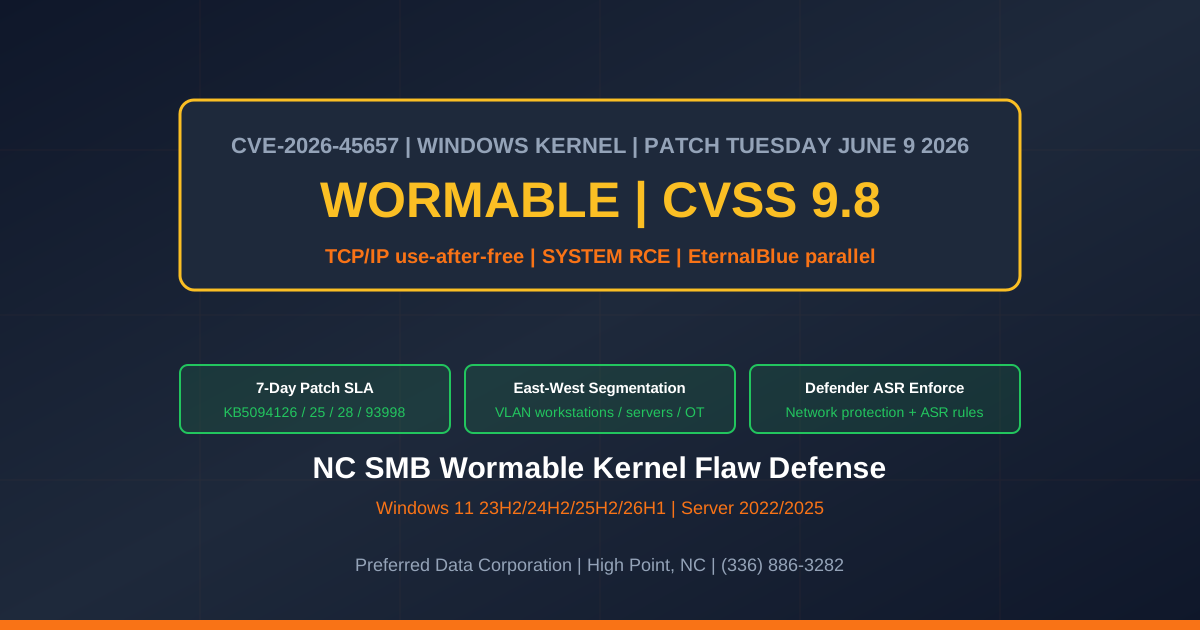
TL;DR: Inside Microsoft's record-setting June 2026 Patch Tuesday - 206 vulnerabilities, the largest single-month batch since 2003 per BleepingComputer - the headline CVE is CVE-2026-45657, a CVSS 9.8 use-after-free in the Windows Kernel's TCP/IP stack. An unauthenticated attacker can send a crafted TCP/IP packet and execute code at SYSTEM with no user click, no login, and no prior access, per Microsoft Security Response Center. Zero Day Initiative analyst review confirmed the flaw's characteristics allow self-propagation across networks - the same wormable profile that powered WannaCry / EternalBlue in 2017, per Threat-Modeling.com. For NC SMBs running Windows 11 (23H2, 24H2, 25H2, 26H1), Windows Server 2022, or Windows Server 2025, the patch is the most important June 2026 item on the IT calendar.
Key takeaway: "Wormable" is the word that turns a normal patch deadline into a fire drill. CVE-2026-45657 is the first wormable Windows kernel flaw in production OS versions since EternalBlue. Every NC SMB needs the patch in 7 days, every SMB needs east-west segmentation in 30 days, and every SMB needs to assume the next worm-class campaign will look exactly like this one.
Need help deploying the June 2026 Windows patches with rollback safety, plus network segmentation that limits worm blast radius? Preferred Data Corporation runs managed IT and managed cybersecurity for NC SMBs since 1987. Call (336) 886-3282 or book an emergency patch + segmentation review.
What is CVE-2026-45657 and why is "wormable" the word that matters?
CVE-2026-45657 is a CVSS 9.8 use-after-free vulnerability in the Windows Kernel's TCP/IP processing path, disclosed by Microsoft on June 9, 2026, per NVD. A malformed TCP/IP packet triggers the use-after-free, allowing the attacker to execute code at SYSTEM-level privilege over the network - without authentication, without user interaction, and without any prior foothold.
| CVE-2026-45657 attribute | NC SMB implication |
|---|---|
| CVSS score | 9.8 (critical) |
| Attack vector | Network (TCP/IP) |
| Authentication required | None |
| User interaction required | None |
| Privilege gained | SYSTEM (highest on Windows) |
| Wormable | Yes - flaw allows self-propagation per Zero Day Initiative |
| Affected systems | Windows 11 23H2/24H2/25H2/26H1, Windows Server 2022/2025 |
| Patches | KB5094126, KB5094125, KB5094128, KB5093998 |
| Reference parallel | EternalBlue / MS17-010 (WannaCry, NotPetya, 2017) |
Per Talos Intelligence and SecurityWeek, the June 2026 release fixed 206 CVEs total - the largest Patch Tuesday since Microsoft started the program in October 2003. Six were zero-days; five were publicly disclosed before patch; one was actively exploited in the wild. CVE-2026-45657 was not the actively-exploited one - it was the wormable one, which is the higher-risk profile over 30 - 90 days because public PoCs typically follow patch disclosure for wormable flaws within weeks.
Quotable definition: A wormable vulnerability is a flaw that can be exploited to spread from one infected host to other hosts on the network without further attacker action. A single compromise becomes a fleet compromise inside hours.
Three facts an NC SMB owner should write down today:
- The historical parallel is WannaCry, not "just another patch." Per Zero Day Initiative, the network-propagation profile of CVE-2026-45657 maps to EternalBlue (CVE-2017-0144), the vulnerability that powered WannaCry's 200,000-machine sweep across 150 countries in 72 hours. The wormable kernel-class flaw is exactly the type of CVE that becomes a global incident if a credible PoC drops.
- All currently supported Windows are affected. Per Microsoft, Windows 11 23H2, 24H2, 25H2, 26H1, Windows Server 2022, and Windows Server 2025 are in scope. The NC SMB Windows 10 ESU population (post-October-14-2025 EoL) is not patched by KB5094126 - they need ESU coverage or migration.
- Network segmentation is the second control. Patch closes the door. Network segmentation determines the blast radius of any wormable malware that lands behind the patch deadline. NC SMBs with flat networks (single VLAN, no east-west firewall, full domain trust) get the WannaCry experience.
Why does CVE-2026-45657 matter to NC SMBs in 2026?
Because the median NC SMB is one wormable-class CVE away from a fleet-wide outage. The NC SMB Windows estate runs heavily on Windows 11 24H2 and 25H2 (with 26H1 starting to roll), Windows Server 2022 (still dominant in NC manufacturing and professional services), and Windows Server 2025 (greenfield rollouts at NC SMBs that did a server refresh in 2025-2026). All three are in scope for CVE-2026-45657.
The NC SMB victim profile maps cleanly:
- A High Point manufacturer running a Windows Server 2022 file server on the same VLAN as 60 production-floor PCs, 30 office PCs, and a CNC controller. A worm against the file server crosses to everything, including the CNC control box that schedules a 3-shift production line.
- A Greensboro CPA firm running Windows Server 2025 for Drake Tax, with all 25 accountants' Windows 11 25H2 workstations on the same /24 subnet, no internal segmentation, and a single Cisco Meraki MX firewall at the edge. Edge defense does not stop east-west TCP/IP traffic.
- A Piedmont Triad professional services firm with Windows Server 2022 hosting QuickBooks, Microsoft 365 sync, and the document management system - on a flat network with Windows 11 workstations, a few BYOD laptops, and a couple of unmanaged contractor machines. The unmanaged machines are the entry vector; the flat network is the spread vector.
- A Charlotte NC SMB healthcare clinic with Windows Server 2025 hosting the EMR, Windows 11 workstations at every exam-room desktop, and a separate clinical-imaging VLAN - except the VLAN tagging was misconfigured during the last office expansion and the segmentation is not actually enforced.
Per the Verizon DBIR 2026 coverage of SMB ransomware, ransomware was present in 88% of SMB breach incidents - and the operators of every major ransomware brand watch Patch Tuesday for wormable flaws to weaponize. Per The Hacker News, a working PoC for CVE-2026-45657 was anticipated within 14 - 30 days of disclosure based on prior wormable-flaw historical timing.
Key takeaway: Patch closes one door. Segmentation closes the hallway. NC SMBs that patch but do not segment will survive this specific CVE, then get caught by the next wormable-class flaw in the next quarter. The structural fix is east-west segmentation, not patch heroics.
How does an NC SMB respond to CVE-2026-45657 in 30 days?
Run a six-step plan inside 30 days. The first three steps are inside 7 days; the remaining three are structural and complete within the month.
- Patch every Windows endpoint and server in 7 days (Day 0-7). Deploy KB5094126 (Windows 11 24H2 / 25H2), KB5094125 (Windows Server 2025), KB5094128 (Windows Server 2022), and KB5093998 (Windows 11 23H2). Use phased rings - test ring (5% of fleet), broad ring (50%), and remaining (100%) - over the 7-day window, not a single Friday push.
- Disable SMBv1 anywhere it still runs (Day 0-3). Per Arctic Wolf's June 2026 Patch Tuesday recap, SMBv1 remains the most common "should already be gone" worm-spread protocol in NC SMB environments. The June 2026 CVE does not require SMBv1, but defense in depth says it stays off.
- Enable Microsoft Defender network protection and ASR rules (Day 3-7). Network protection (Defender for Endpoint feature) inspects outbound network connections for known malicious destinations. Attack Surface Reduction rules block common worm-stage behavior (LSASS dumping, Office child-process spawning, scripted Win32 API abuse). These rules are off by default on most NC SMB tenants.
- Stand up east-west network segmentation (Day 7-21). Workstations on one VLAN, servers on a second, OT / production on a third, BYOD / guests on a fourth. Inter-VLAN firewall rules permit only required ports (3389 RDP from admin VLAN to servers, 445 SMB only between sanctioned hosts, etc.). For NC manufacturers, this means putting the CNC / PLC / OT estate behind a dedicated firewall, not the office /24.
- Tabletop the WannaCry-class incident (Day 14-21). Walk through: "It's Friday at 3pm. EDR flags a worm-class behavior on workstation 17. By 3:15, 30 workstations are flagged. What is the response?" If the answer is not in a written runbook, write it. Cover containment (isolate VLAN), backup (latest immutable snapshot), customer notification, and DoD CIO / DFARS notification for in-scope defense suppliers.
- Sign up for Microsoft Security Update Guide RSS + KEV feed (Day 14-30). The June 2026 batch had 206 CVEs. The next wormable flaw will be in some future Patch Tuesday. Push the SUG feed and the CISA KEV feed into the IT team's alerting pipeline so the 7-day patch SLA starts on disclosure day, not the day someone reads the news.
| Day-30 control | Target outcome | Why it matters |
|---|---|---|
| Patch KB5094126 / 25 / 28 / 93998 deployed | 100% of Windows 11 + Server 2022/2025 fleet | Closes the kernel use-after-free |
| SMBv1 disabled | All Windows hosts | Defense in depth against worm spread |
| Defender network protection + ASR enabled | All endpoints | Behavior-based worm spread blocking |
| East-west VLAN segmentation in place | Workstations / servers / OT / BYOD separated | Limits worm blast radius |
| WannaCry-class tabletop completed | Documented runbook in IT folder | Reduces incident response time from hours to minutes |
Key takeaway: A 7-day patch SLA for wormable kernel flaws is the new baseline. The structural answer is segmentation. NC SMBs that get both right will sleep through the next WannaCry-class campaign.
How does Preferred Data Corporation help NC SMBs defend against wormable kernel flaws?
PDC has run managed IT, managed cybersecurity, and network infrastructure for NC SMBs since 1987. For the June 2026 record Patch Tuesday and CVE-2026-45657 in particular, PDC brings three things:
- 7-day patch SLA on critical kernel CVEs: PDC runs a tested, ring-based patch deployment process - test, broad, full - so the patch is in production inside the federal compliance window without breaking line-of-business apps.
- East-west segmentation design and implementation: PDC redesigns the NC SMB internal network so workstations, servers, OT, and BYOD live on separate VLANs with firewall enforcement between them. The wormable flaw becomes a flaw with a 25-machine blast radius, not a 250-machine blast radius.
- Defender for Endpoint P2 + 24/7 SOC monitoring: Network protection, ASR rules, and behavior-based detection tuned for worm-class behavior, with active SOC tuning so the alert reaches an analyst in minutes, not Monday morning.
For NC manufacturers in High Point with file servers and CNC controllers on the same VLAN, NC CPA firms in Greensboro running Drake Tax on Windows Server 2025, NC professional services firms in the Piedmont Triad with mixed-trust device fleets, and NC healthcare SMBs in Charlotte where EMR and clinical imaging share network infrastructure - this is the patch-and-segment combination that prevents the next WannaCry from being your weekend.
Need help deploying the June 2026 patches and segmenting your network in 30 days? Call (336) 886-3282 or book an emergency patch + segmentation review.
Frequently Asked Questions
What is CVE-2026-45657?
CVE-2026-45657 is a CVSS 9.8 use-after-free vulnerability in the Windows Kernel's TCP/IP processing path, disclosed June 9, 2026 in Microsoft's Patch Tuesday. Per NVD, an unauthenticated remote attacker can execute code at SYSTEM level by sending a crafted TCP/IP packet, with no user interaction. Zero Day Initiative confirmed the flaw has self-propagating (wormable) characteristics.
Which Windows versions are affected?
Per Microsoft, the affected systems are Windows 11 23H2, 24H2, 25H2, 26H1, Windows Server 2022, and Windows Server 2025. The relevant cumulative updates are KB5094126 (Windows 11 24H2 / 25H2), KB5094125 (Windows Server 2025), KB5094128 (Windows Server 2022), and KB5093998 (Windows 11 23H2). Windows 10 is end-of-life as of October 14, 2025 - ESU customers need the ESU equivalent; non-ESU machines need migration urgently.
Is CVE-2026-45657 being actively exploited in the wild?
Per Microsoft, the answer at disclosure was no - it was not the actively-exploited zero-day in the June 2026 batch (that was a separate CVE). However, per The Hacker News, the wormable kernel-class profile typically attracts public PoC development within 14 - 30 days of disclosure. Treat the patch deadline as 7 days, not 30.
Why does "wormable" change the patch urgency?
A wormable flaw can spread from one infected host to other hosts on the network without further attacker action. WannaCry (EternalBlue, 2017) hit ~200,000 machines in 72 hours and cost the global economy an estimated $4 - 8 billion. NotPetya (same exploit class) hit ~$10 billion in damages. A single SMB compromise via a wormable kernel flaw can turn into a fleet-wide outage in hours - which is why segmentation matters as much as patching.
What is the cheapest segmentation control for a 25-person NC SMB?
A managed firewall (Cisco Meraki MX67, Fortinet FortiGate 40F, Sophos XGS, Palo Alto PA-440) with internal VLANs and inter-VLAN firewall rules. Workstations on one VLAN, servers on another, BYOD / guests on a third, and (if a manufacturer) OT on a fourth. Inter-VLAN allow-rules permit only the ports that line-of-business apps require. Cost typically $1,500-$4,000 in hardware + $80-$200/mo in licensing for a 25-person SMB.
What about Microsoft Defender ASR rules?
Attack Surface Reduction rules in Microsoft Defender for Endpoint block common malware behaviors regardless of the underlying CVE - LSASS credential dumping, Office spawning child processes, Win32 API abuse from scripts, and more. Per Arctic Wolf, most NC SMBs running Defender P2 have ASR rules in audit mode, not enforce. Move them to enforce. This single change blocks a large share of the post-exploitation behavior a wormable flaw enables.
How do I prepare for the next wormable flaw, not just this one?
Three durable controls: (1) ring-based patch deployment with a 7-day SLA on critical wormable CVEs, (2) east-west network segmentation that caps blast radius, and (3) behavior-based EDR with active SOC tuning. The first two limit damage from the next flaw; the third detects the first machine to fall and triggers containment. PDC delivers all three for NC SMBs as a managed cybersecurity program.
Related Resources
- Managed Cybersecurity for NC Businesses - EDR + 24/7 SOC + ASR tuning
- Managed IT for NC Businesses - 7-day patch SLA on critical CVEs
- Network Infrastructure Services - East-west segmentation for NC SMBs
- Microsoft June 2026 Patch Tuesday Record 200 CVEs - Companion June 2026 patch event
- PTC Windchill CVE-2026-12569 KEV Defense
- DirtyClone Linux Kernel CVE-2026-43503 LPE Defense
- Windows 10 ESU Year 2 October 2026 Cliff
- Contact Preferred Data Corporation - Emergency patch + segmentation for NC SMBs