
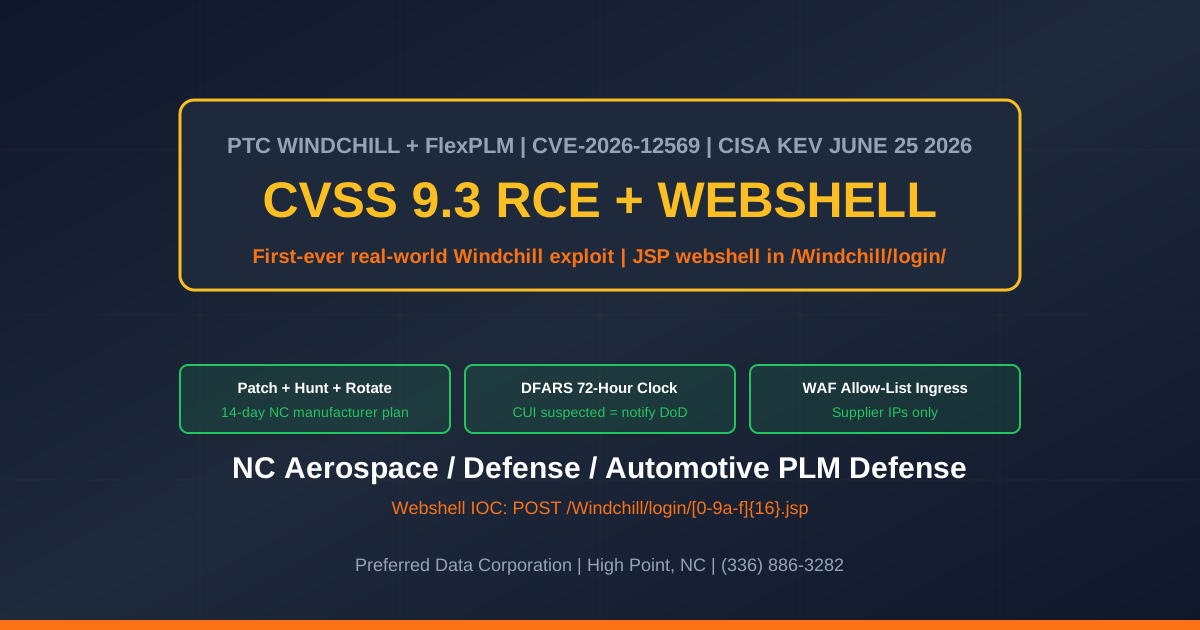
TL;DR: The Windchill flaw CISA flagged in June has turned into a named extortion campaign with a public victim list. The Cl0p group is behind the attacks on CVE-2026-12569 - a CVSS 9.3 unauthenticated remote code execution flaw in PTC Windchill and FlexPLM - and by August 19, 2026 had listed more than 40 organizations on its leak site, per SecurityWeek, including manufacturers, industrial-equipment makers, and technology and medical-device firms. This is data theft, not encryption: a backup restores the server but does not un-publish your CAD library. Windchill holds the CAD, BOM, change-management, and CUI data at the center of North Carolina's aerospace, defense, automotive, and heavy-equipment supply chains. Any NC manufacturer running Windchill or FlexPLM that skipped the June cleanup is the reason this page exists.
Key takeaway: Your Windchill server is the single richest target inside the average NC manufacturer's network. This is the first confirmed real-world exploitation of Windchill, and CISA gave federal agencies three days to patch. NC manufacturers should match that pace.
Need help patching Windchill, hunting for JSP webshells, and tightening PLM access? Preferred Data Corporation has run managed cybersecurity for NC manufacturers since 1987. Call (336) 886-3282 or request an emergency PLM review.
Does this affect your shop? A 30-second check
You are only exposed if your engineering team uses PTC Windchill or FlexPLM, the product lifecycle management (PLM) software that stores CAD files, bills of materials, and design data for a customer like an aerospace or defense prime. Not sure? Ask your IT or engineering lead: do we run Windchill or FlexPLM, and is it reachable from the internet? If the answer is yes or "not sure," keep reading. A "webshell" is just a hidden back door an attacker leaves running on that server.
Update, August 2026: the June warning is now a named Cl0p extortion campaign
The "assume you were probed" caution this post raised in June has hardened into a public extortion campaign. The Windchill and FlexPLM attacks exfiltrate data for extortion, per BleepingComputer, and the Cl0p group has claimed them by naming victims on its leak site, full names from August 12, 2026 and past 40 organizations by August 19, per SecurityWeek. Ransom-ISAC flagged the campaign on July 23 and compared the method to Cl0p's Oracle E-Business Suite mass extortion; extortion emails have reached hundreds of employees inside listed companies.
Two facts change how you respond. Cl0p's game is theft and publication, the same one-flaw playbook it ran through MOVEit, Cleo, and Oracle EBS, so a restored server does not un-publish a stolen CAD library; the asset at risk is the product itself. And a leak-site listing is an allegation, not a verdict: Cl0p listed and then quietly removed GE, and its lists have a history of padding, so treat a listing as a reason to investigate, never as proof a named firm was negligent. The webshell that landed in June is why data walked out in July, and why a prime contractor is reading your name on a leak site in August. The deadline just moved from "patch it" to "prove you were not one of them."
What is CVE-2026-12569 and why is it a five-alarm problem?
CVE-2026-12569 is an improper input validation vulnerability in PTC Windchill and FlexPLM, carrying a CVSS 4.0 base score of 9.3, that lets a remote, unauthenticated attacker execute arbitrary code by sending specially crafted requests, per NVD. PTC began releasing patches on June 17, 2026, and updated its advisory on June 26 to confirm heightened threat activity with active webshell deployment, per PTC's Trust Center.
| Attribute | CVE-2026-12569 detail |
|---|---|
| CVSS score | 9.3 (CVSS 4.0, critical) |
| Authentication required | None |
| User interaction required | None |
| Exploit vector | Network (HTTP/HTTPS) |
| Active exploitation | Confirmed in the wild (first-ever for Windchill) |
| CISA KEV add date | June 25, 2026 |
| Federal patch deadline | June 28, 2026 (three days) |
| Payload observed | Persistent JSP webshells in /Windchill/login/[0-9a-f]{16}.jsp |
| Outcome | Remote command execution + data exfiltration |
The flaw is significant because Windchill is the spine of product-lifecycle management for the sectors that dominate NC industrial GDP - aerospace, defense, automotive, heavy machinery, and medical-device and electronics makers, per CSO Online. That is exactly the profile Cl0p went hunting for among internet-exposed instances.
Quotable definition: PTC Windchill (PLM software) holds a manufacturer's master engineering record - CAD designs, bills of materials, change orders, and CUI for defense contracts. A webshell on that server is a webshell on the intellectual property.
Two facts to write down today:
- The webshell IOC is specific. Per Help Net Security and PTC's advisory, attackers drop webshells named with 16 lowercase-hex characters in the
/Windchill/login/directory, so defenders can grep logs forPOST /Windchill/login/[0-9a-f]{16}\.jspto spot post-compromise activity. - A compromised Windchill = a compromised supply chain. The supplier-collaboration links inside Windchill make it a third-party-risk amplifier, and the Verizon DBIR 2026 found 48% of breaches involve third parties.
Why is this a North Carolina manufacturer story?
Because the NC industrial corridor runs on PLM. The Piedmont Triad and Charlotte regions are thick with Tier-1 and Tier-2 suppliers to aerospace, automotive, and DoD primes; the ones running Windchill or FlexPLM are directly in scope.
The NC manufacturer victim profile maps cleanly:
- A High Point aerospace machining shop running Windchill on a self-hosted Windows Server, exposed via HTTPS on a static public IP for supplier collaboration. The flaw is unauthenticated, so the customer identity federation in front of it is irrelevant.
- A Piedmont Triad defense subcontractor with Windchill in a CMMC Level 2 CUI enclave. A webshell there is a CUI breach, which starts a 72-hour DoD CIO notification clock under DFARS 252.204-7012.
- A Charlotte heavy-equipment supplier running Windchill for change management with a prime like John Deere or Caterpillar, on a supplier-collaboration URL issued ten years ago and never re-checked for internet exposure.
The webshell survives a reboot and survives the patch itself, so patch-and-walk-away is not a response, per The Hacker News. PTC first warned customers on June 17, 2026; any Windchill that was internet-reachable around then should be treated as compromised until proven otherwise, and Cl0p's leak site is now the proof of what that costs.
Key takeaway: Patch closes the front door. Hunt closes the back door. If you patched Windchill on June 18 and did not hunt for the JSP webshell on June 26, you patched a server an attacker still owns.
How does an NC manufacturer respond to CVE-2026-12569 in 14 days?
Run this seven-step sequence inside two weeks. It is built for a 1-3 person IT team at an NC manufacturer, not a Fortune 500 SOC.
- Inventory every Windchill and FlexPLM instance (Day 0-1). Include test, QA, dev, supplier-collaboration, and "we forgot we had it" instances. Every version before PTC's fixed release is affected, per PTC's Trust Center advisory.
- Patch to the PTC-listed fixed version (Day 1-3). Match the federal three-day BOD 22-01 window, and snapshot the system first to preserve forensic evidence.
- Hunt for the JSP webshell IOC (Day 2-4). Grep IIS / web-server logs for POST requests to
/Windchill/login/[0-9a-f]{16}.jsp, and flag any unexpected.jspfile in the Windchill webapp directory. PTC has published IOCs, per Help Net Security - apply them. - Restrict Windchill internet exposure to known supplier IPs (Day 3-7). A WAF (Cloudflare, F5) with an allow-list of customer and supplier IP ranges. The flaw is unauthenticated, so authentication does not help; network access control does.
- Rotate every credential the Windchill server has touched (Day 5-10). Domain service accounts, SSO and federated tokens, database credentials, and supplier-portal API keys - a persistent webshell has already exfiltrated them.
- Notify the prime contractor / customer if you are in their PLM federation (Day 1-5). Defense suppliers with CUI have a 72-hour DFARS notification clock the moment compromise is suspected; aerospace and automotive primes have similar supplier-program clauses.
- Tabletop the "what if the webshell predated the patch" scenario (Day 7-14). Exploitation was confirmed in the wild in late June, so assume any Windchill exposed to the internet in mid-June was probed, and rehearse the disclosure and customer-notification steps now, not during the incident.
| Control | Day-7 target | Why it matters |
|---|---|---|
| Windchill patched to fixed version | 100% of instances | Closes the unauthenticated RCE |
/Windchill/login/[0-9a-f]{16}.jsp log search | All instances since mid-June | Detects the persistent webshell |
| WAF allow-list on Windchill ingress | All internet-reachable instances | Limits exploitation to trusted IPs |
| Service-account credentials rotated | All Windchill-adjacent accounts | Closes the post-compromise lateral path |
| DoD / customer notification | All defense-prime federations | DFARS 72-hour rule + prime supplier clauses |
Key takeaway: The technical patch is the easy part. The hunt for the webshell, the credential rotation, and the customer notification are the parts that distinguish a 14-day clean exit from a 9-month dwell-time breach.
How does Preferred Data Corporation help NC manufacturers defend against CVE-2026-12569?
PDC has run managed cybersecurity, managed IT, and network and OT segmentation for NC industrial firms since 1987. For this flaw and the Cl0p campaign built on it, PDC brings three things:
- Emergency PLM patch + webshell hunt: snapshot the Windchill server, apply the PTC fix, grep web-server logs for the 16-hex JSP IOC, and clear any post-compromise residue found.
- Network access control on PLM ingress: WAF allow-listing of customer and supplier IP ranges, conditional access on the Windchill federation, and removing internet exposure introduced years ago and forgotten.
- CMMC / DFARS notification workflow: if CUI is on the system, a 72-hour clock applies, and PDC helps NC defense subcontractors document the timeline, prepare the DoD CIO submission, and coordinate the prime-contractor disclosure.
Done right, that patch-and-hunt cycle is what keeps a Windchill breach from turning into a lost customer contract or a missed DFARS deadline for a Piedmont Triad shop.
Need a Windchill emergency response inside 14 days? Call (336) 886-3282 or book an emergency PLM review.
Frequently Asked Questions
What is CVE-2026-12569?
CVE-2026-12569 is a CVSS 9.3 unauthenticated remote code execution vulnerability in PTC Windchill and FlexPLM. Per NVD, a remote attacker can execute arbitrary code via specially crafted HTTP requests without authentication or user interaction. CISA added it to the KEV catalog on June 25, 2026, after confirmed in-the-wild exploitation.
How are attackers exploiting Windchill in the wild?
Per The Hacker News, attackers deploy persistent JSP webshells named with 16 lowercase-hex characters inside the /Windchill/login/ directory, enabling remote command execution and data exfiltration. The webshell survives the patch - patching closes the entry vector but does not remove the implant.
Cl0p is stealing data instead of encrypting it - will our backups help?
No. Cl0p's Windchill campaign is data-theft extortion, per BleepingComputer. Backups restore an operational server, but they do nothing about CAD files, bills of materials, and CUI already copied off the box. What matters here is keeping Windchill off the open internet, hunting for the webshell, and watching for data leaving; recovery from backup solves the wrong problem.
What is the patch deadline for Windchill?
PTC released patches starting June 17, 2026. CISA set a three-day federal deadline of June 28, 2026 for federal civilian agencies under BOD 22-01. NC manufacturers - especially defense suppliers with CUI on Windchill - should match the federal pace.
Why does this matter for North Carolina manufacturers specifically?
PTC Windchill and FlexPLM are widely deployed across aerospace, defense, automotive, and heavy-machinery suppliers, the four sectors that dominate the NC industrial corridor. A Windchill webshell on a Tier-1 supplier's network is a foothold inside the engineering-data spine of the supply chain, so NC suppliers to the region's aerospace, automotive, and DoD primes are directly in scope.
How can I tell if my Windchill server was already compromised before I patched?
Grep IIS or web-server access logs for POST /Windchill/login/[0-9a-f]{16}.jsp - the published IOC pattern - and flag any unexpected .jsp file in the Windchill webapp directory. Per CSO Online, persistent webshells are the dominant post-exploit payload, so absence-of-webshell is a meaningful (though not conclusive) negative signal.
Does CMMC require notification if Windchill in our CUI enclave was hit?
If Controlled Unclassified Information (CUI) was on the Windchill instance and a compromise is reasonably suspected, DFARS 252.204-7012 requires notification to the DoD CIO within 72 hours of discovery. The notification clock starts at discovery, not at confirmation. NC defense subcontractors with Windchill CUI should engage counsel and the prime contractor immediately.
How do I prevent future Windchill exploitation?
Three controls together: (1) WAF allow-listing the Windchill ingress to known supplier / customer IP ranges, (2) keeping the Windchill version current with PTC patches and subscribing to the PTC Trust Center advisory feed, and (3) monitoring with behavior-based EDR on the Windchill host so that a webshell payload is detected on first use, not on first ransom note.
Related Resources
- Managed Cybersecurity for NC Businesses - Patch + hunt + EDR for manufacturers
- Managed IT for NC Businesses - PLM operations and SLA-driven patch management
- Manufacturing IT and OT Security - Engineering-data security for NC manufacturers
- Inside the Cl0p Data-Theft Extortion Playbook: NC Defense
- MOVEit Automation CVE-2026-4670/5174: Managed File Transfer Defense
- Verizon DBIR 2026: 48% Third-Party Breaches
- Contact Preferred Data Corporation - Emergency Windchill response for NC manufacturers