
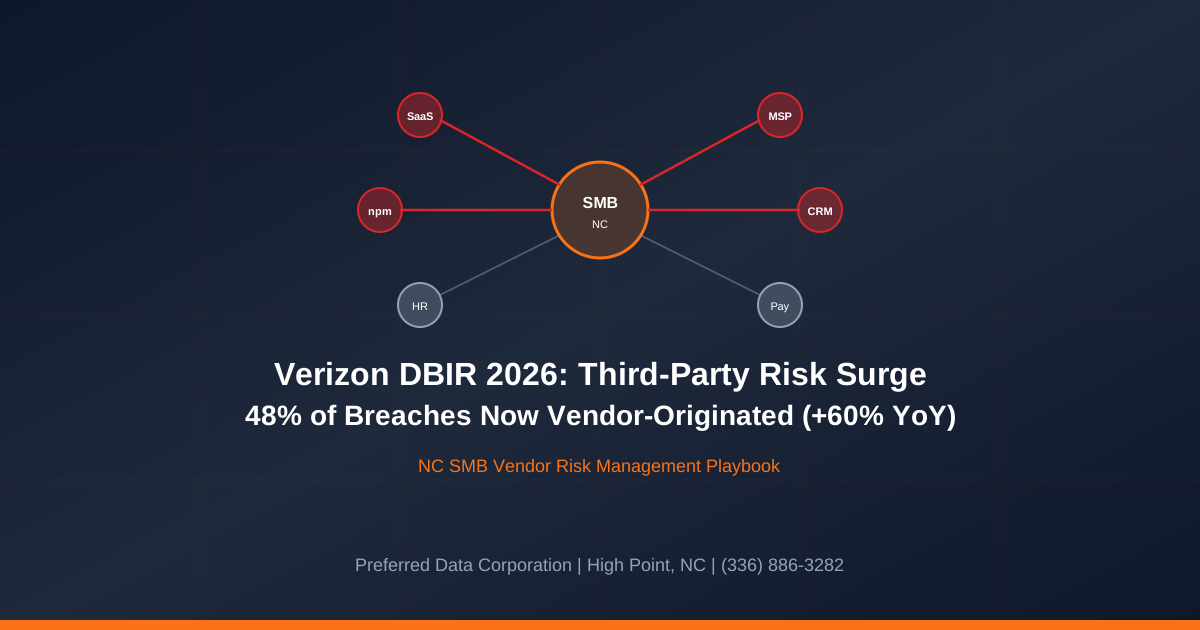
TL;DR: Per the 2026 Verizon Data Breach Investigations Report, third-party involvement is now a factor in 48% of all confirmed breaches - up roughly 60% year over year from the 2025 DBIR's 30% baseline. Per Safe Security's analysis and Tenchi Security's coverage, vulnerability exploitation has also overtaken stolen credentials as the #1 initial breach cause for the first time in 19 years of monitoring. For an NC SMB, the message is direct: half of all breaches now arrive through a vendor, an MSP, a SaaS platform, or a software dependency, and any 2026 risk program that does not treat vendor risk management (TPRM) as a Tier 1 control is operating against last year's threat model.
Key takeaway: In 2026, your weakest cybersecurity link is not your password policy. It is the SaaS vendor's password policy. And theirs. And theirs.
Need a vendor risk management program scoped to an NC SMB? Preferred Data Corporation runs managed cybersecurity, SBOM, and TPRM for NC small businesses. Call (336) 886-3282 or request a vendor risk review.
What did the 2026 Verizon DBIR actually find on third-party risk?
Per Verizon's official DBIR landing page, its press release, and the third-party-risk analyses from Safe Security and Tenchi Security:
| Metric | 2025 DBIR | 2026 DBIR | YoY change |
|---|---|---|---|
| Third-party involvement in breaches | 30% | 48% | +60% |
| Human element in breaches | 68% | 62% | -6 pts |
| Vulnerability exploitation as #1 initial vector | No (creds were) | Yes | First time in 19 years |
| SMB ratio of breaches vs large org | 4x | 4x | flat |
The 30% to 48% third-party jump is the single largest year-over-year change in the report's history for any breach-factor category. Per TechRepublic's coverage, the structural drivers are SaaS sprawl, cloud connector authentications (OAuth tokens that survive password changes), and software supply chain compromises like Mini Shai-Hulud.
Why is third-party risk now the dominant breach factor?
Three structural forces are converging in 2026. Per Safe Security's analysis, ColorTokens' DBIR insights, and Push Security's review:
- SaaS sprawl. The average NC SMB now uses 80-120 SaaS apps, most provisioned by individual teams and connected via OAuth. A breach at any one creates a token-theft and pivot path into the parent SaaS environment.
- OAuth and integration token persistence. Unlike a password compromise, an OAuth token can outlive credential rotation, MFA enforcement, and even user offboarding unless explicitly revoked.
- Software supply chain compromise. Per our coverage of Mini Shai-Hulud, an npm worm can compromise a vendor's CI/CD and ship malicious code downstream to thousands of customers without any human action by either party.
The 2026 DBIR captures the cumulative impact: vendor security is your security, whether your contract acknowledges that or not.
What does a third-party breach look like for an NC SMB?
Five patterns recur in 2026 NC SMB incident data. Each ends with the SMB explaining a breach to its customers despite never having been "hacked" directly:
| Pattern | Vendor type | What happens |
|---|---|---|
| Salesforce OAuth connector compromise | CRM connector (e.g., Drift, Salesloft) | Attacker pivots from connector to SF, exfils data |
| MSP credential reuse | Outsourced IT MSP | MSP technician account compromised, used to push ransomware to clients |
| Payroll vendor breach | Payroll / HR SaaS | Customer SSN/W-2 data published on leak site |
| Backup vendor ransomware | Cloud backup provider | Customer backups encrypted; restoration blocked |
| npm / PyPI supply chain | Open source dependency | Malicious code shipped to customer's product as a dependency |
In every pattern, the SMB has the disclosure obligation and the customer-facing reputational damage regardless of whose technical environment was breached. Per our SEC Reg S-P briefing, the 30-day breach notification rule applies even if the breach originated at a third party.
What is a vendor risk management (TPRM) program for an NC SMB?
A documented, lightweight program. NC SMBs cannot run enterprise TPRM, but they need - and can run - a tier-based program. Per ComplianceHub's 2026 DBIR analysis and Axonius's fundamentals brief:
- Inventory every vendor. Build a register of every SaaS, software, contractor, and managed services vendor with access to your data or systems. Most NC SMBs underestimate by 60-80%.
- Tier by data sensitivity. Tier 1 = customer PII, PHI, payroll, or financial data. Tier 2 = internal data, business systems. Tier 3 = public, low-risk integrations.
- Tier 1 vendor due diligence. Require SOC 2 Type II reports, security questionnaire response, MFA / SSO support, OAuth scope review, and contractual breach notification of 72 hours or less.
- Continuous monitoring. Subscribe to vendor security bulletins, set up DNS/CNAME monitoring for status pages, and review SaaS audit logs weekly.
- Documented offboarding. Token revocation, account deprovisioning, data export and destruction certified in writing.
Quotable definition: Third-party risk management (TPRM) is the practice of identifying, assessing, monitoring, and controlling the cybersecurity risk that vendors, suppliers, and software dependencies introduce into your business. In 2026 it is the dominant SMB breach factor, not a compliance afterthought.
Are MSP vendors specifically in scope of the third-party risk surge?
Yes, and aggressively so. Per the Verizon 2026 DBIR commentary and Push Security's review, MSP credential compromise is now a documented attack chain in which a single MSP technician account compromise cascades into ransomware against the MSP's entire SMB customer base.
For an NC SMB selecting or auditing an MSP, the practical questions are:
- Does your MSP enforce phishing-resistant MFA for every technician account?
- Does your MSP use customer-isolated administrative tooling, or shared admin tooling with weak segmentation?
- Does your MSP run 24x7 SOC monitoring on its own infrastructure?
- Does your MSP carry meaningful cyber insurance with breach notification obligations to you?
Per our 94% SMB MSP adoption briefing, the MSP relationship is now structural for NC SMBs. The question is which MSP, and what controls.
Does cyber insurance cover third-party breaches?
Increasingly only when documented vendor risk controls were in place. Per the 2026 SMB cyber insurance environment, most carriers' 2026 questionnaires now ask about:
- Vendor inventory and tiered risk register.
- SOC 2 Type II report retention for Tier 1 vendors.
- Documented vendor security review schedule.
- Contractual 72-hour breach notification with vendors handling PII or PHI.
- Token revocation and offboarding documentation.
A 2026 NC SMB that cannot answer "yes" on those is increasingly likely to see exclusions on the vendor / supply chain rider and premium increases at renewal.
What is the right 60-day NC SMB rollout?
Sequence the controls so the highest-yield protections land first. PDC scopes this as a two-month sprint inside the managed cybersecurity service:
| Week | Action | Outcome |
|---|---|---|
| 1-2 | Build complete vendor inventory; tier by data sensitivity | True vendor footprint visible for the first time; Tier 1 vendor list defined |
| 3-4 | Collect SOC 2 reports, security questionnaires from Tier 1 vendors | Documented vendor risk posture; gaps identified |
| 5-6 | Update contracts with 72-hour breach notification and audit rights | Contractual leverage in place for incident response |
| 7-8 | Stand up monitoring (SaaS audit logs, vendor status pages, NVD/CVE feeds) | Continuous visibility into vendor security posture |
Key takeaway: The 30%-to-48% jump in third-party breach involvement is the most important single statistic for NC SMB risk planning in 2026. Half of all breaches now arrive through a vendor or supplier. The defense is a documented TPRM program, not an additional firewall.
Ready to stand up a vendor risk management program? Call (336) 886-3282 or request a vendor risk review.
How does Preferred Data Corporation help?
PDC supports NC small businesses with the three layers required to close the third-party breach gap:
- Managed cybersecurity with vendor inventory, SOC 2 review, OAuth scope monitoring, SaaS audit log streaming, and incident response retainer that covers vendor-originated breaches.
- Managed IT services with MSP-grade controls, technician MFA, customer-isolated administrative tooling, and contractual breach notification commitments PDC itself meets.
- Software development services that include SBOM, dependency review, and supply chain hardening for any NC SMB that ships software or maintains internal applications.
PDC has served NC small businesses, manufacturers, distributors, and professional services firms for over 39 years with on-site coverage within 200 miles of High Point. The combination of local NC presence, 20+ year average client retention, and modern TPRM tooling is what gets a documented vendor risk program landed and verified before the next renewal.
Frequently Asked Questions
What does the Verizon DBIR 2026 say about third-party risk?
Per the 2026 Verizon DBIR, third-party involvement is now a factor in 48% of all confirmed breaches, up roughly 60% year over year from the 2025 DBIR's 30% baseline. This is the single largest year-over-year change for any breach-factor category in the report's history and reflects SaaS sprawl, OAuth token persistence, and software supply chain compromise.
What is the difference between third-party and fourth-party risk?
Third-party risk is the cyber risk from your direct vendors and suppliers. Fourth-party risk is the cyber risk from your vendors' vendors - the SaaS your CRM uses, the cloud provider your payroll vendor uses, the open source library your business app vendor depends on. Per Safe Security's analysis, modern breach chains routinely include fourth- and fifth-party hops.
Do small businesses really need a vendor risk management program?
Yes, especially in 2026. Per the DBIR, nearly half of all breaches now arrive through a third party. An NC SMB without a documented vendor inventory and tier-based review program is accepting an unmeasured risk that is now the dominant attack vector.
How much does vendor risk management cost for an NC SMB?
For a 25-person NC SMB, expect 2-4 weeks of managed services time for the initial inventory and Tier 1 review, then 4-8 hours per month for continuous monitoring and renewal. PDC scopes this inside the managed cybersecurity service for predictable per-seat pricing.
What is the most important vendor risk control for an NC SMB to implement first?
The vendor inventory. Most NC SMBs cannot tell you accurately how many SaaS, software, and contractor vendors have access to their data and systems. The inventory is the foundation of every other control - tier-based review, contractual breach notification, offboarding - and is the first deliverable in PDC's 60-day rollout.
Related Resources
- Managed Cybersecurity Services for NC Businesses - Vendor inventory, SOC 2 review, OAuth monitoring
- Managed IT Services for NC Businesses - MSP-grade controls and customer-isolated administration
- Software Development Services - SBOM, dependency review, supply chain hardening
- Mini Shai-Hulud npm Worm: NC SMB Defense (June 2026) - Software supply chain context
- 94% SMB MSP Adoption: In-House IT Unviable - MSP selection criteria
- Contact Preferred Data Corporation - Schedule a vendor risk review