
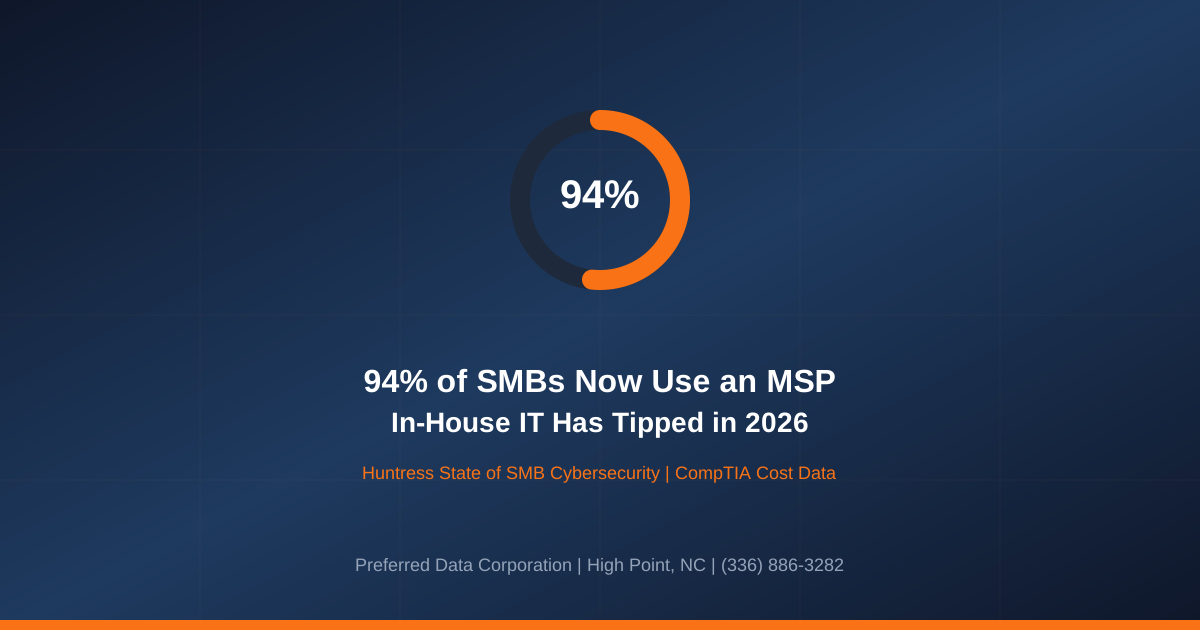
TL;DR: 94% of SMB organizations now use a managed service provider (MSP), per Huntress's State of SMB Cybersecurity report. CompTIA research found 59% of SMBs that engaged an MSP reduced IT-related expenses inside the first year. The 2026 IT investment priorities for SMBs (cybersecurity, cloud, AI/automation, data analytics, hybrid work) all reward the MSP model and punish the lone in-house generalist. For NC small businesses, the question in 2026 is no longer "should we hire IT?" but "which MSP covers our risk surface, our compliance posture, and our growth plan?"
Key takeaway: A 2026 SMB IT environment is firewalls plus Microsoft 365 plus SaaS plus AI plus cybersecurity plus compliance plus 24/7 monitoring. No single in-house hire covers that span. The MSP question is now about fit and capability, not whether.
Outgrowing your one-person IT setup? Preferred Data Corporation has provided MSP services to North Carolina small businesses since 1987. Call (336) 886-3282 or request a 30-minute IT capability review.
Why is in-house IT no longer enough for an SMB in 2026?
Because the SMB technology stack expanded faster than headcount. A typical NC small business in 2026 has to run patched edge appliances (Fortinet, SonicWall, Palo Alto, Cisco), Microsoft 365 with conditional access and MFA, a half-dozen line-of-business SaaS tools, an EDR/MDR product, regular backups and tested recovery, a vendor risk program, an AI usage policy, and a cyber insurance posture that passes underwriting. The 2026 IDC SMB Cybersecurity Spending Report found 60% of SMBs plan to increase cybersecurity spending over the next 12 months because they cannot keep up with that surface.
Three forces drove the shift:
- Threat acceleration. Per the 2026 Verizon DBIR, vulnerability exploitation overtook stolen credentials as the #1 initial access vector at 31%, with median patch time stretching to 43 days. A one-person IT team cannot patch at attacker speed.
- Compliance pressure. CMMC, state privacy laws (Tennessee, Texas, Oregon, NC pending), cyber insurance application questions, and customer security questionnaires all expect documented controls that a generalist cannot produce alone.
- Tooling sprawl. SMBs run a median of 5+ AI tools, 8+ SaaS systems, and at least one edge appliance per location. Each demands patching, monitoring, identity integration, and policy.
For NC manufacturers, construction firms, and professional services in particular, the math no longer works for a single in-house IT generalist.
What does the 94% MSP adoption number actually mean?
It means MSPs are the default model, not the alternative. Huntress's State of SMB Cybersecurity 2024 report found 94% of SMB organizations now use an MSP, with Integris citing 88% in adjacent research. The variance is small. The signal is clear: in 2026, "we handle IT internally" is increasingly an outlier for SMBs above 10 employees.
| Function | In-house generalist | Modern MSP |
|---|---|---|
| 24/7 monitoring and alerts | No | Yes (SOC and NOC) |
| Patch management at attacker speed | Difficult | Standard |
| EDR/MDR with tamper protection | Often missing | Standard |
| Cyber insurance evidence package | Manual | Documented and ready |
| AI usage policy and tool governance | Ad hoc | Sanctioned tools, policy, training |
| Vendor risk and SaaS inventory | Spreadsheet | Continuous |
| vCIO and roadmap | Owner-driven | Quarterly strategic review |
| Cost predictability | Salary plus surprises | Fixed monthly fee |
The bignewsnetwork.com coverage of the 2026 MSP shift and Channel Insider's 2026 outlook both point to the same picture. SMBs are not shrinking their IT need; they are outsourcing it to providers who can spread the cost of 24/7 coverage and specialized tooling across many clients.
What are the actual cost savings of switching to an MSP?
Real, and documented. CompTIA research cited in Big News Network's 2026 reporting found that 59% of SMBs that engaged an MSP reported a reduction in IT-related expenses inside the first year of outsourcing. The mechanism is not magic. Modern MSPs combine the cost of:
- A help desk that would otherwise need to be on call evenings and weekends.
- A patch and monitoring stack (RMM, EDR, MDR, SIEM) that runs into five figures annually for a single SMB to license and run alone.
- A vCIO function that would cost six figures to hire full-time.
- Vendor and license management that an in-house engineer handles part-time at best.
For an NC small business that currently has one or two in-house IT staff and is feeling the gap (slow patching, after-hours pages going unanswered, no MDR, no documented backup recovery), the move to an MSP is often cost-neutral or cost-positive in year one and clearly cost-positive in year two.
Quotable definition: A 2026 managed service provider (MSP) is an outsourced IT and cybersecurity partner that delivers 24/7 monitoring, patch management, EDR/MDR, help desk, backup and recovery, vendor governance, and vCIO advisory under a fixed monthly fee, sized for SMBs that cannot economically run those functions in-house.
What should an NC small business look for in an MSP in 2026?
Pick an MSP that covers your risk surface, not just your help desk. The checklist that matters in 2026:
- Local presence. On-site response inside a few hours when something breaks at a plant, jobsite, or office. For Piedmont Triad businesses, that means an MSP based in or near the High Point, Greensboro, Charlotte, Raleigh corridor.
- Cybersecurity depth. EDR/MDR with tamper protection, 24/7 SOC, KEV patching cadence, MFA enforcement, written incident response plan. Ask for evidence, not promises.
- Industry fit. Manufacturing, construction, professional services, healthcare each have specific OT/SaaS stacks. A generalist MSP without your sector's experience is a long onboarding ramp.
- vCIO and roadmap. Quarterly strategic review with the owner or CFO, three-year capital plan, cyber insurance evidence package, AI governance.
- Cost transparency. Per-user or per-device pricing, well-defined out-of-scope billing, clear renewal terms.
- References in your region. Talk to two or three current clients of similar size and sector.
For NC manufacturers, construction firms, and professional services in the Piedmont Triad, that checklist narrows the field considerably. PDC has been the answer for North Carolina small businesses since 1987, with on-site response inside 200 miles of High Point and decades of manufacturing, construction, and CMMC experience.
Ready to compare? Call (336) 886-3282 or request a 30-minute IT capability review. We will tell you honestly whether the move makes sense for your business.
Why is this a structural shift, not a fad?
Because the cost curve of running a complete 2026 SMB IT and cybersecurity program in-house has crossed the cost of buying it as a service. The 2026 Verizon DBIR, the 2026 IDC SMB Cybersecurity Spending Report, CompTIA's MSP research, and the Huntress State of SMB Cybersecurity report all describe the same trend: SMBs are absorbing a workload that a single hire (or even two) cannot deliver economically, and they are doing it in increasingly hostile threat conditions.
For a Piedmont Triad small business, the MSP shift is the same kind of structural move that payroll, accounting, and legal made decades ago. The function did not disappear; it moved to specialists who could deliver it at higher quality and lower cost. The 2026 question for NC SMBs is not whether to make the move, but which partner to make it with.
PDC supports this through managed IT services, managed cybersecurity, and vCIO and IT strategy.
Frequently Asked Questions
How many SMBs actually use an MSP in 2026?
About 94%, per Huntress's State of SMB Cybersecurity report, with Integris citing 88% in adjacent research. The variance is small. The point is that the MSP model is now the default for SMBs above 10 employees, not the alternative.
Will an MSP really save us money compared to one in-house IT person?
For most NC SMBs, yes. CompTIA research found 59% of SMBs reduced IT-related expenses inside the first year of engaging an MSP, per the Big News Network 2026 coverage. The savings are not from cutting people; they are from spreading the cost of specialized tooling (EDR/MDR, SIEM, 24/7 SOC, patching automation) and senior expertise (vCIO, cybersecurity, compliance) across many clients. A full in-house equivalent in 2026 typically costs more than two or three FTEs.
Can we keep an internal IT person and add an MSP?
Yes, and this is the most common pattern for SMBs above 50 employees. The internal person owns user-facing support, vendor relationships, and project execution. The MSP delivers 24/7 monitoring, patching, EDR/MDR, SOC, compliance, vCIO, and after-hours coverage. The model is a "co-managed IT" arrangement and it is the fastest-growing MSP delivery model in 2026.
What if we already have an MSP but feel we have outgrown it?
This is common in 2026 for SMBs that signed with a generalist MSP three to five years ago. The 2026 stack (KEV-rate patching, MDR, AI governance, CMMC, cyber insurance evidence) is materially heavier than the 2021 stack. A 30-minute capability review with a manufacturing- and SMB-focused MSP will tell you quickly whether your current provider has kept pace.
How long does it take to switch MSPs without an outage?
For an NC SMB of 25-100 employees, a typical migration runs 60-90 days from selection to full cutover, with no user-visible outage if the transition is planned. Most of the time goes into asset discovery, documentation, tool overlap during cutover, and policy reissue. The actual switchover happens in a single business day for endpoint and identity, with edge and infrastructure scheduled over weekends.
Related Resources
- Managed IT Services for NC Businesses - 24/7 support, patching, monitoring, vCIO
- Managed Cybersecurity Services for NC Businesses - EDR/MDR, SOC, KEV patching, compliance
- Network and Infrastructure Services - Edge, segmentation, design, support
- Signs You Should Outsource IT Support - Decision framework for SMBs
- vCIO Services for NC Manufacturers - Strategic IT advisory model
- Contact Preferred Data Corporation - 30-minute IT capability review