
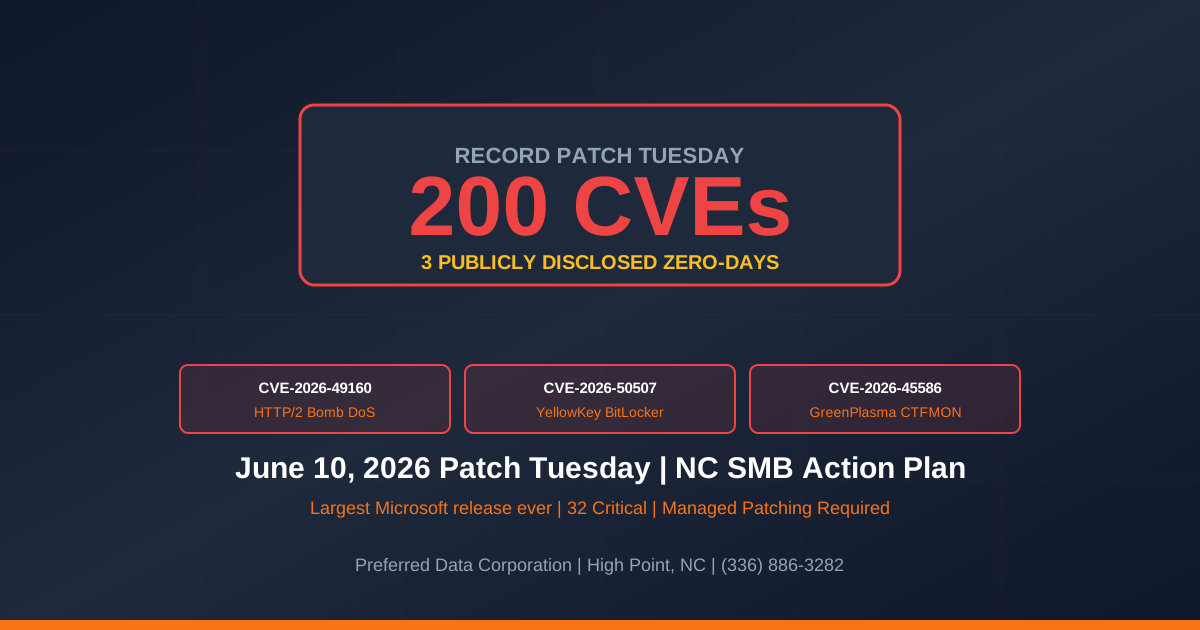
TL;DR: Microsoft's June 10, 2026 Patch Tuesday is the largest single release in the program's history at approximately 200 CVEs, including three publicly disclosed zero-days: CVE-2026-49160 (HTTP/2 Bomb DoS, CVSS 7.5), CVE-2026-50507 (YellowKey BitLocker bypass, CVSS 6.8), and CVE-2026-45586 (GreenPlasma CTFMON privilege escalation, CVSS 7.8). Per Tenable's June 2026 analysis, 32 issues are rated Critical and Remote Desktop Client carries 11 RCE CVEs. NC small businesses without managed fleet patching cannot land 200 CVEs by hand inside their cyber insurance SLA.
Key takeaway: June 10, 2026 is the month manual patching stopped scaling for SMBs. A 200-CVE Patch Tuesday with three publicly disclosed zero-days is now the new normal. The SMBs that close it on time are running managed fleet patching with KEV-rate cadence, not a help-desk ticket queue.
Need your fleet on the June 2026 Patch Tuesday baseline this week? Preferred Data Corporation runs managed patching for NC small businesses since 1987. Call (336) 886-3282 or request a patch posture review.
Why is the June 2026 Patch Tuesday a record-breaking event?
Microsoft released approximately 200 security fixes on June 10, 2026, the largest single Patch Tuesday since the program began in 2003. Per Computer Weekly's coverage, the prior record was 167 CVEs in October 2025; June 2026 smashes through it by ~20%. Per Dark Reading, the practical explanation is that AI-assisted vulnerability research is producing CVEs faster than Microsoft engineering can ship single-cycle patches.
Three facts an NC SMB owner needs in their head:
- 200 CVEs in one Patch Tuesday. Per Tenable and BleepingComputer, the tally lands at approximately 198-208 CVEs depending on which mid-cycle items are counted, with 32 rated Critical.
- Three publicly disclosed zero-days. CVE-2026-49160 (HTTP/2 DoS), CVE-2026-50507 (BitLocker bypass), and CVE-2026-45586 (CTFMON privilege escalation) all had public details before patches shipped, which means exploit tooling is being weaponized inside the same week. See the Zero Day Initiative June 2026 analysis.
- Remote Desktop Client received the largest cluster. Per Tenable, 11 RDP Client RCE CVEs landed in a single cycle. For NC SMBs with remote workforces in the Piedmont Triad, Charlotte, Greensboro, and Raleigh, that is a high-impact attack surface.
For an NC manufacturer in High Point, a distributor in Greensboro, or a professional services firm in Charlotte, the practical question is no longer "should we patch this month" - it is "do we have the managed-patch capacity to land 200 CVEs by month-end."
What are the three publicly disclosed zero-days in June 2026 Patch Tuesday?
The three publicly disclosed zero-days are CVE-2026-49160 (HTTP/2 Bomb), CVE-2026-50507 (YellowKey BitLocker bypass), and CVE-2026-45586 (GreenPlasma CTFMON elevation of privilege). Each one was disclosed publicly before Microsoft shipped a fix, so attackers had a head-start.
| CVE | Nickname | CVSS | Type | Impact |
|---|---|---|---|---|
| CVE-2026-49160 | HTTP/2 Bomb | 7.5 | DoS (HTTP.sys) | Web servers crash from tiny crafted requests |
| CVE-2026-50507 | YellowKey | 6.8 | Security feature bypass (BitLocker) | Lost/stolen laptop drives decryptable via WinRE |
| CVE-2026-45586 | GreenPlasma | 7.8 | Elevation of privilege (CTFMON) | Low-priv foothold becomes SYSTEM |
Per Microsoft's Security Update Guide entry for CVE-2026-45586, the CTFMON link-following bug carries an "exploitation more likely" assessment, which raises the priority above a typical EoP item.
For an NC SMB, the impact translates as follows: HTTP/2 Bomb takes down any internet-exposed IIS, RD Gateway, or Exchange OWA endpoint with negligible attacker bandwidth. YellowKey converts every lost or stolen Windows 11 laptop in your sales fleet into a decryptable risk. GreenPlasma converts a phishing landing into full-domain-control speed.
Why is AI making Patch Tuesday bigger?
Because researchers are now using LLM-assisted code review to find vulnerabilities at scale, and Microsoft is in turn shipping more CVEs in a single cycle to clear the queue. Per Dark Reading, the 200-CVE June 2026 release is a function of three structural shifts:
- AI-augmented vulnerability research. Independent researchers, ZDI submitters, and internal Microsoft teams all now use AI to scan codebases for memory-safety, link-following, and input-validation bugs. The discovery rate climbed faster than the fix rate.
- AI-augmented exploit development. Per the Verizon 2026 DBIR, vulnerability exploitation overtook credential abuse as the top initial-access vector in 2026. AI compresses time-from-CVE-to-working-exploit, narrowing the window between disclosure and weaponization.
- Cyber insurance pressure. Insurers now require evidence of timely patching for KEV-listed CVEs. SMBs that miss KEV deadlines see premium increases or non-renewal. This pressure forces the patch program from "occasional" to "managed monthly cadence."
Quotable definition: AI is now the rate-limiting factor on both ends of the vulnerability lifecycle. It accelerates discovery faster than vendors can patch, and accelerates weaponization faster than SMBs can respond. The only economic answer for a 25-500-employee SMB is a managed fleet patching program.
What should an NC small business do this week?
Run a four-step plan and finish each step inside its window. June 2026 is a fleet-wide event, not a single-server patch.
- Triage by exposure (today). Inventory every Windows 11 / Windows Server endpoint, every IIS / Exchange OWA / RD Gateway exposed to the internet, and every laptop running TPM-only BitLocker. The HTTP/2 Bomb CVE-2026-49160 prioritizes internet-exposed assets; YellowKey CVE-2026-50507 prioritizes mobile laptops; GreenPlasma CVE-2026-45586 prioritizes endpoints that receive email.
- Patch critical workloads inside 72 hours. Per CrowdStrike's June 2026 analysis, the Critical-rated RDP Client cluster and the three publicly disclosed zero-days are the highest-priority items. Push them first.
- Rotate BitLocker to TPM+PIN where TPM-only is in use. Microsoft's pre-patch mitigation for YellowKey was TPM+PIN. Even with the patch, NC SMBs handling regulated data (CMMC, HIPAA, PII) should keep TPM+PIN as a defense-in-depth control.
- Land the long tail inside 30 days. The remaining ~190 CVEs need to land on every endpoint inside the cycle. Manual patching cannot finish that on schedule; managed fleet patching (RMM + patch policy + reporting) can.
Key takeaway: A 200-CVE month is the new SMB baseline. The work shifts from "patch the critical one" to "land the entire cycle on every endpoint inside the cyber-insurance SLA." Without RMM-driven managed patching, an SMB will miss the SLA in June.
How does Preferred Data Corporation help close June 2026 Patch Tuesday?
PDC runs managed fleet patching for NC small businesses with KEV-rate cadence, cyber insurance reporting, and 24/7 SOC coverage. We bring three things to the June 10, 2026 release:
- Managed cybersecurity services: KEV-rate patching, RMM-driven Windows fleet management, BitLocker policy enforcement (TPM+PIN), and Microsoft Defender for Business EDR. We close the three zero-days inside their public-exposure window and land the 200-CVE long tail inside 30 days.
- Managed IT services: Patch reporting, change management evidence for cyber insurance, and quarterly patch posture reviews. We treat Patch Tuesday as a managed program, not a help-desk ticket.
- Network and infrastructure: Edge and IIS hardening for the HTTP/2 Bomb attack surface, RD Gateway protection for the RDP Client cluster, and managed firewall rules that limit blast radius if a zero-day weaponizes faster than the patch.
For NC manufacturers in High Point and the Piedmont Triad, NC distributors in Greensboro and Winston-Salem, and NC professional services firms in Charlotte and Raleigh, June 2026 is the patch month that decides which SMBs are insurable in 2027.
Need help landing the June 2026 Patch Tuesday on every endpoint? Call (336) 886-3282 or book a patch posture review.
Frequently Asked Questions
How many CVEs did Microsoft fix in the June 2026 Patch Tuesday?
Per BleepingComputer, Tenable, and Computer Weekly, the June 10, 2026 release fixes approximately 200 CVEs (counts range from 198 to 208 depending on whether mid-cycle Defender and Azure issues are included), including 32 rated Critical and three publicly disclosed zero-days. It is the largest single Patch Tuesday in the program's history.
What are the three publicly disclosed zero-days in June 2026?
The three publicly disclosed zero-days are CVE-2026-49160 (HTTP/2 Bomb DoS in HTTP.sys, CVSS 7.5), CVE-2026-50507 (YellowKey BitLocker bypass through Windows Recovery Environment, CVSS 6.8), and CVE-2026-45586 (GreenPlasma CTFMON link-following elevation of privilege to SYSTEM, CVSS 7.8). All three had public technical details before Microsoft shipped a patch.
Why is the June 2026 Patch Tuesday so large?
Per Dark Reading, AI-assisted vulnerability research is producing CVEs faster than Microsoft engineering can ship single-cycle fixes, and Microsoft chose to clear the queue in one release rather than spread it across multiple cycles. The Verizon 2026 DBIR also documents that vulnerability exploitation has overtaken credential abuse as the top initial-access vector, which raises the bar for shipping fixes quickly.
Should an NC SMB still use TPM-only BitLocker after CVE-2026-50507?
NC SMBs handling regulated data (CMMC, HIPAA, customer PII) should rotate to TPM+PIN as a defense-in-depth control, even after applying the June 2026 patch. Per The Hacker News' coverage of the earlier YellowKey mitigation, Microsoft itself published TPM+PIN as the pre-patch workaround, which signals that TPM+PIN remains the stronger long-term posture for mobile laptops.
How fast does an NC SMB need to patch the three zero-days?
KEV-rate cadence is the right answer: 48-72 hours for the Critical-rated and publicly disclosed items, inside 30 days for the remaining ~190 CVEs. Cyber insurers and CMMC assessors now expect evidence of timely closure for KEV-listed CVEs; missing the window can affect renewal, premiums, and claim outcomes.
Why does the Remote Desktop Client cluster of 11 RCE CVEs matter for an NC SMB?
Per Tenable, 11 RCE CVEs landed in a single cycle against the Windows Remote Desktop Client. NC SMBs with remote workers connecting back to office or plant-floor systems via RDP are a direct match for that attack surface. The patch needs to land on every endpoint that runs the RDP client, not only on the RDP server.
Related Resources
- Managed Cybersecurity Services for NC Businesses - KEV-rate patching, EDR, and managed SOC
- Managed IT Services for NC Businesses - RMM-driven fleet patching with insurance evidence
- Network and Infrastructure Services - Edge appliance and RDP gateway hardening
- YellowKey BitLocker CVE-2026-50507 NC SMB Laptop Defense - Companion deep-dive on the BitLocker bypass
- HTTP/2 Bomb CVE-2026-49160 NC SMB Web Defense - Companion deep-dive on the DoS zero-day
- Contact Preferred Data Corporation - Patch posture review for NC SMBs