
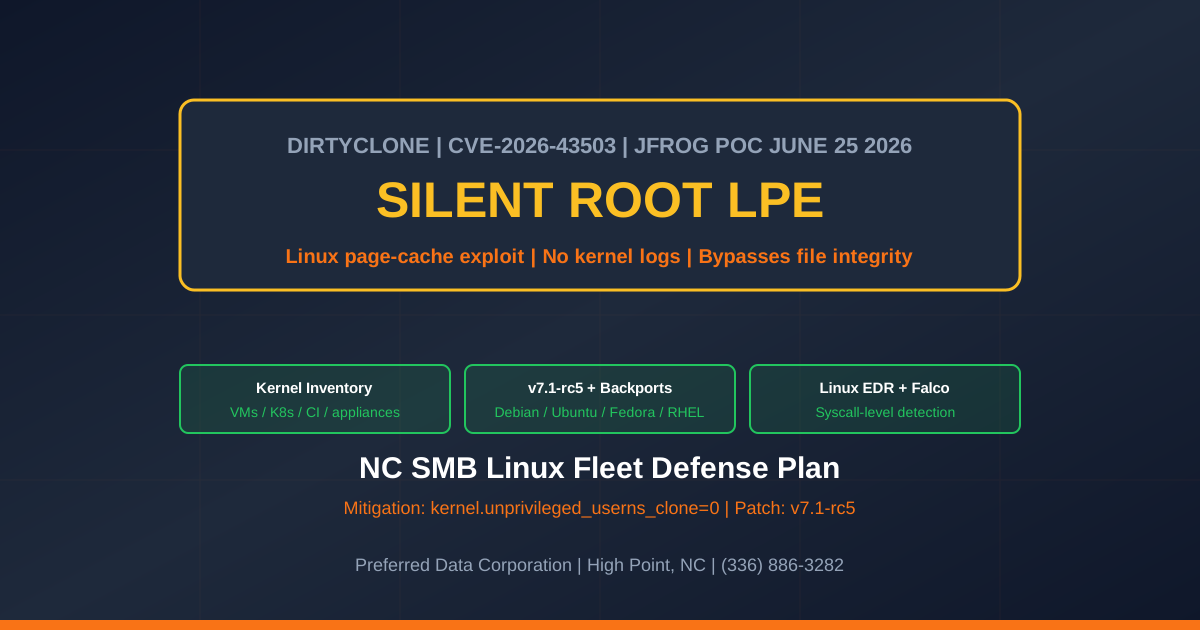
TL;DR: On June 25, 2026, JFrog Security Research published a working privilege-escalation exploit for CVE-2026-43503 ("DirtyClone"), a CVSS 8.8 Linux kernel local privilege escalation flaw that lets any unprivileged local user gain root by manipulating the page cache, per The Hacker News. It is a DirtyFrag variant - the safety flag that the original DirtyFrag fix added (SKBFL_SHARED_FRAG) is dropped by __pskb_copy_fclone(), reopening the page-cache write surface. The attack is silent: it leaves no kernel logs, no audit traces, and bypasses common on-disk integrity monitoring, per JFrog Security Research. For NC SMBs running Linux servers, Kubernetes hosts, CI runners, or multi-tenant container hosts on Debian, Ubuntu, Fedora, or RHEL-family distros, patching is the only durable answer - and the fix lives in Linux v7.1-rc5.
Key takeaway: DirtyClone is a DirtyFrag re-run on the same memory primitive. The 2024 mitigation was good but partial; the 2026 exploit is silent root. If your NC SMB ships a single Linux server, you have a patch to schedule this week.
Need help patching Linux kernels across a server fleet without breaking apps? Preferred Data Corporation runs managed Linux services for NC SMBs since 1987. Call (336) 886-3282 or book a Linux fleet hardening review.
What is DirtyClone (CVE-2026-43503) and how does it work?
DirtyClone is a Linux kernel privilege-escalation flaw (CVSS 8.8) that allows any unprivileged local user to gain root by abusing how the kernel clones packet buffers, per Cybersecurity News. JFrog researchers dubbed it "DirtyClone" because it is a variant of the original DirtyFrag (CVE-2024-26581) bug - and the original fix introduced a safety flag (SKBFL_SHARED_FRAG) to block file-backed page-cache writes through socket buffers. CVE-2026-43503 drops that flag in __pskb_copy_fclone(), reopening the attack surface.
| DirtyClone characteristic | NC SMB implication |
|---|---|
| Local privilege escalation (root) | Any low-privilege foothold becomes admin |
| Page-cache write primitive | Modifies on-disk binary contents in cache without disk write |
| No kernel logs, no audit trail | Silent root; standard SIEM does not see it |
| Bypasses on-disk integrity monitoring | AIDE, Tripwire, OSSEC file integrity miss the write |
| Requires unprivileged user namespaces enabled | Default on Debian, Fedora; partial on Ubuntu 24.04+ |
| Affects Kubernetes hosts, CI runners, multi-tenant servers | Container escape paths and CI compromise vectors |
The exploit chain is documented in JFrog's research blog: memory-map /usr/bin/su to load it into the page cache, attach those page-cache pages directly into a UDP socket buffer using vmsplice and splice, configure a loopback IPsec tunnel, and use the __pskb_copy_fclone() path to write attacker-controlled bytes back into the page-cached binary. The next time the binary executes, it executes attacker code as root.
The fix landed in Linux mainline on May 21, 2026 (commit 48f6a5356a33) and the first fixed release tag is Linux v7.1-rc5 (May 24, 2026). Distribution backports started rolling out across Debian, Ubuntu, Fedora, and RHEL the week of June 23, 2026.
Quotable definition: A page-cache write exploit modifies the in-memory copy of a binary or shared library without writing to disk. The on-disk file is unchanged - so file integrity monitoring tools see "no modification" - but the running system executes attacker code as root.
Three facts an NC SMB's IT lead should write down today:
- The disclosure is silent root. Per Red Secure Tech, DirtyClone leaves no kernel log, no audit message, no on-disk artifact. The standard "we'd see it in logs" assumption is wrong for this class of LPE.
- Default Linux distros are exposed. Per The Hacker News, Debian and Fedora ship with unprivileged user namespaces enabled by default, Ubuntu 24.04+ partially mitigates via AppArmor namespace restrictions, and RHEL / CentOS Stream are affected in any configuration that allows user namespaces.
- CI runners and container hosts are the highest-value targets. GitLab Runners, GitHub Actions self-hosted runners, Jenkins workers, Kubernetes nodes, and multi-tenant container hosts let untrusted workloads run on shared kernels - which is the exact threat model DirtyClone defeats.
Why does DirtyClone matter to NC SMBs in 2026?
Because the modern NC SMB runs more Linux than its IT inventory shows. NC machine shops use Linux PLC gateways, NC MSPs run Linux RMM and monitoring servers, NC accounting firms host QuickBooks Desktop on a Windows server but run their CRM on Linux, NC manufacturers operate Linux Kubernetes for MES / data lake workloads, and almost every NC SMB uses Linux-based Cloudflare R2, AWS EC2, or DigitalOcean droplets without the in-house Linux skills to keep the kernel current.
The NC SMB victim profile maps cleanly:
- A High Point manufacturer with a CI/CD runner that builds firmware for OEM customers. A poisoned dependency in a PR triggers a build that runs DirtyClone on the runner host - the build infrastructure is compromised silently, and every artifact built afterwards is suspect.
- A Greensboro MSP running a Linux RMM server (Tactical RMM, Ninja, or similar) hosted on a $10/month VPS. A single web-app exploit on the RMM gives a low-privilege foothold; DirtyClone turns it into root on the server that controls every client endpoint the MSP manages.
- A Piedmont Triad SaaS startup running Kubernetes on AWS EKS or a self-hosted control plane. A tenant escape from a single pod via DirtyClone gives root on the worker node, which means every tenant's secrets and data are reachable.
- A Charlotte NC SMB using a shared web-hosting provider running multi-tenant Linux (cPanel, Plesk, or rolled-your-own). The provider's default config almost certainly allows user namespaces and is exposed - and the SMB has no visibility into the patch SLA.
Per Cryptika Cybersecurity, this class of LPE is the standard "second stage" of cloud breaches: an initial web-app foothold gives a low-privilege shell, the LPE gives root, and root gives the credential cache, the secrets, and the lateral movement options.
Key takeaway: Patching the kernel is not just for Linux teams. Every NC SMB owns Linux somewhere - on a hosted RMM, a Kubernetes cluster, a CI runner, a Cloudflare Worker that calls back to a Linux origin, or a SaaS vendor whose patch SLA you do not control. The exposure is not optional.
How does an NC SMB patch and harden against DirtyClone in 14 days?
Run a five-control sequence inside two weeks. The sequence is sized for an SMB with a small IT or DevOps team, not a Fortune 500 platform group.
- Inventory every Linux kernel in scope (Day 0-2). Cloud VMs, on-prem servers, Kubernetes nodes, CI runners, RMM hosts, edge gateways, Linux-based NAS / NVR appliances. Include vendor appliances - many Synology, QNAP, TrueNAS, pfSense, and OPNsense devices run a Linux kernel.
- Update kernel to v7.1-rc5 or the backported distro fix (Day 2-7). Per Penligent, the fix is in mainline and backports are rolling. Subscribe to Debian Security Announcements, Ubuntu USN, Fedora FEDORA-2026-XXXX, and RHSA feeds. For long-life distros, expect the patch to land within 7-14 days of disclosure.
- Restrict unprivileged user namespaces on Debian / Ubuntu (Day 2-3). Per JFrog's mitigation guidance, set
kernel.unprivileged_userns_clone=0via/etc/sysctl.d/. Test container workloads first - rootless Podman, Docker, and Kubernetes user namespaces use this surface. - Apply AppArmor or SELinux confinement on multi-tenant hosts (Day 4-10). Ubuntu 24.04's AppArmor namespace restriction is a partial mitigation; SELinux with strict policy is stronger. Tune for the workload.
- Stand up Linux EDR or runtime-security tooling (Day 7-14). Behavior-based Linux EDR (Microsoft Defender for Endpoint on Linux, CrowdStrike Falcon, SentinelOne, Wazuh + Falco, or Sysdig Secure) catches the syscall pattern (
vmsplice+splicefrom an unprivileged user) that DirtyClone uses - even when on-disk file-integrity monitoring does not.
| Day-7 control | Target outcome | Why it matters for NC SMBs |
|---|---|---|
| Kernel inventory complete | Every Linux kernel ID + version known | The patch you forget is the patch the attacker uses |
| Distro kernel update applied | 100% of in-scope hosts | DirtyClone is silently rootable until patched |
unprivileged_userns_clone=0 on Debian / Ubuntu | Mitigation in place pre-patch | Buys time before the backport lands |
| AppArmor / SELinux strict on multi-tenant | Confinement on shared kernels | Reduces CI / container blast radius |
| Linux EDR or Falco runtime detection | Active syscall monitoring | Silent root becomes a detectable event |
Key takeaway: The patch is the answer, but the inventory is the work. The NC SMBs that get hit are the ones who forgot they had a Linux VM running a 2022-era kernel on a 2020-era Cloudflare-fronted side project.
How does Preferred Data Corporation help NC SMBs defend against DirtyClone?
PDC has run managed IT, managed cybersecurity, and cloud solutions for NC SMBs since 1987. For the June 25, 2026 DirtyClone disclosure, PDC brings three things:
- Linux fleet inventory and patch SLA: PDC inventories every Linux kernel in scope - cloud, on-prem, container, CI runner, vendor appliance - and runs a 7-day patch SLA on critical kernel CVEs with rollback safety.
- Hardening on multi-tenant hosts:
unprivileged_userns_cloneconfiguration, AppArmor / SELinux tuning for Kubernetes nodes, CI runner isolation patterns, and runtime-security tooling (Falco, Wazuh) deployment. - Managed EDR for Linux: Microsoft Defender for Endpoint on Linux + 24/7 SOC monitoring with the syscall-pattern rules tuned for LPE detection. A silent root attempt becomes a Tier-2 alert in minutes, not a six-month dwell.
For NC manufacturers running Linux MES / data-lake clusters, NC MSPs running Linux RMM, NC startups on Kubernetes, NC professional-services firms on shared Linux hosting, and NC accounting firms whose Cloudflare R2 buckets sit behind a Linux origin - this is the patching cadence that matches the disclosure cadence.
Need help patching Linux at scale without breaking apps? Call (336) 886-3282 or book a Linux fleet review.
Frequently Asked Questions
What is DirtyClone?
DirtyClone is the JFrog-assigned name for CVE-2026-43503, a Linux kernel local privilege escalation flaw (CVSS 8.8) that lets any unprivileged user gain root by manipulating the kernel page cache. Per JFrog Security Research, it is a DirtyFrag variant that bypasses the original mitigation by dropping the SKBFL_SHARED_FRAG safety flag during packet cloning.
Which Linux distros are affected?
Per The Hacker News, Debian and Fedora are vulnerable by default (unprivileged user namespaces enabled). Ubuntu 24.04+ is partially mitigated via AppArmor namespace restrictions but still listed as affected. Kubernetes clusters, multi-tenant clouds, and containerized workloads with enabled user namespaces face the highest risk.
When is the patch available?
The fix was merged into Linux mainline on May 21, 2026 (commit 48f6a5356a33) and the first fixed release tag is Linux v7.1-rc5 (May 24, 2026). Distribution backports for Debian, Ubuntu, Fedora, and RHEL began rolling the week of June 23, 2026. Track your distro's security advisory feed for the exact CVE-2026-43503 backport release.
What's the quickest mitigation while waiting for the distro patch?
Set kernel.unprivileged_userns_clone=0 via /etc/sysctl.d/99-dirtyclone.conf on Debian / Ubuntu, then sysctl -p. Test container workloads first - rootless Podman, Docker Desktop, and Kubernetes user namespaces depend on this surface. For Fedora and RHEL, restrict user namespaces via user.max_user_namespaces=0 (test workload impact). Then apply the distro kernel patch as soon as it ships.
How would I detect DirtyClone in progress?
Per Cybersecurity News, the exploit leaves no kernel logs and bypasses on-disk file integrity monitoring. Behavior-based Linux EDR or runtime-security tools (Falco, Sysdig Secure, Wazuh) can detect the syscall sequence: vmsplice + splice from an unprivileged user combined with an IPsec loopback configuration. Standard SIEM rules will not catch it; syscall-level monitoring will.
Are NC SMBs really running Linux at scale?
Yes - usually without realizing it. The typical NC SMB's Linux footprint includes one or more cloud VMs (AWS / DigitalOcean / Linode), a Kubernetes cluster if they ship software, GitHub Actions or GitLab Runners for CI, RMM / monitoring servers, vendor appliances (Synology, pfSense, TrueNAS), and SaaS vendors whose patch SLA they inherit. DirtyClone is in scope for almost every NC SMB once that inventory is honest.
How does this relate to container security?
A container shares the kernel of its host. A DirtyClone exploit running inside an unprivileged container - or a Kubernetes pod with runAsNonRoot: true - still escalates to root on the host kernel, because the kernel is the same kernel. That is the definition of a container escape via kernel LPE.
Related Resources
- Managed Cybersecurity for NC Businesses - Linux EDR + 24/7 SOC
- Managed IT for NC Businesses - Linux patch SLA and fleet management
- Cloud Solutions for NC Businesses - Hardened Linux cloud workloads
- PTC Windchill CVE-2026-12569 KEV Defense - Companion June 2026 KEV disclosure
- Microsoft June 2026 Patch Tuesday Record 200 CVEs - Companion June 2026 patch event
- Linux Kernel CVE-2022-0492 cgroup KEV Defense - Prior LPE coverage
- Contact Preferred Data Corporation - Managed Linux services for NC SMBs