
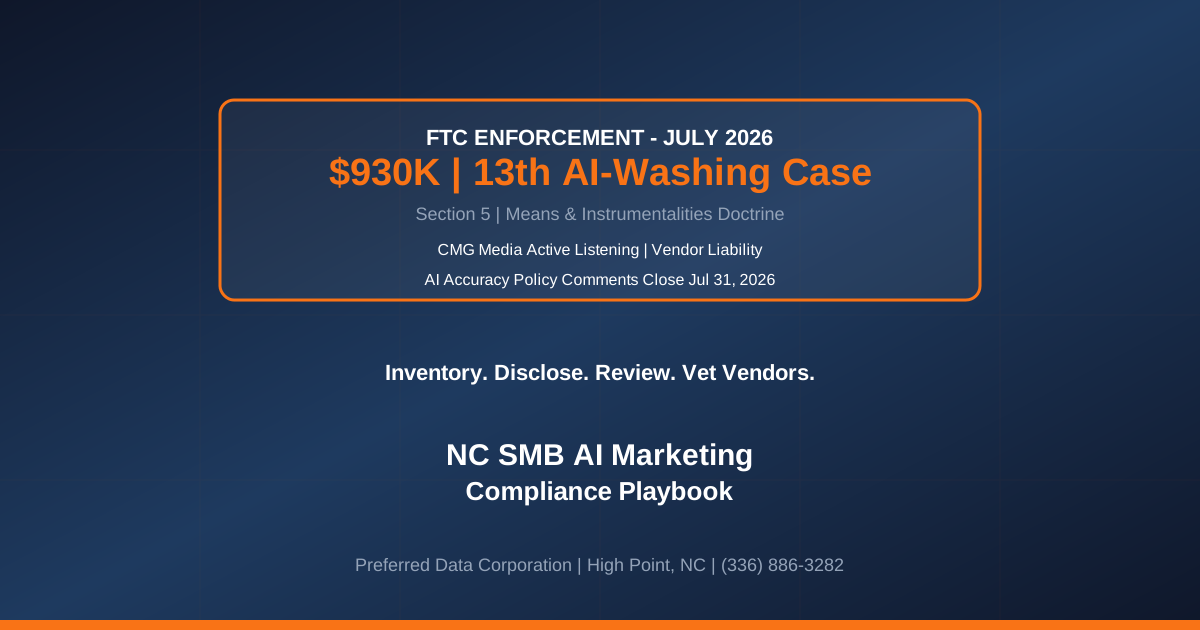
TL;DR: The May 2026 Cox Media Group (CMG) "Active Listening" settlement has three companies paying a combined $930,000 over FTC allegations that they falsely claimed an AI service could target ads by listening to conversations on smart devices (the FTC alleged the service instead resold email lists at a markup). On July 1, 2026, the FTC published a proposed policy statement expanding Section 5 enforcement to cover AI-output steering, with public comment open until July 31, 2026. For North Carolina small businesses that buy AI-powered marketing services, sell AI-powered software or services to other SMBs, or use AI to generate customer-facing content, this is the moment to build a Section 5-defensible compliance posture.
Key takeaway: AI-washing is no longer a reputational risk; it is a live FTC enforcement priority with vendor liability doctrine attached. The Section 5 "means and instrumentalities" theory the FTC used against the CMG vendors applies to any NC SMB providing AI-related marketing tooling or content to another business.
Need help building an AI-compliance posture for your NC business? Contact Preferred Data Corporation — BBB A+ rated, 39+ years of NC IT expertise, on-site within 200 miles of High Point. Call (336) 886-3282.
What Actually Happened in the CMG Media Case?
Cox Media Group (CMG), MindSift LLC, and 1010 Digital Works LLC settled FTC charges over deceptive marketing of an "Active Listening" AI-powered ad-targeting service. The pattern is precisely the one an NC SMB marketing agency or SaaS reseller could stumble into.
- The claim: Ads could be targeted to consumers based on conversations captured through smart devices, powered by a proprietary AI algorithm.
- What the FTC alleged: No listening. No voice data. The "service" resold email lists obtained from other data brokers at a markup.
- The payments: $880,000 (CMG) + $25,000 (MindSift) + $25,000 (1010 Digital Works) = $930,000 total, all directed to consumer redress for affected CMG customers.
- The doctrine expansion: MindSift and 1010 Digital Works — the smaller vendors — were charged with the "means and instrumentalities" theory: providing marketing materials, sales pitches, and customer-response scripts that CMG used to deceive downstream customers.
The case matters for NC SMBs not because it is unusually large (it is not) but because it formalizes vendor liability for AI-marketing claims.
What Did the July 1, 2026 FTC Policy Statement Add?
The Federal Register published a proposed FTC policy statement titled Suppression of Accuracy in Artificial Intelligence Systems on July 7, 2026. The policy operates under Section 5 of the FTC Act.
- Scope: AI systems whose outputs are steered toward "undisclosed ideological objectives" rather than what consumers request or reasonably expect.
- Theory: Steering AI outputs without disclosure is a deceptive act or practice under Section 5.
- Public comment window: Open until July 31, 2026.
- Enforcement posture: The FTC signaled it would use existing Section 5 authority — not wait for new legislation — to pursue AI-accuracy cases.
Combined with the CMG case, the policy statement puts NC SMBs on notice: if you sell, resell, or embed AI in a product marketed to another business, you are inside the FTC's active enforcement lens.
Key takeaway: The FTC's approach is now clear: it does not need Congress to pass an "AI Act" to hold companies accountable. Section 5 (deception, unfairness) covers AI-washing today, and vendor-liability doctrine reaches upstream to the tooling providers.
Which NC Small Businesses Are Most Exposed?
Five NC SMB profiles are most likely to trigger scrutiny — or to be pulled into scrutiny of a larger customer.
| SMB Profile | Exposure Type | Concrete Example |
|---|---|---|
| Marketing agencies serving NC SMBs | Direct: claims about AI in campaigns | "Our AI writes personalized outreach for you" — must be true and disclosed |
| SaaS vendors selling to NC SMBs | Direct + means-and-instrumentalities | Sales scripts and marketing materials must be defensible when resellers use them |
| MSPs bundling AI-powered security tools | Direct + vendor liability | Claims about "AI detects zero-days" must match actual product capability |
| NC manufacturers using AI in customer-facing tools | Direct: product descriptions on the website | Product spec sheets that say "AI-powered" must reflect actual behavior |
| E-commerce brands using generative AI for product content | Direct: FTC endorsement + advertising guides | AI-generated product photos/descriptions that misrepresent the product are actionable |
For NC contractors, distributors, and specialty retailers layering ChatGPT/Claude into customer emails or website copy, the risk is not that AI is used — it is that AI is misrepresented (or that the output is materially wrong and the SMB has no review process).
What Is the NC SMB AI Compliance Playbook?
A defensible posture pairs an AI inventory with disclosure discipline, output review, and vendor-management diligence.
Layer 1: AI Inventory (Week 1).
- List every AI tool in use — ChatGPT, Claude, Copilot, Gemini, Perplexity, Jasper, Midjourney, embedded features in Salesforce/HubSpot, industry-specific AI, and shadow-AI browser extensions.
- Classify by risk tier: customer-facing content (highest), internal decision support (medium), personal productivity (lowest).
- Assign an accountable owner per tool.
- Document data flows — what enters the model, what leaves.
Layer 2: Marketing-Claim Review (Week 2).
- Audit the website, sales collateral, and product pages for AI claims.
- For each claim, document (a) the underlying capability, (b) the model or vendor providing it, (c) the evidence for the claim.
- Remove or rephrase any claim that cannot be substantiated inside 4 hours of FTC inquiry.
- Add disclosure language where AI is used to generate or influence customer-facing content.
Layer 3: Output Review Process (Week 3).
- Establish human review checkpoints for AI-generated customer-facing content.
- Define "material accuracy" standards for the specific business context.
- Document the review process — the paper trail is the compliance defense.
Layer 4: Vendor Due Diligence (Week 4).
- For every AI-powered vendor, obtain and file: model documentation, accuracy claims, disclosure guidelines, indemnification language.
- Any vendor providing marketing materials, sales scripts, or customer-response templates is a "means and instrumentalities" risk — request review rights.
- Update your master services agreements with AI-specific representations and warranties.
Layer 5: Board and Executive Reporting (Ongoing).
- Standing quarterly AI-compliance report to the board or ownership.
- Log incidents (hallucinations that reached customers, deceptive claims caught in review, vendor-provided materials that failed accuracy review).
- Refresh the AI inventory annually or after any major tool addition.
Explore Preferred Data's AI transformation services
How Does This Intersect With NIST AI RMF and State Laws?
The FTC pathway is one of several converging regulatory pressures on NC SMBs using AI. The FTC action does not preempt state law — it adds to it.
- NIST AI Risk Management Framework (AI RMF 1.0). Voluntary, but referenced in FTC consent orders and cyber-insurance questionnaires. NC SMBs adopting NIST AI RMF governance signal to underwriters and enterprise customers that they are Section 5-defensible.
- Colorado SB 24-205 (effective June 30, 2026). Requires impact assessments and consumer notices for "high-risk" AI in employment, financial services, and insurance. Applies to NC SMBs doing business in Colorado.
- Illinois HB 3773. Restrictions on AI in employment decisions.
- EU AI Act (effective August 2, 2026 for general-purpose AI provisions). Applies to NC SMBs with any EU customer touchpoints.
- Texas TRAIGA, Utah AI-related bills. Additional state-level obligations that overlap with FTC Section 5.
Key takeaway: Building a NIST AI RMF-aligned governance program — inventory, risk assessment, disclosure, human oversight, incident logging — satisfies most FTC, state-law, and insurance-questionnaire requirements simultaneously. It is not five different compliance projects; it is one.
What Are the Practical Deadlines Right Now?
Three near-term milestones frame the July 2026 urgency.
| Date | Milestone | Action |
|---|---|---|
| July 31, 2026 | FTC public comment closes on AI Accuracy Policy | File a comment through counsel if your business model depends on AI-output steering |
| August 2, 2026 | EU AI Act general-purpose AI provisions take effect | NC SMBs with EU customers should complete GPAI-scope review |
| September 30, 2026 (typical) | Cyber-insurance renewal window opens for many NC SMBs | AI governance evidence is now standard on renewal questionnaires |
Explore Preferred Data's managed IT services
How Does Preferred Data Support NC SMB AI Compliance?
Preferred Data Corporation delivers AI transformation, managed IT, cybersecurity, and governance services for NC manufacturers, contractors, agencies, and specialty SMBs. With 39+ years of NC IT expertise, an average client retention of 20+ years, and deep familiarity with NIST AI RMF, we build compliance posture as a byproduct of a well-run AI transformation — not as a separate project.
- AI inventory and risk classification. Shadow-AI discovery, tool-by-tool risk tiering, accountable-owner assignment.
- Marketing-claim audit. Website, sales collateral, and product-page review with an evidence-backed rewrite of every AI claim.
- Output review workflow design. Human-in-the-loop checkpoints, documentation templates, incident logging.
- Vendor due diligence. Master-services-agreement templates with AI-specific representations, indemnification language, and audit rights.
- NIST AI RMF-aligned governance program. Board reporting, quarterly refresh, and insurance-renewal-ready documentation.
Ready to build an FTC-defensible AI compliance posture? Call (336) 886-3282 or contact our team.
Frequently Asked Questions
Is my NC small business too small for the FTC to care?
Two of the three companies in the CMG case were small marketing vendors. The FTC's "means and instrumentalities" doctrine specifically pulls smaller vendors into liability when they provide the marketing tooling that a larger company uses to deceive customers. Size is not the shield it used to be.
We do not sell an "AI product" — do we still need to comply?
Yes, if you make AI-related claims in your marketing (website, sales collateral, product descriptions), if you use AI to generate customer-facing content, or if you provide marketing materials to reseller partners. The exposure is about the claim, not the product.
What does "means and instrumentalities" mean in the CMG case?
The FTC alleged that MindSift and 1010 Digital Works provided CMG with the marketing materials, sales pitches, and response scripts that CMG then used to deceive its customers. Because these materials were the alleged mechanism of deception, the FTC charged the vendors under that theory in a separate count.
How does this affect our cyber-insurance renewal?
AI-related insurance provisions are increasingly separate from general cyber. Underwriters are asking about AI inventory, disclosure practices, output-review processes, and vendor due diligence. A documented NIST AI RMF-aligned program is the current standard for a defensible answer.
Can we self-certify our AI compliance or do we need outside review?
For most NC SMBs, an internal-plus-external approach works: internal AI inventory and owner assignments; external review of marketing claims, vendor-diligence templates, and NIST AI RMF alignment. The FTC's own materials are useful as source-of-truth references (ftc.gov/ai).
How long does a full compliance program take to stand up?
Typical NC SMB (25-150 employees) with 5-15 AI tools in use: 30-45 days for the full four-layer program, 90 days including vendor-due-diligence remediation. Call (336) 886-3282.
Related Resources
- AI Transformation Services for NC SMBs
- Managed IT Services for NC Manufacturers and SMBs
- Cybersecurity Services for NC Small Businesses
- AI Productivity Paradox: 82% Adopt, 29% See ROI — NC SMB Fix
- AI Compliance Safe Harbor: NIST AI RMF, TRAIGA, Colorado Delay Playbook
- Langflow CVE-2026-55255: NC SMB Shadow AI Credential Defense