
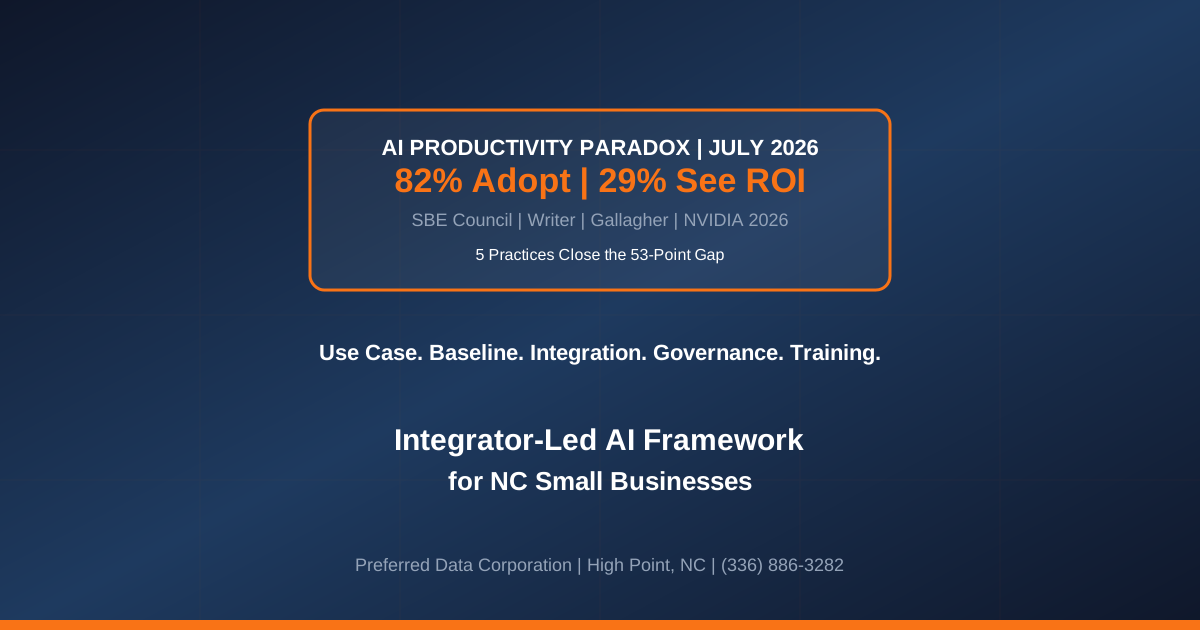
TL;DR: The 2026 SBE Council Small Business Tech Use Survey reports 82% of small business employers have invested in AI tools. Writer's 2026 Enterprise AI Adoption research reports that only 29% of enterprises see significant ROI from generative AI. NVIDIA's 2026 State of AI report puts the individual productivity gain at up to 5x — but the business-level value capture is dramatically lower. This is the AI productivity paradox, and it hits NC SMBs harder than large enterprises because they lack the integration, governance, and change-management scaffolding to translate individual gains into business-level results. This is the NC integrator-led framework — five specific practices — that closes the gap without ballooning the AI budget.
Key takeaway: Buying AI tools is not the same as capturing AI value. The 53-point gap between adoption (82%) and significant ROI (29%) is a gap of implementation discipline, not tool quality. Integrator-led adoption — where AI capabilities are integrated into workflows, measured against baseline, and governed against hallucination and privacy risk — closes the gap.
Need a same-quarter AI ROI assessment for your NC SMB? Contact Preferred Data Corporation for an AI use-case audit and integrator-led rollout plan. BBB A+ rated. 37+ years of NC IT and manufacturing expertise. On-site within 200 miles of High Point. Call (336) 886-3282.
Why Have 82% of NC SMBs Adopted AI but Only 29% Capture Meaningful ROI?
The gap between adoption and ROI is not accidental. It reflects a specific set of missing practices that separate the businesses capturing value from the ones paying subscription fees for underused tools. Three converging data sets frame the paradox:
- SBE Council 2026 Small Business Tech Use Survey. 82% of small business employers have invested in AI tools; typical SMB uses a median of five tools; 66% report revenue increases linked to AI; owners save a median of five hours per week and businesses save 11.5 employee hours per week.
- Writer 2026 Enterprise AI Adoption research. Only 29% of enterprises see significant ROI from generative AI, despite 79% actively investing.
- Gallagher 2026 AI Adoption and Risk Benchmarking. 57% cite AI errors, misinformation, and hallucinations as top risk; 56% cite legal and reputational risk from AI misuse; 55% cite data protection and privacy violations; over 50% cite skills gaps.
The consistent pattern is that individual productivity gains (5x, per NVIDIA) do not aggregate to business-level ROI without deliberate integration. When one employee saves an hour a day with an AI assistant but the freed hour is absorbed by other work, the P&L never sees the productivity.
Key takeaway: The 82%-vs-29% gap is not about tool selection — it is about what happens between the individual productivity gain and the business-level impact. Closing it requires practices most SMBs cannot self-diagnose because they do not know what "good" looks like.
What Are the Five Practices That Separate 29% ROI SMBs From the Rest?
Five practices, drawn from Writer, NVIDIA, PwC, and OECD 2026 research plus NC-specific implementation experience, consistently show up in the SMBs that translate AI adoption into meaningful ROI.
Practice 1 — Use-case selection anchored to workflow bottlenecks:
- What it is. AI is applied to the top 3-5 documented bottlenecks in your business — quote turnaround, invoice processing, customer support triage, sales prospecting, technical documentation. Not to whatever demo looked impressive.
- Why it works. Bottleneck-focused AI unblocks a queue that was consuming labor. Freed hours convert to throughput, not slack.
- What NC SMBs get wrong. Deploying general-purpose AI assistants (ChatGPT, Copilot) without workflow anchoring. Individual productivity rises; business throughput does not.
Practice 2 — Baseline measurement before deployment:
- What it is. You measure current cycle time, error rate, cost per transaction, or customer satisfaction for the target workflow before you deploy AI. Post-deployment measurement compares against baseline.
- Why it works. Without a baseline, the ROI conversation is anecdotal. Executives dismiss anecdote. CFOs fund measured impact.
- What NC SMBs get wrong. Skipping the pre-measurement step because it feels bureaucratic. Six months later, no one can prove the AI investment paid back.
Practice 3 — Integration into the system of record, not alongside it:
- What it is. AI capability is integrated into the ERP, CRM, or line-of-business system employees already use. Not a separate app they toggle to.
- Why it works. Context matters. AI applied to a purchase order inside the ERP has full order context and can auto-populate fields. AI applied outside the ERP requires copy-paste, which erodes the productivity gain.
- What NC SMBs get wrong. Buying AI as a separate subscription without integration budget. Adoption plateaus at 20-40% of eligible users.
Practice 4 — Governance framework against hallucination and privacy risk:
- What it is. A written policy — aligned to NIST AI RMF 1.0 — that defines which data can and cannot enter which AI tool, how outputs are reviewed before customer-facing use, and what audit trail is retained.
- Why it works. Governance prevents the reputational or legal event that stops an AI program in its tracks. Without it, one bad output can shut down a promising rollout.
- What NC SMBs get wrong. Assuming SaaS vendor privacy terms are sufficient. They rarely address the specific data your business handles or the specific compliance regime you operate under.
Practice 5 — Change management with role-specific training:
- What it is. Each role that uses AI receives training tailored to their workflow, plus quarterly refresher and a peer-learning cadence. Not a one-time all-hands demo.
- Why it works. OECD 2026 SMB data shows over 50% cite skills gaps as adoption obstacles. Training resolves the gap directly.
- What NC SMBs get wrong. Assuming employees will self-teach because "the tools are intuitive." Adoption stalls when the tool does not match how the employee actually works.
| Practice | ROI Impact | Time to Deploy | Prerequisite |
|---|---|---|---|
| Workflow-bottleneck use-case selection | High | 2-4 weeks | Executive workshop |
| Baseline measurement | Medium (unlocks proof) | 2 weeks | Data availability |
| Integration into system of record | High | 1-2 quarters | ERP / CRM access |
| Governance framework | Foundational | 1 quarter | Written policy |
| Role-specific change management | High | Ongoing | Training investment |
| Combined execution | Compound | 2 quarters | Integrator partnership |
Why Do NC Manufacturers Especially Need Integrator-Led AI Adoption?
NC manufacturers face structural obstacles that make self-serve AI adoption particularly unlikely to hit the 29% ROI bar. Three specific dynamics:
- Line-of-business systems are older and more customized. ERP systems built on Pervasive SQL / Actian Zen, MRP systems from the 1990s-2000s, and custom accounting/quoting tools do not have out-of-the-box AI integration. Manufacturers who buy general-purpose AI subscriptions cannot apply them to their most valuable workflows without integration engineering.
- Data quality is uneven. Plant-floor data, quality inspection results, and supplier communication live in a mix of ERP, paper, spreadsheets, and email. AI applied to inconsistent data produces inconsistent output.
- Compliance requirements are non-trivial. Manufacturers with ITAR, CMMC, HIPAA-adjacent, or automotive-supplier compliance obligations cannot deploy AI without governance that satisfies audit.
The right response is an integrator — a partner that connects general-purpose AI capabilities to your specific ERP, MRP, and workflow systems, sets up the governance policy, delivers the training, and measures the ROI. This is Techaisle's documented "AI Integrator Shift" pattern of 2026: the value moves from tool sale to integration outcome.
Explore Preferred Data's AI transformation services
What Does an NC SMB AI ROI Assessment Look Like?
A concrete two-week engagement that identifies where AI can deliver measurable ROI and where it will not.
Week 1 — Workflow discovery and baseline:
- Executive workshop. Identify top 5-10 workflow bottlenecks by revenue or cost impact.
- Data quality audit. Confirm data availability, consistency, and access for the top-5 bottlenecks.
- Current-state measurement. Measure cycle time, error rate, cost per transaction for the top-3-priority workflows.
- Governance gap analysis. Review current AI policy against NIST AI RMF 1.0. Identify gaps.
Week 2 — Use case selection and roadmap:
- Use case scoring. Score each candidate workflow against ROI potential, integration complexity, data quality, and governance risk.
- Prioritized roadmap. Two-to-three use cases for the first 90-day sprint.
- Investment estimate. All-in cost including licensing, integration, training, and governance.
- Success criteria. Specific measurable outcomes for each use case.
Output is a written AI ROI plan the CFO can fund and the operations team can execute. For NC SMBs, typical engagement recovers full assessment cost from the first successful use case within one quarter.
Learn about Preferred Data's managed IT services
How Should NC SMBs Think About AI Governance?
Governance is not the barrier to AI adoption — it is the foundation. NIST AI RMF 1.0 provides an SMB-scaled framework that satisfies audit, satisfies cyber insurance, and provides Texas TRAIGA affirmative-defense coverage for NC SMBs doing multi-state business.
Six governance elements NC SMBs need in writing:
- Data classification. Which data classes can enter which AI tools. Public / internal / confidential / regulated.
- Approved vendors. Which AI tools are approved. Everyone else is shadow AI and prohibited without exception request.
- Human-in-the-loop rules. Which AI outputs require human review before customer-facing use.
- Audit trail. How AI-generated content is logged and retained for review.
- Incident response. What happens when AI produces a wrong output that reaches a customer.
- Vendor risk. How you assess and monitor AI vendors' security, privacy, and reliability.
A one-page policy covering these six elements is sufficient for most NC SMBs and can be written in a single work session with an experienced integrator.
How Does Preferred Data Deliver AI Productivity ROI for NC SMBs?
Preferred Data Corporation delivers AI use-case assessment, integrator-led rollout, NIST AI RMF-aligned governance policy authoring, ERP and CRM integration engineering, role-specific training design, and 24/7 managed IT support for NC manufacturers, construction firms, healthcare providers, professional-services offices, and financial institutions. With 37+ years of North Carolina IT and manufacturing expertise, an average client retention of 20+ years, and PDC Software Suite integration capability, our AI transformation practice closes the 82%-vs-29% gap through implementation discipline, not tool churn.
Our AI ROI engagement includes the two-week assessment, first-quarter use-case rollout, governance policy authoring, employee training curriculum, and quarterly ROI review with your executive team.
For businesses within 200 miles of High Point, we deliver on-site engagement including plant-floor process observation, ERP integration work, and executive briefings.
Review our AI transformation services
Frequently Asked Questions
Why do 82% of SMBs adopt AI but only 29% see meaningful ROI?
Because adoption is buying a subscription; ROI is capturing business-level impact. The gap comes from missing practices: use-case selection anchored to bottlenecks, baseline measurement, integration into the system of record, governance framework, and role-specific change management.
What is the typical AI investment for a 50-person NC manufacturer?
For year 1, $50K-$150K all-in including licensing, integration engineering, governance, and training for 2-3 prioritized use cases. First-year ROI for well-executed programs runs 3-10x this investment.
Which use cases have the highest ROI for NC manufacturers specifically?
Quote turnaround, supplier communication triage, technical documentation drafting, invoice/PO processing, and shop-floor knowledge capture consistently score high. Actual priority depends on your bottlenecks — the workshop is how you find them.
Do I need to worry about AI hallucinations?
Yes, but the fix is human-in-the-loop review policy, not tool avoidance. Any AI output that reaches a customer or a regulatory filing requires human review. Internal-use outputs can operate with lighter review.
How do we handle employee concerns about AI replacing jobs?
Directly and honestly. NVIDIA and PwC 2026 data shows AI redistributes work more than it eliminates jobs at the SMB scale. Communicate the workflow changes, invest in training, and be explicit about which roles change and how.
What is Texas TRAIGA and does it matter for NC SMBs?
Texas Responsible AI Governance Act (effective 2026) imposes civil penalties for high-risk AI use without governance. NIST AI RMF alignment provides affirmative defense. If your NC SMB serves Texas customers, TRAIGA compliance matters. Colorado's ADMT framework is now delayed to January 1, 2027.
Can Preferred Data run the AI ROI assessment for us this month?
Yes. Our two-week assessment fits into your existing operations without disrupting the team, and delivers a fundable roadmap. Call (336) 886-3282 to schedule.
How does PDC Software Suite integration play into AI transformation?
For NC SMBs already using PDC's custom software, AI capabilities integrate directly into existing workflows — quote generation, order processing, quality management, service dispatch. This eliminates the "AI alongside vs AI inside" gap that stalls SMB adoption.