
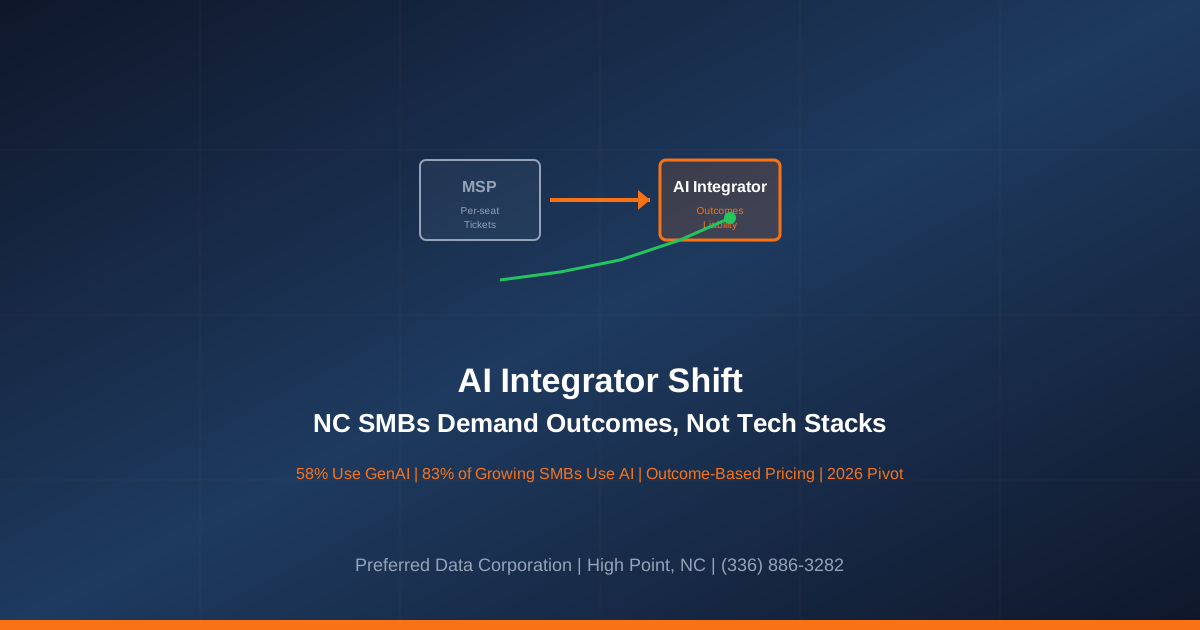
TL;DR: Techaisle's 2026 SMB and midmarket predictions, built on a study of 4,500 channel partners, describes a structural shift in how small businesses buy IT: from paying for "Managed Service Providers" (MSPs) that deliver labor-plus-licenses to engaging "AI Integrators" (AIIs) that deliver specific business outcomes and assume liability for the result. The thesis is reinforced by the U.S. Chamber of Commerce's "Empowering Small Business" report, which found 58% of small businesses now use generative AI (up from 40% in 2024), and 83% of growing SMBs use AI compared to 55% of declining SMBs. For NC manufacturers, construction GCs, and professional services firms, the question this summer is no longer "should we adopt AI?" but "is our IT partner positioned to integrate AI into our workflows, or are they still selling us seats and tickets?"
Key takeaway: SMBs are moving fast from "buy software, hire people, run it" to "buy outcomes." The winning IT partner in 2026 is the one that integrates AI into the customer's actual workflows, owns the result, and ties pricing to business KPIs, not user counts.
Want help mapping a 90-day AI integration roadmap that ties to revenue, margin, or cost? Preferred Data Corporation works with NC manufacturers and SMBs on outcome-based AI integration plans. Call (336) 886-3282 or request an AI integration roadmap workshop.
What is the "AI Integrator" (AII) and how is it different from an MSP?
Answer capsule: Per Techaisle's 2026 predictions, an "AI Integrator" (AII) is a channel partner that delivers measurable business outcomes (revenue lift, margin improvement, cost reduction, throughput) rather than a technology stack. AIIs sell outcomes and liability protection rather than software subscriptions, and their pricing increasingly ties to business KPIs. A traditional MSP sells labor-plus-licenses: a per-user managed-IT seat, a per-endpoint cybersecurity license, a ticket-resolution SLA.
The difference in 2026 is structural, not cosmetic:
| Dimension | Traditional MSP | AI Integrator (AII) |
|---|---|---|
| Pricing | Per-user, per-endpoint, per-ticket | Per-outcome, per-process, KPI-linked |
| What's sold | Software + labor | Business result + liability |
| Win condition | Uptime, ticket SLA | Revenue lift, margin lift, throughput |
| Customer expectation | "Keep us running" | "Improve our P&L" |
| AI's role | Internal automation (Zero-Touch MSP) | Embedded in customer workflows |
| Partner team | Helpdesk + sysadmin | Process engineers + data + integrators |
Per Techaisle's "Beyond the Reseller" note, partners that succeed in 2026 become "context custodians" who own the customer's data, process knowledge, and integration substrate. That role is qualitatively different from "we manage your endpoints."
How fast is SMB AI adoption actually moving?
Answer capsule: Per the U.S. Chamber of Commerce's 2026 Empowering Small Business report, 58% of small businesses use generative AI in 2026, up from 40% in 2024. The growth-vs-decline correlation is stark: 83% of growing SMBs use AI compared to 55% of declining SMBs.
Three data points that shape the NC SMB strategic context:
- 88% of SMBs use or plan to use MSP services, per the Support Adventure 2026 MSP industry trends report. The IT services model is not going away; it is being redefined.
- 58% of small businesses use generative AI, more than double the 2023 baseline, per the U.S. Chamber's report.
- 83% of growing SMBs use AI vs 55% of declining SMBs - the largest reported gap between "winning" and "losing" SMBs in any technology category.
For an NC manufacturer in High Point, Charlotte, Raleigh, Winston-Salem, or Greensboro, the implication is that competitors who integrate AI into quoting, scheduling, quality control, supply chain forecasting, and customer service are pulling away on margin and growth. The lag-vs-lead gap will likely widen through 2026 and 2027.
Why are SMBs willing to pay for outcomes instead of seats?
Answer capsule: Per Techaisle's 2026-2028 efficiency mandate analysis, SMBs are squeezed on margin and labor, and the obvious lever (generative AI plus process redesign) is too risky to deploy without skin-in-the-game from the partner. Outcome-based pricing solves the trust problem: the partner only gets paid (or paid more) when the SMB sees the result.
Three forces driving the shift:
- Margin compression in core SMB sectors. NC manufacturers and construction GCs face tariff exposure, labor cost increases, and customer-side price pressure. Outcome-based IT pricing aligns IT spend to business performance.
- Labor shortage in skilled roles. Quoting, scheduling, quality assurance, customer service, and accounting are roles where SMBs cannot hire fast enough. AI integration is one of the few credible ways to grow throughput without growing headcount.
- Distrust of "rip-and-replace" vendor pitches. SMBs have absorbed multiple years of "this AI will transform your business" pitches that did not deliver. Outcome-based pricing forces the vendor to prove value before extracting it.
The shift is asymmetric for partners. MSPs that compete on price-per-seat will face commoditization. AIIs that own a measurable customer KPI and have the operational capacity to move the number will command premium pricing.
What does outcome-based IT actually look like for an NC manufacturer?
Answer capsule: For an NC manufacturer in the Piedmont Triad or Charlotte metro, outcome-based IT looks like a partner who integrates AI into quoting, scheduling, quality, supply chain, and customer service, and prices the engagement against measurable outcomes such as quote turnaround time, on-time delivery rate, scrap rate, inventory turn, or customer-service first-contact resolution rate.
Five concrete outcome targets an NC manufacturer can pursue with an AI integrator this quarter:
- Quote turnaround time. From 3-5 business days to 4-8 business hours via AI-assisted quoting tied to BOM and historical pricing.
- On-time delivery rate. From 82-88% to 92-95% via AI-assisted production scheduling and demand forecasting.
- Scrap and rework rate. Reduction of 15-25% via AI-assisted vision inspection and SPC.
- Customer service first-contact resolution. From 45-55% to 70-80% via an AI assistant grounded in ERP, CRM, and ticket history.
- Inventory turn. Improvement of 10-20% via AI-assisted demand forecasting that integrates with the ERP.
Each of these is measurable, owned by an operational leader (production manager, supply chain manager, customer service manager), and amenable to a 60-90 day pilot. The AII model proposes "pay X for the pilot, Y per quarter once we hit the target, escalator Z if we exceed it."
For NC construction GCs, equivalents include estimate-to-bid conversion rate, schedule slippage at 25% completion, RFI turnaround time, and submittal cycle time. For NC professional services firms, equivalents include time-to-quote, proposal win rate, billable utilization, and AR days.
What should an NC SMB look for when selecting an AI integrator?
Answer capsule: An NC SMB selecting an AI integrator should screen for five capabilities: deep familiarity with the SMB's actual systems (ERP, CRM, line-of-business), data engineering capacity to build the integration substrate, security and governance posture appropriate for the customer's regulatory environment, willingness to tie pricing to measurable KPIs, and operational continuity to maintain the integration over years.
A six-item evaluation checklist:
- System fluency. Does the partner know your ERP, CRM, and core operational systems? Generic AI consultancies that have never integrated with QuickBooks, Sage, Epicor, Acumatica, Microsoft Dynamics, NetSuite, or a Pervasive SQL-backed shop-floor system will spend the first 6 months learning.
- Data engineering capacity. AI integration is 80% data plumbing and 20% model magic. Partners that lead with model names ("we use Claude!") rather than data integration capacity are signaling a gap.
- Security and governance posture. Especially for NC manufacturers in defense supply chain (CMMC Phase 1), professional services (state regulators, SEC Reg S-P for advisers), and healthcare (HIPAA). The AII model concentrates more data with the partner; the partner's security maturity must rise correspondingly.
- KPI-linked pricing willingness. A partner unwilling to write outcome targets into the contract is selling labor, not outcomes. Walk away.
- Local presence and continuity. Multi-year integrations succeed only when the partner is around in year three to maintain, extend, and re-baseline. For NC SMBs, regional partners with multi-decade operational continuity carry less continuity risk than venture-funded national consultancies.
- Liability posture. Per Techaisle, 2026 SMBs increasingly expect "liability protection" as part of the AII offering. What does the partner stand behind if the integration produces a bad outcome (incorrect AI quote, missed forecast, wrong scheduling decision)?
How does Preferred Data Corporation fit the AI Integrator (AII) model?
Answer capsule: Preferred Data Corporation has operated as an outcome-focused IT partner for NC manufacturers and SMBs since 1987. The combination of 37+ years of NC manufacturing and SMB context, in-house proprietary software (PDC Software Suite), ERP and OT/IT integration depth, and on-site coverage within 200 miles of High Point positions PDC to deliver the kind of outcome-tied integration the AII model describes.
PDC's positioning on the AII transition includes:
- Custom software and AI integration including the PDC Software Suite, custom workflow software for NC manufacturers, and AI-assisted process integrations tied to measurable outcomes.
- Managed IT services with the operational discipline (patch SLAs, monitoring, change control) that lets the AI integration substrate stay reliable in production.
- OT/IT integration with deep familiarity in NC manufacturing shop floors, where AI integration must reach down to PLCs, MES, SCADA, and quality systems.
- vCIO and strategic advisory that maps AI integration opportunities to actual P&L impact, then sequences pilots against the operational capacity of the customer.
PDC has served NC small and mid-size businesses for over 37 years from 1208 Eastchester Drive in High Point. The 20+ year average client tenure is the operational continuity that makes outcome-tied integration credible: a 90-day pilot that becomes a 5-year integration is the model, not a one-off engagement.
How does an NC SMB begin the transition this quarter?
Answer capsule: An NC SMB transitioning from MSP-only to AII engagement this quarter should run a three-step process: (1) identify the highest-leverage outcome target, (2) inventory the data and system readiness for that target, (3) select an AII partner with system fluency and KPI-linked pricing willingness, scoped to a 60-90 day measurable pilot.
A six-week starter plan:
- Week 1 - Outcome workshop. Cross-functional 3-4 hour session to identify 2-3 candidate outcomes (quote turnaround, on-time delivery, customer service FCR) with current baseline and target.
- Week 2 - System and data readiness. Inventory ERP, CRM, ticket, and operational data sources. Identify integration gaps and data quality issues.
- Week 3 - AII shortlist. Identify 2-3 candidate partners, including incumbent MSP if AII-capable. Issue an outcome-scoped RFP, not a technology RFP.
- Week 4 - Partner evaluation. Score against system fluency, data engineering capacity, security posture, KPI-linked pricing willingness, and local continuity.
- Week 5-6 - 60-90 day pilot contract. Define success metric, baseline, target, pilot pricing, and KPI-linked production pricing. Include a kill switch if pilot does not hit threshold.
- Week 7+ - Pilot execution. Weekly check-ins. Public commitment to measurement. End-of-pilot decision: scale, iterate, or kill.
NC SMBs that complete this loop once can repeat it across 3-5 outcome targets over the following 12-18 months, building a portfolio of AI integrations that materially shift the P&L.
Frequently Asked Questions
Is the MSP business model dying?
No, but it is bifurcating. Per Techaisle, traditional MSP services (patch, monitor, help desk, security operations) are increasingly delivered with AI-driven internal automation, compressing margins. The growth opportunity for partners is in AI integration tied to customer outcomes. SMBs will likely retain MSP relationships for foundational IT and add AII engagements for outcome targets, often with the same partner if the partner can grow into both roles.
What if our incumbent MSP is not ready to be an AI Integrator?
Run the AII evaluation anyway. If the incumbent is investing toward AII capability, give them an outcome-scoped pilot to prove it. If the incumbent is resistant ("AI is hype" / "we just do IT") or unwilling to tie pricing to outcomes, plan a parallel AII engagement with a partner that can. The transition does not require ripping out the foundational MSP relationship.
How risky is outcome-based pricing for a small business?
Lower than the alternative. Outcome-based pricing transfers part of the implementation risk from the SMB to the partner. The SMB pays a small pilot fee, then full production pricing only after the outcome target is met. The risk that remains with the SMB is opportunity cost (running a 90-day pilot that does not work) and data exposure (giving the partner deeper system access).
Will AI integration require us to rip-and-replace our ERP or CRM?
Usually not. The AI integration substrate is typically an integration layer that connects the existing ERP, CRM, and operational systems, augmented with AI inference for specific decisions. Most NC manufacturers on Sage, Epicor, Acumatica, or NetSuite (or older systems including Pervasive SQL / Actian Zen) can be integrated without replacing the system of record.
What about data governance and security for AI integrations?
Data governance becomes more important with AI integration, not less. The AII model concentrates customer data in the integration substrate, so the partner's security posture must be commensurate with the customer's regulatory environment. NC defense contractors in CMMC Phase 1, healthcare practices under HIPAA, and SEC-registered advisers under Reg S-P should treat the AII security posture as a primary selection criterion.
How long does an AI integration take to pay back?
Per the Techaisle 2026 SMB top 10 business issues note, well-scoped AI integrations on high-leverage outcomes (quoting, scheduling, customer service) commonly show measurable improvement within 90 days and full payback within 9-18 months. Poorly scoped integrations (vague outcome, weak data, executive disengagement) often show no payback and should be killed at the end of pilot.
Related Resources
- Custom Software and AI Integration - PDC Software Suite, custom workflow integration, AI-assisted processes
- Managed IT Services for NC Businesses - Foundational IT operations, patch SLAs, vCIO advisory
- OT/IT Integration for Manufacturers - Shop floor to ERP integration substrate
- Managed Cybersecurity Services - vCISO, security posture for AI integration
- Small Business AI Adoption Surge 2026: NC Advantage - Companion post on the 58% adoption figure
- 94% of SMBs Now Use MSPs: In-House IT Is Unviable - The MSP adoption baseline this trend builds on
- Contact Preferred Data Corporation - Schedule an AI integration roadmap workshop