
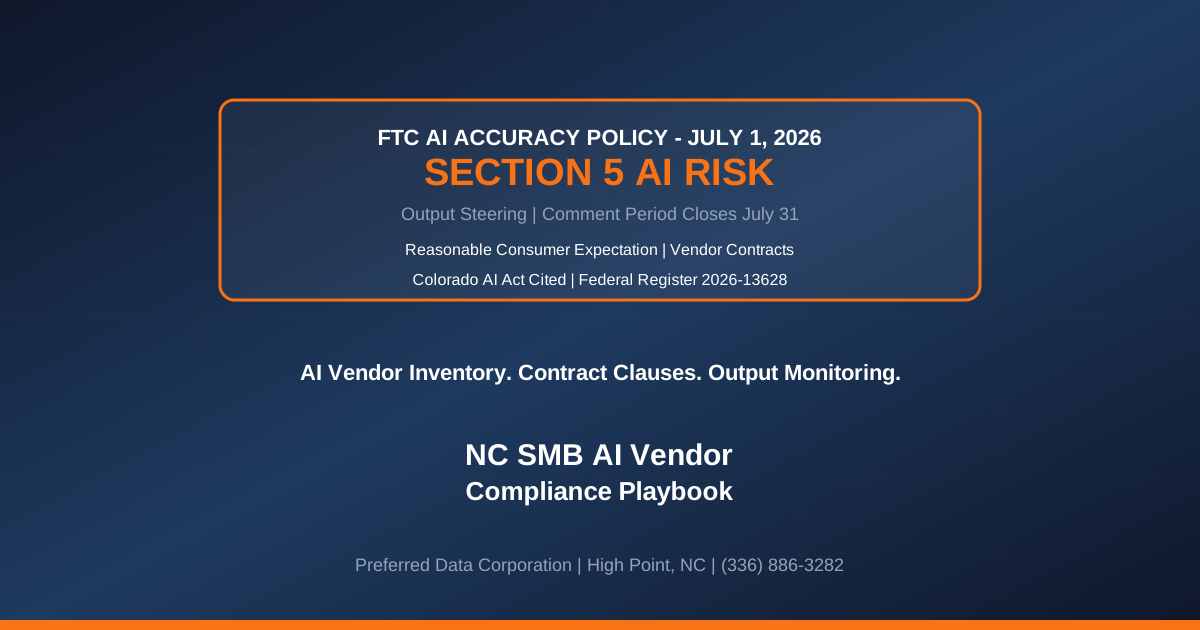
TL;DR: On July 1, 2026, the Federal Trade Commission published a proposed policy statement titled "Concerning the Suppression of Accuracy in Artificial Intelligence Systems" in the Federal Register (2026-13628) and opened a public comment period that closes July 31, 2026. The statement applies Section 5 of the FTC Act — the prohibition on unfair or deceptive acts or practices — to AI providers whose marketing creates a reasonable consumer expectation that the system delivers accurate, objective, or user-directed outputs. For North Carolina small businesses, the immediate implication is not "will we get sued by the FTC" — it is "which of our AI vendors just became a Section 5 liability we now have to document, contract around, and monitor." This is the vendor-vetting playbook.
Key takeaway: The FTC has not created a new AI regulation. It has clarified that existing Section 5 authority applies to AI. That distinction matters because Section 5 has been the FTC's operating tool for a century — it is exercised through enforcement, not rulemaking, and the enforcement targets can be either the AI vendor or the downstream business that resells or embeds the AI in a customer-facing offering. NC SMBs that deploy AI in their client workflow are inside the enforcement cone whether they built the model or bought it.
Need help translating the FTC's July 1 statement into an NC SMB AI vendor policy? Contact Preferred Data Corporation — BBB A+ rated, 39+ years of NC IT expertise, on-site within 200 miles of High Point. Call (336) 886-3282.
What Did the FTC Actually Publish on July 1, 2026?
The FTC's proposed policy statement (Federal Register document 2026-13628) formalizes the agency's position that undisclosed "output steering" in AI systems is a candidate deceptive practice under Section 5 of the FTC Act. Four elements define the statement's scope.
- Trigger: a marketed representation. The Section 5 analysis attaches when an AI provider represents that the system is designed to deliver accurate, objective, or user-directed outputs. That includes marketing copy, product-page claims, model cards, and sales-motion collateral.
- The claim creates a "reasonable consumer expectation." Under Section 5 doctrine, deception is measured against what a reasonable consumer would understand — not the technical fine print. An AI vendor that markets "accurate legal research" cannot rely on a buried disclaimer to defeat a Section 5 case.
- Output steering that departs from the expectation is the deceptive act. The FTC's examples include modifying outputs to advance ideological goals, changing outputs in response to political or public pressure, and altering outputs to avoid liability under state laws (Colorado's AI Act is named).
- Comment period closes July 31, 2026. Public comments will inform the final statement. The proposed statement is already the FTC's operating position.
For NC SMBs, the enforcement landscape is now: if your AI vendor's marketing sets an accuracy expectation and their model quietly biases outputs to avoid state-law risk (or vendor-preferred outcomes), the vendor's Section 5 exposure runs downstream through your reseller or embedder relationship.
Why Should a North Carolina Small Business Care About an FTC Policy Statement?
Three vectors move the FTC's July 1 statement from Washington to Winston-Salem in weeks, not years.
- Contract chain-of-liability. NC SMBs that embed a third-party AI vendor's model in a customer-facing offering (a legal-research assistant for a Charlotte law firm, an underwriting AI for a Raleigh insurance broker, a diagnostic-support tool for a Greenville medical practice) inherit their vendor's Section 5 exposure through the marketing claim they pass along to their own clients.
- Cyber-insurance and E&O underwriting. 2026 renewal cycles are already asking for AI vendor inventory and governance documentation. Carriers with material AI-liability book concentration (Beazley, AXA XL, Chubb) began adding AI-specific exclusions in Q2 2026 for vendors without documented output monitoring.
- State attorneys general amplify FTC theory. The NC Attorney General has consumer-protection authority parallel to the FTC. State-level AI enforcement, especially in healthcare and financial services, typically cites FTC theory. The July 1 statement is a precedent citation ready for state AG use within a quarter.
The average NC SMB now uses 8-15 AI-enabled SaaS tools — chatbots on the website, transcription in meetings, summarization in email, code assistance in engineering, image generation in marketing, and predictive analytics in operations. Each one is a candidate vendor for Section 5 spillover.
Key takeaway: The right question for the July 31 comment deadline is not "should we file a comment." It is "do we know which AI vendors we have deployed, what their accuracy representations are, and what our contract says about their output-steering liability." NC SMBs that cannot answer that question by August 1 will be answering it under duress in Q4 during renewal underwriting.
What Does an FTC-Compliant AI Vendor File Actually Look Like for an NC SMB?
The vendor file is the SMB's evidence pack for demonstrating reasonable care. Five artifacts anchor it.
- AI vendor inventory. A row per vendor with product, business owner, use case, data flow (input types, retention, cross-border), and marketing-claim capture (screenshot of the vendor's accuracy representation).
- Contract clause set. Section 5 warranty (vendor represents outputs are not steered for undisclosed objectives), audit-right (SMB may request output-behavior evidence on 90-day cadence), notice-of-material-change (vendor must notify SMB of model, training-data, or system-prompt changes that could shift output distributions), indemnification (vendor indemnifies SMB against Section 5 claims arising from vendor's representations).
- Output monitoring plan. Documented sampling of vendor outputs against a reference-answer set, cadence (monthly minimum for customer-facing use cases), and drift-detection threshold.
- User-facing disclosure. If the SMB re-represents AI outputs to its own customers, disclosure of the fact that AI was used, the vendor identity, and the scope of human review.
- Governance record. Executive owner, quarterly review minutes, and any remediation actions taken when an output was found to depart from the represented behavior.
For most NC SMBs, this documentation takes 40-80 hours to build the first time and 4-8 hours per quarter to maintain. That is meaningfully less than the incident-response cost of a single Section 5 investigation.
How Should NC SMBs Vet AI Vendors Between Now and August?
Emergency vendor-review runs in four steps over the next four weeks.
Step 1: Inventory (Week 1).
- Pull every AI-enabled SaaS the business pays for from the finance system.
- Query IT for SSO log-ins to any AI product not on the finance list — shadow-IT surfaces here.
- Interview the marketing, sales, HR, finance, and operations leaders for AI tools they piloted or use informally.
Step 2: Marketing-claim capture (Week 1-2).
- Screenshot each vendor's product page, marketing landing, and pricing page for accuracy, objectivity, or user-direction language.
- Note the date of capture. FTC exposure attaches to representations in force at the time of the transaction.
Step 3: Contract review (Week 2-3).
- Pull the master services agreement for each vendor.
- Flag any vendor without a Section 5 warranty, without an audit-right, and without a notice-of-material-change clause.
- Prioritize vendors used in customer-facing workflow for renegotiation before Q4.
Step 4: Output monitoring (Week 3-4).
- Build a reference-answer set for each customer-facing AI vendor use case (5-20 canonical prompts with expected acceptable-output ranges).
- Run the reference set on a monthly cadence, log results, and treat any deviation as a governance event.
Explore Preferred Data's AI transformation services
FTC-Ready vs FTC-Naive AI Deployment: What Does the Governance Delta Look Like?
The cost of readiness is low compared to the cost of exposure. NC SMBs that build the governance stack now can move quickly on new AI features without triggering a compliance freeze.
| Governance Element | FTC-Naive Deployment | FTC-Ready Deployment |
|---|---|---|
| AI vendor inventory | Ad-hoc, marketing owns | Formal register, IT + legal owned |
| Vendor accuracy representations | Not captured | Screenshot + dated capture per vendor |
| Contract Section 5 warranty | Absent from MSA | Standard clause in every MSA |
| Output monitoring | None | Monthly reference-set sampling |
| User-facing AI disclosure | Optional | Standard on every AI-touched deliverable |
| Governance owner | None named | Executive owner + quarterly review |
| Incident-response readiness | Reactive | Playbook drilled + insurance-notified |
| Cyber-insurance renewal | Rising premiums, coverage gaps | Documented posture, flat premiums |
For NC SMBs, the takeaway is the same as it was for the FTC Safeguards Rule and the CMMC transition: the businesses that build governance ahead of enforcement pay less over the long run and never enter panic mode. The businesses that wait for enforcement to reach them pay premiums, defense costs, and remediation costs simultaneously.
Explore Preferred Data's managed IT services
How Does Preferred Data Help NC SMBs Implement AI Vendor Governance?
Preferred Data Corporation delivers AI transformation strategy, vendor governance, and executive-level program management for NC manufacturers, healthcare providers, financial institutions, contractors, and professional services firms. With 39+ years of NC IT expertise, an average client retention of 20+ years, and an on-site radius of 200 miles from High Point, we can stand up an FTC-ready AI vendor file this quarter.
- AI vendor inventory sprint. Two-week engagement to catalog, screenshot, and classify every AI vendor in your stack, including shadow IT.
- Contract clause library. Standard Section 5 warranty, audit-right, notice-of-material-change, and indemnification clauses tuned for NC SMB negotiation posture.
- Output monitoring runbook. Reference-answer sets built per use case, monthly sampling, and drift-detection thresholds.
- Governance and executive review. Quarterly review cadence, board-level reporting, and integration with existing cybersecurity and risk-management programs.
Ready to close the FTC AI exposure gap before the July 31 comment period ends? Call (336) 886-3282 or contact our team.
Frequently Asked Questions
Does the FTC statement apply if we only use AI for internal work, not customer-facing?
The Section 5 analysis attaches to representations to consumers, which typically requires an external representation. Purely internal use of AI (summarizing internal meeting notes, drafting internal memos) does not typically create direct Section 5 exposure — but it creates internal governance exposure that matters for E&O, cyber-insurance, and board-level risk oversight. Build the vendor file either way.
Should NC SMBs file public comments during the July 31 window?
For most SMBs, filing a comment is not necessary. The higher-leverage action is building the internal vendor file so the SMB is FTC-ready if enforcement moves. Industry associations (NC Chamber, National Federation of Independent Business, NC Retail Merchants Association) are better positioned to file the sector-representative comment.
What if our AI vendor refuses to add a Section 5 warranty to their contract?
Refusal is a material data point. Vendors with adequate output-monitoring practices routinely add Section 5 warranties in Q3 2026 as market pressure grows. Refusal signals either output monitoring is not in place, or the vendor's counsel has advised them the warranty is uninsurable — either way, downstream SMB risk is elevated. Escalate the vendor to the highest-risk tier and prioritize replacement.
Is a national vendor (OpenAI, Anthropic, Google, Microsoft) safer than a startup?
Not automatically. Larger vendors have more sophisticated legal posture but also broader Section 5 attack surface — more marketing claims, more products, more downstream integrations. The right frame is not "large versus small" but "documented output-monitoring practice versus not." A well-run startup with documented alignment posture is often safer than a large vendor whose marketing outruns their monitoring.
How does the FTC statement interact with Colorado's AI Act and other state laws?
The FTC statement explicitly cites Colorado's AI Act as an example of a law that could incentivize an AI provider to modify outputs in ways that defeat consumer expectations. That is a warning shot: a vendor that changes outputs to avoid Colorado exposure but does not disclose the change to buyers becomes an FTC Section 5 target. NC SMBs relying on national AI vendors should assume state-law-driven output steering will surface in enforcement over 2026-2027.
How fast can Preferred Data build our AI vendor governance file?
For an active NC SMB inside our 200-mile service radius, the vendor inventory sprint completes in two weeks and the full governance stack (contract clauses, output monitoring, executive review) rolls out over 60-90 days. Call (336) 886-3282 to schedule.