
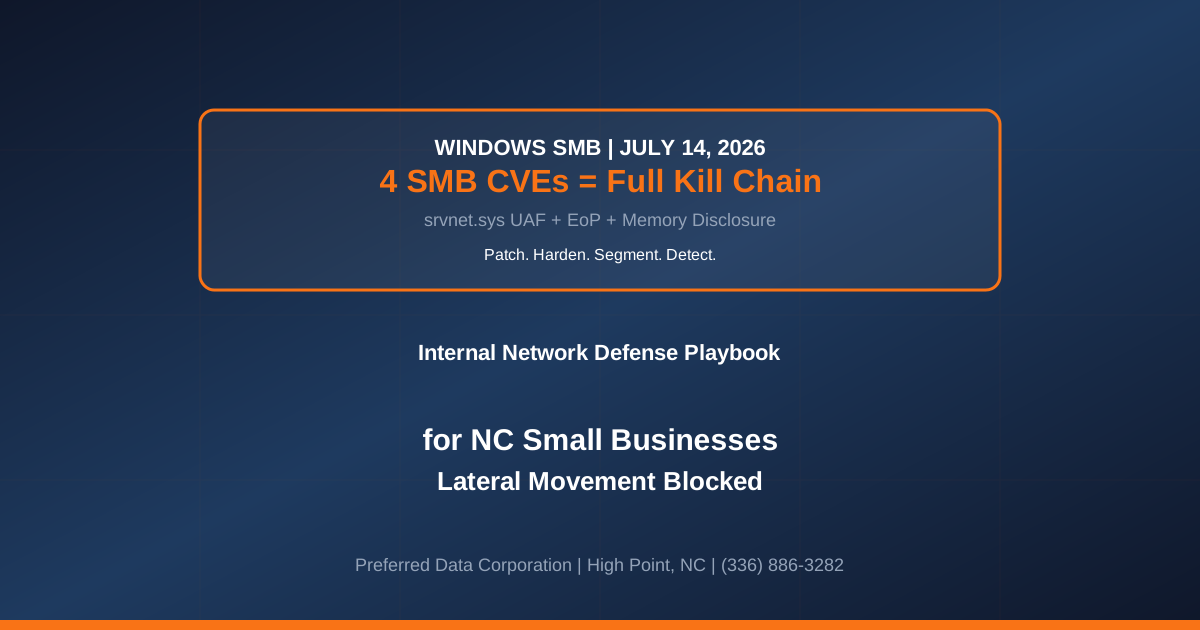
TL;DR: Microsoft's July 14, 2026 Patch Tuesday shipped four SMB-focused CVEs whose combined blast radius is the internal lateral-movement kill chain every ransomware operator now follows. CVE-2026-57089 is a use-after-free in the Windows SMB server driver srvnet.sys enabling remote code execution against internal file servers. CVE-2026-58531 is an SMB race condition allowing authenticated privilege escalation to SYSTEM. CVE-2026-54997 discloses SMB server memory contents locally. CVE-2026-50360 is a network-adjacent privilege escalation exploitable by any attacker with valid credentials. None of the four is a headline zero-day. Together, they are the exact toolkit an attacker uses after landing on a single foothold, and they demand a patch cadence and internal-segmentation posture that NC SMBs have historically underprioritized because "the firewall stops that." The firewall does not stop east-west.
Key takeaway: Perimeter patching (SonicWall SMA1000, SharePoint on-prem) matters. Internal patching (SMB, RDP, DCOM) matters more once the attacker is inside, and every ransomware event of the last five years has the attacker inside. Windows file servers and domain controllers are 2026's blast radius amplifier, and July 14 shipped the tools to detonate them.
Does your NC SMB run one or more Windows file servers, a domain controller, or file shares hosted on Windows endpoints? Contact Preferred Data Corporation for an internal-network patch and segmentation review including SMB hardening, file-server isolation, domain-controller lockdown, and east-west traffic policy. BBB A+ rated. Call (336) 886-3282.
What Are the Four July 14, 2026 SMB CVEs and Why Do They Matter Together?
Microsoft's July 14, 2026 Patch Tuesday addressed 622 CVEs (a record), including four scoped to the Windows Server Message Block (SMB) implementation. Individually, none is a headline vulnerability. Together, they are the internal-network exploit toolkit ransomware needs.
The four July 14 SMB CVEs:
- CVE-2026-57089 - SMB server remote code execution. Use-after-free in the Windows SMB server driver srvnet.sys. High severity. Enables RCE against internal file servers exposed to SMB traffic from any compromised endpoint.
- CVE-2026-58531 - SMB elevation of privilege to SYSTEM. Race condition in SMB service allowing an authenticated user to escalate to SYSTEM on the target host. Enables the "foothold → domain admin" leap once initial access is established.
- CVE-2026-54997 - SMB local memory disclosure. Discloses SMB server memory contents to a local attacker. Enables credential and cryptographic-material extraction from a running server.
- CVE-2026-50360 - Windows SMB Server network-adjacent privilege escalation. Exploitable by any attacker with valid credentials over the network. Enables lateral movement across every SMB-reachable server.
Three concrete facts every NC SMB should treat as confirmed:
- The chain is complete without a zero-day. An attacker who lands on any single Windows endpoint via phishing, drive-by, unpatched browser, or a compromised RDP session can pivot to file servers (CVE-2026-57089), escalate to SYSTEM on the pivoted server (CVE-2026-58531), disclose memory to extract credentials (CVE-2026-54997), and move network-adjacent (CVE-2026-50360) - using only the exploit primitives shipped in the same July 14 Patch Tuesday.
- The vulnerable code is in every supported Windows version. Servers, client Windows 10/11, Windows Server 2019/2022/2025. Any Windows host with the SMB server service running is in scope.
- SMB is the ransomware ingress and egress path. Ransomware families including LockBit (dormant), Cl0p, Akira, RansomHub, Play, Qilin, and Interlock consistently use SMB for lateral movement, staging, and encryption-payload deployment.
Key takeaway: The July 14 SMB CVEs are not a July 14 problem. They are what makes every 2026-2027 ransomware event faster and cheaper. The patch is the answer. The segmentation is the durable answer.
Why Doesn't Perimeter Defense Stop Internal SMB Exploitation?
The classic NC SMB architecture - perimeter firewall, internal flat network, "the AV catches malware" - worked when initial-access vectors were expensive and internal traffic was implicitly trusted. Neither assumption survives 2026.
Three concrete reasons perimeter defense fails against internal SMB exploitation:
- Initial access is cheap. A single successful phishing click, a browser-drive-by against an unpatched Chrome, a compromised remote-access tool (ConnectWise ScreenConnect, TeamViewer, Splashtop), or an OAuth-consent grant hands an attacker a foothold inside the network. The perimeter firewall never sees it because it did not go through the perimeter.
- East-west traffic is unfiltered. In a flat NC SMB LAN, once the attacker has one endpoint, SMB reaches every file server, domain controller, and endpoint on the LAN. No firewall inspects the traffic. No IPS fires on it. It is all "internal."
- File servers are typically the least-patched systems in the environment. They host business-critical data. Downtime for patching is politically expensive. They run on quarterly or annual cadences that make them permanently one Patch Tuesday behind their exploit primitives.
Preferred Data's internal-network reviews at NC SMB clients routinely find file servers 90-180 days behind Patch Tuesday, domain controllers on quarterly cadence, and zero east-west segmentation. Every one of those environments is one phishing click from the SMB exploit chain we just described.
What Should NC SMBs Do in the Next 30 Days?
The response is a coordinated three-workstream program that closes the July 14 SMB CVE window and lays the durable segmentation posture that survives the next Patch Tuesday.
Track 1 - Patch (Weeks 1-2).
- Apply the July 14 cumulative update to every Windows Server (2019, 2022, 2025) in the environment. Prioritize file servers, print servers, and domain controllers.
- Apply the July 14 cumulative update to every Windows 10/11 endpoint. This includes any endpoint hosting an SMB share (including "temporary" file shares on user workstations that nobody documented).
- Verify KB installation. Windows Update history is the primary evidence. Document each server's patch state for cyber-insurance attestation.
Track 2 - SMB hardening (Weeks 2-3).
- Disable SMBv1 across the environment. SMBv1 has been unsupported since 2020, but Preferred Data's audits still find it enabled on 15-30% of NC SMB file servers via legacy compatibility flags. Disable and remove.
- Enforce SMB signing on all servers and clients. This defeats SMB relay attacks that would otherwise chain with the July 14 CVEs.
- Disable NTLM authentication on domain controllers where operationally possible. NTLM is the underlying credential primitive most SMB attacks abuse. Kerberos-only is the durable answer.
- Enable SMB over QUIC where clients support it. This encrypts SMB traffic and prevents the on-network sniffing patterns modern attackers use to accelerate lateral movement.
Track 3 - Segmentation (Weeks 3-6).
- Deploy internal firewalls or host-based firewalls between the workstation subnet and the server subnet. SMB (445/TCP) should only be permitted from documented client hosts to documented server hosts.
- Isolate domain controllers. DCs should be reachable only for authentication traffic from workstations, not for SMB file-share purposes.
- Deploy Microsoft Defender for Identity (or equivalent) to detect lateral-movement patterns including SMB abuse, NTLM relay, and Kerberoasting.
- Deploy EDR on every Windows endpoint and every Windows server. EDR (CrowdStrike, SentinelOne, Microsoft Defender for Endpoint P2, Huntress) is the primary detection layer for the exploit-chain behavior even if a single patch cycle is missed.
What Does the Ransomware Kill Chain Look Like Without These Controls?
Understanding the kill chain is what turns the July 14 patches from "just another Patch Tuesday" into "this changes our operating cadence."
The seven-step 2026 ransomware kill chain that the July 14 SMB CVEs accelerate:
| Step | Attacker Action | Defense Layer | July 14 CVE Involvement |
|---|---|---|---|
| 1 | Initial access via phish/drive-by/RMM | Email security, EDR, patching | N/A |
| 2 | Credential dump on foothold host | EDR, LSASS protection | N/A |
| 3 | Discovery of file servers via SMB | Segmentation, monitoring | CVE-2026-57089 discovery |
| 4 | Lateral move to a file server | Segmentation, MFA on RDP | CVE-2026-50360 network EoP |
| 5 | Escalate to SYSTEM on file server | Server patching | CVE-2026-58531 SMB EoP |
| 6 | Extract creds from file server memory | Server patching | CVE-2026-54997 memory disclosure |
| 7 | Ransomware deployment via SMB | Immutable backup, EDR | Uses SMB reach established above |
The chain is stable and predictable. Attackers do not improvise; they follow the playbook. The July 14 CVEs make each step faster.
How Does This Fit the July 14, 2026 Patch Tuesday in Context?
Microsoft's July 14 Patch Tuesday is one of the largest in history at 622 CVEs. The SMB set is inside that number and is easy to lose in the noise.
The July 14 Patch Tuesday priority stack for NC SMBs:
| Priority | CVE Category | Reason | Deadline |
|---|---|---|---|
| P0 | SharePoint on-prem (CVE-2026-56164) | Actively exploited zero-day, KEV | July 17 |
| P0 | AD FS (CVE-2026-56155) | Actively exploited zero-day, KEV | July 28 |
| P0 | BitLocker (CVE-2026-50661) | Publicly disclosed bypass | 14 days |
| P1 | SMB set (four CVEs above) | Ransomware kill-chain accelerators | 14 days |
| P2 | Kernel, driver, and remaining critical | Standard critical cadence | 30 days |
| P3 | Everything else | Baseline monthly cadence | Monthly |
Preferred Data operates this priority stack across NC SMB clients as a standing monthly service. The P0 items get same-week engagement. The P1 SMB set is inside a two-week envelope. The rest is baseline cadence.
Explore PDC's cybersecurity services - Managed IT services - Network services
How Does Preferred Data Handle Internal Network Defense for NC SMBs?
Preferred Data Corporation has designed, built, and hardened Windows-server environments across NC SMBs for 39 years. Our internal-network defense program is a four-layer deliverable.
PDC's four-layer internal-network defense program:
- Patch program and evidence. Monthly baseline cadence, same-week emergency for KEV, documented attestation for every server and endpoint. Evidence packet retained for cyber-insurance renewal and post-incident review.
- SMB and identity hardening. SMBv1 removed, SMB signing enforced, NTLM disabled where possible, Kerberos hardening, LAPS deployed for local admin, tiered admin model for Active Directory.
- Segmentation. Server subnet separated from workstation subnet, SMB restricted at the internal firewall, domain controllers isolated for authentication traffic only, host-based firewalls on file servers.
- Detection and response. EDR on every Windows host, 24/7 SOC alerting on lateral-movement behaviors, Microsoft Defender for Identity or equivalent for behavioral anomaly detection, documented IR runbook.
Cost for a typical 40-100 person NC SMB with one to three Windows servers and 40-100 endpoints: $8,000-$20,000 for initial engagement plus $2,500-$6,000/month managed. Delta versus the ransomware event a fully-flat unpatched environment invites: six-figure incident-response cost plus five-to-seven-figure business interruption cost.
Frequently Asked Questions
What is CVE-2026-57089 and why is it dangerous?
CVE-2026-57089 is a high-severity use-after-free vulnerability in the Windows SMB server driver (srvnet.sys) that enables remote code execution. An attacker who has landed on any single Windows endpoint can pivot from that foothold to internal file servers hosting the driver. Microsoft's July 14, 2026 Patch Tuesday shipped the fix. Any unpatched file server or domain controller is exposed to internal lateral movement even without a zero-day.
Are these SMB CVEs zero-days?
No. All four July 14 SMB CVEs (CVE-2026-57089, CVE-2026-58531, CVE-2026-54997, CVE-2026-50360) were disclosed responsibly and patched in the same Patch Tuesday. There is no public evidence of active exploitation as of July 17, 2026. That does not mean they will be unexploited a week from now. Exploit primitives for SMB-family vulnerabilities routinely appear within 14-30 days of disclosure.
Doesn't my firewall protect against SMB attacks?
Only external SMB. Your firewall drops inbound SMB from the internet by default (assuming a competent perimeter). Internal east-west SMB, from a compromised workstation to a file server on the same LAN, does not touch the perimeter firewall. Internal segmentation is what defends against that path.
Should we still be running SMBv1?
No. SMBv1 has been unsupported since 2020 and is enabled today only via legacy compatibility flags on aging NC SMB file servers. Every SMBv1-enabled endpoint is exposed to a decade of known exploitation, including WannaCry-class events. Disable and remove immediately.
How does this affect our cyber insurance renewal?
2026 cyber-insurance underwriting increasingly requires attestation that Patch Tuesday critical and important updates are applied within 14 days. SMB CVEs in particular are called out on some carriers' renewal applications because of their ransomware kill-chain role. Missing this cycle is a documented control gap for renewal. Preferred Data's evidence packet is designed to preserve coverage.
How do we know if our file servers are patched?
Windows Update history on each server shows applied KB numbers. Preferred Data's monthly patch report itemizes every server, every endpoint, and every applied update. If your MSP does not provide that report, it is a scoping question, not a technical one.
How fast can PDC assess our internal network?
A two-day on-site inventory plus one week of remote analysis produces the internal-network gap report including patch state, SMB hardening state, segmentation state, and monitoring state. Full remediation program rollout is typically 30-60 days for a mid-sized NC SMB.
Related Resources
- Cybersecurity Services for NC Small Businesses
- Managed IT Services
- Network Services
- Contact PDC - request an internal-network patch and segmentation review