
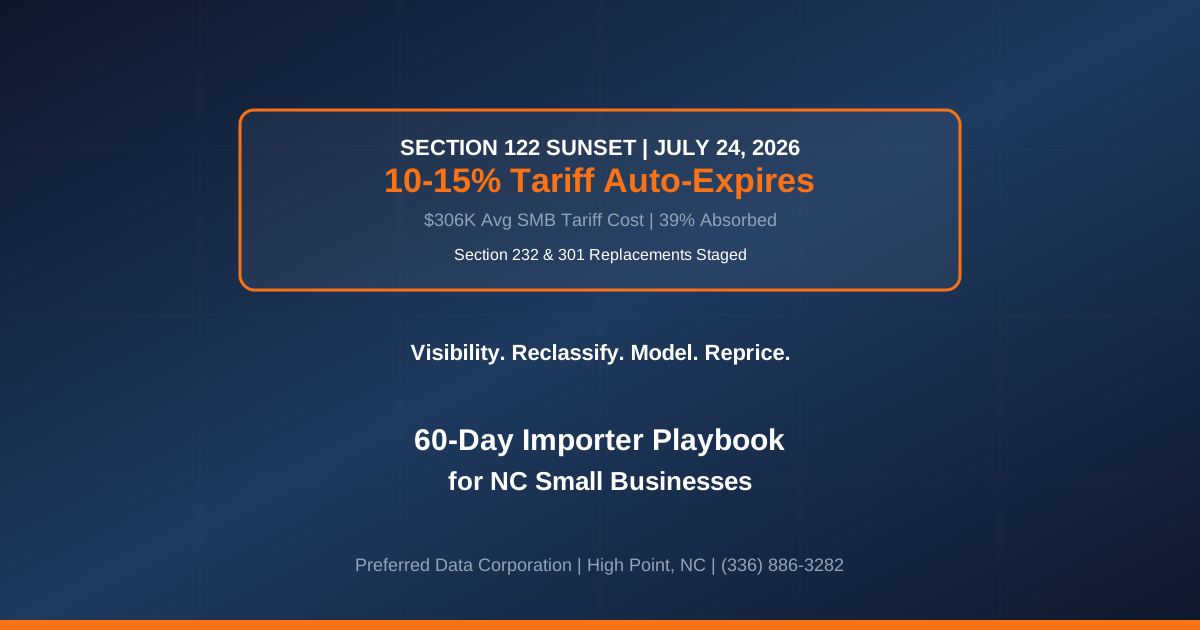
TL;DR: At 12:01 AM EDT on July 24, 2026, the 10-to-15 percent Section 122 global tariff surcharge invoked in February 2026 will expire automatically by operation of law. Section 122 of the Trade Act of 1974 caps a presidential balance-of-payments surcharge at 150 days, and no extension legislation is pending. The administration is simultaneously (1) processing court-ordered tariff refunds, (2) advancing Section 232 investigations on pharmaceuticals and medical devices with reports due July 31 and September 29, 2026, and (3) opening wide-ranging Section 301 investigations that could impose replacement tariffs by late summer. Per the Center for American Progress, average small-business importer tariff cost through February 2026 was $306,000 per year, roughly $25,500 per month. NC SMB importers in furniture, textiles, food service, electronics, and medical equipment face a chaotic 60-day pricing window and need to lock landed-cost quotes, refresh Incoterms on open POs, and start the CBP entry-summary review for potential Section 122 refunds.
Key takeaway: The July 24, 2026 sunset removes one tariff. It does not remove tariff risk. Section 301 and Section 232 replacements are being staged now. NC SMB importers who use the 60-day window to instrument their landed-cost visibility, harmonize HTS classification, and stress-test pricing across three tariff scenarios will exit the year in a better margin position than they entered it, regardless of what comes next.
Is your ERP telling you the landed cost of your open POs by SKU today? Contact Preferred Data Corporation for a same-week ERP landed-cost visibility engagement. BBB A+ rated. On-site within 200 miles of High Point. Call (336) 886-3282.
What Actually Expires on July 24, 2026?
The Section 122 global tariff surcharge invoked by Proclamation 11012 on February 24, 2026, will expire automatically at 12:01 AM EDT on July 24, 2026. The expiration is statutory and cannot be extended by executive action alone.
Three concrete facts every NC SMB importer should treat as confirmed:
- Section 122 caps a presidential balance-of-payments surcharge at 150 days. February 24 plus 150 days equals July 24. The cap is written into the Trade Act of 1974 and requires an act of Congress to extend. No extension legislation is pending in either chamber.
- The current surcharge started at 10 percent and was raised to 15 percent. The tariff applied ad valorem on nearly all imports from all countries, with narrow exemptions for certain critical minerals and pharmaceutical inputs. The two-step increase compounded margin pressure on SMB importers with just-in-time inventory.
- The Court of International Trade granted permanent injunctive relief to three plaintiffs. The State of Washington, Burlap and Barrel, Inc., and Basic Fun, Inc. won a summary-judgment ruling that Proclamation 11012 exceeded the president's Section 122 authority. The injunction extends only to those three plaintiffs. All other importers remain subject to the surcharge until July 24 unless they file their own action.
For NC SMBs, the practical effect is simple: from February 24 through July 23, 2026, every FOB-origin container carried an added 10-15 percent duty at CBP entry. From July 24 onward, that specific surcharge is off. What replaces it, if anything, is the July-through-October 2026 story.
Key takeaway: Do not confuse Section 122 with the totality of 2026 US tariff policy. Section 122 was the emergency balance-of-payments tool. Section 301 (unfair trade practices) and Section 232 (national security) are different authorities with different rulings and different timelines. NC SMB importers need a tariff-scenario model, not a single-tariff plan.
What Is the Direct Dollar Impact for NC SMB Importers?
The magnitude of Section 122's dollar impact on SMB importers has been documented across multiple independent sources. NC SMB importers should model their own exposure against these industry benchmarks.
Three industry benchmarks NC SMB importers should apply:
- $306,000 average annual tariff cost per SMB importer. Center for American Progress calculated this figure from the first year of Trump-era tariff activity through February 2026, aggregating Section 122, Section 232, Section 301, and IEEPA (International Emergency Economic Powers Act) authorities. For a typical NC furniture, textile, or food-service SMB importer, this is roughly $25,500 per month in incremental duty cost that was not in the pre-2024 P&L.
- 39 percent absorption rate at the SMB tier. Thomson Reuters, Ivalua, and the National Small Business Association converged on the same figure through Q2 2026: 39 percent of the tariff cost is absorbed by the importer rather than passed through to the customer, versus 13 percent in the 2018-2019 tariff cycle. For a $300,000 annual tariff exposure, that is $117,000 per year of margin erosion.
- 97 percent of SMB importers are actively mitigating. The same surveys show 65 percent are changing sourcing, 47 percent are diversifying across regions, and material shares are pursuing HTS reclassification. NC SMBs that are not on this list are conceding margin to competitors who are.
The direct dollar upside of Section 122 expiration for a $300,000-tariff-per-year NC SMB importer is roughly $150,000 to $200,000 annualized (Section 122's share of the total tariff stack, adjusted for other authorities that continue). That upside is real. Whether it survives Q3 2026 depends on Section 232 pharma and Section 301 investigation outcomes.
What Comes Next: Section 232 and Section 301 Timelines
The administration has been transparent about staging replacement tariffs on different authorities with different timelines. NC SMB importers should track three specific dates.
Three replacement-tariff dates on the Q3 2026 calendar:
- July 31, 2026: Section 232 pharmaceutical and medical device investigation report due. Section 232 investigations produce a Commerce Department report to the president, who then has 90 days to act. Products in scope include finished pharmaceuticals, active pharmaceutical ingredients (APIs), and a wide range of medical devices. NC SMB medical-equipment distributors and pharmacy-services firms are directly exposed.
- September 29, 2026: Second Section 232 report due. A parallel Section 232 investigation covers additional strategic-goods categories. Details are less public, but Commerce filings suggest coverage of semiconductor-adjacent inputs, permanent magnets, and rare-earth downstream products.
- Late summer 2026: Section 301 investigation determinations. The administration has initiated Section 301 investigations under the Trade Act of 1974 authority to impose tariffs on countries engaged in unfair trade practices. Determinations could land any time from late July through October 2026 with tariffs following on a compressed timeline.
For NC SMB importers, the correct mental model is: Section 122 was a broad blunt instrument. The replacements will be narrower and more targeted, but they may hit specific NC industry verticals harder than Section 122 did.
What Should NC SMB Importers Do in the 60-Day Window?
The 60-day window from July 15 through September 15 is the time to fix the visibility, HTS-classification, and pricing-model gaps that most NC SMBs deferred while operating under Section 122 pressure. Every one of these deliverables pays off regardless of what replaces Section 122.
PDC's 60-day post-Section-122 execution plan for NC SMB importers:
- Weeks 1-2: ERP landed-cost visibility. Configure the ERP so every open PO, receiving line, and finished-goods SKU carries a landed-cost breakdown by cost element: FOB, freight, insurance, duty, brokerage, and handling. If your ERP cannot deliver this in a report, that is a same-quarter fix.
- Weeks 2-3: HTS reclassification review. Engage a licensed customs broker to review the top-20 SKUs by tariff dollar exposure. Reclassification frequently yields a 3-8 percent duty rate reduction that is legitimate under current CBP guidance and durable across future tariff regimes.
- Weeks 3-5: Section 122 refund analysis. Pull CBP entry summaries (CBP Form 7501) for every entry between February 24 and July 23, 2026 that carried Section 122 duty. Aggregate the Section 122 line-item total. Coordinate with customs counsel on whether a protest or refund claim is warranted for your entries specifically.
- Weeks 4-6: Pricing scenario modeling. Build three landed-cost scenarios for Q3 and Q4: (A) no replacement tariff, Section 122 pure sunset; (B) Section 232 pharma/medical replacement, moderate impact; (C) Section 301 broad replacement, high impact. Price contracts and quotes with escalation language keyed to scenario B or C, not scenario A.
- Weeks 5-8: Incoterms and supplier terms refresh. Move where possible from FOB origin to CIF or DDP incoterms with supplier absorption of tariff volatility. Renegotiate long-lead-time supplier contracts to include tariff-pass-through clauses.
- Weeks 6-8: China Plus One / reshoring feasibility. For NC SMBs concentrated in a single low-cost country of origin, run a modeled cost comparison of a second-source origin or a partial reshore. The math often works at 39 percent absorption rates that Section 232 or 301 could reintroduce.
The right-hand column is the "same total effort, permanently better margin visibility" plan. NC SMBs who execute it during the Section 122 sunset window will handle whatever comes next with data instead of guesses.
How Does This Interact With NC SMB ERP and Accounting Systems?
The single biggest execution barrier for NC SMB importers is ERP data quality. Most NC SMBs have functional ERP systems that were configured for a 2018-2023 low-tariff world where landed cost was FOB plus a 3-5 percent broker fee. Modern tariff regimes demand line-item-level attribution and scenario modeling that older ERP configurations do not deliver.
Comparison: NC SMB ERP landed-cost posture, pre-2024 vs 2026 target.
| Capability | Pre-2024 Typical NC SMB ERP | 2026 Target NC SMB ERP |
|---|---|---|
| Landed cost per SKU | FOB + flat 5% broker | FOB + freight + insurance + duty + brokerage + handling |
| Duty rate source | Manual customs broker email | HTS lookup with automated rate feed |
| Currency hedging | Ad hoc | Line-item currency capture, hedge reporting |
| Tariff scenario modeling | Absent | 3+ scenarios by SKU with margin waterfall |
| Section-line reporting | Absent | Section 122 vs 232 vs 301 vs IEEPA attribution |
| CBP entry summary reconciliation | Manual PDF file | Automated CBP 7501 import into ERP GL |
| Refund analysis | Not possible | Automated aggregation of any refundable duty by CVE-adjacent event |
| Customer quote automation | Cost-plus | Landed cost + tariff scenario + freight + margin |
The right-hand column is achievable inside a single quarter for any NC SMB running SYSPRO, Sage, NetSuite, Epicor, Global Shop Solutions, Infor VISUAL, or Actian Zen ERPs. PDC's Custom Software practice and our Managed IT Services practice have delivered this exact scoping for NC furniture, textile, food-service equipment, medical device, and metal fabrication importers.
Why NC SMB Importers Should Not Wait for the Task Force Outcome
The temptation on July 15 is to wait for Section 232 pharma to publish, wait for Section 301 to determine, and only then act. That posture has three concrete costs.
Three cost dimensions of waiting:
- Margin erosion continues during the wait. Every day from July 15 through the September or October replacement-tariff decision is a day of open POs and quoted customer contracts booked at yesterday's landed-cost assumption. If the replacement hits, that lag is pure margin loss.
- Customer-contract price protection risk. NC SMB importers with 30-90 day customer contracts locked at pre-July 24 prices are exposed if the customer's replacement-tariff pass-through arrives after your input costs have moved. Refresh terms now.
- ERP configuration cannot be done in a crisis. Landed-cost ERP configuration is a 4-6 week engagement for a typical NC SMB. Started in October when the Section 301 tariff lands, it will not be delivered before the Q4 close. Started in July, it is done well before the storm.
The right posture is: do the ERP and pricing work during the 60-day window, price contracts against scenario B or C, and be a first-mover on whatever replacement authority the administration chooses.
How Does Preferred Data Support NC SMB Importers?
Preferred Data Corporation has spent 39 years supporting NC manufacturers, distributors, and importers through exactly the kind of tariff and supply-chain regime change the July 24 sunset represents. Our post-Section-122 support is a four-layer deliverable.
PDC's four-layer post-Section-122 support for NC SMB importers:
- ERP landed-cost visibility. We configure your ERP so every SKU carries a full landed-cost breakdown, with automated duty-rate feeds and section-authority attribution.
- Tariff scenario modeling. We build three scenarios (pure sunset, Section 232 replacement, Section 301 replacement) and produce a per-SKU and per-customer margin waterfall.
- HTS reclassification coordination. We coordinate with your customs broker to review top-20 SKU classifications and document any legitimate reclassification opportunities.
- Section 122 refund analysis. We pull your CBP 7501 entry summaries, aggregate Section 122 duty, and hand your customs counsel a clean workbook to inform the refund decision.
Cost for a typical NC SMB importer with $2M-$50M in annual imports: $18,000-$45,000 all-in for the 60-day catch-up program, $1,500-$3,500 per month ongoing for the maintenance and monitoring program. Set against $150,000-$400,000 of annualized tariff dollar exposure, this is the highest-ROI ERP investment a NC SMB importer can make in Q3 2026.
Frequently Asked Questions
Can the Section 122 tariff be extended past July 24, 2026?
Only by an act of Congress. Section 122 of the Trade Act of 1974 caps a presidential balance-of-payments surcharge at 150 days, and there is no pending extension legislation in either chamber. The tariff will expire automatically at 12:01 AM EDT on July 24, 2026 unless Congress affirmatively acts.
Am I automatically entitled to a refund on Section 122 duties I already paid?
No. The Court of International Trade granted permanent injunctive relief to three specific plaintiffs (State of Washington, Burlap and Barrel, Basic Fun) who filed suit. Other importers remain subject to the Section 122 duty and would need to file their own protest or refund action to recover. Coordinate with customs counsel on the merits of a claim for your specific entries.
What is the difference between Section 122, Section 232, Section 301, and IEEPA tariffs?
Section 122 is a temporary balance-of-payments surcharge capped at 150 days. Section 232 covers imports that threaten national security and requires a Commerce Department investigation and report. Section 301 covers imports from countries engaged in unfair trade practices and requires a USTR investigation. IEEPA covers imports from foreign entities in a national emergency and has faced significant court pushback. Each has different scope, different duration, different court exposure, and different NC SMB implications.
Should I stockpile inventory before July 24, 2026?
Generally no. The tariff comes off on July 24, so stockpiling now locks in the higher landed cost. The exception is inventory where you have a defensible expectation that Section 232 or Section 301 replacement tariffs will hit the same origin/HTS combination in Q3 2026, in which case a modest pull-forward may hedge. Model both scenarios in your ERP before committing.
How does ERP landed-cost visibility help with future tariff changes?
An ERP that captures landed cost by cost element and by section-authority attribution turns tariff changes from a pricing crisis into a repricing operation. When Section 232 or Section 301 lands, you re-run the model, refresh customer quotes with escalation language, and continue operating. Without landed-cost visibility, every tariff change is a manual Excel exercise that lags reality by weeks.
Do NC SMB importers need to re-file HTS classifications for every SKU?
No. HTS classification is per-product and durable across tariff regimes. The right time to review is once a year and after any major product-line change. What tariff changes affect is the duty rate applied to each HTS code, not the classification itself.
How is PDC different from a customs broker or trade attorney?
Customs brokers file CBP entries and are the right partner for entry-summary filings, HTS classification, and CBP correspondence. Trade attorneys handle protests, refund claims, and litigation. PDC is neither. PDC is the technology partner that stands up the ERP landed-cost visibility, the tariff scenario modeling, and the customer-quote automation that lets customs brokers and trade attorneys do their jobs from clean data. All three roles are needed for a full response.
Related Resources
- Managed IT Services for NC Small Business Importers
- PDC Software Suite and Custom ERP Integration
- Manufacturing Industry Solutions
- Contact PDC — request a same-week ERP landed-cost visibility engagement