
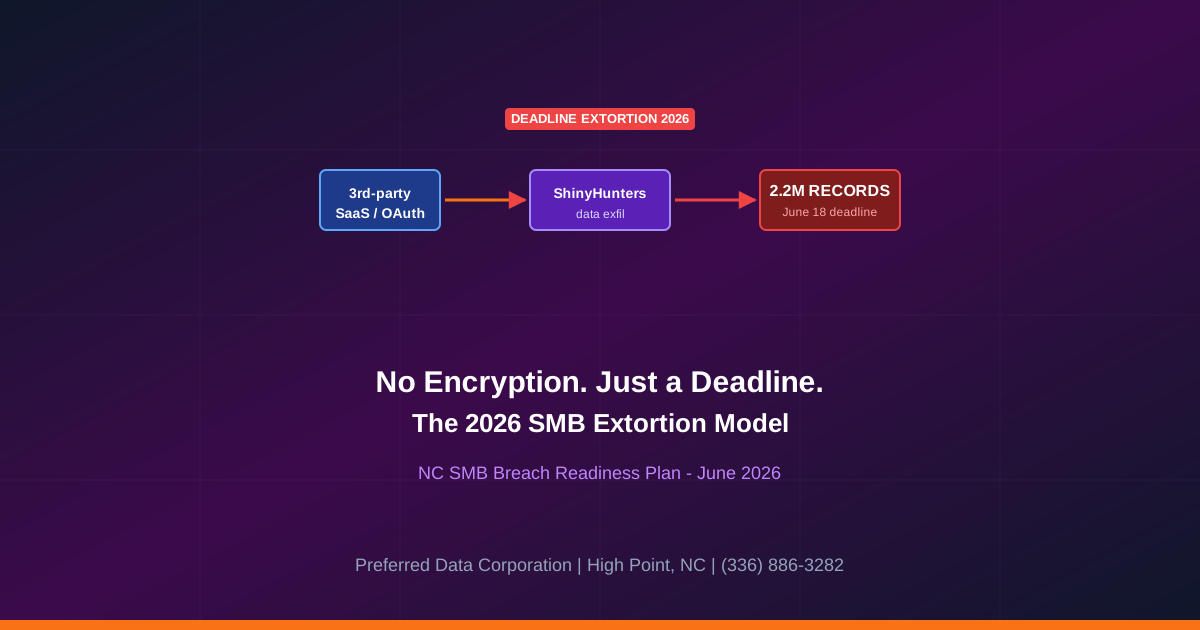
TL;DR: On June 17, 2026 Kodak confirmed a data breach after the ShinyHunters extortion group claimed it had stolen 2.2 million records and set a June 18 deadline to publish if Kodak did not pay. Per Computing.co.uk, Malwarebytes' deadline coverage, and SecurityWeek's analysis, the ShinyHunters operation has been running an enterprise-platform campaign targeting third-party integrations (Salesforce OAuth, customer-success tools, SaaS connectors) and using deadline-extortion (the threat of publishing data on a specific date) instead of file encryption. For NC small businesses, this is the 2026 archetype to plan against: no ransomware to negotiate, no decryption needed, just a leak threat against your customer data, your employee W-2s, and your client work.
Key takeaway: The 2026 SMB extortion model has shifted from "we encrypted your files" to "we have your customer data and we will leak it on Tuesday." The defense is not a better decryptor; it is preventing data exfiltration in the first place, monitoring the dark web for your name, and having a CFO-ready response playbook before the deadline call arrives.
Worried about an extortion call your CFO is not ready for? Preferred Data Corporation runs managed cybersecurity, breach-response retainers, and 24/7 SOC monitoring for NC small businesses. Call (336) 886-3282 or request a breach-readiness review.
What is ShinyHunters and why is the Kodak case the SMB archetype?
ShinyHunters is one of the most prolific cybercrime and extortion groups active in 2026, with a 2026 campaign focus on enterprise-platform third-party integrations (notably Salesforce OAuth-connector campaigns earlier in the year) and a deadline-pressure leak model. Per BleepingComputer, Cybernews, and SQ Magazine's case analysis, the Kodak case timeline is:
- June 15, 2026: ShinyHunters listed Kodak on its dark web leak site.
- June 17, 2026: Kodak confirmed a breach via SEC and corporate disclosure, characterizing it as "temporary access to a limited amount of information."
- June 17, 2026: Council of Europe was probing separate ShinyHunters claims, indicating an active multi-target campaign.
- June 18, 2026: ShinyHunters' threatened deadline to leak 2.2 million records arrived. Reporting confirmed continued negotiation/leak posture rather than encryption.
Three details make the Kodak case the cleanest SMB archetype to plan against:
- No encryption. Kodak's "operations remain unaffected" framing matches the modern shift: the goal is data theft and extortion, not file lockout. There is nothing to decrypt.
- The gap between attacker claim and victim characterization is intentional. ShinyHunters claims 2.2 million records; Kodak characterizes the access as "limited." Per SQ Magazine's analysis, this gap is the group's negotiation posture: withhold proof samples before the deadline, use the threat of publication as leverage.
- Third-party platform leverage. Earlier 2026 ShinyHunters campaigns targeted Salesforce OAuth integrations (per TechJack Solutions' analysis of the ongoing enterprise-platform campaign). The SaaS supply chain is the entry; the corporate brand is the leverage.
For a Piedmont Triad small business in High Point, Greensboro, Charlotte, Raleigh, or Winston-Salem, the Kodak case is what an extortion event looks like in 2026: a phone call or message from an extortion broker, a leak-site listing, a deadline, and a decision the CFO and CEO must make in 48 to 72 hours under enormous pressure with imperfect information.
Why is the deadline-extortion model harder to defend against than ransomware encryption?
Because the defender's options are narrower. With encryption, the decision tree is: pay for decryption keys, or restore from backups and absorb downtime. With pure data-theft extortion, the decision tree is: pay for promises that the stolen data is deleted, or accept publication and the regulatory, customer, and reputational fallout. Backups do not help. Decryptors do not exist. The data is already gone.
Per the Verizon 2026 DBIR and BlackFog's State of Ransomware 2026 report, data theft now accompanies 100% of disclosed ransomware incidents, and pure data-theft extortion (no encryption) has grown to a significant share of 2026 incidents:
- Payment does not guarantee deletion. Extortion groups have an incentive to retain the data for future leverage, re-extortion, or sale on dark web markets, regardless of payment.
- Reputation damage is asymmetric. A confirmed leak of customer PII or employee W-2s causes years of customer-trust and recruitment impact, well beyond the immediate ransom.
- Regulatory clocks start at discovery, not payment. NC's G.S. 75-65, HIPAA's 60-day rule, the SEC's four-business-day rule for public companies, and various state breach-notification laws require disclosure independent of whether a ransom is paid or the data is "deleted."
- OFAC sanctions exposure. Per the conti-plea coverage, ransom payments to designated entities risk federal criminal exposure for the SMB, the CFO, and any payment facilitator.
- Cyber insurance may not cover the data-theft branch. Many 2026 policies require explicit cyber-extortion endorsements, and even endorsed policies often exclude reputation-damage payouts.
| Decision factor | Encryption ransomware | Deadline extortion (Kodak archetype) |
|---|---|---|
| Recovery option | Restore from backups | None (data already exfiltrated) |
| Pay-to-restore math | Backups vs. ransom + downtime | Trust vs. publication |
| Regulatory clock | Starts at discovery | Starts at discovery |
| OFAC exposure | Yes | Yes |
| Reputation damage | Limited by recovery speed | Open-ended after publication |
| Insurance coverage | Usually covered subject to controls | Often requires extortion endorsement |
The structural insight for an NC small business is that the deadline-extortion model rewards prevention investment far more than it rewards "we will pay our way out" planning. Once the data is exfiltrated, every option is bad.
What does this mean for NC small businesses preparing for 2026 extortion?
Build the controls that prevent exfiltration, build the monitoring that catches the leak-site listing early, and build the response plan that lets the CFO make a decision under pressure. Per the Huntress 2026 SMB Threat Report and SQ Magazine's 2026 statistics, the average SMB breach cost in 2026 is $3.31 million, only 34% of SMBs have a formal incident response plan, and 70.5% of all data breaches now hit SMBs.
For a Piedmont Triad SMB, the practical defense stack against ShinyHunters-style deadline extortion has eight controls.
- Phishing-resistant MFA on every account that touches customer or employee data. FIDO2 or certificate-based auth on M365, Salesforce, HubSpot, Gusto, ADP, QuickBooks Online, and every industry SaaS.
- OAuth grant audit and revocation. Quarterly review of third-party SaaS integrations. Earlier 2026 ShinyHunters campaigns leveraged Salesforce OAuth connectors specifically; the same pattern applies across the SaaS landscape.
- Data Loss Prevention (DLP) on sanctioned SaaS and email. Block bulk exports of customer data, employee PII, and intellectual property to personal accounts or unmanaged destinations.
- Managed XDR or EDR + MDR. Detect data-exfiltration patterns (unusual bulk downloads, archive creation, off-hours export activity) in real time, not after the deadline call.
- Dark web and leak site monitoring. A SOC service that watches ShinyHunters, INC, BlackSuit, Qilin, and other group leak sites for your domain, your customers' domains, and your brand name lets you find out about a listing before the CFO gets the email.
- Breach response retainer with legal and forensics on call. A pre-arranged engagement with cyber counsel and a forensics firm cuts response time from days to hours when the deadline arrives.
- Annual extortion tabletop exercise. Walk the CEO, CFO, GC, head of operations, and IT through a documented Kodak-style scenario. Make the OFAC-sanctions check, the breach-notification decision, and the customer communication decision before the actual incident.
- Cyber insurance with extortion endorsement and documented control evidence. Per Help Net Security's 2026 underwriting coverage, policies condition payment on documented controls. Have the evidence packet ready.
Quotable definition: Deadline extortion is a 2026 cybercrime model exemplified by ShinyHunters' June 18 Kodak deadline, in which threat actors exfiltrate data (often via third-party SaaS or platform compromise), demand payment under threat of publishing the stolen records on a specific date, and operate without file encryption, leaving the victim with no decryption-key negotiation but full reputational, regulatory, and customer-impact exposure if publication proceeds.
What should an NC small business do this quarter to be ready?
Run the breach-readiness playbook. Most SMBs put off these steps until an incident; the cost of doing them before is materially lower than doing them after.
- Inventory the data that would be the leak threat. Customer PII, employee W-2s, client matter files, engineering drawings, financial records. Know what is sensitive before someone else does.
- Map the SaaS that holds it and the people who can export it. This is the same SaaS-governance exercise from the iRhythm third-party breach analysis, with a specific emphasis on bulk-export capability.
- Deploy the eight-control prevention stack above. Phishing-resistant MFA, OAuth audit, DLP, managed XDR, dark web monitoring, breach retainer, tabletop, insurance.
- Document the response playbook. Who answers the extortion email. Who calls counsel. Who decides about payment. Who notifies the board, the customers, the regulators. Print it and rehearse it.
- Engage a managed partner that runs all of this as a single bundle. The pieces have to integrate or they will not work under deadline pressure at 9 PM Saturday.
Need this readiness program for your business? Call (336) 886-3282 or contact Preferred Data Corporation for a breach-readiness review.
Why is this a managed problem, not a "buy more security tools" problem?
Because the deadline-extortion model rewards integration, response speed, and pre-negotiated relationships, not tool count. When the email arrives ("we have 2.2 million of your records and will publish in 48 hours unless you pay $X"), the response window is in hours and the team that has to coordinate is in five different organizations: counsel, forensics, insurance, IT, and executive leadership. An SMB that meets each of those for the first time after the email arrives loses.
The defense that survives a deadline-extortion event is a managed lifecycle: prevention controls deployed and evidenced, monitoring catching the leak-site listing early, retainers and tabletop rehearsed, and a documented playbook that the CFO can execute under pressure. Per the Verizon 2026 DBIR and the steady stream of 2026 ShinyHunters listings, this is now baseline SMB risk, not edge-case.
For a Piedmont Triad small business, the answer is clear. Pick a managed partner that runs prevention, monitoring, response retainers, and tabletop programs as a single bundle with documented evidence for cyber insurance and customer due-diligence questionnaires. Preferred Data Corporation has delivered that managed protection to North Carolina small businesses since 1987, from our High Point headquarters and on-site across the Piedmont Triad, Charlotte, Greensboro, Raleigh, and Winston-Salem.
PDC supports this through managed cybersecurity, cloud solutions, and managed IT services.
Frequently Asked Questions
Should an NC small business pay a ShinyHunters-style ransom?
It depends, but the default answer is "engage counsel and forensics before you decide." Per the conti-plea coverage, payments to OFAC-designated entities expose the SMB to federal criminal liability, payment does not guarantee deletion, and post-payment re-extortion is documented. Cyber counsel and a reputable forensics firm conduct the OFAC check, evaluate the proof-of-data sample, and negotiate from a position of evidence, not panic.
What NC laws govern breach notification?
Primarily G.S. 75-65, which requires notification to affected NC residents and to the NC Attorney General without unreasonable delay when personal information is exposed. For healthcare data, HIPAA breach notification within 60 days also applies. For SEC-regulated entities, the four-business-day rule attaches.
How do I monitor the dark web for my company name?
Through a managed SOC or specialized service that ingests leak-site feeds (ShinyHunters, INC, BlackSuit, Qilin, etc.), checks them against your domain list, customer list, and brand keywords, and alerts your team in minutes. Building this in-house is expensive and unreliable for an SMB; a managed partner runs it across many clients with shared threat intelligence.
Does cyber insurance cover deadline-extortion payments?
Conditionally. Per Help Net Security's 2026 underwriting coverage, policies require explicit cyber-extortion endorsements, documented controls (MFA, EDR, monitoring), pre-approval of the payment, and OFAC compliance. Many policies cap the extortion sublimit well below the headline coverage number. The policy reading happens after the email, when it is too late to add controls.
Can preventing exfiltration really stop this?
For most variants, yes. Per the iRhythm third-party SaaS breach analysis, the Salesloft Drift OAuth campaign, and the Storm-2949 Entra ID case, the common pattern is identity or SaaS compromise followed by data exfiltration. Phishing-resistant MFA, OAuth audit, DLP on bulk exports, and managed XDR with off-hours alerting break the kill chain before the data leaves.
Related Resources
- Managed Cybersecurity Services for NC Businesses - DLP, dark web monitoring, 24/7 SOC, response retainer
- Cloud Solutions for NC Small Businesses - Microsoft 365 and SaaS hardening
- Managed IT Services for NC Businesses - End-to-end small business technology partner
- iRhythm Third-Party SaaS Breach: NC SMB Vendor Risk Plan 2026 - Same third-party SaaS attack pattern
- Conti Ransomware Guilty Plea: NC SMB Payment & Reporting Defense - Ransom payment legal exposure
- Salesloft Drift OAuth Audit: NC SMB SaaS Defense 2026 - Salesforce OAuth campaign context
- Contact Preferred Data Corporation - Breach-readiness review for NC small businesses