
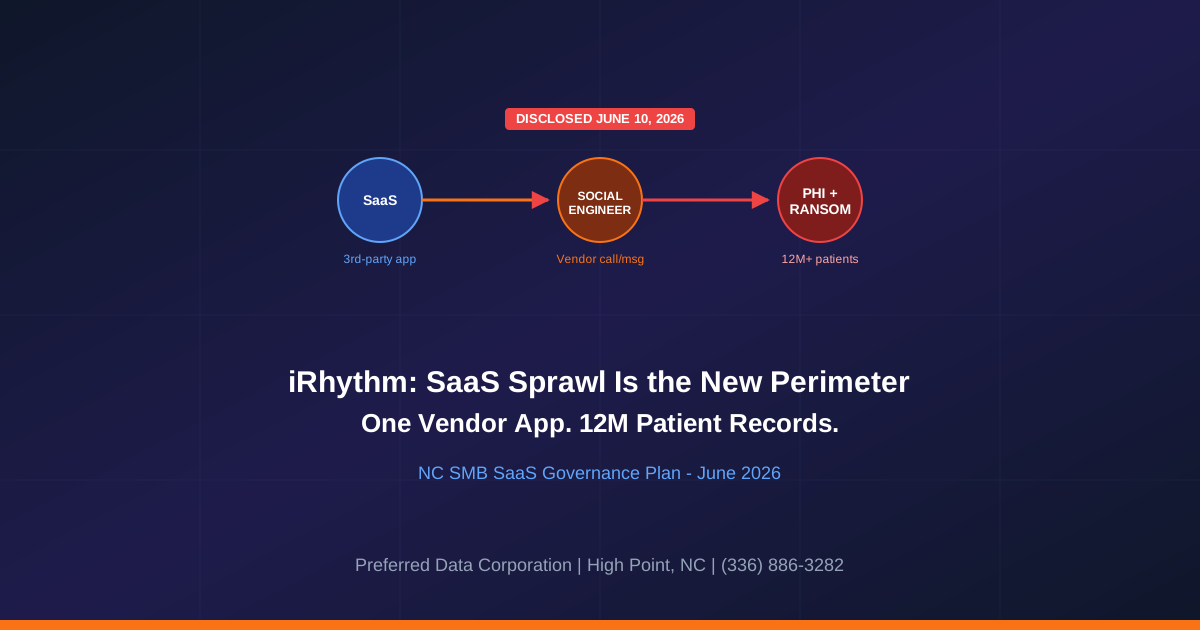
TL;DR: On June 10, 2026, iRhythm Holdings disclosed a data breach in which attackers used social engineering to compromise third-party-hosted business applications and exfiltrated patient health information, proprietary data, and personal information from a company whose cardiac-monitoring platform has analyzed over 12 million patients. Per Help Net Security and the HIPAA Journal, the attackers demanded a ransom and the breach scope is still being investigated. For NC small businesses, the lesson is direct: your weakest link is no longer your firewall - it is the third-party SaaS application a vendor logged into yesterday, and most SMBs do not know how many of those there are or who can sign in to them.
Key takeaway: SaaS sprawl is the 2026 SMB attack surface. A typical 50-person NC small business runs 70 to 150 SaaS applications, most provisioned outside IT, most without phishing-resistant MFA, and most with admin access for vendors and contractors who left months ago. The iRhythm breach is what happens when one of those forgotten doors is socially engineered open.
Worried your SaaS stack would survive an iRhythm-style attack? Preferred Data Corporation runs managed SaaS governance and vendor-risk reviews for NC small businesses. Call (336) 886-3282 or request a SaaS risk review.
What did the iRhythm breach actually involve?
Social engineering of third-party-hosted business applications, not a CVE in iRhythm's own product. Per BleepingComputer, Security Affairs, and Help Net Security's June 17 coverage, the documented kill chain is:
- June 8, 2026: iRhythm identified unauthorized activity involving third-party-hosted business applications.
- June 9, 2026: The threat actor contacted iRhythm and claimed to have stolen proprietary data, patient protected health information (PHI), and other personal information.
- June 10, 2026: iRhythm publicly disclosed the breach via SEC 8-K filing, confirming threat actor contact and ransom demand.
- June 17, 2026: Reporting confirmed the entry vector was social engineering against the third-party SaaS apps; iRhythm's own clinical and medical device systems were not affected.
Three details make the iRhythm pattern the SMB archetype to internalize:
- The vulnerable system was not the company's product. iRhythm builds class II medical devices and a clinical platform that has analyzed over 2 billion hours of cardiac data from 12 million patients. The breach happened in the business SaaS layer (likely sales, HR, customer success, or operations apps) that lives outside the regulated platform.
- The entry method was a phone call or message, not malware. Social engineering against a third-party SaaS administrator bypasses every endpoint control the security team purchased for the product side.
- The ransom demand was direct contact, not a leak-site listing. The attacker emailed or called the target before any public claim, a 2026 trend that compresses incident-response timelines from weeks to hours.
For a Piedmont Triad small business in High Point, Greensboro, Charlotte, Raleigh, or Winston-Salem, this is the new shape of the SaaS-first SMB threat. The crown-jewel data is no longer behind the firewall; it is in HubSpot, Salesforce, Gusto, QuickBooks Online, Microsoft 365, an ATS, a custom industry tool, or a SaaS that the sales team set up six months ago and never told IT about.
Why does third-party SaaS exposure hit NC small businesses harder than the iRhythm case suggests?
Because SMBs run more SaaS per employee than enterprises and govern it with less. Per Productiv's 2026 State of SaaS report and broader Gartner research, a typical 50-person business now runs 70 to 150 SaaS applications, with 40% to 60% provisioned outside IT's knowledge and 25%+ retaining at least one orphaned admin account from a former employee or vendor.
The structural reality compounding the risk:
- SSO is partial. Most SMBs route their primary tools (M365, Google Workspace, Salesforce) through SSO, but tail SaaS (industry tools, spot-purchase apps, AI-coding helpers, marketing automation niche tools) still use local passwords with weak or no MFA.
- Vendor admin accounts persist. When a consultant, fractional CTO, marketing agency, or accounting firm finishes an engagement, their admin accounts in the SMB's SaaS often remain active for months or years.
- OAuth grants are forgotten. A user who once approved "Allow MarketingApp to read your email" months ago still has that app actively pulling data unless someone audits OAuth grants quarterly.
- Help-desk verification is informal. A call to the SMB's outsourced IT or to a SaaS vendor's support line can reset a password without strong out-of-band verification, the exact archetype that hit iRhythm and is documented in Microsoft's Storm-2949 case.
| SaaS risk control | What it covers | Common SMB gap |
|---|---|---|
| SSO + conditional access | Sanctioned tier-1 apps | Tail SaaS still on local passwords |
| Phishing-resistant MFA | Admins, finance, IT | Sales reps with CRM admin |
| OAuth grant review | Suspicious permission scopes | Never audited after initial setup |
| Vendor offboarding | Documented at end of engagement | Vendor still has admin 6 months later |
| 24/7 monitoring | Sanctioned apps in SIEM | Tail SaaS has zero alerting |
For an NC small business, the iRhythm breach is the canary for the same risk applied at smaller scale. The same SaaS sprawl, the same social-engineering target, the same gap in vendor offboarding, except the SMB does not have the SEC disclosure obligation that forced iRhythm to surface the incident within 48 hours.
What's the financial and compliance exposure for a Piedmont Triad SMB?
Larger than most operators expect. Per SQ Magazine's 2026 SMB cyber statistics, the average SMB breach cost in 2026 is $3.31 million, 70.5% of all data breaches now hit SMBs, and only 34% of SMBs have a formal incident response plan. Per the Verizon 2026 DBIR, third-party-related breaches now drive 48% of incidents, double the prior-year figure.
For a Piedmont Triad small business, the exposure stacks:
- Customer data in SaaS. CRM, support tickets, signed contracts in DocuSign or Adobe Sign, and email all contain customer PII, financial data, and competitive information.
- Employee data in HR SaaS. Gusto, ADP, BambooHR, Justworks store W-2 data, SSNs, direct-deposit info, and benefit elections.
- Operational data in industry SaaS. Manufacturers use cloud MES/ERP integrations; construction firms use Procore, Buildertrend, or PlanGrid; legal and accounting firms use Clio, NetDocuments, or Karbon. Each is a potential iRhythm-shaped target.
- Regulatory exposure stacks. HIPAA (for healthcare-adjacent SMBs), GLBA (for accounting and finance), CMMC 2.0 (for defense-adjacent manufacturers), and state breach-notification laws (NC's G.S. 75-65) all attach. NC requires notification "without unreasonable delay" and the AG's office tracks reportable incidents annually.
The economic punchline is that a SaaS-layer breach is now a peer-level event with a perimeter breach, but with less inherent visibility because the SMB never deployed a SIEM that ingests SaaS audit logs.
Quotable definition: A third-party SaaS breach is a 2026 attack pattern in which adversaries socially-engineer or credential-stuff their way into a sanctioned or unsanctioned third-party hosted business application that holds the SMB's data, then exfiltrate that data and demand ransom directly from the SMB rather than from the SaaS vendor, bypassing the SMB's network perimeter entirely.
What should an NC small business do this quarter to harden the SaaS layer?
Treat SaaS like the new perimeter and run the six-step SaaS governance playbook.
- Build a SaaS inventory. Pull a list of every application with corporate credentials by reviewing M365/Google audit logs, expense reports for SaaS subscriptions, and OAuth grant lists. Most SMBs find 30% to 50% more applications than they expected.
- Enforce SSO or phishing-resistant MFA on every application that holds material data. Per Microsoft's data on FIDO2 adoption, phishing-resistant MFA reduces credential-theft account compromise rates by more than 99% versus password-only.
- Audit OAuth grants and integration tokens quarterly. Revoke anything unused, anything from a vendor relationship that ended, and anything with excessive permission scopes. Document a review cadence.
- Document vendor offboarding. When a contractor, fractional executive, marketing agency, or accounting firm finishes an engagement, the offboarding checklist must include admin-account removal across every SaaS application, not just M365 and Google.
- Train the workforce on social engineering against SaaS. The iRhythm pattern is a call or message to a SaaS admin claiming to be the vendor, IT, or a senior leader. Train staff to verify out-of-band with a known phone number, never the number the caller provides.
- Stand up SaaS log ingestion in a SIEM with 24/7 SOC eyes. A successful login from an unexpected geography at 3 AM Sunday must trigger a response. Per the 2026 Huntress SMB Threat Report, the gap between attacker speed and defender response is the dominant breach driver of 2026.
Need this restructured for your business? Call (336) 886-3282 or contact Preferred Data Corporation for a SaaS risk and vendor review.
Why does this require a managed partner, not just an internal SaaS-ops checklist?
Because SaaS sprawl is a moving target. Marketing approves a new tool every quarter. Sales adopts an AI helper without asking. Finance integrates QuickBooks Online with three new fintech apps. HR onboards a benefits portal. A typical SMB's SaaS inventory turns over 20% to 30% a year. An in-house generalist running the SaaS audit around other duties will fall behind within a quarter.
The defense that survives an iRhythm-shaped attack is a managed lifecycle: continuous SaaS discovery, OAuth grant review, vendor-account offboarding, identity-provider hardening across all sanctioned tools, and 24/7 SOC monitoring with alerting on unusual SaaS sign-in patterns. Per the Verizon 2026 DBIR and Huntress 2026 SMB Threat Report, third-party-related breaches doubled year over year and SMBs remain the dominant target.
For a Piedmont Triad small business, the answer is clear. Pick a managed partner that runs SaaS governance, identity hardening, vendor-risk review, and 24/7 SOC coverage as a single bundle with documented evidence for cyber insurance, HIPAA, and CMMC. Preferred Data Corporation has delivered that managed protection to North Carolina small businesses since 1987, from our High Point headquarters and on-site across the Piedmont Triad, Charlotte, Greensboro, Raleigh, and Winston-Salem.
PDC supports this through managed cybersecurity, cloud solutions, and managed IT services.
Frequently Asked Questions
Was iRhythm itself negligent?
Not on the disclosed facts. iRhythm responded within 48 hours of identifying the unauthorized activity, engaged law enforcement, and confirmed via SEC 8-K that clinical, medical device, manufacturing, and financial reporting systems were unaffected. The breach exploited the third-party SaaS layer, a problem that virtually every SMB and mid-market organization shares.
What SaaS apps are highest risk for a typical NC small business?
Anything with admin-level access to customer data, employee data, financial systems, or email. Per Productiv's 2026 SaaS report, the highest-risk categories are CRM, HR/payroll, accounting, marketing automation, file storage, and any AI tool with broad OAuth scopes against email or storage. The "long tail" of niche industry apps is also a major hidden risk because it rarely sits behind SSO.
Do I need to notify customers if a vendor breach exposed their data?
Often yes. NC's breach-notification statute G.S. 75-65 requires notification without unreasonable delay when personal information is exposed, regardless of whether the breach happened on the SMB's network or on a third-party SaaS the SMB controls access to. For healthcare-adjacent data, HIPAA breach-notification rules also apply within 60 days. For CMMC-scoped data, DoD reporting requirements attach.
Does cyber insurance cover third-party SaaS breaches?
Generally yes, but with exclusions and underwriting controls. Per Help Net Security's 2026 coverage, 2026 applications now ask explicitly about SaaS-application inventory, MFA enforcement on third-party apps, vendor-offboarding documentation, and 24/7 monitoring. Organizations without those controls face sublimits, increased deductibles, or denial when a SaaS-layer claim is filed.
How long does a SaaS-risk review take for a 25-100 person SMB?
A managed partner can complete an initial SaaS inventory, OAuth-grant review, identity-control assessment, and vendor-offboarding gap analysis in two to four weeks. Sustaining the program requires monthly to quarterly review cadences. The cost is materially lower than a single SaaS-layer incident response engagement, which now averages six figures for SMBs per SQ Magazine's 2026 statistics.
Related Resources
- Managed Cybersecurity Services for NC Businesses - SaaS governance, identity controls, 24/7 SOC
- Cloud Solutions for NC Small Businesses - Microsoft 365 and SaaS hardening
- Managed IT Services for NC Businesses - End-to-end small business technology partner
- Storm-2949 Entra ID Cloud Takeover: NC SMB Defense (June 2026) - Related identity social-engineering pattern
- Verizon DBIR 2026: 48% Third-Party Breaches - NC SMB Vendor Risk - Broader vendor-risk context
- Contact Preferred Data Corporation - SaaS risk review for NC small businesses