
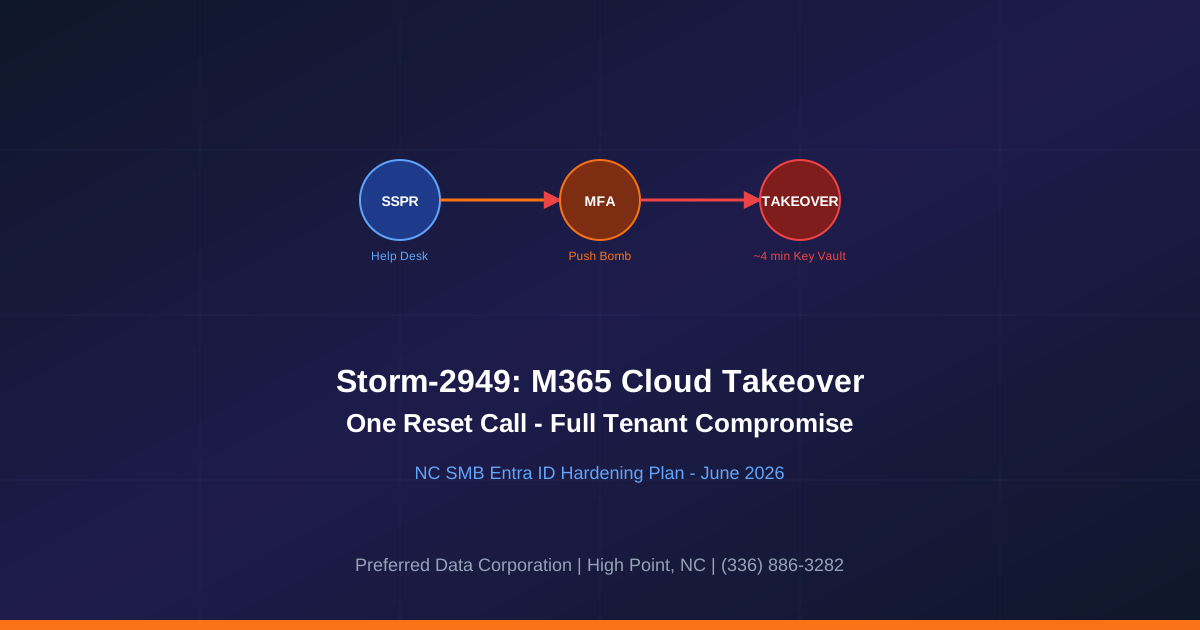
TL;DR: Microsoft's May 18, 2026 Storm-2949 case study documents how a single Entra ID identity compromise, started by social-engineering the Self-Service Password Reset (SSPR) flow, escalated into a full Microsoft 365 and Azure tenant takeover within minutes. The attacker impersonated internal IT, pushed fraudulent MFA prompts, then used the stolen identity to read dozens of Key Vault secrets in roughly four minutes and exfiltrate production data via a custom Python script. For NC small businesses standardized on M365 and Azure, the lesson is direct: identity is now the perimeter, and SMB tenants without phishing-resistant MFA, conditional access, and identity threat detection are the soft target.
Key takeaway: One reset call to your help desk can now equal full cloud takeover. SMBs that survive the 2026 identity wave are the ones that retire SMS/push MFA in favor of phishing-resistant factors, enforce conditional access, monitor for SSPR abuse, and treat help-desk verification as a security control, not a courtesy.
Worried your M365 tenant would survive a Storm-2949-style social engineering call? Preferred Data Corporation runs managed Microsoft 365 hardening and 24/7 identity monitoring for NC small businesses. Call (336) 886-3282 or request an Entra ID review.
What did Storm-2949 actually do to compromise a Microsoft 365 tenant?
Storm-2949 turned one social-engineered password reset into cloud-wide control in roughly the same time it takes to brew coffee. Per the Microsoft Security Blog, the actor (1) reconnoitered IT and senior leadership on LinkedIn, (2) called the help desk impersonating internal IT, (3) abused Entra ID Self-Service Password Reset to gain a foothold, (4) pushed fraudulent MFA prompts the target eventually approved, (5) authenticated to Azure, (6) read dozens of Key Vault secrets in about four minutes, and (7) used those secrets to authenticate into the primary production web app and exfiltrate data via Python over several days. SQL firewall rules were modified to allow access, then deleted to cover tracks.
Three things make this archetype a top-tier risk for SMBs:
- Initial access was free. No 0-day, no malware, no phishing email. A phone call to a help desk plus pressure plus push-bombing.
- Blast radius scaled with cloud privileges. Once the attacker held a single privileged identity, all the integrations a modern SMB relies on (Key Vault, SQL, Exchange, Teams, SharePoint, Power Automate, third-party SaaS) became reachable.
- Speed beat human review. The Key Vault enumeration completed inside four minutes. By the time a 9-5 in-house IT generalist would have seen the alert (if there was one), the data was already moving.
For an NC small business standardized on M365 and Azure (the default stack for most 25-500 person firms in High Point, Greensboro, Charlotte, Raleigh, and Winston-Salem), this is not a hypothetical. It is the exact attack pattern the Verizon 2026 DBIR and Huntress 2026 SMB Threat Report call out as the new front door.
Why is Self-Service Password Reset abuse so effective against small businesses?
Because SSPR is a one-call attack surface that bypasses every traditional defense the SMB invested in. Per BleepingComputer's coverage of related Entra ID flaws and Cybersecurity News's analysis, three structural realities make the SMB help desk an attractive target:
- Help desk authority is hard to verify after hours. When the "CFO" calls Friday at 6 PM asking for a reset because she "cannot get into Teams for the board call," the on-call tech is biased toward helping.
- SSPR is enabled by default for most M365 tenants. Disabling it breaks legitimate password recovery flows that the in-house team depends on.
- MFA fatigue defeats push notifications. A user pushed 30 prompts in a row will eventually tap Approve to make their phone stop buzzing. The attacker only needs one approval.
| Defense layer | What it stops | What it misses against Storm-2949 |
|---|---|---|
| Password complexity | Brute force | Social engineering of reset flow |
| SMS MFA | Casual phishing | Push-bombing, SIM swap, voice cloning |
| Push MFA | Many credential thefts | Push-bombing once user gives up |
| Conditional access (basic) | Foreign IP logins | Trusted-region attackers, residential proxies |
| Endpoint antivirus | Known malware | Cloud-native, Python exfiltration |
The defenses that actually break this kill chain are phishing-resistant MFA (FIDO2/passkeys or certificate-based), conditional access with risk-based controls, continuous access evaluation, help-desk caller verification controls, and identity threat detection (ITDR) with 24/7 SOC eyes. That stack is what an MSP runs across many clients and what an in-house SMB generalist cannot economically deploy alone.
What does this mean for NC small businesses in practice?
If the attacker can get one help-desk call answered, your tenant is in scope. Per the Verizon 2026 DBIR, 96% of ransomware victims for which size was known were SMBs, and the Huntress 2026 SMB Threat Report found that in 65% of incidents inside SMB environments, the adversary hijacked remote monitoring and management tooling supplied by an MSP or internal IT team. Storm-2949 is the cloud-identity equivalent of that pattern: hijack the identity that already has the keys.
For a Piedmont Triad small business, the exposure stacks predictably:
- Microsoft 365 is the crown jewel. Email, files, Teams, Power Automate, SharePoint, third-party SaaS that uses M365 SSO.
- Entra ID controls access to everything else. Cloud backups, CRM, ERP, accounting, design tools, vendor portals.
The fix is not "more MFA prompts." It is to rebuild the identity layer around phishing-resistant authentication, conditional access, and detection.
Quotable definition: Storm-2949 is a 2026 Microsoft-documented attack archetype in which a single Entra ID identity compromise, initiated by social-engineering the Self-Service Password Reset flow and bypassed via MFA push-bombing, escalates within minutes into full Microsoft 365 and Azure tenant takeover via Key Vault enumeration and credential theft.
What should an NC small business do this quarter?
Treat identity as the perimeter and rebuild the M365 baseline around phishing-resistant MFA, conditional access, and 24/7 monitoring.
- Retire SMS and basic push MFA for privileged accounts. Move admins, finance, and IT to FIDO2 security keys or certificate-based auth. Passkeys for everyone else as the floor.
- Lock down Self-Service Password Reset. Require strong reauthentication factors, monitor SSPR events as high-signal alerts, and document a help-desk verification script that includes out-of-band callback to a known number.
- Deploy conditional access with risk-based controls. Block legacy auth, require compliant device for admin sign-ins, and use continuous access evaluation to revoke sessions when risk changes mid-session.
- Add identity threat detection (ITDR). Entra ID P2 with Identity Protection or a third-party ITDR feeding a 24/7 SOC. Storm-2949 was detectable in real time by token replay, impossible travel, and Key Vault enumeration signals; nobody was watching at 9 PM Saturday.
- Harden Key Vault and service principals. Least privilege, conditional access for Azure service principals, secret expiration, and audit logging on every secret read.
- Train the help desk on caller verification. Out-of-band callback, photo ID over Teams, manager approval for after-hours resets. This is a security control, not a courtesy gate.
- Run an Entra ID attack-path review. Map who can reach what if their account is compromised at 2 AM. Most SMBs have far more standing privilege than they realize.
Need this restructured for your business? Call (336) 886-3282 or contact Preferred Data Corporation for an Entra ID hardening review.
Why is this a managed problem, not a single-tool problem?
Because the attack surface (Entra ID + Azure + every SaaS that uses M365 SSO) is too large for any one in-house tech to monitor 24/7. The Storm-2949 detection signals (SSPR abuse pattern, MFA push-bombing, impossible travel, Key Vault enumeration spike, token replay) are all visible in Microsoft Defender for Identity, Entra ID Identity Protection, and Defender for Cloud, but only if someone is watching at 9 PM Saturday when the attack lands. Per the 2026 Huntress SMB Threat Report and Verizon 2026 DBIR, the gap between attacker speed and defender response is the dominant breach driver in 2026.
For a Piedmont Triad small business, the answer is clear. Pick a managed partner that runs Microsoft 365 hardening, conditional access, ITDR, and 24/7 SOC coverage as a single bundle, with documented evidence for cyber insurance and CMMC. Preferred Data Corporation has delivered that managed protection to North Carolina small businesses since 1987, from our High Point headquarters and on-site across the Piedmont Triad, Charlotte, Greensboro, Raleigh, and Winston-Salem.
PDC supports this through managed cybersecurity, cloud solutions, and managed IT services.
Frequently Asked Questions
Who is Storm-2949?
Storm-2949 is a Microsoft Threat Intelligence designation for a financially motivated actor (or cluster) documented in May 2026 for converting a single Entra ID identity compromise into a full Microsoft 365 and Azure tenant takeover via SSPR social engineering, MFA push-bombing, and Key Vault enumeration. Microsoft uses "Storm-" prefixes for groups still under analysis.
Does phishing-resistant MFA actually stop this attack?
Yes, in the great majority of variants. FIDO2 security keys, passkeys, and certificate-based authentication cannot be approved by tapping a push notification, cannot be intercepted by an attacker-in-the-middle proxy, and require physical possession of the authenticator. Microsoft's own data shows FIDO2 reduces credential-theft account compromise rates by more than 99% versus password-only and meaningfully more than push MFA.
Is SSPR the only weak point?
No. The SSPR flow was the initial entry in the Microsoft-documented case, but the same archetype works against IT help desks that allow password resets over chat or phone without strong out-of-band verification. The Hacker News and Cybersecurity News have documented the same pattern via Microsoft Teams chat impersonation and direct phone calls in 2026.
What does it cost an SMB to deploy this defense?
For a 25-100 person NC small business already on Microsoft 365 Business Premium, the licensing for Entra ID P1 + Defender for Office is already included; the upgrade path to P2 (Identity Protection) is a few dollars per user per month. The dominant cost is operational: someone has to monitor the alerts and respond at 2 AM. That is the function that justifies a managed cybersecurity partner with 24/7 SOC.
Will cyber insurance underwriters care?
Yes, increasingly. Per Help Net Security's 2026 coverage and broker advisories, applications now ask explicitly about phishing-resistant MFA on admin accounts, SSPR controls, conditional access enforcement, and 24/7 monitoring. Tenants without these controls face rate hikes, sublimits, or outright denial.
Related Resources
- Managed Cybersecurity Services for NC Businesses - Phishing-resistant MFA, ITDR, 24/7 SOC
- Cloud Solutions for NC Small Businesses - Microsoft 365 + Azure hardening
- Managed IT Services for NC Businesses - Identity, endpoint, and access governance
- Scattered Spider Help-Desk Vishing: NC SMB Defense 2026 - Related social-engineering archetype
- Storm Infostealer: Session Theft Beats MFA - NC SMB Defense - Complementary session-theft pattern
- Contact Preferred Data Corporation - Entra ID hardening review for NC small businesses