
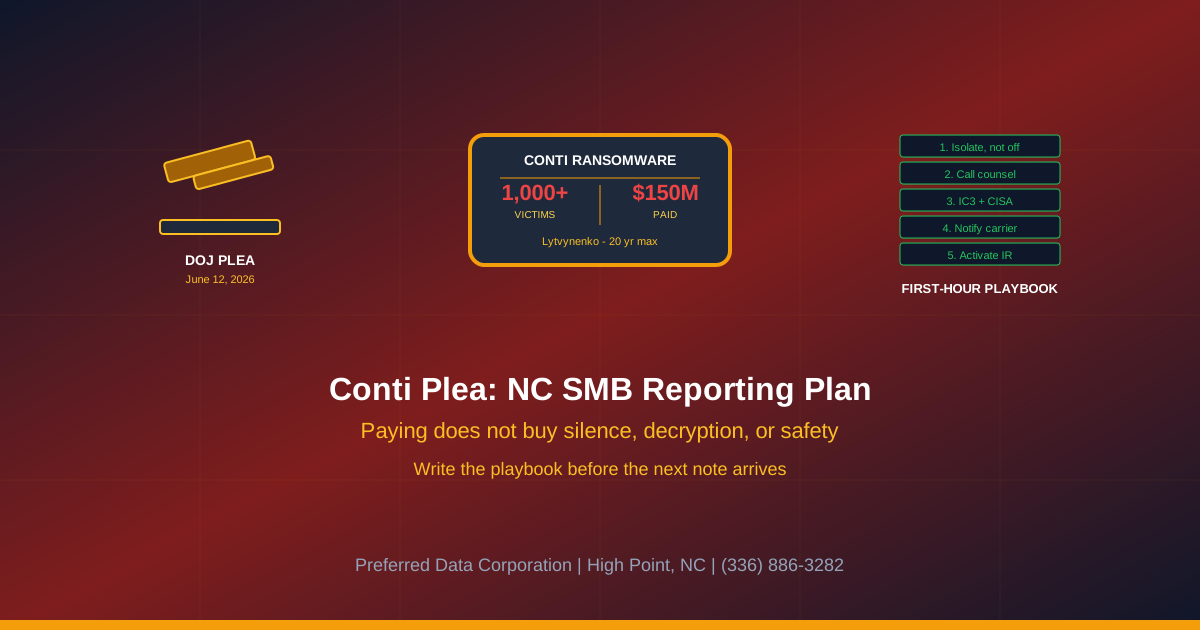
TL;DR: On June 12, 2026, Oleksii Oleksiyovych Lytvynenko, a 44-year-old Ukrainian national, pleaded guilty in U.S. federal court to wire fraud conspiracy connected to Conti ransomware operations - one of the most prolific cybercrime groups in history, with over 1,000 victims and more than $150 million in ransom payments per the U.S. Department of Justice. Per Help Net Security's June 15 coverage, Lytvynenko was extradited from Ireland after his 2023 arrest and faces up to 20 years at his September 10, 2026 sentencing. The takeaway for NC small business owners is not the courtroom drama: it is that paying a ransom does not buy silence, does not buy decryption, and does not prevent prosecution from naming you as a victim later.
Key takeaway: Law enforcement victories against ransomware operators close out individual cases, but the SMB-side risk - decryption that does not work, data that is leaked anyway, OFAC penalties for paying sanctioned actors, and disclosure obligations to customers - is the same on day one of the next attack. NC SMBs need a written ransomware playbook before the next ransomware note arrives, not after.
Need a tested ransomware playbook for your NC business? Preferred Data Corporation has supported NC small businesses since 1987 and can write and exercise the plan in two weeks. Call (336) 886-3282 or request a ransomware readiness review.
What happened in the Conti guilty plea on June 12-15, 2026?
Oleksii Oleksiyovych Lytvynenko, a 44-year-old Ukrainian national, pleaded guilty to conspiracy to commit wire fraud in connection with deploying Conti ransomware that infected more than 1,000 computers and networks worldwide. Per the U.S. Department of Justice press release, Lytvynenko joined the Conti conspiracy around September 2021 and possessed data stolen from eight U.S. victims and four overseas victims. Per BleepingComputer's reporting, he was extradited from Ireland following his July 2023 arrest and faces a maximum sentence of 20 years; sentencing is set for September 10, 2026.
Three facts NC SMBs should pull out of the case file:
- Conti victims included hospitals, schools, and SMBs. Per Becker's Hospital Review, Conti hit healthcare organizations, local governments, sheriff's departments, EMS, and businesses of every size. NC SMBs were not exempt and are not exempt from the successor groups.
- $150 million paid, 1,000+ victims. Per the DOJ, Conti is estimated to have received at least $150 million in ransom payments. That is paid-not-prevented money - it did not stop the data leak and did not stop court records from naming victims.
- Extradition from Ireland. The case took two years from arrest to plea; the prosecution still proceeded even after the Conti "brand" effectively dissolved into successor groups like Black Basta, BlackCat, and the current Qilin operation.
What does paying a ransom actually buy in 2026?
Less than NC small businesses think. Per the CISA #StopRansomware guide, paying a ransom does not guarantee that decryption keys work, does not prevent re-extortion, does not stop the leak of exfiltrated data, and may itself be illegal if the actor is OFAC-sanctioned. The Conti case file is full of evidence that the "service" was not what was advertised.
| What victims pay for | What victims actually got under Conti |
|---|---|
| Working decryption | Buggy decryptor; partial file recovery in many cases |
| Data deletion | Data often leaked anyway; double-extortion was standard |
| Confidentiality | Court records and disclosure laws name victims |
| One-and-done | Re-extortion or re-targeting by successor groups |
| Lawful resolution | OFAC risk if the wallet was sanctioned |
| Insurance reimbursement | Carrier denials if controls were not in place |
The honest summary: per the Treasury OFAC advisory on ransomware payments, paying a ransomware operator who is OFAC-designated can expose the paying company to civil penalties even if the company believed in good faith that payment was the only option. The decision to pay is no longer a clean business decision; it is a legal-counsel-and-breach-coach decision.
What is the correct first-hour response when a NC small business gets a ransom note?
The first hour is about containment and counsel, not negotiation. Per CISA's #StopRansomware Guide, the first-hour actions are isolating affected systems, preserving evidence, contacting law enforcement, and engaging breach counsel - in that order. NC SMBs that try to pay in the first hour usually skip the legal-counsel step, which is where OFAC exposure, insurance reimbursement, and downstream notification obligations are decided.
The first-hour playbook:
- Isolate, do not power off. Disconnect affected systems from the network but keep them powered on so memory and process state remain available for incident responders.
- Engage breach counsel. Your business attorney is not your breach coach. NC SMBs should have a privacy and cyber lawyer on retainer or on speed dial; the call to counsel is what triggers attorney-client privilege over the investigation.
- Contact the FBI via IC3.gov and CISA via stopransomware.gov. Per the DOJ, ransomware reporting is what gives prosecutors the evidence chain to do what they did in the Conti case.
- Notify your cyber insurance carrier. Most policies require notification within 24-72 hours; missing the deadline can void coverage.
- Activate the incident response (IR) retainer. If you have an IR retainer, the IR firm directs containment, forensics, and negotiation strategy. If you do not have an IR retainer, the next 48 hours are when you find out it would have been worth it.
Quotable definition: A ransomware incident response plan is the written, exercised set of decisions a business has agreed to in advance - isolation steps, who calls counsel, who calls law enforcement, who is authorized to negotiate, what the insurance carrier needs in writing - so the first hour after a ransom note is not the first time those decisions are made.
Which NC small businesses are most exposed to ransomware in mid-2026?
NC SMBs in sectors that ransomware groups target most aggressively: manufacturing (where downtime is expensive), healthcare-adjacent services (where data sensitivity makes pressure high), professional services (where client data is leverage), and any SMB without a tested backup-and-restore process. Per Industrial Cyber's 2026 ransomware reporting, attack volumes have held at an "elevated new normal" through 2026 rather than declining as some predicted after the Conti takedown.
The highest-exposure NC SMB profiles:
- NC manufacturers in High Point, Winston-Salem, and Greensboro running aging ERP and shop-floor systems. Per CISA, manufacturing has been the most-attacked sector in recent quarters because downtime carries direct revenue and contract-penalty consequences. See our Managed IT services page for manufacturing endpoint hardening.
- NC healthcare-adjacent SMBs (medical practices, billing companies, durable medical equipment, home health) in Charlotte, Raleigh, and the Triad. PHI raises pressure on the business to pay; HIPAA raises pressure on the business to disclose.
- NC professional services firms (law, accounting, engineering) in Raleigh, Charlotte, and Winston-Salem. Client data is the ransom lever; insurance carriers expect documented controls.
- NC distributors and 3PLs in Greensboro and Charlotte. Downtime cascades into customer SLA penalties; cyber insurance underwriters scrutinize the backup-and-restore process specifically.
- NC defense contractors and CMMC-scoped firms. A ransomware event involving CUI is a reportable cyber incident under DFARS 252.204-7012, with a 72-hour clock that runs whether or not you are ready to report.
Worried that your team would not know what to do in the first hour of a ransomware event? Call (336) 886-3282 or book a ransomware readiness review.
What should NC SMBs do this week to be ready before the next ransomware event?
Run a five-step plan over the next 30 days. The Conti plea is the news; the work is internal. Per the CISA #StopRansomware guide, the controls that prevent ransomware are also the controls that limit the blast radius when prevention fails.
- Write a one-page incident response playbook (days 1-5). Document who calls counsel, who calls IC3 and CISA, who calls the insurance carrier, who is authorized to communicate with the attacker, who is authorized to authorize payment, and who is the technical lead on containment. One page. Print it. Put it in the safe.
- Verify backups can restore (days 5-14). Most NC SMBs have backups. Most NC SMBs have not tested a restore in the last 12 months. Test now. Time the restore. Document the result.
- Engage incident response and breach counsel before you need them (days 7-14). A pre-negotiated IR retainer and a pre-introduced cyber lawyer turn the first hour from chaos into checklist. Reference our Cybersecurity services for retainer relationships.
- Audit your cyber insurance policy (days 10-21). Read the controls schedule. Confirm you have what the carrier requires: MFA everywhere, EDR on every endpoint, immutable backups, documented patch cadence, security awareness training. Carriers deny claims when controls are not in place.
- Run a 90-minute tabletop exercise (days 21-30). Get the executive team, IT, legal, and finance in one room. Hand out the ransom note. Walk through the playbook. Identify gaps. Fix them.
Key takeaway: The first action is writing the one-page playbook. NC SMBs that have not documented who makes which decision in the first hour will rediscover those decisions under pressure, with the attacker holding the clock. A one-hour planning session is the highest-ROI security step of the next 30 days.
How does Preferred Data Corporation help NC SMBs prepare for ransomware?
PDC has supported NC small businesses since 1987 and treats ransomware preparedness as part of every managed-services relationship. We bring three things to the Conti-era conversation:
- Cybersecurity services: Incident response retainers, breach-counsel and breach-coach introductions, ransomware tabletop exercises, cyber insurance control audits, and 24x7 monitoring tuned for ransomware precursor activity. We help NC SMBs treat the first hour as a checklist, not a fire drill.
- Managed IT services: Patch management, endpoint hardening, immutable backup architecture, MFA enforcement, and the day-to-day operational work that prevents ransomware in the first place. For NC manufacturers in High Point, distributors in Greensboro, and professional services firms in Charlotte and Raleigh, the managed baseline is the control schedule the cyber insurance carrier asks for.
- Backup and recovery services: Immutable, off-site backups with tested restore processes; the single control most likely to make the difference between "we restored and kept going" and "we paid and hoped." We test restores so you do not test them under duress.
For small business owners in High Point, the Piedmont Triad, Greensboro, Winston-Salem, Charlotte, and Raleigh, the Conti plea is the cue to formalize ransomware readiness now rather than after the next note arrives. The CISA #StopRansomware resources frame this clearly: SMBs face enterprise-grade exposure with a fraction of the staff. A trusted local partner closes the gap.
Ready to write the one-page playbook this week? Call (336) 886-3282 or book a ransomware readiness review.
Frequently Asked Questions
Who pleaded guilty in the June 2026 Conti case?
Oleksii Oleksiyovych Lytvynenko, a 44-year-old Ukrainian national, pleaded guilty on June 12, 2026, to conspiracy to commit wire fraud in connection with Conti ransomware. Per the DOJ, he was extradited from Ireland and faces up to 20 years; sentencing is scheduled for September 10, 2026.
Does the Conti takedown reduce ransomware risk for NC SMBs?
Not materially. Per Industrial Cyber, ransomware attack volumes have held at an elevated new normal through 2026 as successor groups (Black Basta, BlackCat, Qilin, Akira, and others) absorbed Conti talent and infrastructure. The brand changed; the threat did not.
Should an NC small business pay a ransom?
The decision must go through breach counsel and the cyber insurance carrier before any commitment. Per the Treasury OFAC advisory, payments to sanctioned actors can carry civil penalties; per CISA, payment does not guarantee working decryption or prevent data leak. Most NC SMBs find that an audited restore process is cheaper and faster than negotiation.
What is the first thing to do when a ransom note appears?
Isolate affected systems without powering them off, engage breach counsel, contact the FBI via IC3.gov and CISA via stopransomware.gov, notify your cyber insurance carrier, and activate your incident response retainer - in that order. The first hour is a checklist, not an improvisation.
Will my cyber insurance policy reimburse a ransom payment?
Only if the controls schedule in your policy was met at the time of the event. Carriers deny claims where MFA, EDR, immutable backups, or other required controls were absent. NC SMBs should audit their policy controls schedule annually and confirm operational compliance.
What is the first thing an NC SMB should do this week?
Write a one-page incident response playbook. Document who calls counsel, who calls IC3 and CISA, who calls the insurance carrier, who is authorized to negotiate, and who is the technical lead. Print it. Put it in a safe and in a Google Doc. The Conti plea is the reminder; the playbook is the work.
Related Resources
- Cybersecurity Services for NC Small Businesses - Incident response retainers and ransomware tabletops
- Managed IT Services for NC Businesses - Endpoint hardening and patch management
- Backup and Recovery Services - Immutable backups with tested restore processes
- AudiA6 Ransomware Takedown: NC SMB Payment Reality 2026 - Earlier law enforcement lesson
- Tycoon 2FA Takedown: NC SMB Phishing-Proof MFA Plan 2026 - MFA hardening
- Veeam CVE-2026-44963 Backup RCE: NC SMB Defense 2026 - Backup tool hardening
- Contact Preferred Data Corporation - Ransomware readiness review for NC SMBs