
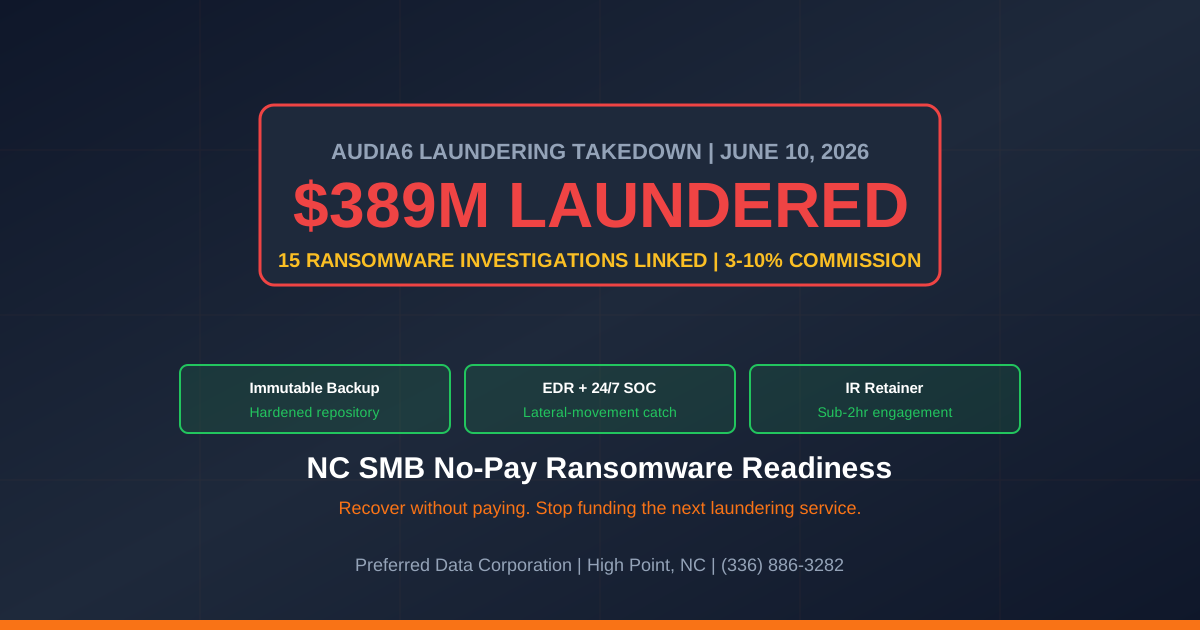
TL;DR: On June 10, 2026, Europol, the FBI, and international partners dismantled AudiA6, a cryptocurrency laundering service that moved EUR 336 million (~$389 million) for cybercriminals between 2022 and 2025. Per BleepingComputer and The Hacker News, the service was linked to 15 distinct international ransomware investigations and returned cleaned crypto to operators in approximately one hour at a 3-10% commission. 25 domains were seized, 30+ servers taken offline, and two administrators arrested in Georgia. The takedown is a meaningful disruption - but the message for NC SMBs is that the ransomware payment economy is industrialized, professionalized, and resilient. The durable answer is no-pay readiness, not waiting for the next takedown.
Key takeaway: AudiA6's industrial-scale laundering proves ransomware is a logistics business with vendors, commissions, and SLAs. NC SMBs that go into an incident with no immutable backup, no incident-response retainer, and no business-continuity plan are paying customers in that logistics chain - whether or not they want to be. The fix is no-pay readiness, locked in before the encryption hits.
Need your no-pay ransomware readiness validated this quarter? Preferred Data Corporation runs managed cybersecurity and incident response for NC small businesses since 1987. Call (336) 886-3282 or book a ransomware readiness review.
What was AudiA6 and why does it matter to NC SMBs?
AudiA6 was a cryptocurrency laundering service - effectively a money-laundering-as-a-service offering - that ransomware crews used to convert ransom payments into clean crypto for operator payouts. Per Help Net Security and Chainalysis' AudiA6 case study, the service had four properties that explain its longevity:
- EUR 336 million laundered (~$389M) between 2022 and 2025, per Europol.
- 3-10% commission with cleaned crypto returned in approximately one hour, per Cybersecurity News.
- Linked to 15 distinct international ransomware investigations, per Europol's statement.
- Thousands of fraudulent exchange accounts opened using stolen or purchased identities to obscure transaction origins.
The June 10, 2026 operation included two arrests (Ukrainian and Russian administrators) in Georgia, 25 domains seized, 30+ servers offline, more than 80 vehicles and multiple properties confiscated, and EUR 692,000 in crypto frozen plus EUR 86,000 seized outright. Per The Hacker News, the same operators ran the "Dark2Web" cybercrime forum where AudiA6 was advertised.
For an NC SMB owner, AudiA6 is the part of the ransomware economy nobody photographs - the back office that makes the front-office encryption profitable. The takedown is a win, but it does not change the realistic ransomware operating model for 2026: successor services already exist, the demand is unchanged, and the same operators will reappear under new branding inside the same quarter.
What does AudiA6's $389M tell an NC SMB about ransomware payment economics?
It tells you ransomware is a logistics business, not a hacking story. Per TRM Labs' AudiA6 dismantling analysis, the realistic 2026 payment economy works as follows:
| Ransomware Logistics Layer | What It Costs the Victim | Who Profits |
|---|---|---|
| Initial access broker | $1,000-$50,000 per access sold to ransomware affiliates | IAB operator |
| Ransomware affiliate share | 60-80% of ransom paid | The crew running the intrusion |
| Ransomware-as-a-Service platform fee | 20-40% of ransom | The RaaS operator (LockBit, Akira, etc.) |
| Crypto laundering commission | 3-10% of ransom (AudiA6 rate) | Mixer / laundering service |
| Operator payout | Net cash to operator after laundering | Individual operators in source countries |
Per Infosecurity Magazine, the takedown's tactical value is real, but the durable lesson is that the ransomware logistics chain is robust. AudiA6 had at least one direct competitor at every stage of the supply chain at the moment of takedown, which means operators continue earning. For NC SMB victims, this translates as: ransom demands stay realistic to SMB pay capacity ($150K-$2M, per the NightSpire profile), and "negotiation" is a sales call by a professional intake team.
Should an NC SMB ever pay a ransom in 2026?
The realistic answer is "almost never, and only after sanctions review." Per OFAC guidance and the Treasury Department's 2020 ransomware advisory updated through 2026, ransom payments to sanctioned ransomware crews, mixers, or wallets can constitute OFAC violations carrying civil and criminal penalties even when the victim was the target. With AudiA6 now under U.S. sanctions exposure, any ransom payment from a 2022-2025 victim that flowed through AudiA6 is potentially in scope for retroactive review.
Three operational realities NC SMBs should internalize:
- Paying does not guarantee data return. Per BlackFog's 2026 State of Ransomware, a meaningful share of payers do not get usable decryption keys or do get partial recovery only.
- Paying does not guarantee deletion of exfiltrated data. Double-extortion crews regularly resell or re-leak victim data after payment.
- Paying increases the victim's repeat-attack probability. Crews that get paid mark the victim in shared affiliate networks as a "good customer."
Quotable definition: A ransom payment in 2026 is a sanctions-risk-bearing, success-rate-limited, recidivism-risk-amplifying transaction. The decision must run through cyber-insurance carrier coordination, OFAC sanctions screening, and incident-response counsel before any wallet sends. NC SMBs that want to keep the option closed should fund the no-pay readiness work in advance.
What is no-pay readiness for an NC SMB?
No-pay readiness is the set of controls that lets an NC SMB recover from a ransomware incident without paying the demand. Per Industrial Cyber's 2026 ransomware analysis, the durable controls are:
- Immutable / air-gapped backup with tested restore. Veeam Hardened Repository on Linux XFS with single-use credentials, S3 / Wasabi / Azure Blob with object lock, or offline tape. The tier must be unreachable from the production domain even with backup-server credentials, and the restore must be tested quarterly.
- Tier-zero AD hardening. Domain controllers isolated from the production domain admin path, separated admin workstations, and credential-guard / LAPS rollout. Ransomware crews that cannot reach tier-zero cannot kill the recovery path.
- EDR / MDR with 24/7 SOC coverage. Microsoft Defender for Business, CrowdStrike Falcon Go, or SentinelOne Singularity Control with a managed response provider. Most SMB ransomware events are detected during the lateral-movement phase by EDR signals - if anyone is watching.
- Incident response retainer with sub-2-hour engagement SLA. Pre-negotiated rates, NDA in place, communication paths defined, and DFIR contacts staged. The first 48 hours of an incident is not the time to evaluate vendors.
- Tested business continuity plan. Tabletop exercises with the leadership team that walk through "we are encrypted; we will not pay; production runs from backups by Wednesday" scenarios. The plan is only real if it has been rehearsed.
What should an NC SMB do this quarter to reach no-pay readiness?
Run a four-step plan inside 90 days.
- Audit your backup tier (this week). Verify which restore points are immutable, when the last test restore happened, and whether a domain-admin compromise could delete the backups. Per the Veeam CVE-2026-44963 advisory, domain-joined Veeam servers are an active risk this month.
- Sign an incident response retainer (this month). Pre-negotiated DFIR with 1-2 hour engagement SLA. Most cyber insurers maintain approved IR rosters; NC SMBs can also engage local providers with rapid-onsite capability.
- Roll out EDR with managed response (this month). Microsoft Defender for Business is the lowest-friction baseline for NC SMBs; CrowdStrike, SentinelOne, and Sophos are the upgrade tier. Pair the EDR with a managed SOC that responds to alerts 24/7.
- Run a no-pay tabletop exercise (this quarter). 2-hour leadership exercise with a simulated incident timeline, OFAC sanctions decision tree, cyber-insurance notification path, and recovery sequencing. The exercise frequently reveals BCP gaps that the SMB owner did not know existed.
Key takeaway: AudiA6's takedown does not change the 2026 ransomware threat - it confirms the threat is industrial. NC SMBs that close the no-pay readiness gap before the next ransomware crew lands can recover without funding the next AudiA6.
How does Preferred Data Corporation help NC SMBs reach no-pay readiness?
PDC runs managed cybersecurity, backup, and incident response for NC small businesses with quarterly readiness exercises and 24/7 SOC. We bring three things to the post-AudiA6 ransomware landscape:
- Managed cybersecurity services: EDR / MDR deployment, identity hardening, KEV-rate patching for ransomware initial-access CVEs (Fortinet, Veeam, Exchange), and managed Microsoft Defender for Business with 24/7 SOC.
- Managed IT services: Immutable backup design (Veeam Hardened Repository, object-lock S3, offline tape), tier-zero AD hardening, BCP / DR runbook authoring, and quarterly recovery testing.
- Network and infrastructure: Segmentation between production, backup, and management networks; Zero Trust remote access; and managed firewall rules that limit ransomware blast radius.
For NC manufacturers in High Point and the Piedmont Triad, NC distributors in Greensboro and Winston-Salem, NC professional services firms in Charlotte and Raleigh, and NC defense contractors handling CUI under CMMC, the AudiA6 takedown is a free preview of the 2026 ransomware industry. The work this quarter decides whether your SMB recovers on its backups or funds the next mixer.
Need help reaching no-pay ransomware readiness this quarter? Call (336) 886-3282 or book a ransomware readiness review.
Frequently Asked Questions
What was AudiA6 and when was it taken down?
AudiA6 was a cryptocurrency laundering service that ransomware crews used to convert ransom payments into clean crypto for operator payouts. Per BleepingComputer and Europol, the service laundered approximately EUR 336 million (~$389M) between 2022 and 2025 at a 3-10% commission. The takedown was executed June 10, 2026 and announced June 11, 2026.
How much money did AudiA6 launder for ransomware crews?
Per Help Net Security and Cybersecurity News, AudiA6 moved EUR 336 million (~$389 million) for cybercriminals between 2022 and 2025. The service was linked to 15 distinct international ransomware investigations and used thousands of fraudulent exchange accounts to obscure transaction origins.
Does the AudiA6 takedown reduce ransomware risk for NC small businesses?
Marginally. The takedown disrupts one laundering operator but does not change ransom demand, technique, or operator economics. Per the Industrial Cyber 2026 ransomware retrospective, competitor laundering services existed at takedown and operators continue earning. NC SMBs should not adjust their ransomware threat model down based on AudiA6 alone.
Should an NC SMB ever pay a ransom?
Almost never, and only after OFAC sanctions screening, cyber-insurance carrier coordination, and incident-response counsel review. Per Treasury Department guidance, ransom payments to sanctioned crews, mixers, or wallets can carry civil and criminal penalties. AudiA6's takedown brings 2022-2025 payment flows into potential retroactive OFAC scope. The durable posture is no-pay readiness, not pay-and-pray.
What is no-pay ransomware readiness for an NC SMB?
No-pay readiness is the set of controls that lets an SMB recover without paying. The five durable controls are: immutable / air-gapped backup with tested restore, tier-zero AD hardening, EDR / MDR with 24/7 SOC, incident response retainer with sub-2-hour SLA, and tested business continuity plans. NC SMBs without all five are paying customers in the ransomware logistics chain whether they want to be or not.
How fast can PDC stand up no-pay readiness for an NC SMB?
Realistic timeline is 60-90 days for a typical 25-200 employee NC SMB. Immutable backup design + IR retainer can be in place in 30 days; EDR / MDR rollout is 30-60 days; tier-zero AD hardening and tested BCP is 60-90 days. PDC delivers the program in phases with cyber-insurance evidence at each milestone.
Related Resources
- Managed Cybersecurity Services for NC Businesses - EDR, MDR, and managed SOC
- Managed IT Services for NC Businesses - Immutable backup and BCP / DR design
- Network and Infrastructure Services - Network segmentation and Zero Trust
- Veeam CVE-2026-44963 NC SMB Backup RCE Defense - Companion backup-tier hardening
- NightSpire Ransomware: NC SMB Manufacturer Defense - Companion ransomware threat profile
- Contact Preferred Data Corporation - Ransomware readiness review for NC SMBs