
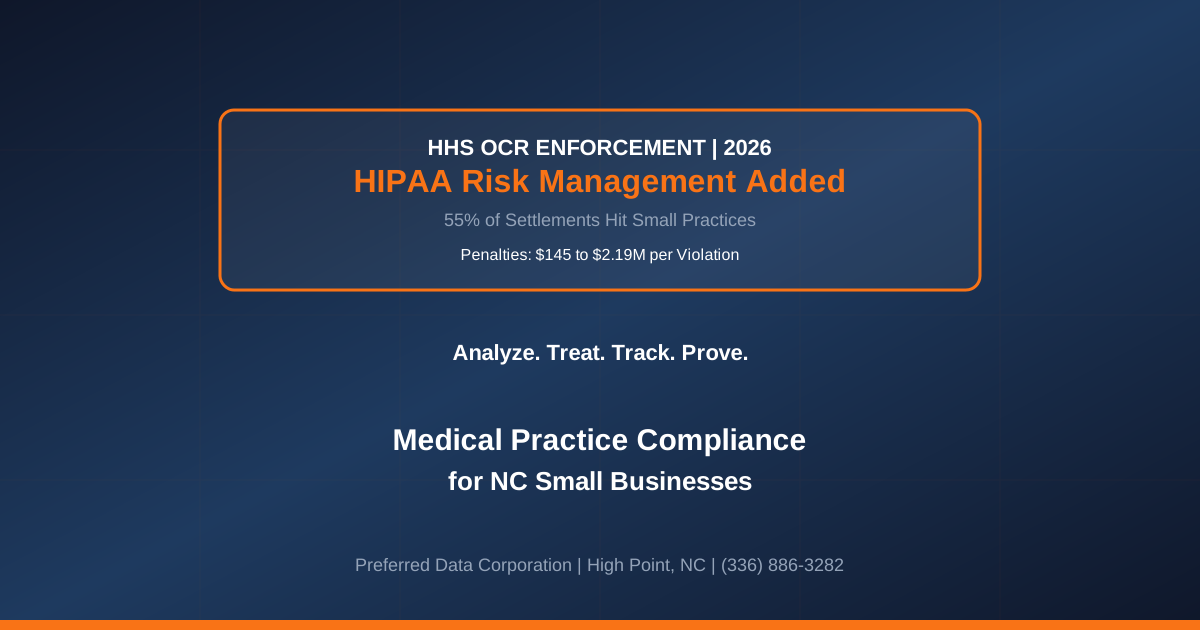
TL;DR: The HHS Office for Civil Rights (OCR) extended its longtime HIPAA Risk Analysis enforcement initiative in 2026 to also cover Risk Management, meaning covered entities and business associates must now document not only that they identified security risks, but that they treated them. 55% of documented 2022 OCR settlements targeted small practices, and 2026 penalty tiers per HIPAA violation range from $145 to $2,190,294, with annual caps of $36,506 (Tier 1) up to $2,190,294 (Tier 4). For NC small medical practices, dental offices, therapy groups, imaging centers, and medical billing companies (business associates), the compliance ask has moved from "did you do a security risk assessment" to "did you treat the risks you found." A written risk analysis with no remediation tracker is now a self-documented enforcement target.
Key takeaway: OCR's expansion is not a new statute. It is an enforcement priority. That is arguably more dangerous, because it means OCR's investigators arrive with a specific script and specific evidence expectations. The right response is a documented risk register with dated remediation entries, not a shelf binder.
Do you run a small medical practice, dental office, therapy group, medical billing company, or MSP serving healthcare in NC? Contact Preferred Data Corporation for a same-month HIPAA Risk Analysis and Risk Management program build. BBB A+ rated. On-site within 200 miles of High Point. Call (336) 886-3282.
What Actually Changed in HHS OCR's HIPAA Enforcement Posture in 2026?
The HHS Office for Civil Rights has, since 2016, run a "Risk Analysis Initiative" that specifically flagged the HIPAA Security Rule's Risk Analysis requirement (45 CFR § 164.308(a)(1)(ii)(A)) as an enforcement priority. In 2026, OCR extended that initiative to also cover the paired Risk Management requirement (45 CFR § 164.308(a)(1)(ii)(B)).
Three concrete facts every NC medical SMB should treat as confirmed:
- Risk Analysis and Risk Management are two separate Security Rule requirements. Risk Analysis is the identification and documentation of risks to ePHI. Risk Management is the implementation of security measures sufficient to reduce those risks to a reasonable and appropriate level. Historically, OCR settlements cited Risk Analysis alone. In 2026, both are on the table.
- 55% of documented 2022 OCR settlements targeted small practices. OCR does not disproportionately go after hospitals. The enforcement pattern for the mid-decade window has consistently landed on small practices, dental offices, therapy groups, and business associates.
- 2026 penalty tiers range from $145 to $2,190,294 per violation. The four-tier structure (Tier 1 unknowing, Tier 2 reasonable cause, Tier 3 willful neglect corrected, Tier 4 willful neglect not corrected) has annual caps of $36,506 (Tier 1) up to $2,190,294 (Tier 4).
The 2026 enforcement expansion is not a Security Rule amendment. It is a priority shift in what OCR investigators look for when they arrive after a breach notification or a complaint. That priority shift, however, has the same practical effect on the compliance ask as an amendment would, because the evidence expectations are new and specific.
Key takeaway: The old compliance conversation was "when is the last time you did a HIPAA risk assessment." The new conversation is "show me your risk register, show me the treatment plan for each risk, and show me the dated evidence that the plan was executed." One-time compliance artifacts are not sufficient.
What Is the Difference Between HIPAA Risk Analysis and Risk Management?
For NC medical SMBs unfamiliar with the specific text of the HIPAA Security Rule, the two requirements have distinct scopes.
Risk Analysis (45 CFR § 164.308(a)(1)(ii)(A)): "Conduct an accurate and thorough assessment of the potential risks and vulnerabilities to the confidentiality, integrity, and availability of electronic protected health information held by the covered entity or business associate."
Risk Management (45 CFR § 164.308(a)(1)(ii)(B)): "Implement security measures sufficient to reduce risks and vulnerabilities to a reasonable and appropriate level to comply with § 164.306(a)."
Three concrete implications every NC medical SMB should build into their program:
- A risk analysis identifies. A risk management program treats. A risk analysis that lists "unencrypted laptop is a moderate risk to ePHI" and stops there is a compliance liability, not a compliance artifact. The paired risk management deliverable is the encryption rollout project, dated, tracked, and completed.
- Risk management is continuous, not annual. The Security Rule specifically requires that measures be sufficient to reduce risks "to a reasonable and appropriate level." That standard is not a snapshot. It requires evidence of ongoing tracking, testing, and updating as the risk landscape changes.
- Business associates are held to the same standard. MSPs serving NC medical practices, medical billing companies, medical answering services, medical waste vendors, and cloud-hosting providers whose infrastructure holds ePHI are all business associates. Every one has direct HIPAA obligations, including the paired Risk Analysis and Risk Management requirements.
What Should NC Medical SMBs Do in the Next 60 Days?
The response is a coordinated four-track program to bring the Risk Analysis and Risk Management practice into a defensible state. Tracks run in parallel over 60 days.
Track 1: Current-state Risk Analysis refresh (Weeks 1-3).
- Update the current Risk Analysis to include the 2024-2026 threat landscape. AI-driven phishing, ransomware, MFA-bypass session-cookie theft, SaaS OAuth abuse, and vendor supply-chain compromise are all in scope.
- Enumerate every system, application, and third-party vendor that touches ePHI. EHR, practice management system, imaging PACS, dental software, therapy notes SaaS, cloud storage, IT vendors, medical billing outsource partners, patient portal, telehealth platform.
- Rank risks by likelihood and impact. The output is a risk register with a defensible ranking methodology (NIST SP 800-30, ISO 27005, or a documented internal approach).
Track 2: Risk Management treatment plan (Weeks 2-6).
- For each identified risk, document the treatment decision. Mitigate, transfer (insurance), accept (with rationale), or avoid.
- For every mitigation, document the treatment plan. Specific action, responsible party, target completion date, and evidence-of-completion definition.
- Track completion in a shared risk register. Not a Word document on a shelf. A living tracker that OCR investigators can walk through with dates, initials, and evidence links.
Track 3: Core control validation (Weeks 3-8).
- MFA enforcement on every system that touches ePHI. EHR, practice management, cloud storage, email, remote access. Documented via export or screenshot.
- Encryption at rest on every device that holds ePHI. Workstation drives (BitLocker), server drives (BitLocker or LUKS), backup targets, mobile devices, portable media.
- Encryption in transit for every ePHI flow. TLS 1.2+ for web, portal, and API traffic. No cleartext protocols in production.
- Audit logging on every ePHI system. Sign-in logs, access logs, configuration change logs, retained per the HIPAA six-year evidence standard.
- Backup with documented restore test. Immutable copy plus a restore test executed inside the last 90 days.
Track 4: Business Associate Agreement (BAA) inventory (Weeks 4-8).
- Enumerate every business associate. MSP, cloud vendor, billing outsourcer, transcription vendor, patient portal, telehealth platform, remote support tool, email hosting.
- Confirm a current BAA is on file for each one. Not the 2019 template. A 2024+ BAA with modern breach-notification and subcontractor provisions.
- Confirm the business associate's own HIPAA posture. If a business associate cannot describe their own Risk Analysis and Risk Management program, that gap is now inherited by the covered entity.
What Does an OCR Investigator Actually Ask For?
Every NC medical SMB should assume, in the event of a breach notification or a complaint-driven investigation, that OCR will ask for a specific and non-negotiable evidence set.
Six evidence items OCR investigators consistently request in 2026:
- The current Risk Analysis document. Dated, signed, comprehensive across all systems and vendors touching ePHI.
- The risk register with treatment decisions. Every identified risk with mitigate/transfer/accept/avoid annotation.
- The Risk Management action plan. Specific projects, responsible parties, target dates, evidence of completion.
- Executed workforce training records. Annual HIPAA training completion for every workforce member with dates and content confirmation.
- Business Associate Agreements. Current BAAs on file for every business associate with proof of execution.
- Incident response documentation. Written IR plan, table-top exercise records, and any actual incident records including breach notification decisions.
An investigator who requests these six items and receives them, dated and organized, on the same day of the request is dealing with a defensible covered entity. An investigator who receives "let me get back to you" or a fragmented set of undated artifacts is dealing with a target.
How Do 2026 HIPAA Fines Actually Work?
The four-tier penalty structure is defined by 45 CFR § 160.404 and is inflation-adjusted annually.
Comparison: 2026 HIPAA violation penalty tiers.
| Tier | Culpability Standard | Minimum per Violation | Maximum per Violation | Annual Cap |
|---|---|---|---|---|
| Tier 1 | Unknowing | $145 | $36,506 | $36,506 |
| Tier 2 | Reasonable cause, not willful | $1,461 | $73,013 | $146,025 |
| Tier 3 | Willful neglect, corrected | $14,617 | $73,013 | $438,076 |
| Tier 4 | Willful neglect, not corrected | $73,013 | $2,190,294 | $2,190,294 |
The tier assignment is at OCR's discretion and depends heavily on the presence or absence of documented Risk Analysis and Risk Management. A covered entity with a defensible program can commonly negotiate Tier 1 or Tier 2. A covered entity with no documented Risk Analysis at all is a Tier 3 or Tier 4 candidate. The gap between Tier 1's $36,506 annual cap and Tier 4's $2,190,294 annual cap is the difference documentation makes.
Explore Preferred Data's cybersecurity services
How Does Preferred Data Handle HIPAA Compliance for NC Medical SMBs?
Preferred Data has served NC medical practices, dental offices, therapy groups, imaging centers, and medical billing companies as their IT and cybersecurity provider for decades. Our HIPAA program is a four-layer deliverable aligned to the 2026 OCR expansion.
PDC's four-layer HIPAA compliance program for NC medical SMBs:
- Risk Analysis refresh. Comprehensive Risk Analysis document aligned to NIST SP 800-30 methodology, covering every system, application, and vendor that touches ePHI. Updated annually and after any material environmental change.
- Risk Management program build. Risk register with treatment decisions, action plans, and dated evidence. Continuous tracking with quarterly reviews.
- Core control implementation. MFA enforcement, encryption at rest and in transit, EDR on workstations and servers, immutable backup with documented restore test, audit logging, workforce training.
- BAA and evidence-packet governance. BAA inventory maintained, business associate posture verified annually, evidence packet organized for immediate OCR request response.
Cost for a typical NC small medical practice (5-25 workforce members, single office, standard EHR + practice management stack): $8,000-$18,000 for the initial program build, plus ongoing quarterly review and evidence maintenance included in a managed cybersecurity retainer. The alternative, a Tier 4 OCR settlement on a documented Risk Analysis failure, is a $73,013-$2,190,294 penalty exposure plus the reputational and patient-attrition cost that follows a public breach notification.
Frequently Asked Questions
Is our annual HIPAA risk assessment sufficient in 2026?
An annual assessment is the starting point, not the finish line. The 2026 enforcement posture requires evidence of ongoing risk management activity between assessments: dated remediation entries, quarterly reviews of the risk register, and evidence of controls executed against the treatment plan. A shelf-binder annual assessment with no downstream tracking is now specifically what OCR investigators look for as a Tier 3 or Tier 4 indicator.
Are we a "business associate" if we are an MSP serving a medical practice?
Yes. Any vendor whose access to a covered entity's systems creates the capacity to access ePHI is a business associate, regardless of whether ePHI is actually accessed. That includes MSPs, cloud vendors, remote-support tool operators, medical billing companies, transcription vendors, and any other vendor with system-level access. Every business associate needs its own HIPAA program and a signed Business Associate Agreement with each covered entity client.
What is the actual penalty a small NC dental practice would face for a HIPAA violation?
The penalty depends on OCR's tier assignment. A first-time unknowing violation with a documented Risk Analysis program in place is commonly resolved at the Tier 1 level with a $36,506 annual cap and often a Corrective Action Plan rather than a settlement. A small practice with no documented Risk Analysis facing a breach that affected patient records is a Tier 3 or Tier 4 candidate with per-violation penalties starting at $14,617 and reaching $2,190,294 annually. The gap is entirely about documentation.
How does the 2026 OCR expansion interact with NC state breach notification law?
North Carolina's Identity Theft Protection Act (N.C.G.S. § 75-65) requires notification to affected residents and the NC Attorney General for breaches involving personal information, which overlaps with but is not identical to HIPAA's ePHI definition. NC medical SMBs face both HIPAA notification obligations (to HHS and affected individuals) and state obligations (to the NC AG and affected residents). Both regimes now expect documented Risk Management evidence as part of the breach-notification package.
Does encryption of every device really matter for a small practice?
Yes. HIPAA specifically treats encryption as an "addressable" implementation specification, but OCR guidance and settlement patterns since 2013 have consistently treated unencrypted devices holding ePHI as a documented Risk Analysis failure when the breach involves that device. The lost-laptop breach pattern (theft from a rental car, hotel room, or employee vehicle) is a common OCR enforcement trigger for small practices. Encryption at rest via BitLocker or equivalent is a compliance floor.
We use a cloud EHR. Isn't the vendor responsible for HIPAA?
Partially. The cloud EHR vendor is a business associate and has direct HIPAA obligations. However, the covered entity (your practice) retains obligations for the systems and workflows on your side of the shared-responsibility line: workstation security, user provisioning and deprovisioning, MFA on your logins, network security, physical security of your office, workforce training, and BAA governance. The cloud vendor's HIPAA compliance does not shift these obligations to them.
How often should a business associate refresh their HIPAA Risk Analysis?
Annually at minimum, plus after any material environmental change (new system, new vendor, significant workforce change, discovery of a vulnerability, or a breach). Business associates serving multiple covered entities should also refresh whenever a covered entity requests updated documentation for their own compliance package.
Related Resources
- Cybersecurity Services for NC Small Businesses
- Managed IT Services
- Backup Services
- Contact PDC — request a same-month HIPAA Risk Analysis and Risk Management program build