
Count the Apple devices reaching your company email. Not the ones you bought. All of them.
In the estates we inventory at North Carolina manufacturers, the number of personal iPhones collecting company mail routinely runs several times the number of company-owned phones, and none of them appear in anybody's patch report. That gap is the actual subject of this post. Apple shipped an emergency fix on September 28 for a flaw in the code that renders PDFs and images, and the only honest answer most 20-250 person companies can give to "are we patched" is that they do not know, because they do not know what they have.
Start with the part that has a right answer.
Which OS version should each device be on?
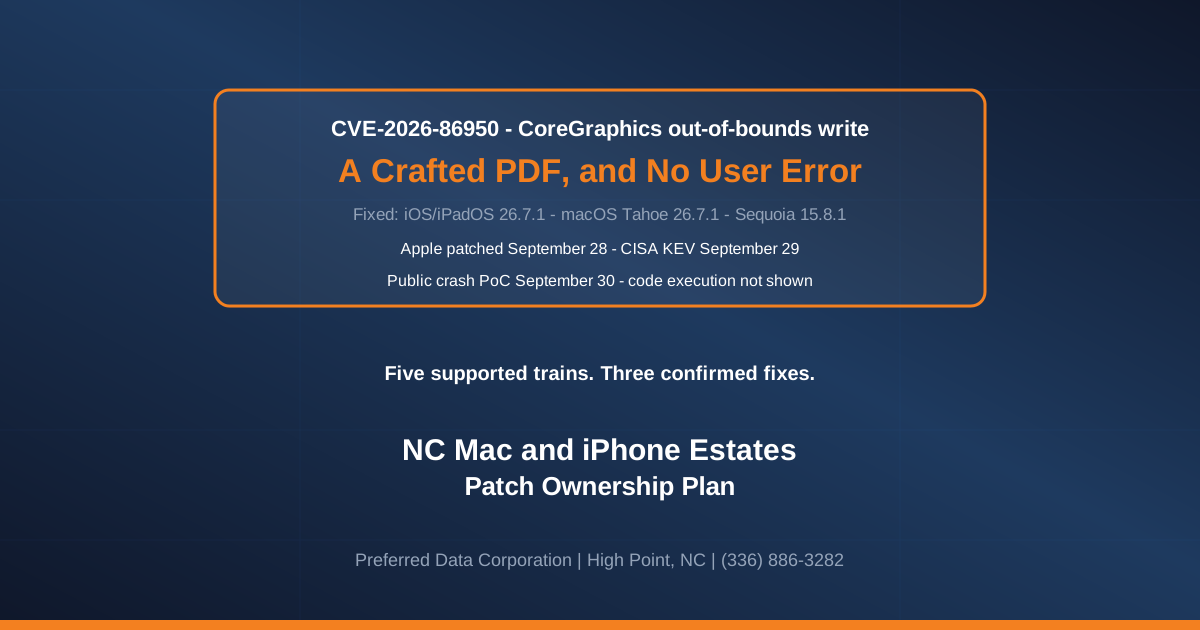
Apple is supporting three macOS trains and two iOS trains at once, so there are five answers rather than one. Only three of them are confirmed fixes for this flaw. "Update to the latest version" is wrong advice for at least two rows of this table.
| Device and train | OS version to be on | Does it carry this fix? | Source |
|---|---|---|---|
| iPhone or iPad on iOS/iPadOS 27 (current) | 27.0.1 | Unknown. Apple published no CVE entries for this update and has not said whether iOS 27 contains the bug | Apple's security releases list |
| iPhone or iPad on iOS/iPadOS 26 | 26.7.1 | Yes, named in the release notes | Apple's iOS 26.7.1 release notes |
| Mac on macOS Golden Gate 27 (current) | 27.0.1 | Unknown, same as iOS 27. No CVE entries published | Apple's security releases list |
| Mac on macOS Tahoe 26 | 26.7.1 | Yes, named in the release notes | Apple's macOS Tahoe 26.7.1 notes |
| Mac on macOS Sequoia 15 | 15.8.1 | Yes, named in the release notes | Apple's macOS Sequoia 15.8.1 notes |
Read that third column before you report anything as remediated. Apple named this CVE in exactly three updates. For the two current trains it shipped updates the same day with no CVE entries at all, which is silence rather than clearance: install 27.0.1 because being current is right, but do not record those devices as confirmed fixed.
Three more things follow from that table that generic coverage keeps getting wrong.
A Mac that cannot run Golden Gate is not stranded. It gets Tahoe 26.7.1 or Sequoia 15.8.1, both of which carry the same fix. Pull the actual OS version off each machine before anyone concludes a Mac needs replacing.
An iPhone already on iOS 27 cannot install 26.7.1, because Apple does not permit downgrades. If somebody tells your staff to go find 26.7.1 in Settings, the ones on iOS 27 will find nothing and reasonably conclude their phone is unpatchable.
And the limit of what Apple has said bears repeating, because it is the easiest thing here to get wrong in either direction. Apple limits the reported attack to versions before iOS 27. That is a statement about what was observed, not about what the code contains, and it is the only thing Apple has committed to.
What is the flaw, in one paragraph?
An out-of-bounds write in CoreGraphics, the Apple framework that renders images, fonts and PDFs on every iPhone, iPad and Mac. Apple's description of the impact is that "processing a maliciously crafted file may lead to arbitrary code execution," and the fix was "an out-of-bounds write issue was addressed with improved bounds checking." Meta Product Security reported it. The word doing the work is processing. Nothing has to be installed, trusted or approved: the file only has to be handed to the code that draws it. How much deliberate action that takes depends on the app, and Apple does not say. Where a client renders a preview or a thumbnail by itself, the rendering is the trigger; where it does not, somebody still has to open the attachment. Either way the user has done nothing wrong, which is what separates this class of flaw from a phishing link.
Why is a targeted-spyware bug on a three-day clock?
Because the clock is not set by who the attacker was. CISA added CVE-2026-86950 to the Known Exploited Vulnerabilities catalog on September 29, 2026. CISA does not publish per-CVE reasoning, but the catalog entry's own fields say a good deal: a remediation date of October 2, three calendar days out, and a forensic-triage flag, which in Binding Operational Directive 26-04 marks the shortest tier, where an agency must both remediate inside three days and triage the asset to establish whether it was already compromised.
BOD 26-04, issued June 10, 2026, revoked both BOD 22-01 from 2021 and BOD 19-02 from 2019. It replaced their flat deadlines with a risk matrix keyed on whether an asset is publicly exposed, whether the flaw is in the catalog, whether exploitation is automatable, and whether it yields total or partial control. The matrix is published as a table in the directive itself and the longer tiers run out to months, so read it there rather than from a summary.
Note who CISA makes responsible for the exposure call. The catalog entry says in terms that "stakeholders are responsible for evaluating each asset's internet exposure." It does not classify an employee iPhone for you. Our own rule, which is ours and not CISA's, is that code which opens files, on devices that receive files from outside the company, earns a fast lane regardless of how narrow the original attack was.
Key takeaway: Only federal civilian agencies are bound by those deadlines. The sorting logic is free, and it beats what most small companies actually use, which is "patch when something breaks." File-parsing and internet-facing flaws in days. Internal-only flaws in weeks. Everything else on the next refresh.
Want the OS versions off your estate instead of an argument about them? We will pull the list and hand you what is behind. (336) 886-3282, or start here.
How worried should a 70-person NC manufacturer be?
Less than the headlines suggest, and more than before the September 30 proof-of-concept went public. In descending order of how much it should move you:
The proof-of-concept is real and public. On September 30, researchers Dion Blazakis, Josh Maine and Anna Groza at the firm Calif published the first public proof-of-concept, reported by The Hacker News: a PDF carrying a crafted TrueType font, with the generation scripts and a sample file in a public repository. Anyone can reproduce the trigger now.
It crashes devices rather than taking them over. The reporting is specific that the code "causes a crash, not an execution error," with the write landing on "two adjacent 16-bit values in a buffer that the attacker can control," and that "turning the memory corruption into a working exploit is separate work the analysis does not demonstrate." That gap is real. It is also not a guarantee: a public crash primitive in a font parser is a starting point other people now have, and nobody can tell you how long that takes to close.
The WhatsApp angle is thinner than it will sound. Researchers compared WhatsApp 26.37.73 against 26.38.74 and found new code in the later build whose attachment scanner inspects PDFs for embedded font streams, flagging them as MalformedFontProgram, UndecodableFontProgram or UnverifiedFontProgram. Suggestive, and not evidence of a delivery path. The sentence asserting that WhatsApp could deliver the exploit was removed 85 minutes after publication, in a commit by Calif's chief executive Thai Duong, and WhatsApp has published no advisory linking this flaw to its products. If a vendor email reaches you this week headlined "WhatsApp zero-day," that email is ahead of the facts and you are entitled to ask the sender why.
Key takeaway: A retracted sentence is not a secret. A vendor who builds urgency on the retracted version of a story is telling you how they will handle the next one.
The email to send your current IT provider
Most people reading this already have somebody doing their IT and are not shopping for a replacement. They are grading the one they have. So here are the questions, and what a good answer looks like, because this is worth more to you than another description of our services.
- How many Apple devices currently connect to our company mailboxes, and how many of those do we own? Good answer: two numbers, today. Bad answer: the number of company-owned devices only, which is not what was asked.
- What OS version is each of them on, and which are behind the September 28 releases? Good answer: a list of version numbers, matching the table above. Bad answer: "they auto-update."
- Who is accountable for applying Apple updates, by name? Good answer: a person or a contract clause. Bad answer: the user.
- Can our mail platform refuse a device running an unsupported OS, and is that turned on? Good answer: yes or no, plus which platform and the setting. Bad answer: "modern platforms can do that."
- If we believed a specific device had been targeted, what would you preserve before touching it? Good answer: an image or a diagnostic capture, named. Bad answer: "we would reimage it."
Four good answers out of five and you are ahead of most companies in the Piedmont Triad. Two, and you have learned something this week that no article could have told you.
The pattern we see in NC manufacturers is a Windows estate somebody manages and an Apple estate nobody can see, because the Macs belong to the one designer or the marketing person and the phones are reimbursed rather than owned. Nobody thinks the Mac is the weak machine. The problem is that it sits outside the process, so when an advisory lands there is no report that covers it and no one to ask. That is an administrative gap, it is cheap to close, and it is the thing this flaw should actually prompt you to fix.
One caution on expectations, including of us. Pulling that device list requires administrative access to your mail platform, which your current provider holds and will not generally hand to another firm over the phone. If you want us to produce it, that is a scoped engagement with your authorization, not a favor on a first call. Anyone who promises otherwise is describing something they cannot do.
Want the inventory question answered once rather than every time a zero-day lands? That is what managed IT is for. Preferred Data Corporation, 1208 Eastchester Drive, Suite 131, High Point, NC 27265, working with NC businesses since 1987. Call (336) 886-3282.
What this changes about the next one
Separate the file-parsing flaws from everything else. Bugs in the code that renders images, fonts, PDFs and documents deserve a faster response than almost anything, because the delivery path is ordinary correspondence and the user does nothing wrong. Our cybersecurity practice treats that category as same-week whether or not a specific campaign is known.
Insist on version numbers in any guidance you act on. "Update your iPhone" produced a wrong answer twice in this very advisory, once for Sequoia Macs and once for phones already on iOS 27. A provider who hands you a version table is doing the work. One who hands you a verb is forwarding a press release.
And keep the forensic question separate from the patch. On its top-tier items CISA now requires federal civilian agencies to triage the asset as well as fix it. The proportionate private-sector version is modest: patching is far less destructive than a reimage, but it is not neutral either, because an OS update rotates logs and replaces system files. If you genuinely believe a specific device was targeted, capture an image or at least a diagnostic bundle before you update it, and certainly before you wipe it.
Frequently Asked Questions
Does this affect Windows PCs?
No. CoreGraphics is Apple code, and both Apple and CISA scope this flaw to iOS, iPadOS and macOS. That is also why a Windows-centric IT process misses it entirely.
Is my iPhone at risk if I never use WhatsApp?
The flaw is in how the operating system renders files, not in any one app. WhatsApp came up only because researchers noticed its attachment scanner changing, and the claim connecting it to this flaw was retracted. Removing WhatsApp is not the answer either way. If your iPhone is on iOS 26, install 26.7.1, which Apple names as carrying this fix. If it is on iOS 27, install 27.0.1 because being current is the right posture, but note that Apple published no CVE entries for it and has not said whether iOS 27 contains this bug, so do not record that device as remediated for CVE-2026-86950.
We are on iOS 27. Are we fine?
Probably better off, and not confirmed safe. Apple limits the reported attack to versions before iOS 27 and issued this fix only for the 26 and 15 trains, but it has not said whether iOS 27 contains the same bug, and the 27.0.1 update it shipped on September 28 lists no published CVE entries at all. Install 27.0.1, and treat iOS 27 devices as lower priority than iOS 26 ones rather than as cleared.
How do I check OS versions without touching every phone?
With device management, from a report. Without it, you cannot, and that is the honest answer to most patch questions at this company size. If you are weighing whether device management earns its cost, use this week as the test case: count the hours you are about to spend confirming versions by text message.
Our employees own their phones. Can we require an update?
You can set conditions on access to company resources, which is a different thing from controlling the device. Requiring a supported operating system before a phone can reach company mail is common and defensible, and most mail platforms can enforce it. Write the rule before you need it, and give people notice rather than cutting off a salesperson's mail on a Tuesday.
Is a crash dangerous by itself?
A crash is an availability problem. The concern is what it proves: that memory is being written where it should not be, which is the foundation somebody else builds code execution on.
What happens Monday?
Send the five questions above to whoever runs your IT, and put a date on the email. The answers decide what else needs doing, and the email itself is the record that you asked. If nobody is on the other end of it, call (336) 886-3282.