
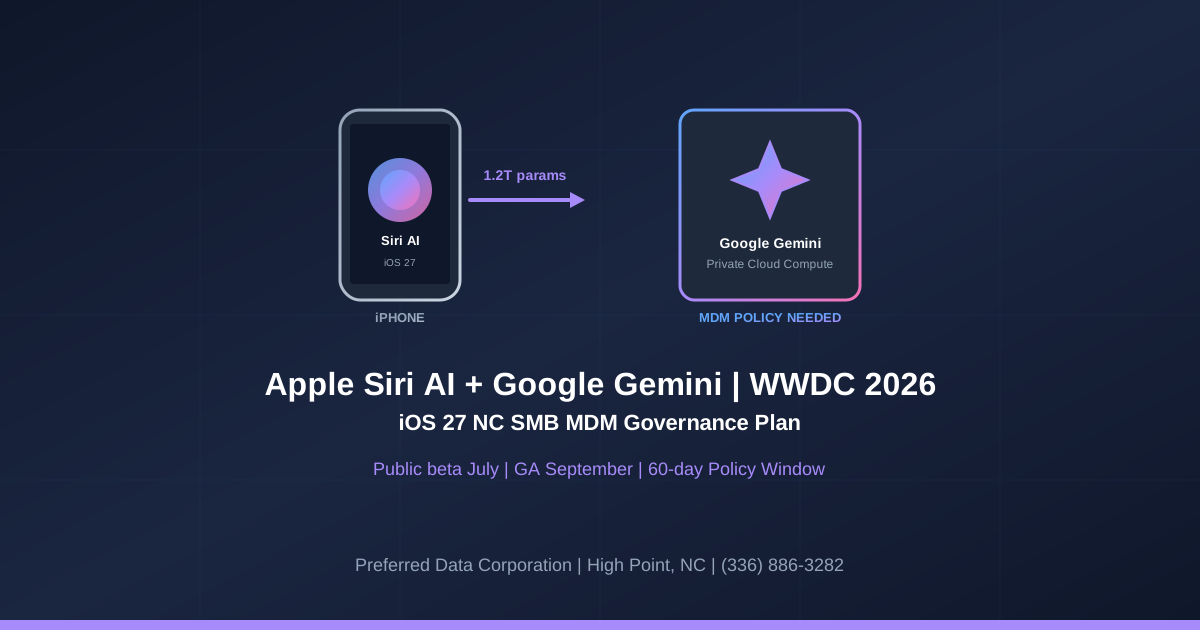
TL;DR: At WWDC 2026 (June 8, 2026), Apple announced Siri AI, a complete rebuild of the assistant powered by a custom 1.2-trillion-parameter Google Gemini model under a multi-year deal reported around $1 billion annually. Per CNBC, simple requests run on-device, complex reasoning routes through Apple's Private Cloud Compute, and the underlying model weights are Gemini-based. iOS 27 ships in September with public betas in July. For NC small businesses, the MDM and data-governance decision must be made before the public beta, not after the iPhone fleet has already opted in.
Key takeaway: Apple's Private Cloud Compute is the strongest privacy story on the market, but the underlying model is still Gemini, and the policy question is who decides which iPhone queries route to which provider. NC SMBs that write the policy before iOS 27 ships keep control; the ones that wait inherit whatever default the user picks.
Need an iOS 27 MDM and AI governance plan before September 2026? Preferred Data Corporation runs managed Apple Business Manager, Microsoft Intune iOS supervision, and AI governance baselines for NC small businesses. Call (336) 886-3282 or request an iOS 27 readiness call.
What did Apple actually announce at WWDC 2026?
Apple unveiled Siri AI, a from-scratch conversational assistant built on a customized Google Gemini foundation, plus updates across iOS 27, macOS 27 ("Golden Gate"), iPadOS 27, watchOS 27, tvOS 27, and visionOS 27. Per CNBC's WWDC 2026 live updates and MacRumors' architecture deep-dive, three things matter for an NC SMB owner:
- Siri AI runs on Google Gemini under the hood. Per Bloomberg coverage, Apple is paying Google approximately $1 billion per year for a customized 1.2-trillion-parameter Gemini model. Apple distilled smaller versions for on-device inference; larger queries route to Apple's Private Cloud Compute.
- Three-tier privacy stack. Per The Next Web, the architecture is on-device → Private Cloud Compute (Apple-owned hardware, no data retention) → optional ChatGPT / external for explicit user opt-in. Apple's stance is that the Gemini weights run on Apple hardware in Private Cloud Compute, not on Google infrastructure.
- AI App Store agents. Per TechCrunch's WWDC 2026 preview, Apple is opening App Store agent integration so users can delegate tasks like reservations, document edits, and smart-home control to third-party agents. This is the surface where SMB data governance gets hardest.
For an NC SMB owner, the practical question is not "should we adopt Siri AI" - the iPhones already on the corporate AppleCare for Business plan will receive it in September automatically. The question is "what policy do we want in place before that happens."
Why is the Gemini foundation a governance issue for NC SMBs?
Because the data-handling defaults differ depending on which tier of the Apple Intelligence stack processes a given request, and the policy decision sits with the user unless MDM makes it. Per Claims Journal and the Bloomberg preview, Apple's position is that Gemini weights running inside Private Cloud Compute on Apple silicon are equivalent to on-device inference for privacy purposes. The challenge for NC SMBs is that not every request stays in that tier.
Three structural risks for an NC SMB:
- Tier-routing ambiguity. Simple weather queries run on-device; multi-step reasoning over a document, calendar, and email runs in Private Cloud Compute; some queries optionally route to ChatGPT or external providers. The user does not always know which tier handles a given prompt.
- App Store agent surface. Per TechCrunch, third-party agents installed from the App Store can act on personal and corporate data. Without MDM constraints, an employee can connect a CRM agent to their corporate Salesforce instance with one tap.
- Regulated data overlap. NC defense contractors handling CUI, NC healthcare-adjacent SMBs handling PHI, and NC professional services firms handling client PII all share the same iPhones with Siri AI. The CMMC, HIPAA, and customer-contract review now extends to the AI assistant.
| Governance dimension | Default Siri AI (no MDM) | Managed iOS 27 with MDM policy |
|---|---|---|
| Routing across tiers | User choice per request | Policy-pinned to Private Cloud Compute |
| External provider opt-in (ChatGPT, etc.) | User toggle | MDM-disabled for regulated data |
| App Store agent install | User can install any | Allowlist via Apple Business Manager |
| Corporate data access by agents | User-granted | Policy-controlled |
| CMMC / HIPAA / PII audit posture | Documented gap | Documented control |
| Cyber insurance review | Question on application | Answered "yes" with evidence |
What is Private Cloud Compute and why does it matter?
Private Cloud Compute is Apple's server-side inference platform: Apple-designed silicon, no data retention after processing, attested boot, and cryptographic transparency about which model weights ran. Per The Next Web, Apple is positioning it as the strongest enterprise-grade privacy story in consumer AI to date. For an NC SMB, that matters in two specific ways:
- It is auditable. Apple publishes attestations about which model weights run in Private Cloud Compute, which makes it possible for a CMMC assessor or a cyber insurer to verify the data path.
- It is not a substitute for policy. Even the strongest infrastructure-level privacy story needs an explicit acceptable-use policy and an MDM-enforced configuration that ties iPhones to it. Without policy, Private Cloud Compute is a feature; with policy, it is a control.
Quotable definition: Private Cloud Compute is Apple's server-side AI inference platform, designed so that model weights run on Apple silicon, no user data is retained after processing, and the data path is cryptographically attestable. It is the part of Apple Intelligence that enterprises can audit and that MDM can pin a policy to.
What should an NC small business do before iOS 27 ships in September 2026?
Run a 60-day plan. Public betas arrive in July, so the policy window is now through the end of August. The four steps:
- Inventory the corporate iPhone fleet (week 1). Pull Apple Business Manager, Intune, and Jamf inventories. Tag every device by role (sales, executive, field-service, plant-floor) and by data sensitivity (CUI / PHI / PII / general).
- Decide the AI tier policy (week 2-3). Document which roles can use Siri AI at all, which queries are allowed (on-device only vs Private Cloud Compute vs external ChatGPT), and which categories of corporate data Siri AI is allowed to index. Map the decision to CMMC, HIPAA, and customer-contract obligations.
- Build the MDM configuration (week 4-6). Use Microsoft Intune or Jamf to enforce the policy: restrict ChatGPT-tier opt-in for regulated roles, allowlist App Store agents, manage corporate data access for third-party agents, enforce Apple Business Manager enrollment.
- Train and communicate (week 7-8). Roll out the acceptable-use policy in writing, train users on what is and is not allowed, and publish an FAQ that explains the privacy tiers in plain English.
Key takeaway: iOS 27 ships in September. NC SMBs that finish the inventory + policy + MDM + training cycle before public beta lands in July keep ownership of the AI surface. The ones that wait inherit the user's choices and the audit findings that follow.
How does Apple Intelligence compare to Microsoft 365 Copilot for an NC SMB?
They solve different problems and most NC SMBs will run both. Apple Intelligence with Siri AI is a general-purpose AI assistant on the device; Microsoft 365 Copilot is a productivity assistant inside the M365 productivity surface (Outlook, Word, Excel, Teams). Per Enterprise DNA's enterprise-readiness analysis, most SMBs need both, governed under one written acceptable-use policy.
Three concrete differences that change the MDM decision:
- Data surface. Copilot operates inside the M365 tenant, with Microsoft Purview as the governance layer. Siri AI operates across the device, with App Store agents and per-app authorizations as the governance layer.
- Policy tooling. Copilot policy lives in Microsoft Purview, Entra Conditional Access, and Intune. Siri AI policy lives in Apple Business Manager, Intune iOS configuration, and the acceptable-use policy.
- Audit evidence. Both can be audited, but they require different evidence packages. CMMC assessors and cyber insurers will increasingly ask about both.
For an NC SMB, the right approach is one written AI acceptable-use policy that covers Copilot and Siri AI together, with MDM enforcement on the iPhones and Purview policy on the M365 tenant.
How does Preferred Data Corporation help NC SMBs govern Apple Intelligence?
PDC runs Apple Business Manager, Microsoft Intune, and AI governance baselines for NC small businesses since 1987, with on-site coverage within 200 miles of High Point. We bring three things to the iOS 27 transition:
- AI Transformation: AI acceptable-use policy covering both Apple Intelligence and Microsoft 365 Copilot, tier-routing decisions for regulated data, and quarterly governance reviews.
- Managed IT services: Apple Business Manager management, Intune iOS supervision policy, App Store allowlisting, recovery key escrow, and lifecycle management for the iPhone fleet.
- Cybersecurity services: CMMC and HIPAA mapping for iOS-based AI use, conditional access integration, and managed monitoring for data-exfiltration risks on AI surfaces.
For NC manufacturers in High Point and the Piedmont Triad with field-service iPhones, NC distributors in Greensboro and Winston-Salem with sales iPhones, and NC professional services firms in Charlotte and Raleigh with consultant iPhones, the iOS 27 transition is a 60-day window that benefits from a managed-program plan.
Ready to govern Apple Intelligence before iOS 27 lands? Call (336) 886-3282 or book an iOS 27 readiness call.
Frequently Asked Questions
Is Apple Siri AI really powered by Google Gemini?
Per MacRumors' architecture coverage, Bloomberg's preview, and CNBC's live coverage, Siri AI is powered by a custom 1.2-trillion-parameter Gemini foundation model running under Apple's terms. Apple distilled smaller variants for on-device inference; larger queries run in Apple's Private Cloud Compute on Apple silicon, not on Google infrastructure.
When does iOS 27 ship for NC SMB iPhones?
Public betas arrive in July 2026; the general release ships in September 2026 alongside new iPhone hardware. Per TechCrunch's WWDC 2026 preview, enterprise IT teams typically have a ~90-day policy window between WWDC announcement and general availability.
What is Private Cloud Compute and how does it protect SMB data?
Per The Next Web and MacRumors, Private Cloud Compute is Apple's server-side AI inference platform built on Apple-designed silicon with no user-data retention after processing and cryptographic attestation of the model weights that run. For an NC SMB, this is the architectural feature that makes it possible to audit the data path and pin MDM policy to it.
What MDM platform should an NC SMB use for iOS 27 governance?
Most NC SMBs already running M365 should use Microsoft Intune for iOS supervision. NC SMBs with mixed Mac and iPhone fleets, especially professional services firms, may prefer Jamf. The Apple Business Manager enrollment is a prerequisite either way; it is what gives the MDM platform the supervision authority to enforce policy.
Should an NC defense contractor allow Siri AI on iPhones that handle CUI?
The default answer for CMMC-scoped iPhones handling CUI is no, until a written policy, an MDM configuration, and a documented data-flow mapping confirm that Siri AI queries against CUI-bearing apps stay inside Apple's Private Cloud Compute and never route to external providers. PDC works with NC defense contractors to build that documentation as part of the CMMC governance baseline.
How does Apple Intelligence change the Microsoft 365 Copilot rollout for an NC SMB?
It does not replace Copilot - it sits alongside it. Per Enterprise DNA's analysis, most NC SMBs will run both, with one written AI acceptable-use policy that covers both surfaces. The Copilot governance work and the Siri AI governance work should be sequenced together, not separately.
Related Resources
- AI Transformation Services for NC Businesses - AI governance, policy, and adoption KPIs
- Managed IT Services for NC Businesses - Apple Business Manager, Intune iOS supervision
- Cybersecurity Services for NC Businesses - CMMC and HIPAA mapping for mobile AI
- Microsoft 365 Copilot SMB Pricing: NC July 1 Deadline - Companion Copilot rollout guide
- Agentic AI Browsers Prompt Injection NC SMB Governance Guide - Related agent-surface governance
- Contact Preferred Data Corporation - iOS 27 readiness call for NC SMBs