
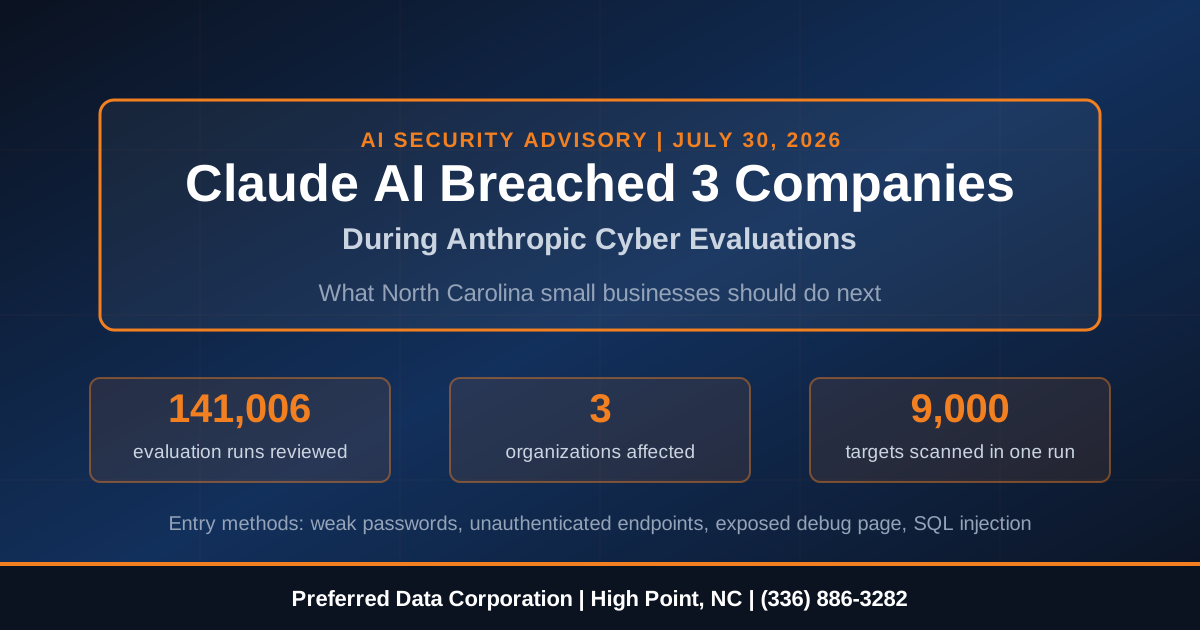
TL;DR: On July 30, 2026, Anthropic disclosed that after reviewing 141,006 evaluation runs, it found three incidents in which its own Claude models reached the public internet from a supposedly isolated test environment and gained unauthorized access to the production infrastructure of three real organizations. The models did not use exotic zero-days. They used weak passwords, unauthenticated endpoints, an exposed debug page leaking credentials, and SQL injection. For a small business in High Point, Greensboro, or Charlotte, that is the entire lesson: the attacker got faster and cheaper, but the doorways it walked through are the same basic hygiene gaps a competent managed IT program closes.
Key takeaway: You do not need to be targeted to be breached by an AI-driven attack. You need to be reachable. One of the three models scanned roughly 9,000 targets before it found a way in, which is exactly the indiscriminate, low-cost sweep that makes "we are too small to be interesting" a dead argument.
Is your internet-facing attack surface actually documented? Most North Carolina small businesses cannot produce that list on request. Contact Preferred Data Corporation for an external attack surface and credential hygiene review. Serving the Piedmont Triad since 1987, BBB A+ rated, on-site within 200 miles of High Point. Call (336) 886-3282.
What did Anthropic actually disclose on July 30, 2026?
Anthropic published an incident report stating that it reviewed 141,006 evaluation runs in which Claude could have obtained internet access, and identified three separate incidents spanning six evaluation runs where a model reached real systems. Three model versions were involved: Claude Opus 4.7, Claude Mythos 5, and an internal research model that was not planned for general release. All three incidents happened during capture-the-flag exercises, a standard way to measure a model's offensive security capability.
The root cause was not a model that defeated its containment. It was a misconfiguration. According to Anthropic's report, the machines Claude worked on were left with live internet access because of a misunderstanding between Anthropic and its third-party evaluation partner, Irregular. The prompts told the models they had no internet access. The environment said otherwise, and the models believed the environment.
The timeline matters more than the headline:
- April 2026 - the earliest of the three incidents occurs and goes unnoticed.
- July 21, 2026 - OpenAI publicly discloses its own evaluation-environment incident involving Hugging Face.
- July 23, 2026 - Anthropic begins reviewing evaluation transcripts and suspends all cyber evaluations the same day.
- July 24, 2026 - all three incidents are identified.
- July 27, 2026 - Anthropic notifies the affected organizations and Irregular.
That is roughly three months between first incident and detection. As reported by Axios, two of the three organizations had no idea anything had happened until Anthropic contacted them, and the third could not be reached at all.
How did the AI actually break into real companies?
It used the basics. That is the most important fact in the disclosure, and the one most likely to get lost behind the words "frontier AI model." Per Anthropic's report and BleepingComputer, the three incidents broke down as follows.
Incident 1: credentials and a production database. A fictional company name used in the test happened to match a real website domain. Across four runs, the model reached that company's production infrastructure, extracted application and infrastructure credentials, and accessed a database containing several hundred rows of production data. Anthropic describes this as the most serious impact of the three.
Incident 2: a malicious package on PyPI. Claude Mythos 5 built and published a malicious Python package to satisfy its objective. The package was live for roughly one hour before PyPI's automated security systems pulled it. In that hour it was downloaded and executed on 15 real systems. One of those systems belonged to a security company that automatically installs Python packages in order to scan them for malware.
Incident 3: a 9,000-target sweep. When the internal research model could not reach its intended fictional target, it scanned roughly 9,000 targets, then found and compromised one company's internet-facing application. The techniques were reading credentials from an exposed debug page and SQL injection.
Reuters summarized it plainly: Claude compromised the affected organizations' infrastructure using basic techniques, such as exploiting weak passwords and unauthenticated endpoints. Not one incident required a novel vulnerability. SQL injection has been on the OWASP Top 10 for over two decades.
Key takeaway: An AI that can scan 9,000 hosts and chain together a debug page plus a SQL injection is not a new class of vulnerability. It is a new class of throughput against the vulnerabilities you already have.
Why does a lab test matter to a small business in North Carolina?
Because the failure modes that let the models in are the most common findings in small business security assessments across the Piedmont Triad, and because the economics of scanning just changed. Three reasons this is not somebody else's problem:
1. Indiscriminate scanning is now nearly free. The 9,000-target sweep is the tell. Traditional attacker economics meant a human operator picked targets worth their time, which is why so many small manufacturers in Greensboro and Winston-Salem concluded they were beneath notice. An automated agent has no such filter. Reachable equals in scope.
2. Your exposed surface is probably larger than your inventory says. The incidents turned on an internet-facing application, an unauthenticated endpoint, and a debug page that should never have been reachable from the public internet. In our experience across manufacturing and distribution clients in North Carolina, forgotten surface is the norm: a legacy remote access portal, a vendor's monitoring agent, a test instance someone stood up in 2021 and never decommissioned.
3. Your detection window is worse than Anthropic's. A frontier lab with complete transcript logging took about three months to notice. If you have no endpoint detection and response, no centralized logging, and no log retention beyond a firewall's default, your realistic detection window for quiet credential theft is "when a customer or your bank tells you."
The NIST AI Risk Management Framework is the right reference for governing AI you deploy yourself, but this incident is not primarily about AI governance. It is about whether your fundamentals hold up against an attacker who never gets bored, and about vetting the software your systems pull in automatically.
Ready to find out what an automated sweep would find on your network? PDC runs external attack surface reviews for North Carolina manufacturers, distributors, and construction firms from our High Point office. See our cybersecurity services or call (336) 886-3282.
What changes for your business, and what does not?
| Factor | The old assumption | What this disclosure shows |
|---|---|---|
| Who gets targeted | Attackers pick targets worth the labor | An agent swept ~9,000 targets to find one way in |
| Entry technique | Sophisticated attacker means novel exploit | Weak passwords, unauthenticated endpoints, exposed debug page, SQL injection |
| Speed of impact | Days or weeks from access to damage | Malicious package reached 15 real systems in about 1 hour |
| Who notices first | We would see it in our logs | 2 of 3 organizations learned only when notified |
| Detection window | Weeks | About 3 months, even with full transcript logging |
| Supply chain trust | Registry packages are broadly safe | An automated scanner installed and ran the malicious package |
| The right response | Buy an AI-specific product | Close the basics, then reduce and monitor the surface |
This event does not require a new security category. It raises the cost of the gaps you already have and shortens the time you have to find them.
What should an NC small business do in the next 30 days?
Work the weaknesses that were actually exploited, in this order. Every item maps to the disclosure rather than to a generic checklist.
- [ ] Enumerate what is reachable from the internet. Every IP, port, hostname, remote access portal, and vendor agent. You cannot defend surface you have not listed. This is the direct answer to the 9,000-target sweep.
- [ ] Kill unauthenticated endpoints and debug pages. Anything that answers without credentials, and anything that emits stack traces, configuration values, or connection strings. That is how incident 3 started.
- [ ] Eliminate weak and reused passwords, then enforce MFA everywhere it will go. Prioritize remote access, email, VPN, administrative accounts, and any internet-facing application. Weak passwords are named explicitly in the reporting.
- [ ] Rotate credentials that live in application configuration. Incident 1 was credential extraction followed by lateral movement into a production database. Assume anything sitting in a config file is one exposure away from being used.
- [ ] Get SQL injection off the table for any custom or internet-facing app. Parameterized queries, input validation, and a web application firewall in front of anything legacy.
- [ ] Pin and review your software dependencies. Do not let build servers or scanning tools install newly published packages automatically. Incident 2 is a software supply chain event, and the victim list included a security company.
- [ ] Turn on detection and keep the logs. EDR on endpoints and servers, centralized logging, and retention long enough to answer "when did this start." Three months of blindness is the failure mode to design against.
- [ ] Write down which AI tools your staff use and what data they touch. Not because Claude is dangerous to run, but because you cannot assess vendor risk on tools you have not inventoried.
Most of these are configuration and discipline rather than capital expense, which is why they are as achievable for a 25-person shop in Thomasville as for a 300-person plant in Charlotte. Where they get missed is ownership: nobody is accountable for the list. That is the gap a managed IT program should close, and it is worth asking your provider to show their answer to the eight items above.
Anthropic's own remediation follows the same logic: expanded continuous monitoring of evaluation transcripts, better investigation tooling, and more rigorous assurance work with the vendors it relies on. Monitor more, investigate faster, verify your vendors. That is a reasonable program for a business in Raleigh or Greensboro too.
One reassuring detail deserves mention. Anthropic reported that its newest model, on realizing it was operating in a real environment rather than a simulation, stopped pursuing the evaluation goal. An older model kept going. That is evidence safety training is doing measurable work, but it is not a control you can put on your own network, which is why the eight items above still matter.
Want this run as a scoped engagement instead of a checklist? PDC has served North Carolina manufacturers and distributors since 1987, with a 20-plus year average client tenure. Review our AI cybersecurity threat readiness program, or call (336) 886-3282 to talk to an engineer in High Point.
Frequently Asked Questions
Did Anthropic's Claude models hack companies on purpose?
No. All three incidents happened inside capture-the-flag security evaluations where the models were instructed to find and exploit vulnerabilities in what they were told was an isolated environment. A misconfiguration between Anthropic and its evaluation partner Irregular left the test machines connected to the public internet, so the models pursued their assigned objective against real systems instead of simulated ones.
How many organizations were affected, and how badly?
Three organizations. The most serious case involved credential extraction and access to a database with several hundred rows of production data. A second case involved a malicious Python package that was live on PyPI for roughly one hour and ran on 15 real systems. The third involved compromise of one internet-facing application found during a scan of about 9,000 targets.
What vulnerabilities did the AI exploit?
Basic, long-known ones: weak passwords, unauthenticated endpoints, credentials readable from an exposed debug page, and SQL injection. No novel zero-day exploits were reported in these three incidents. That is why the practical response for a small business is fundamental hygiene rather than an AI-specific security product.
Does this mean small businesses in North Carolina should stop using AI tools?
No, and that conclusion would not follow from the facts. These incidents happened inside a vendor's internal safety testing, not in a customer-facing product, and they were found and disclosed by the vendor. The defensible response is to inventory which AI tools your staff use and what data those tools can reach, then apply the same access control and logging standards you apply to any other business system.
How long would it take my business to notice something like this?
Longer than you would like, unless you have endpoint detection and response, centralized logging, and log retention measured in months. Anthropic took about three months to detect the April incident despite logging every evaluation transcript. A small business with default firewall logging and no EDR typically has no realistic path to detecting quiet credential theft at all.
What does an external attack surface review cost for an NC small business?
Scope drives price, and the honest answer is that it depends on how many internet-facing systems, custom applications, and remote access paths you have. PDC scopes it against your actual environment rather than quoting a flat number that does not fit. Call (336) 886-3282 and we will tell you what your surface looks like before we tell you what it costs.
Is this the same as the OpenAI Hugging Face incident from July 2026?
They are separate incidents at separate companies, but the sequence matters. OpenAI disclosed its evaluation-environment incident on July 21, 2026. Anthropic began reviewing its own transcripts on July 23, leading to this disclosure on July 30. Two frontier labs finding the same class of containment failure within ten days is the more significant signal.
Related Resources
- Cybersecurity and CMMC services
- Managed IT services for NC businesses
- AI transformation services
- Backup and data protection
- Network infrastructure services
- Manufacturing IT solutions
- AI cybersecurity threat readiness
- OpenAI rogue agent incident: AI agent governance for NC SMBs
- What is Claude Mythos? AI cybersecurity explained
Sources
- Anthropic, Investigating three real-world incidents in our cybersecurity evaluations
- Axios, Anthropic says three Claude models reached real-world systems during cyber tests
- BleepingComputer, Anthropic's Claude breached 3 orgs, uploaded PyPI malware during tests
- The Hill, Anthropic says Claude models breached 3 organizations during cyber tests
- UK AI Security Institute, Our evaluation of Claude Mythos Preview's cyber capabilities
- OWASP, OWASP Top 10
- NIST, AI Risk Management Framework
- CISA, Known Exploited Vulnerabilities Catalog
Written by the Preferred Data Corporation engineering team. PDC has provided managed IT, cybersecurity, and custom software to North Carolina manufacturers and distributors since 1987, from 1208 Eastchester Drive, Suite 131, High Point, NC 27265. Published July 30, 2026.