
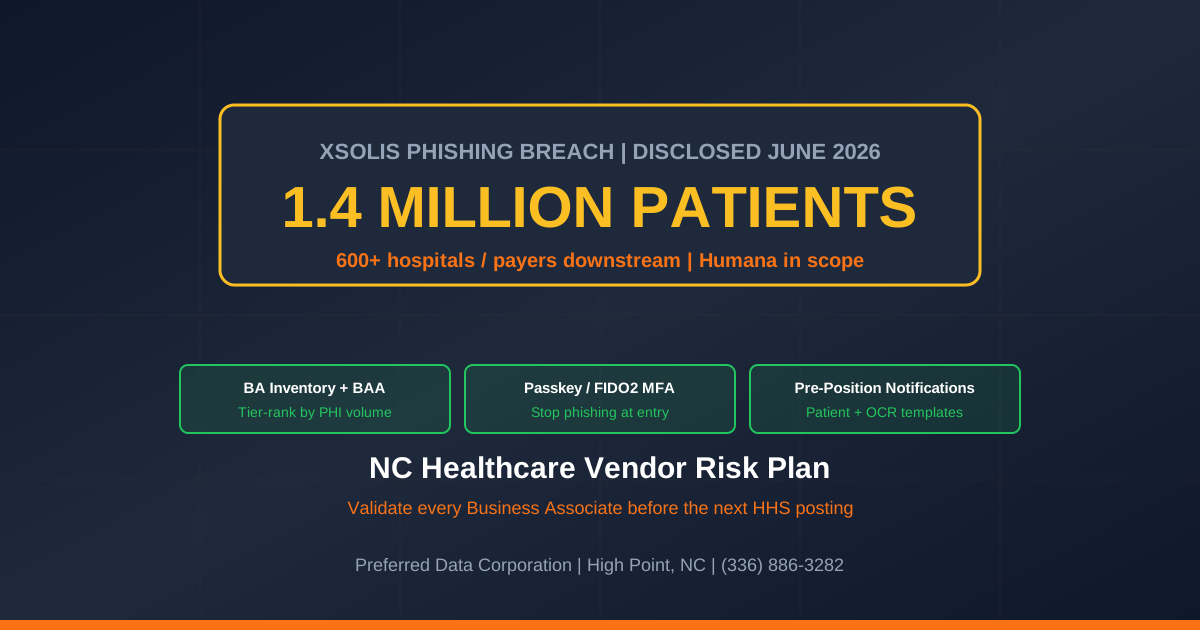
TL;DR: Tennessee-based Xsolis - the AI utilization-management and revenue-cycle vendor serving more than 600 hospitals and health plans, including Humana - disclosed a data breach affecting 1,396,519 individuals, per BleepingComputer and the HHS data breach tracker. The intrusion started January 22, 2026 from a targeted phishing attack two days earlier, and was disclosed publicly in early June 2026 with HHS posting on Monday, June 22 - 23. Stolen data includes names, dates of birth, addresses, Social Security numbers, health insurance details, and medical treatment information, per SecurityWeek. For NC medical practices, dental offices, ambulatory clinics, behavioral health groups, and any NC SMB running a self-insured employee health plan, the question is not "are we Xsolis customers?" - it is "do we know every vendor with our staff or patient PHI, and what their incident-response window looks like?"
Key takeaway: The Xsolis breach is not a healthcare-only story. Every NC SMB has vendors handling employee health data through self-insured plans, COBRA administration, EAP programs, and benefits enrollment. A vendor's January phishing event becomes your June notification letter.
Need a Business Associate vendor risk inventory before the next HHS posting? Preferred Data Corporation runs managed cybersecurity and HIPAA-aligned vendor reviews for NC SMBs. Call (336) 886-3282 or request a vendor risk review.
What happened at Xsolis and who is affected?
Xsolis is an AI-driven utilization-management and revenue-cycle vendor that serves more than 600 hospitals, health systems, and health plans including Humana, per TechTarget. On January 20, 2026 a targeted phishing attack compromised employee credentials. On January 22 Xsolis detected unauthorized activity. The breach was disclosed publicly in early June 2026 and posted to the HHS Office for Civil Rights breach tracker on Monday, June 22 - 23, 2026, per Cybernews.
| Xsolis breach metric | Value | NC SMB implication |
|---|---|---|
| Individuals affected | 1,396,519 | Posted to HHS tracker June 22 - 23, 2026 |
| Initial vector | Targeted phishing of Xsolis employee | Phishing - not zero-day, not supply chain |
| Time-to-detect | ~2 days | Acceptable detection time, poor disclosure cadence |
| Time-to-public-notification | ~5 months | Inside the HIPAA 60-day clock from "discovery to notification" but at the edge of patient-trust patience |
| Downstream clients | 600+ hospitals, health systems, health plans | NC providers and employer plans potentially in scope |
| Data classes | Name, DOB, address, SSN, insurance info, medical treatment data | Full identity theft + medical-fraud toolkit |
| AI vendor category | Utilization management + revenue cycle | Same vendor pattern across NC employer health plans |
Per the HIPAA Journal, the company confirmed no evidence of further unauthorized access after January 22, 2026 and no evidence of misuse - the standard wording for a breach where data was exfiltrated but downstream fraud has not yet been detected.
Quotable definition: Utilization management is the vendor function that reviews medical necessity and authorizes care on behalf of payers and providers. A utilization-management vendor sits inside the PHI stream for every claim it touches - which is why a single phishing compromise at the vendor scales to seven figures of patient records.
Three facts an NC SMB owner should write down:
- The vector was phishing of a single employee. Per Help Net Security, the entry point was a targeted phishing attack - not a zero-day, not a supply chain compromise. The defense was not exotic; the defense was phishing-resistant MFA, EDR, and a help-desk verification policy.
- The five-month notification gap is real. Detection in January, public notification in June. That window is inside HIPAA's 60-day clock from the date of "discovery" as defined in 45 CFR 164.404, but downstream NC providers and self-insured employers were exposed for months without a vendor-side trigger to act on.
- 600+ downstream clients amplify the blast radius. One Xsolis phishing event becomes 1.4 million notification letters across hundreds of hospitals, health systems, and health plans - the Verizon DBIR 2026 finding that 48% of breaches now involve a third party in concrete form.
Why does the Xsolis breach matter to an NC SMB that is not Xsolis?
Because the structural pattern - a vendor inside the PHI pipeline gets phished, hundreds of downstream organizations carry the notification - applies to every Business Associate every NC SMB hands data to. NC SMB exposure profiles in 2026:
- NC self-insured employer health plans. Any NC SMB with a self-insured medical plan touches a TPA (third-party administrator), a PBM (pharmacy benefit manager), a utilization-management vendor, an EAP provider, a stop-loss carrier, and a wellness platform. Each is a Business Associate handling PHI. The Xsolis pattern says any one of them is one phishing event from your employee data on the HHS tracker.
- NC medical / dental / behavioral-health practices. Practice management software vendors, EHR vendors, RCM/billing vendors, e-prescribing platforms, patient-communication apps, online appointment platforms - all Business Associates. Most NC practice owners cannot name them all without pulling the vendor list, and most have never validated the vendor's security posture beyond the BAA signature.
- NC professional-services firms with HR / benefits admin clients. If you handle benefits admin, COBRA admin, or HR-tech for clients, you are inside the PHI flow as a downstream vendor. Your own vendor stack now matters to your client's HIPAA posture.
- NC employer wellness and EAP programs. Mental-health and EAP vendors operate at a small scale with thin security investment. The Xsolis pattern is the larger-scale version of the same risk.
Per HHS OCR enforcement data, third-party Business Associate incidents have been the dominant source of HIPAA penalties since 2023. Xsolis is the 2026 case study, but the structural risk has been visible for three years.
Key takeaway: Your HIPAA posture is the worst posture of your weakest Business Associate. If you cannot list every BA touching your patient or employee PHI - including the AI vendors your billing team added in the last twelve months - your risk inventory is out of date.
What should an NC SMB do this month?
Run an eight-control plan inside 30 days. The same plan applies whether you are a medical practice, a self-insured employer, or a professional-services firm handling client benefits data.
- Inventory every Business Associate (this week). Pull every active BAA from the contract repository. Cross-reference with current AP records for any vendor receiving payments. Add the AI vendors your billing or RCM team adopted in the past 12 months that may not have a signed BAA yet.
- Risk-rank vendors by PHI volume and access mode (this week). Tier 1: vendors holding full patient or member records (utilization management, EHR, RCM, TPA). Tier 2: vendors processing transactional PHI (clearinghouses, e-prescribing, lab interfaces). Tier 3: vendors with incidental PHI access (IT support, MSPs, document destruction).
- Validate the BAA for every Tier 1 and Tier 2 vendor. Confirm incident-notification windows (target: within 24 - 72 hours of vendor discovery, not 30 - 60 days), insurance coverage, security control attestation, and right-to-audit clauses. Most NC SMB BAAs were signed years ago against weaker template language.
- Request the vendor's most recent SOC 2 Type II or HITRUST attestation. A vendor that cannot produce one in 2026 is a Tier 1 risk regardless of size.
- Enforce phishing-resistant MFA on your own staff (this month). Per Help Net Security, Xsolis was hit through phishing. Your defense against being the next vendor on the HHS tracker is the same control: passkeys / FIDO2 on every email and admin account.
- Deploy behavior-based EDR with managed SOC. The same control set that detects in-memory backdoors (per the Mistic disclosure) detects the phishing-to-credential-misuse pattern that drove Xsolis.
- Write a vendor incident-response runbook. Define: who tracks vendor disclosures, who decides if your patients/members are in scope, who runs internal forensics for downstream impact, who handles patient/member notification when the vendor notification arrives.
- Pre-position breach-notification templates. If your name shows up on a vendor's downstream client list six months from now, you do not want to draft notification language under deadline pressure. Pre-write the patient letter, the carrier notification, the state AG notification, and the OCR HIPAA notification.
Key takeaway: The Xsolis disclosure is a free tabletop. Run it: "If our utilization-management or RCM vendor told us today they had been breached in January, what would we do, who would we notify, and when?" The gaps that surface in that conversation are the Q3 2026 priority list.
How does Preferred Data Corporation help NC SMBs manage healthcare vendor risk?
PDC runs managed cybersecurity, HIPAA-aligned vendor risk programs, and incident-response planning for NC SMBs - including medical practices, healthcare-adjacent professional services, and self-insured employer plans. We bring three things to the Xsolis disclosure:
- Managed cybersecurity services: Phishing-resistant MFA deployment, behavior-based EDR with 24/7 SOC, BAA template review, vendor SOC 2 / HITRUST validation workflow, and breach-notification template pre-positioning.
- Managed IT services: Vendor inventory and PHI flow mapping, conditional-access policies that block risky vendor sign-ins, automated patch SLA on healthcare-vendor endpoints, and managed Microsoft 365 / Google Workspace hardening for clinical email.
- Backup and data protection services: Immutable backup for clinical and member-management systems, tested restore drills, offsite copies isolated from production credentials, and patient-record recovery runbooks aligned to HHS reporting obligations.
For NC medical practices in High Point and the Piedmont Triad, NC behavioral-health and dental groups in Greensboro, NC professional-services firms handling benefits admin in Charlotte and Raleigh, and NC manufacturers with self-insured employee health plans - the Xsolis disclosure is the prompt to validate your vendor list before the next HHS posting names a vendor you forgot you used.
Need help running a Business Associate inventory and BAA review this quarter? Call (336) 886-3282 or book a healthcare vendor risk review.
Frequently Asked Questions
What is Xsolis and what did it do wrong?
Xsolis is a Tennessee-based AI utilization-management and revenue-cycle vendor serving 600+ hospitals and health plans including Humana. Per TechTarget, a targeted phishing attack on January 20, 2026 compromised an employee account, leading to unauthorized access detected January 22 and notification disclosed in early June 2026.
How many people are affected by the Xsolis breach?
Per the HHS data breach tracker and BleepingComputer, the official count posted in June 2026 is 1,396,519 individuals.
What data was stolen in the Xsolis breach?
Per Xsolis's data security notice, the stolen data includes names, dates of birth, addresses, Social Security numbers, health insurance information, and medical treatment information - effectively the full identity-theft and medical-fraud toolkit for affected patients.
Are NC SMBs affected by the Xsolis breach?
Indirectly, yes. Xsolis serves 600+ hospitals, health systems, and health plans nationally including Humana, per Cybernews. NC providers contracted with Humana or any other Xsolis customer may have downstream member or patient data in the disclosed records. NC SMB self-insured employer plans with Humana administration are in scope. NC SMBs should request a vendor scoping statement from any payer or clearinghouse partner that uses Xsolis.
What is a Business Associate Agreement (BAA) and why does it matter here?
A BAA is the HIPAA-mandated contract between a covered entity (e.g., an NC medical practice or self-insured employer plan) and any vendor handling PHI on their behalf. The BAA defines the vendor's security obligations, breach-notification windows, and audit rights. Per 45 CFR 164.504, a covered entity is responsible for vendor non-compliance under certain conditions. NC SMBs should validate that every Tier 1 and Tier 2 vendor has a current, properly-scoped BAA with a 24 - 72 hour breach notification clause.
How do I prevent the Xsolis pattern from happening at my NC SMB?
The same controls that would have stopped the Xsolis vector: phishing-resistant MFA (passkeys / FIDO2) on every email and admin account, behavior-based EDR with 24/7 SOC monitoring, security-awareness training that includes targeted social-engineering scenarios, conditional-access policies that flag impossible-travel and anomalous sign-ins, and a written incident-response plan that names roles and timing. Xsolis was hit by phishing, not by anything exotic.
Related Resources
- Managed Cybersecurity Services for NC Businesses - Phishing-resistant MFA and managed EDR
- Managed IT Services for NC Businesses - Vendor inventory and conditional access
- Backup and Data Protection Services - PHI backup and recovery
- Healthcare Industry Solutions - HIPAA-aligned IT for NC providers
- Verizon DBIR 2026: 48% Third-Party Breaches - Companion vendor risk data
- 73% of SMBs Fail Cyber Insurance Audits - Companion insurance / audit context
- Contact Preferred Data Corporation - HIPAA vendor risk review for NC SMBs