
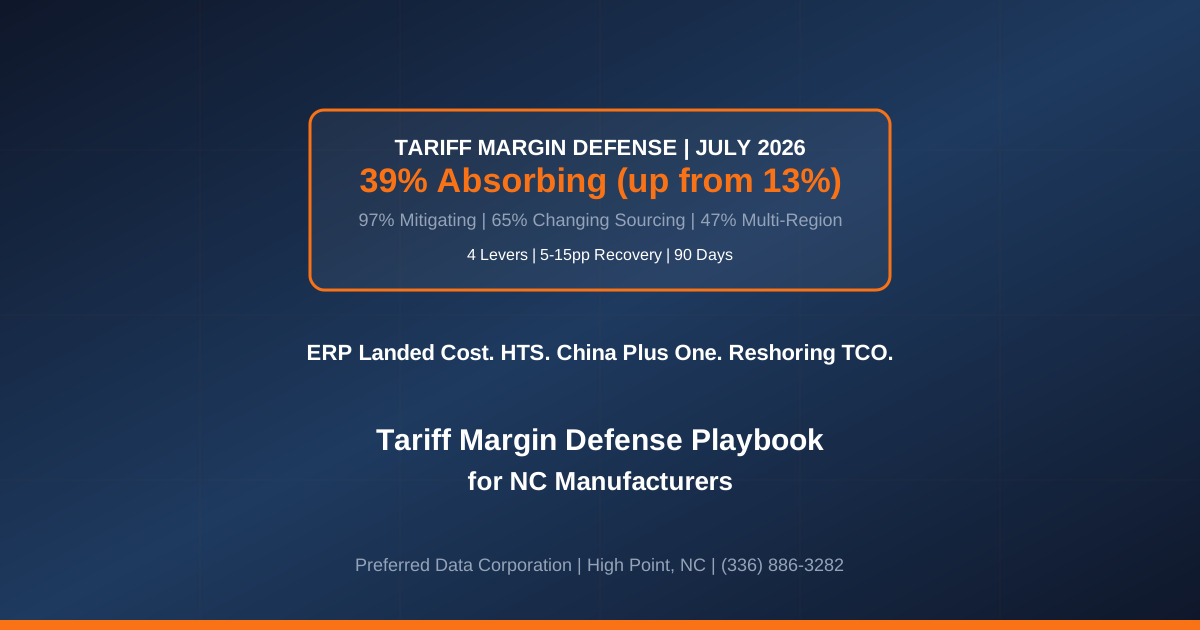
TL;DR: Late-June and early-July 2026 trade data shows a decisive break in SMB tariff strategy: 39% of small manufacturers now absorb tariff costs rather than pass them through, up from just 13% a year prior. Thomson Reuters, Ivalua, and NSBA polling agree that 72% of trade professionals rate tariff volatility the highest-impact regulatory change of 2026, that 97% of companies now have active mitigation strategies, and that 65% of respondents cite sourcing changes as their primary tariff response. For NC furniture, textile, automotive, food-processing, and machinery manufacturers, margin absorption without an ERP-driven landed-cost, HTS-discipline, dual-sourcing, and China-Plus-One playbook is a slow-motion insolvency risk. This is your 90-day margin defense plan.
Key takeaway: Absorbing tariff costs is not a strategy — it is the absence of one. Without an ERP that models landed cost per SKU, an HTS-classification discipline that captures every exemption, and a dual-sourced supplier list tested under actual purchase orders, tariff volatility eats your margin one shipment at a time.
Need a same-quarter tariff margin defense assessment for your NC manufacturing business? Contact Preferred Data Corporation for an ERP landed-cost audit and supply-chain resilience review. BBB A+ rated. 37+ years of NC manufacturing IT expertise. On-site within 200 miles of High Point. Call (336) 886-3282.
Why Are 39% of NC SMBs Now Absorbing Tariff Costs?
The 2026 absorption shift — from 13% to 39% — is the direct result of three converging pressures identified in Thomson Reuters Institute and Ivalua polling this year. NC manufacturers describe the same dynamics in NSBA surveys, where 61% of small manufacturers report negative tariff impact and 86% previously passed costs to customers but are now hitting price-elasticity ceilings.
Three drivers of absorption:
- Customer price resistance. Furniture, textile, and consumer-goods manufacturers who raised prices in 2024-2025 are now hitting demand-destruction thresholds. Passing through a further 8-15% tariff cost triggers double-digit volume decline.
- Competitive parity pressure. When a NC manufacturer competes against imports that were tariffed before landing, the tariff is embedded in the import price. Passing through your own tariff on domestic inputs erases the competitive gap.
- Long-cycle contracts. Construction, industrial, and B2B manufacturers with 12-36 month price contracts cannot renegotiate mid-cycle. The tariff hits the margin, not the customer, until the contract cycles.
Absorption without a compensating cost strategy is a slow-motion insolvency risk. Center for American Progress data from June 2026 shows the average SMB importer now pays $306,000 per year in additional tariff cost; JEC data documents an 11% small-business bankruptcy rise attributable to tariff volatility.
Key takeaway: Absorption is not a rational strategy — it is what happens when a business runs out of other options. The margin defense playbook below is what buys you back optionality.
What Are the Four Levers That Restore NC SMB Margin Under Tariff Volatility?
Four levers, executed together, deliver 3-8 percentage points of margin recovery for the typical NC manufacturer in the first 90 days. Each requires ERP data quality that most NC SMBs do not yet have.
Lever 1 — ERP landed-cost analytics per SKU:
- What it is. A per-SKU landed cost that includes commodity price, tariff by HTS code, freight (ocean, rail, trucking), duties, brokerage, insurance, and any exemption or drawback claim. Recalculated on every purchase order and PO receipt.
- Why it matters. Without per-SKU landed cost, the tariff impact is invisible until the month-end financial close, weeks after the pricing or sourcing decision that could have addressed it.
- NC SMB pattern. Most NC manufacturers running Pervasive SQL (Actian Zen) ERP have SKU-level cost, but landed-cost calculation is manual, in spreadsheets, and lags by weeks. Automating this is a one-quarter project with meaningful margin lift.
Lever 2 — HTS classification discipline and exemption capture:
- What it is. Every imported item is classified against the current Harmonized Tariff Schedule, with active tracking of Section 232 (steel/aluminum), Section 301 (China), and product-specific exemptions.
- Why it matters. Misclassification costs the average NC manufacturer 2-5% of landed cost annually. Missed exemptions cost more. USITC data shows that under 40% of eligible SMB shipments claim available exemptions.
- NC SMB pattern. Furniture and textile manufacturers with 500+ SKUs typically have 20-40 misclassified items eating 3-8% of margin on those SKUs. A one-time classification review often recovers a full year of hidden margin.
Lever 3 — China-Plus-One sourcing and dual-supplier development:
- What it is. Every high-tariff-exposure SKU has at least two qualified suppliers, ideally in different tariff geographies (Mexico, Vietnam, India, US domestic). Purchase orders route to the lower landed-cost supplier automatically.
- Why it matters. Ivalua's 2026 data shows 65% of SMBs are actively changing sourcing patterns, and 47% now source from multiple regions. Single-sourced SMBs face 100% of the tariff risk with no negotiating leverage.
- NC SMB pattern. NC furniture and machinery manufacturers are increasingly qualifying Vietnamese, Mexican, and US-domestic suppliers. The bottleneck is not supplier availability — it is the ERP and quality-management workflows to onboard a second supplier cleanly.
Lever 4 — Reshoring / nearshoring feasibility with a real TCO model:
- What it is. A total-cost-of-ownership model comparing current sourcing against reshored or nearshored alternatives, including tariff, freight, quality, lead-time, working-capital, and IP-protection variables.
- Why it matters. 76% of trade professionals expect the current tariff regime to persist at least four years. A four-year TCO comparison often shifts the decision toward reshoring for high-tariff-exposure SKUs.
- NC SMB pattern. NC manufacturers with existing US or Mexican operations are best-positioned. The TCO model must be updated quarterly as tariff rates and freight costs move.
| Lever | Margin Recovery (Year 1) | Time to Deploy | Prerequisite |
|---|---|---|---|
| ERP landed-cost analytics | 1-3 pp | 1 quarter | Clean SKU-level cost data |
| HTS classification discipline | 2-5 pp | 1 quarter | Classification review |
| China-Plus-One sourcing | 2-4 pp | 2-3 quarters | Supplier qualification |
| Reshoring TCO feasibility | 0-4 pp (SKU-dependent) | 1-2 quarters | Multi-scenario TCO model |
| Combined execution | 5-15 pp | 3-4 quarters | Integrated program |
Explore Preferred Data's ERP and custom software services
What Does an NC Manufacturer's 90-Day Margin Defense Program Look Like?
A concrete 90-day rollout that a mid-sized NC manufacturer can execute this quarter with existing staff plus targeted IT partnership.
Days 1-30 — Diagnose and instrument:
- SKU-level landed-cost audit. Pick the top 100 SKUs by revenue. Calculate current landed cost by hand. Identify the 20 highest-tariff-exposure SKUs.
- HTS classification review. Engage a licensed customs broker or trade attorney to review classifications for the top-20-exposure SKUs. Recover any missed exemptions.
- ERP data quality assessment. Confirm cost-by-SKU, freight-by-shipment, and PO-line-level tariff fields are populated. Fill gaps.
- Baseline margin measurement. Document current gross margin by SKU and product family. This is your before-picture.
Days 31-60 — Automate and diversify:
- Landed-cost automation in ERP. Configure the ERP to auto-calculate landed cost per PO receipt using live HTS-rate feeds.
- Second-supplier qualification. Identify one alternate supplier per top-20-exposure SKU. Issue trial POs.
- Pricing scenario modeling. Model pass-through vs. absorb vs. re-source for each SKU. Choose the highest-margin path.
- Vendor-managed inventory review. If a supplier holds inventory in the US, tariff exposure shifts to the supplier — often a negotiable term.
Days 61-90 — Execute and monitor:
- Sourcing shifts. Route new POs to lower-landed-cost suppliers for the top-20-exposure SKUs.
- Price actions. Implement selective price increases where elasticity permits.
- Reshoring TCO for high-exposure SKUs. Build the four-year TCO model. Present to leadership.
- Dashboard for landed cost and margin by SKU. Weekly refresh, exception-based alerts.
At end of 90 days, most NC manufacturers who execute the program recover 3-6 percentage points of gross margin on the top-20-exposure SKUs, with a full-portfolio impact of 2-4 percentage points on total gross margin.
Learn about Preferred Data's managed IT services
Why Does Landed-Cost Automation Require an IT Partner, Not Just a Spreadsheet?
NC manufacturers with 500-5,000 active SKUs cannot manage landed cost in spreadsheets. The failure modes are consistent: version control breaks, HTS rates drift out of date, freight lookups happen once and stale, exemption calculations get lost when the spreadsheet-owner leaves the company.
A production landed-cost solution has four components that require IT integration:
- ERP integration. Live pull of SKU, cost, PO, and receipt data from your Pervasive SQL or other ERP.
- HTS rate feed. Automated ingest of current HTS rates and exemption changes from USITC or a commercial trade-data provider.
- Freight and duty calculation. Integration with your freight forwarder or customs broker's rate structure.
- Reporting layer. Dashboards for landed cost per SKU, tariff impact per product family, exemption capture rate, and margin-at-risk exposure.
Each component is straightforward individually. Together they require an IT partner who understands both Pervasive SQL / ERP integration and trade-data workflows.
How Does Preferred Data Deliver Tariff Margin Defense for NC Manufacturers?
Preferred Data Corporation delivers ERP landed-cost audit and automation, HTS classification review coordination, dual-supplier qualification workflow, reshoring TCO modeling, custom software integration with your existing ERP (including Pervasive SQL / Actian Zen), and 24/7 managed IT support for NC furniture, textile, automotive, food-processing, machinery, and construction manufacturers. With 37+ years of North Carolina manufacturing expertise and an average client retention of 20+ years, our tariff margin defense integrates with your existing ERP, accounting, procurement, and warehouse-management systems.
Our 90-day margin defense engagement includes SKU-level landed-cost audit, top-100-SKU HTS classification review coordination, ERP landed-cost automation, dual-supplier qualification workflow, and a quarterly reshoring TCO refresh.
For manufacturers within 200 miles of High Point, we deliver on-site engagement including plant-floor process observation, ERP integration work, and executive briefings.
Review our AI transformation services
Frequently Asked Questions
Why did SMB tariff absorption jump from 13% to 39%?
Customer price resistance, competitive parity pressure, and long-cycle contracts. When downstream customers refuse further price increases, and competing imports embed the tariff in a landed price, the SMB manufacturer eats the cost. Thomson Reuters Institute polling documented the shift in Q2 2026.
How much margin can I realistically recover in 90 days?
For a typical NC manufacturer with 500-5,000 SKUs and 15-30% of revenue tariff-exposed, expect 3-6 percentage points of margin recovery on the top-20-exposure SKUs and 2-4 percentage points on the total portfolio. Recovery accelerates in months 4-12 as dual-sourcing and reshoring initiatives execute.
Do I need to replace my ERP to enable landed-cost analytics?
No. Most NC manufacturers on Pervasive SQL / Actian Zen or comparable systems have the underlying data — SKU, cost, PO, receipt, freight. The gap is the calculation layer and the reporting layer. A custom integration or a landed-cost module typically retrofits into your existing ERP.
What does an HTS classification review cost?
For a 100-SKU review, expect $5-15K from a licensed customs broker or trade attorney. Typical NC manufacturer recovers 5-20x that investment in first-year exemption capture and misclassification correction.
How do I qualify a second supplier without disrupting operations?
Start with a low-volume trial PO to one alternate supplier per top-exposure SKU. Establish incoming-quality inspection, lead-time measurement, and sample-lot pricing. Over one to two quarters, ramp volume proportional to demonstrated quality and reliability.
Is reshoring realistic for NC manufacturers?
For specific SKUs — those with high tariff exposure, low labor content, or IP-protection premiums — yes. For low-margin, high-labor-content SKUs, the TCO usually still favors offshore. The point of the TCO model is to make the case SKU by SKU, not by ideology.
How does AI transformation fit into tariff margin defense?
AI helps in two specific ways: automating landed-cost calculation and exception detection across thousands of SKUs, and improving demand forecasting so inventory-buffer strategy against tariff volatility gets sharper. See our AI Transformation services.
Can Preferred Data run the 90-day margin defense program with our team?
Yes. Our engagement includes weekly cadence with your CFO, controller, purchasing manager, and operations lead, plus ERP integration engineering, HTS review coordination, and executive dashboards. Call (336) 886-3282 to scope.