
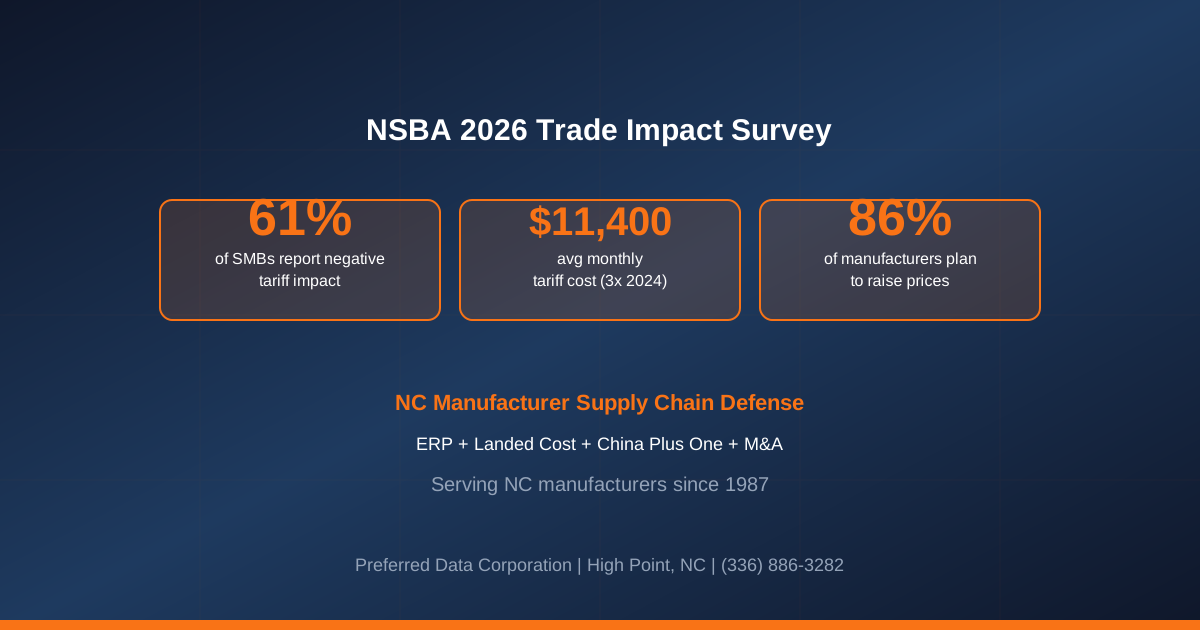
TL;DR: The National Small Business Association's 2026 Trade Impact Survey documents that 61% of small businesses report a negative operational impact from 2026 tariffs, with average monthly tariff-related costs of $11,400 — approximately triple the $3,800 monthly figure from early 2024. 86% of manufacturers plan to pass at least some cost increases to customers, while only 36% are actively pursuing reshoring. For NC small manufacturers — furniture in High Point, textiles in Greensboro, automotive suppliers in Charlotte, agri-tech across the eastern coastal plain — the strategic play is "China Plus One" supplier diversification backed by ERP integration that gives real-time visibility into landed cost, BOM impact, and margin exposure. Technology, not just procurement, is the multiplier here.
Key takeaway: Tariff exposure is not a purchasing problem. It is a data problem. NC manufacturers that can see landed cost, alternate-supplier BOM impact, and margin exposure in real time win. Manufacturers that manage it in spreadsheets lose.
Do you have live landed-cost visibility across your BOM in your ERP? Contact Preferred Data Corporation for an ERP supplier-diversification readiness assessment. BBB A+ rated. Serving NC manufacturers for 37+ years. Call (336) 886-3282.
What Does the NSBA 2026 Trade Impact Survey Actually Say?
The National Small Business Association's 2026 Trade Impact Survey — the standard reference for how tariff policy is landing on Main Street — reports the following headline data:
- 61% of small businesses report that 2026 tariffs have had a negative impact on their operations.
- $11,400 average monthly tariff-related costs for small businesses that import goods — roughly 3x the $3,800 monthly average reported in early 2024.
- 86% of manufacturers plan to pass on at least some cost increases to customers.
- 36% of manufacturers are actively pursuing reshoring — meaning 64% are not, either because reshoring is infeasible for their category or because the cost differential still favors offshore even with tariffs.
- Single-source dependence is the greatest strategic vulnerability exposed by the 2026 tariff environment. Businesses that sourced exclusively from China or any one country found themselves trapped when tariff rates changed.
For NC manufacturers — a segment that includes ~10,000 firms across furniture, textiles, food processing, automotive components, aerospace, biotech, and industrial equipment — the survey data has direct operational meaning. Furniture manufacturers in High Point and the surrounding Piedmont Triad have been particularly exposed to raw materials and finish tariffs; textile manufacturers in Greensboro and Kannapolis face fiber and dye input tariffs; automotive suppliers in Charlotte and Salisbury face component tariffs; food processors across the state face packaging and equipment tariffs.
What Does the "China Plus One" Strategy Look Like Operationally?
The China Plus One strategy — maintain existing Chinese supplier relationships while developing at least one alternative source in a lower-tariff country — is the current mainstream response to tariff volatility. NSBA and multiple industry surveys identify it as the most common tactical approach.
Common Plus-One country candidates for NC manufacturers:
| Category | Typical Plus-One Country | Trade-Off |
|---|---|---|
| Furniture and wood products | Vietnam, Indonesia, Mexico | Quality variability, longer lead times |
| Textiles and apparel | Vietnam, Bangladesh, India, Mexico | Compliance overhead, labor standard verification |
| Electronics and components | Vietnam, Malaysia, Thailand, Mexico | Component-level qualification |
| Automotive parts | Mexico, Vietnam, India | USMCA compliance, tooling investment |
| Industrial equipment | Vietnam, Turkey, Poland | Certification and standards alignment |
| Chemicals and materials | India, South Korea, Mexico | Regulatory approval time |
The operational reality is that Plus-One diversification is a 6-18 month project per supplier category. It requires qualification samples, quality audits, contract negotiation, tooling transfer, initial production runs, and ramp management. For an SMB manufacturer with a lean sourcing team, running this across 5-10 supplier categories in parallel is a full-time program office.
The three things that make China Plus One succeed or fail:
- Data visibility. Can the manufacturer see landed cost by supplier by SKU in real time? If the answer is "we can pull a report next week," diversification decisions will be reactive and expensive.
- BOM management. Can the ERP handle multi-supplier BOM configurations, with what-if landed cost analysis? If BOMs are still managed in Excel, every tariff-driven supplier switch is a data migration project.
- Supplier onboarding cadence. Can the manufacturer qualify a new supplier in 90 days, not 9 months? Qualification speed is the difference between "we responded to the tariff" and "we ate the tariff."
Every one of these three is a technology and process capability, not a procurement capability alone.
Key takeaway: Procurement alone cannot solve a tariff crisis. Supplier diversification requires ERP, integration, and analytics infrastructure that most SMB manufacturers have not modernized in the last decade. That is the constraint.
How Do Tariffs Actually Show Up in a NC Small Manufacturer's Financials?
The NSBA $11,400 monthly figure is the average — the distribution is wide. For an NC furniture manufacturer importing $2M/year in raw wood, hardware, and finish, tariffs at recent rates can add $200K-$500K to annual COGS. For an NC textile manufacturer importing $5M in fiber and specialty dyes, the impact can exceed $1M annually.
Tariff impact appears in five financial categories:
- COGS increase. Direct passthrough of tariff to unit cost. Most visible.
- Working capital lock-up. Higher inventory carrying cost as manufacturers build inventory ahead of tariff increases.
- Freight and logistics. Tariffs interact with shipping route disruption to inflate total landed cost.
- Cost of hedging. Forward-buying, letter-of-credit costs, currency hedging on alternate suppliers.
- Cost of transition. One-time qualification, tooling, and audit costs for Plus-One suppliers.
For a manufacturer with 15-25% gross margins — typical for NC furniture, textile, and food processing SMBs — a 200-400 bps unit-cost increase without a pricing offset is the difference between profit and loss on a product line.
The pricing response is limited. 86% of manufacturers plan to pass some costs to customers, but full passthrough is rare. Customer contracts, competitive positioning, and price-elasticity constraints typically limit passthrough to 40-60% of the tariff cost in the first 90 days. The remainder eats margin until supply-chain adjustments deliver.
What Role Does IT Actually Play in Tariff Resilience?
IT is the multiplier that determines whether procurement can execute Plus-One diversification quickly, accurately, and profitably. Five specific IT capabilities are decisive:
1. ERP that supports multi-supplier BOMs.
Modern ERP (Epicor, NetSuite, Microsoft Dynamics 365 F&O, custom industry-vertical ERPs like PDC Software Suite) supports multiple approved sources per SKU with associated landed-cost and lead-time data. Older ERP that hard-codes a single supplier per SKU forces manual workarounds every time procurement wants to switch.
2. Real-time landed-cost analytics.
Landed cost — the fully-loaded cost of a SKU including tariffs, freight, insurance, and handling — must be visible per unit in real time. Manufacturers that update landed cost quarterly through a manual spreadsheet cannot make daily sourcing decisions during a tariff surge.
3. Supplier scorecarding and onboarding automation.
Every new supplier requires quality data, delivery data, financial-viability data, and compliance data (ITAR, DFARS, ISO). Manufacturers with a modern supplier portal and integrated scorecarding can onboard a Plus-One supplier in 60-90 days. Manufacturers without this infrastructure take 6-9 months per supplier.
4. Integrated EDI and API-based supplier connectivity.
Once a Plus-One supplier is qualified, order management, ASN, invoicing, and payments should flow through EDI or API-based integration — not email attachments. Manufacturers that rely on manual data entry have a scale ceiling.
5. Cybersecurity for the extended supply chain.
Every new supplier is a new supply-chain risk. Verizon's 2026 DBIR reported 48% of breaches involved a third party. Onboarding a new supplier without cyber-vendor-risk assessment is inviting the next incident.
For NC manufacturers evaluating IT modernization to support tariff resilience, the sequence typically is: (1) ERP fitness assessment, (2) landed-cost analytics deployment, (3) supplier portal and scorecarding, (4) EDI / API integration for approved suppliers, (5) vendor-risk-management integration. Each step is 60-120 days for a mid-sized manufacturer.
Explore Preferred Data's cloud solutions
When Does M&A Actually Solve a Tariff Problem?
For some NC manufacturers, tariff exposure is severe enough that supplier diversification is insufficient — the strategic answer is acquisition of a supplier, distributor, or complementary manufacturer. Mergers and acquisitions become a tariff mitigation strategy in three specific scenarios.
Scenario 1: Vertical integration into a domestic supplier.
If a NC manufacturer imports a critical component that has been tariffed at 25-50%, acquiring a domestic supplier of that component removes the tariff entirely from that COGS line. This is the reshoring answer that 36% of manufacturers are pursuing.
Scenario 2: Horizontal expansion to gain scale for supplier leverage.
If tariff impact varies by supplier scale, a smaller manufacturer may be squeezed while larger competitors negotiate better rates. Rollup acquisitions or merger with a peer can restore supplier leverage.
Scenario 3: Acquisition of a Plus-One-country manufacturing footprint.
Rather than qualify a new offshore supplier from scratch, some NC manufacturers acquire a small manufacturer in Vietnam, Mexico, or another lower-tariff jurisdiction that already has qualified capacity. Faster than greenfield, includes existing customer relationships.
Every one of these M&A scenarios requires disciplined due diligence: financial, operational, IT and cybersecurity, ERP and data integration, cultural, legal, and regulatory. NC manufacturers that treat M&A as a tariff mitigation play must recognize that a poorly-run acquisition compounds the tariff problem rather than solving it.
Learn about Preferred Data's M&A advisory services
What Should NC Small Manufacturers Do in Q3 2026?
A structured 90-day tariff resilience program is achievable for a typical NC small manufacturer (25-500 employees).
Weeks 1-2: Assessment.
- Tariff exposure model. Map every imported SKU to current tariff rate. Calculate current monthly tariff cost. Identify top 20% of SKUs driving 80% of tariff exposure.
- Supplier concentration analysis. Identify single-source dependencies and country concentration risk.
- ERP fitness assessment. Can current ERP support multi-supplier BOMs, real-time landed cost, and supplier scorecarding?
Weeks 3-6: Data foundation.
- Landed cost analytics deployment. Real-time landed cost per unit visible to sourcing and finance.
- Supplier portal. Modern portal for Plus-One supplier qualification, scorecarding, and communication.
- BOM cleanup. Multi-supplier BOM structures set up for the top 20% SKUs.
Weeks 7-10: Supplier diversification.
- Plus-One supplier identification for top-exposure SKUs.
- Qualification samples and audits.
- Contract negotiation and initial POs.
- EDI / API integration for approved suppliers.
Weeks 11-13: Pricing and margin management.
- Pricing strategy update for products with meaningful passthrough opportunity.
- Margin monitoring dashboards by product line, customer, and channel.
- Sales team training on updated pricing and value narrative.
The program does not eliminate tariff exposure — it converts it from an existential risk into a managed cost.
Key takeaway: 90 days from decision to landed-cost visibility is achievable if the ERP foundation is in place. Manufacturers still on 15-year-old ERP running BOMs in Excel need 6-12 months.
How Does Preferred Data Deliver Tariff Resilience for NC Manufacturers?
Preferred Data Corporation has served NC manufacturers since 1987 — 37+ years of ERP, cloud, software development, cybersecurity, and M&A advisory. Our clients include furniture manufacturers, textile producers, food processors, automotive suppliers, and industrial equipment makers across the Piedmont Triad, Charlotte, Greensboro, Raleigh, and the eastern coastal plain. The average PDC client retention is 20+ years — because we build the technology that scales with our clients through economic cycles, not just individual projects.
Our tariff resilience offering integrates four practice areas:
- PDC Software Suite — our proprietary ERP and supply chain platform designed for NC manufacturers, with native landed-cost analytics, multi-supplier BOM management, and modern supplier-portal capabilities.
- Cloud solutions and integration — modernizing legacy ERP, EDI, and supplier connectivity to enable rapid supplier diversification.
- Cybersecurity — vendor risk assessment for every new supplier, ensuring supply chain diversification does not import supply chain breach risk.
- M&A advisory — for manufacturers whose tariff strategy requires vertical integration, horizontal rollup, or offshore acquisition, our M&A practice supports the full lifecycle from thesis through 100-day integration.
For NC manufacturers within 200 miles of High Point, we deliver on-site assessment, workshop, and integration support.
Review our 100-day IT integration playbook
Frequently Asked Questions
What is the NSBA 2026 Trade Impact Survey?
The National Small Business Association's annual survey of how trade policy — including tariffs — is affecting small businesses. The 2026 edition documents a 61% negative-impact rate and an average $11,400 monthly tariff cost for importing SMBs, approximately 3x the early-2024 baseline.
What is the "China Plus One" strategy?
A supplier diversification strategy where a manufacturer maintains existing Chinese supplier relationships while developing at least one alternative source in a lower-tariff country. Common Plus-One destinations include Vietnam, Indonesia, Mexico, India, and Thailand.
How much does it cost to qualify a Plus-One supplier?
For a typical NC small manufacturer, Plus-One qualification costs $50K-$250K per supplier category, covering sample production, quality audits, tooling investment, initial production runs, and integration. The payback period depends on tariff differential and annual volume.
Do we need to replace our ERP to support tariff resilience?
Not necessarily. Many mid-market ERPs (Epicor, NetSuite, Dynamics 365, PDC Software Suite) support the necessary multi-supplier BOM, landed cost, and supplier portal capabilities. Older ERPs (pre-2015) often require modernization or replacement.
Is M&A a realistic tariff mitigation strategy for a small manufacturer?
For manufacturers with $20M+ revenue and specific vertical integration opportunities, yes. For smaller manufacturers, supplier diversification is typically the more capital-efficient path. Preferred Data's M&A advisory practice helps evaluate the trade-off.
What is the risk of adding new suppliers from a cybersecurity perspective?
Verizon's 2026 DBIR reported 48% of breaches involve a third party. Every new supplier is a new potential vector for supply-chain compromise. Vendor-risk assessment and network segmentation should be built into the Plus-One qualification workflow.
Can Preferred Data help us assess our ERP in 30 days?
Yes. Our ERP fitness assessment for tariff resilience is a 30-day engagement that covers current ERP capability, gap analysis, supplier diversification readiness, and modernization roadmap. Call (336) 886-3282 to start.