
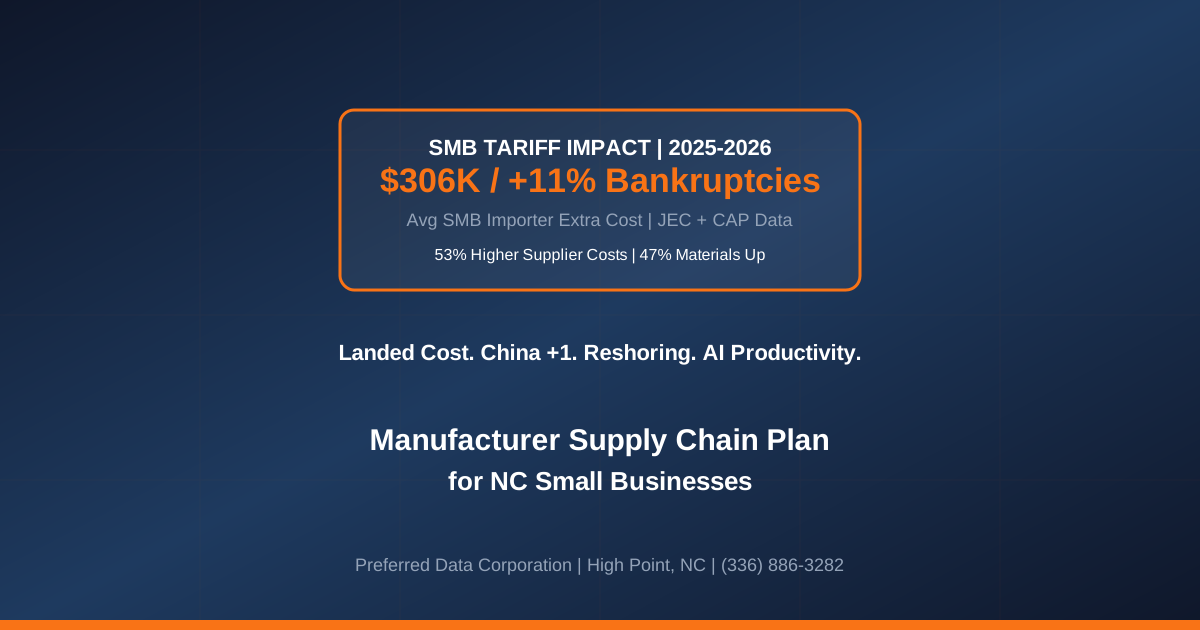
TL;DR: New data landing in the last week of June 2026 confirms the accelerating tariff toll on US small business. The Center for American Progress's July 2026 update reports the average small-business importer paid $306,000 more in tariffs from March 2025 to February 2026 versus the prior 12 months. The Joint Economic Committee's May 2026 release reported the smallest businesses lost 4.5x more jobs in 2025 than during the pandemic in 2020, and small-business bankruptcies rose 11% in 2025. Small Business Majority's March 2026 survey found 53% of small businesses experiencing increased supplier costs and 47% reporting increased material or product costs. Direct tariff costs on US small business total roughly $85 billion annually plus billions more in indirect regulatory and compliance costs. For NC manufacturers — furniture (High Point/Thomasville), textiles (Gastonia/Charlotte), automotive suppliers, food processors, and industrial machinery — this is a two-year margin compression event that only IT-enabled cost containment, landed-cost analytics, and China-Plus-One supply chain diversification can survive.
Key takeaway: In 2026, the small business that can compute tariff-adjusted landed cost per SKU, per lane, per week, and shift purchasing on that data — beats the small business that can't. This is an ERP, data, and AI capability question, not a purchasing-team question. NC manufacturers with 2015-era systems are running blind into a $306K-per-year cost avoidance opportunity.
Do you know your true tariff-adjusted landed cost by SKU? Contact Preferred Data Corporation for a same-week supply chain data and ERP assessment. BBB A+ rated. On-site within 200 miles of High Point. Call (336) 886-3282.
What Do the June-July 2026 Numbers Actually Say?
Four independent data sources converge on the same story between May and July 2026. Individually each is a data point; together they are a policy trend that changes SMB purchasing and IT investment priorities.
Center for American Progress (July 2026 update). In the first year of the 2025 tariff round, the average small-business importer paid $306,000 more in tariffs from March 2025 to February 2026 compared with the prior 12 months. Aggregate direct tariff costs on US small business are approximately $85 billion annually. Added regulatory hours, new trade compliance measures, and competitive disadvantages contribute billions in indirect costs.
Joint Economic Committee (May 2026). New data from the JEC Democrats' analysis found that the smallest businesses lost 4.5x more jobs in 2025 than during the pandemic in 2020, and small-business bankruptcies rose 11% in 2025.
Small Business Majority (March 2026 survey). 53% of small businesses reported input costs increased due to supplier price rises; 47% reported material or product cost increases.
Tax Foundation (2026 update). The 2026 Trump tariffs amount to an average tax increase per US household of $700, without meaningfully altering the trade deficit.
NSBA 2026 Trade Impact Survey (referenced in our July 3, 2026 companion post): 61% of small manufacturers reported negative tariff impact, $11,400 average monthly tariff cost (3x 2024), 86% of manufacturers passing costs downstream, 36% pursuing reshoring.
The variance across surveys is real — sample selection, small-business definition, and time window differ — but the direction is consistent. Small business input costs are up, margins compressed, and bankruptcies rising into 2026.
Key takeaway: $306K/year in incremental tariffs is not a rounding error for a small manufacturer. It is the salary of 4-6 skilled employees, or the entire annual IT budget of most NC SMB manufacturers.
Which NC Industries Are Most Exposed?
The Piedmont Triad's manufacturing base skews toward five sectors that are all high-exposure to the 2025-2026 tariff regime. Each has a distinct exposure pattern and a distinct IT-enabled mitigation path.
Furniture and cabinetry (High Point / Thomasville / Hickory). NC still produces roughly 45% of US-made furniture. Exposure to Chinese, Vietnamese, and Malaysian hardware, upholstery textiles, and finish chemicals is high. The 2025 tariff round hit hardwood plywood, upholstery leathers, and imported components hard. Reshoring is possible for finished goods but the input supply chain is still substantially imported.
Textiles and apparel (Gastonia / Charlotte / Hickory). Legacy NC textile mills continue producing industrial fabrics, technical textiles, and yarn. Exposure to Chinese and Southeast Asian finishing chemicals, dyes, and machinery parts is significant.
Automotive suppliers (Piedmont Triad / Charlotte / Lexington). Tier 2 and Tier 3 automotive suppliers to the Toyota Liberty plant, VinFast Chatham site, and Southeast OEMs face steel/aluminum tariff exposure plus Chinese electronics and rare-earth exposure.
Food processing (Statewide, Piedmont concentration). Packaging materials, processing machinery parts, and specialty ingredients are tariff-exposed. Pass-through to retail is limited by long-term contracts.
Industrial machinery and equipment (Statewide). Machining tools, control electronics, and industrial parts primarily sourced from Germany, Japan, China, and Taiwan face direct tariff exposure.
Every one of these sectors runs on an ERP — often an aging on-prem Pervasive SQL / SAP Business One / Sage 100 / Epicor Prophet 21 / NetSuite / Dynamics NAV instance. Every one of them needs the ERP to compute tariff-adjusted landed cost by SKU and lane. Most cannot.
What Does IT-Enabled Tariff Response Actually Look Like?
The margin recovery playbook is not one project. It is a coordinated set of five IT-adjacent capabilities that any NC SMB manufacturer can build over 3-9 months.
Capability 1 — Landed cost analytics. The ERP should compute, per SKU and per receipt: unit cost + freight + duty + brokerage + insurance + finance carry + demurrage. Most NC SMB ERPs compute only unit cost + freight. Adding true landed cost is a 4-8 week ERP configuration project.
Capability 2 — Tariff classification (HTS code) discipline. Every imported SKU should be tied to a correct 10-digit HTS code with a documented decision trail. Misclassification is a customs enforcement risk; correct classification often unlocks First Sale, Foreign Trade Zone, or duty drawback strategies worth 3-8% of landed cost.
Capability 3 — Multi-source diversification. ERP master data should carry primary and secondary vendor per SKU, with a documented switch procedure. China-Plus-One diversification to Mexico, Vietnam, India, or reshored NC production requires MRP and purchasing workflows that can evaluate alternatives on landed-cost basis, not unit-cost basis.
Capability 4 — Reshoring feasibility analysis. For each imported SKU, a documented reshoring analysis: US and NC vendor availability, minimum order quantity, lead time, quality specification, and landed cost. Publicly-available tools (Reshoring Initiative TCO Estimator, NIST Manufacturing Extension Partnership) accelerate this.
Capability 5 — AI transformation for cost containment. Where labor is a margin lever — quality inspection, planning, scheduling, procurement research — AI-augmented workflows deliver 10-30% productivity gains that offset a chunk of tariff pressure.
| Capability | Typical Payback | ERP Change Required | Data Change Required |
|---|---|---|---|
| Landed cost analytics | 3-6 months | Yes (config) | Yes (freight/duty tables) |
| HTS classification discipline | 6-12 months | Yes (SKU master) | Yes (HTS reference data) |
| Multi-source diversification | 6-9 months | Yes (vendor master) | Yes (vendor performance) |
| Reshoring feasibility | 3-6 months | No (analytics layer) | Yes (US/NC vendor DB) |
| AI transformation | 6-12 months | Integration | Yes (process telemetry) |
Explore Preferred Data's AI transformation services
What Does the Data-Blind Manufacturer Look Like in 2026?
Many NC SMB manufacturers still run one or more of these anti-patterns. Each is a documented tariff-cost multiplier.
Anti-pattern 1 — Unit cost purchasing. Buyer decisions made on unit cost, not landed cost. Tariff and freight adjustments applied months later at close of books. The buyer never sees the true cost of the decision at the point of decision.
Anti-pattern 2 — Single-source dependency without failover. SKU sourced from a single Chinese vendor, no documented alternate. When the tariff hits, purchasing scrambles for alternates in a shortage market and pays premium.
Anti-pattern 3 — HTS on autopilot. SKU HTS codes set 10 years ago, never reviewed. New tariff schedules apply the wrong code, sometimes at higher rates. Customs errors accumulate.
Anti-pattern 4 — Excel-based landed cost. Landed cost calculated in a monthly Excel workbook by one analyst. Not tied to the ERP, not per-SKU, not per-receipt. Decisions lag by 30-60 days.
Anti-pattern 5 — No China-Plus-One strategy. No documented alternate country per SKU. No qualification of Mexico, Vietnam, India, or US alternate vendors. When tariffs shift, no plan to execute.
Anti-pattern 6 — Passing prices without margin discipline. 86% of NSBA-surveyed manufacturers pass tariff costs downstream, but many pass without tracking whether the pass-through covers the actual cost. Under-passing erodes margin invisibly.
Each anti-pattern is fixable with a mix of ERP configuration, master-data cleanup, and workflow discipline. Most NC SMBs need external help to accelerate the fix.
Learn about Preferred Data's managed IT services
How Does This Fit the Broader 2026 SMB Economic Picture?
The tariff pressure lands on top of a broader SMB margin squeeze. VikingCloud's 2026 SMB survey reported cyber overtaking inflation as the top SMB concern; the US Chamber's Q2 2026 SBI showed inflation impacting 53% of small businesses. The 2026 combination of tariffs + cyber + labor + energy is a three-front margin compression that pushes small businesses toward two paths:
- Path A — Consolidate up. M&A activity accelerates. Sub-scale competitors sell to consolidators.
- Path B — Digitize down. IT-enabled cost containment (landed cost, AI, procurement automation, ERP tuning) protects the independent SMB.
For NC SMB manufacturers, the M&A path is a real option — the Piedmont Triad has an active M&A market and Preferred Data operates an M&A advisory practice for both buy-side and sell-side clients. But the digitize-down path is available to every manufacturer with an ERP and the will to modernize.
Three connected 2026 trends every NC SMB manufacturer should track:
- Tariff volatility is the new normal. The 2026 policy environment shifted tariff rates repeatedly; expect continued volatility through 2027.
- Landed cost is now a competitive weapon. Buyers who see true landed cost at decision-time outperform those who don't.
- AI transformation is the fastest labor-productivity lever. The productivity gap between AI-augmented and non-AI-augmented workflows widens each quarter.
Read Preferred Data's NSBA tariff coverage
How Does Preferred Data Help NC Manufacturers Survive?
Preferred Data Corporation delivers ERP assessment and modernization, PDC Software Suite for manufacturing-specific workflows, landed-cost analytics implementation, AI transformation for cost containment, managed IT services, M&A advisory for consolidation strategy, and cybersecurity to protect the resulting technology stack. With 37+ years of North Carolina IT expertise, specialized manufacturing knowledge, and an average client retention of 20+ years, we understand the specific pressures on Piedmont Triad furniture, textile, automotive, food processing, and industrial machinery producers.
Our 2026 tariff response package includes ERP configuration for true landed cost, HTS classification discipline, master-data cleanup for multi-source purchasing, a reshoring feasibility snapshot for high-exposure SKUs, an AI transformation roadmap, and — for sub-scale competitors evaluating a sale — M&A advisory services.
For businesses within 200 miles of High Point, we deliver on-site engagement when the situation calls for hands-on-keyboard ERP or data work.
Review our AI transformation services
Frequently Asked Questions
How much are tariffs actually costing small businesses in 2026?
The Center for American Progress reports the average small-business importer paid $306,000 more in tariffs from March 2025 to February 2026 compared with the prior 12 months. Aggregate direct tariff costs on US small business are approximately $85 billion annually. Indirect costs (regulatory time, compliance) add billions more.
How much have small business bankruptcies risen?
The Joint Economic Committee's May 2026 analysis reports small-business bankruptcies rose 11% in 2025, and the smallest businesses lost 4.5x more jobs in 2025 than during the pandemic in 2020.
Which NC industries are most exposed?
Furniture (High Point/Thomasville/Hickory), textiles (Gastonia/Charlotte), Tier 2/3 automotive suppliers (Piedmont Triad/Charlotte/Lexington), food processing (statewide), and industrial machinery (statewide). Each has different exposure profiles but shares an ERP-modernization opportunity.
What is landed cost analytics?
Landed cost is the total cost of an imported SKU including unit cost, freight, duty, brokerage, insurance, finance carry, and demurrage. Landed cost analytics computes this per SKU per receipt in the ERP, giving purchasing and finance decision-quality data at point of decision.
What is China Plus One?
A supply chain strategy that maintains China as one source but qualifies at least one non-China alternate — typically Mexico, Vietnam, India, or reshored US production. It reduces single-country exposure and enables purchasing to shift on tariff or geopolitical events.
What is HTS classification?
The Harmonized Tariff Schedule (HTS) 10-digit code that customs uses to determine duty rate. Correct classification often unlocks preferential rates, First Sale, Foreign Trade Zone, or duty drawback strategies worth 3-8% of landed cost. Incorrect classification creates customs enforcement risk.
Can AI actually offset tariff cost?
AI transformation typically delivers 10-30% productivity gains in labor-heavy workflows (quality inspection, planning, procurement research, financial analysis). For a small manufacturer, that recaptures a meaningful share of tariff pressure by reducing headcount cost, not by reducing landed cost.
Can Preferred Data assess our ERP and tariff response this quarter?
Yes. Our ERP and tariff response assessment is a 2-4 week engagement for a typical NC SMB manufacturer and delivers a landed-cost configuration review, HTS discipline audit, master-data quality snapshot, and prioritized modernization roadmap. Call (336) 886-3282 to start the engagement.