
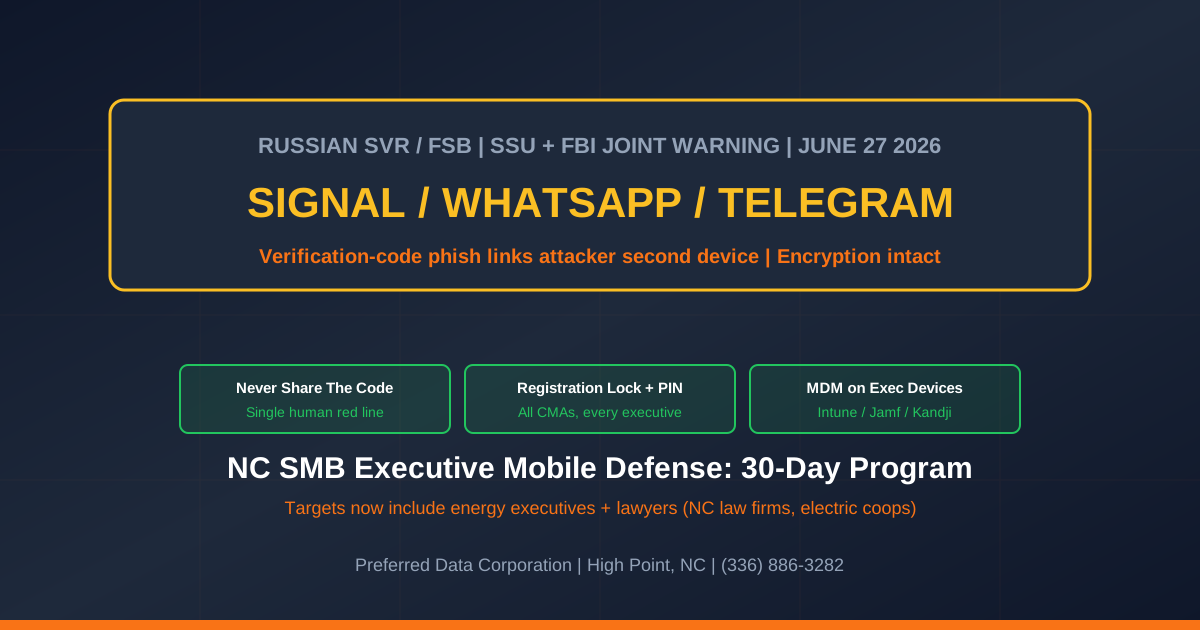
TL;DR: On June 27, 2026, the Security Service of Ukraine (SSU) and the U.S. FBI publicly described a long-running Russian intelligence campaign aimed at hijacking commercial messaging accounts - Signal, WhatsApp, Telegram, iMessage, and SMS - belonging to government officials, military personnel, politicians, journalists, energy-sector executives, and lawyers. The campaign refines a pattern that the FBI's Internet Crime Complaint Center (IC3) first warned about in March 2026 in PSA260320, per The Hacker News. Attackers do not break end-to-end encryption - they impersonate the platform's support bot via SMS or in-app message, urging the target to "verify" their account by sharing a one-time PIN, after which the attacker links a second device and reads every future message. For North Carolina small businesses with executives, lawyers, or operations leaders who do real business in Signal, WhatsApp, or Telegram, this is a now-this-week threat - the target list is widening past the original "journalists and dissidents" focus.
Key takeaway: The Russians did not break Signal. They went around it. The defense for an NC SMB executive is the same defense for any commercial messaging account: never, ever, ever read a verification code or PIN to anyone who calls or texts asking for it.
Need help locking down executive mobile devices and messaging accounts? Preferred Data Corporation has run managed cybersecurity and managed IT for NC small businesses since 1987. Call (336) 886-3282 or request an executive mobile defense review.
What is the Russian SVR messaging app phishing campaign and how does it work?
Per the FBI IC3 PSA260320, Russian Intelligence Services (RIS) cyber actors are targeting commercial messaging application (CMA) accounts on Signal, WhatsApp, Telegram, iMessage, and SMS through tailored phishing messages. The attacker sends a message - via SMS or via in-app DM from a spoofed account - masquerading as the platform's automated support bot, urging the target to click a link or share a verification code or account PIN. Once shared, the attacker links a second device to the victim's account, gaining real-time visibility into the victim's messages and contacts without breaking the underlying encryption.
| Attribute | Russian SVR CMA campaign detail |
|---|---|
| First public FBI/CISA warning | March 2026 (IC3 PSA260320) |
| June 27 update | Joint SSU + FBI campaign disclosure |
| Attribution | Russian Intelligence Services (SVR + FSB) |
| Original targets | Government, military, politicians, activists, journalists |
| Widened targets | Energy sector executives, lawyers, legal professionals |
| Attack vector | SMS or in-app phishing impersonating CMA support |
| Lure | "Verify your account / new device sign-in / suspicious activity" |
| Mechanism | Victim shares PIN / verification code → attacker links second device |
| Outcome | Real-time read of all future messages, without encryption break |
| Affected platforms | Signal, WhatsApp, Telegram, iMessage, SMS |
The campaign matters because it sidesteps the entire "end-to-end encryption is unbreakable" defense posture. The attacker is not decrypting the traffic. The attacker is enrolling as a legitimate second device on the victim's account.
Quotable definition: A commercial messaging application (CMA) account takeover is an attack that links an attacker-controlled second device to a victim's Signal / WhatsApp / Telegram / iMessage account by tricking the victim into sharing the verification code or PIN. The encryption remains intact; the attacker reads the plaintext because they are now a legitimate endpoint on the conversation.
Three facts an NC SMB should write down:
- The target list is widening. The original FBI / CISA warning called out journalists, activists, and political figures. The June 27 update added energy-sector executives and lawyers - meaning the campaign now reaches NC SMB executives in regional law firms, electric cooperatives, oil-and-gas distributors, and any business with a CEO who does deal-flow over WhatsApp.
- The attack does not require a sophisticated actor. Per Malwarebytes, the RIS playbook is now public and replicated by criminal actors. NC SMBs face the same attack from organized crime ransomware operators today.
- The defense is human, not technical. The single control that defeats every variant of this attack: "Never share a verification code or PIN with anyone who calls or messages you, ever, for any reason - including your CEO, your lawyer, your IT, or the platform's official support."
Why does this matter for North Carolina small businesses specifically?
Because NC SMB executives have moved real business communications onto encrypted messaging apps over the last five years. The NC SMB victim profile maps cleanly:
- A High Point manufacturer CEO does deal-flow over WhatsApp with European OEM customers. Pricing discussions, supply-chain disclosures, and unreleased product details flow daily. A linked second device on the CEO's WhatsApp = direct corporate espionage.
- A Charlotte regional law firm uses Signal for partner-to-partner confidential strategy discussions on active matters - including matters involving defense contractors with CUI. A linked second device on a partner's Signal = client privilege exposure plus DFARS notification clock.
- A Greensboro electric cooperative executive uses Signal for grid-operations coordination. Per the June 27 update, energy-sector executives are squarely on the SVR list.
- A Piedmont Triad nonprofit ED uses WhatsApp / Telegram to coordinate with international NGO partners, including in jurisdictions of US foreign-policy interest. The lure ("there's been suspicious activity, please verify") arrives via SMS in fluent English.
Per the FBI IC3 PSA260320, the actors tailor messages to the target's profile and reference real context - publicly available conference appearances, recent board votes, social-media posts. The phish is not generic.
Key takeaway: If your NC SMB has executives who do real business in Signal, WhatsApp, or Telegram, you are inside the target population. The defense is a 15-minute conversation with each executive, repeated quarterly.
How does an NC SMB defend executive messaging in 30 days?
Run a six-step sequence inside 30 days. The plan is designed for an NC SMB CEO or CFO with 1-2 IT staff (or a managed services partner) and 5-30 executive-level users.
- Brief every executive on the verification-code phish (Day 0-7). A 15-minute conversation: "If anyone - including me, including the platform, including IT - calls or messages asking you to share a verification code or PIN for Signal / WhatsApp / Telegram / iMessage, the answer is always no, and you hang up. Tell me you did so we can investigate."
- Enable signal-level account hardening (Day 0-14).
- Signal: Enable the Registration Lock PIN. Set a strong PIN. Enable Screen Lock. Review linked devices weekly.
- WhatsApp: Enable Two-Step Verification with a PIN. Enable Account Protect. Review linked devices weekly.
- Telegram: Enable Two-Step Verification with a password and recovery email. Use Secret Chats for sensitive content. Review linked devices weekly.
- iMessage: Enable Lockdown Mode on the iPhone for executives in higher-risk roles. Review iCloud-linked devices weekly.
- Deploy mobile device management (MDM) on executive devices (Day 7-21). Microsoft Intune, Jamf, or Kandji. Enforce passcode policy, OS-update SLA, app-vetting, and remote wipe. For NC SMBs without Intune, the Apple Business Manager + Apple Configurator path is a low-friction starting point.
- Sweep executive devices for unauthorized linked sessions (Day 0-3). Walk every executive through Signal Settings > Linked Devices, WhatsApp Settings > Linked Devices, and Telegram Settings > Devices. Remove anything they did not personally link. Any anomaly is treated as a discovery event.
- Set a written executive messaging policy (Day 14-30). Approved apps, prohibited topics (board materials, M&A, payroll), backup-or-not posture, retention obligations, and the verification-code red line. Sign it; distribute it; train against it.
- Test the policy with a tabletop (Day 21-30). Simulate a Signal verification-code request to one executive (with their consent). Walk through what they do, who they tell, how IT responds. Most policies break at "did you forget to tell me about the code, or is this a real attack?"
| Control | Day-30 target | Why it matters |
|---|---|---|
| Executive briefing on verification-code phish | 100% of execs | Closes the human entry vector |
| Registration Lock / Two-Step Verification on all CMAs | 100% of exec accounts | Adds a PIN the attacker also has to phish |
| MDM on executive devices | 100% of execs + key staff | Enables passcode, update, and wipe policy |
| Linked-device sweep | All execs + all apps | Detects existing attacker enrollment |
| Written executive messaging policy | Signed + distributed | Documents the red lines |
| Tabletop on verification-code request | Executed + minuted | Validates the policy under simulated attack |
Key takeaway: The technology is unbreakable. The human is the attack surface. A 15-minute executive briefing on "never share a verification code" closes more of this attack than any technical control.
How does Preferred Data Corporation help NC SMBs defend executive messaging?
PDC has run managed cybersecurity and managed IT for NC SMBs since 1987 - including executive protection programs for NC manufacturers, law firms, healthcare practices, and nonprofits. For the Russian SVR CMA campaign and its criminal-actor copycats, PDC brings three things to the table:
- Executive mobile hardening: A 90-minute walkthrough per executive that enables Registration Lock / Two-Step Verification, sweeps linked devices, and configures Lockdown Mode where appropriate.
- MDM deployment + executive policy: Microsoft Intune, Jamf, or Kandji deployment with an executive-tier policy that enforces passcode, OS updates, app-vetting, and a remote-wipe capability that does not require executive sign-off in a crisis.
- Tabletop + training: A quarterly tabletop simulating a verification-code phishing attempt against the executive team, with a 30-minute follow-up training and a documented update to the executive messaging policy.
For NC manufacturers in High Point and Greensboro with international customers, law firms across the Piedmont Triad handling sensitive matters, electric cooperatives and oil/gas distributors in Charlotte, and nonprofits coordinating internationally - this is the 30-day cycle that closes the messaging-account attack surface for the executive team.
Need help with a 30-day executive mobile defense program? Call (336) 886-3282 or book an executive mobile defense review.
Frequently Asked Questions
What is the Russian SVR commercial messaging app phishing campaign?
Per the FBI IC3 PSA260320, Russian intelligence services are sending tailored phishing messages - via SMS or in-app DM - that impersonate the official support bot of Signal, WhatsApp, Telegram, iMessage, and similar platforms. The lure asks the victim to share a verification code or PIN; once shared, the attacker links a second device to the victim's account and gains real-time read access to all future messages without breaking the platform encryption.
Did the Russians break Signal or WhatsApp encryption?
No. The attack does not decrypt traffic. The attacker enrolls as a legitimate second device on the victim's account by phishing a verification code. The encryption remains intact; the attacker is now a legitimate endpoint that reads the plaintext alongside the victim.
How do I tell if my Signal or WhatsApp account has an unauthorized linked device?
Signal: Settings > Linked Devices. WhatsApp: Settings > Linked Devices. Telegram: Settings > Devices. iMessage: Apple ID > Devices. Walk each list and remove anything you did not personally link. Per the FBI IC3 PSA260320, this is the single most useful defensive sweep an executive can perform.
What is the single most important control for an NC SMB executive?
Never share a verification code or PIN for any messaging account with anyone who calls or messages asking for it - including someone who appears to be the platform's official support, your IT team, your CEO, or your lawyer. There is no legitimate reason for anyone to ever ask for that code. If someone does, hang up and report it.
Is my NC SMB really a target?
If your executives do real business in Signal, WhatsApp, or Telegram - and the answer for most NC manufacturers with international customers, regional law firms, electric cooperatives, healthcare practices, and nonprofits is yes - then your executives are inside the target population. Per the June 27 update, the campaign now reaches energy-sector executives and lawyers, not just the original journalist / dissident profile.
Should we ban Signal and WhatsApp for business communications?
Not necessarily. Encrypted messaging serves legitimate business purposes - and an outright ban will be widely ignored. The better posture is a written policy that approves certain apps for certain topics, prohibits sensitive topics (board materials, M&A, payroll), requires Registration Lock / Two-Step Verification, requires MDM enrollment on the device, and trains executives on the verification-code red line.
What if our defense contractor / CUI is exposed via a hijacked Signal account?
If CUI was discussed in the channel and the channel has been compromised, DFARS 252.204-7012 requires DoD CIO notification within 72 hours of discovery. Per the CMMC Phase 2 November 2026 deadline, NC defense subcontractors should treat executive messaging-app compromise as a discovery event and escalate immediately.
Related Resources
- Managed Cybersecurity for NC Businesses - Executive mobile defense + MDM
- Managed IT for NC Businesses - Mobile device management for NC SMBs
- Voice Cloning CEO Fraud / Vishing Defense
- WhatsApp VBScript ManageEngine RMM Campaign: SMB Defense
- Device Code Phishing 37x Surge: NC SMB MFA Defense
- FBI IC3 2025: $893M AI Scams - NC SMB Defense
- Contact Preferred Data Corporation - 30-day executive mobile defense for NC SMBs