
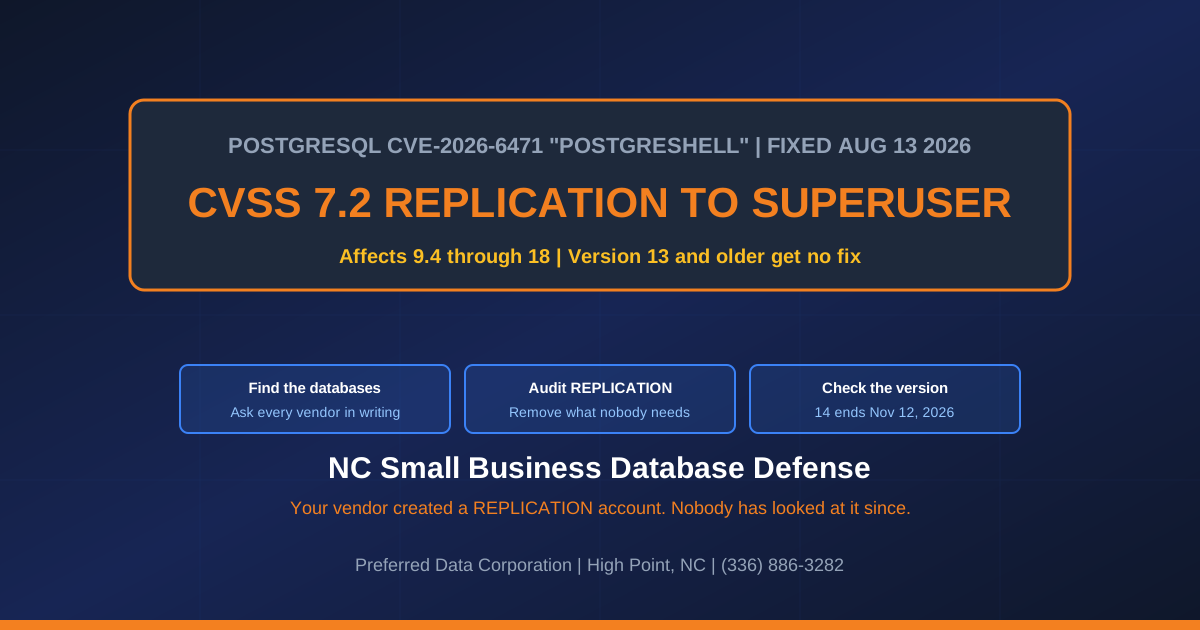
TL;DR: Somewhere in your building there is a database nobody patches, because your software vendor installed it and your IT provider treats it as the vendor's problem. A flaw that got its public write-up this week, nicknamed PostGREShell and tracked as CVE-2026-6471, lets one specific kind of database login, an account carrying the REPLICATION attribute, point the database at a library already sitting on that server and run it as the account that owns the whole thing. That attribute is what a streaming standby, a physical backup tool or a reporting pipeline tends to get handed on install day. PostgreSQL quietly shipped the fix back on August 13, 2026, so in most buildings the patch has been sitting there unapplied for three weeks. Below: one query that answers whether this is your problem, and what to do about the account that made it one.
Key takeaway: The interesting part of this flaw is not the patch. It is what it reveals: a REPLICATION account created once, by a vendor, for a backup or reporting job, that nobody has looked at since, and that this flaw turns into a path to superuser.
Is this urgent, or can it wait?
It can wait a week. It should not wait a quarter. No one has reported an attack using this flaw, and it was not on CISA's Known Exploited Vulnerabilities catalog, the federal list of flaws confirmed under attack, as of September 4, 2026, per The Hacker News. This is not the Switchvox emergency from a few days ago, where exploitation was already running and CISA had set a federal deadline.
What earns it a slot on your schedule is not the flaw. It is that fixing it means restarting your database, and arranging that restart takes longer than the fix does.
One thing before you file it under "later." Cyera, the data-security firm that found this, also ran a threat hunt and turned up 114 malicious PostgreSQL plugins already circulating, including trojans, miners and reverse shells. Nobody is using this particular door yet. The hallway behind it is busy.
For the technical reader: PostgreSQL rates it CVSS 7.2, and the score is held down by a "privileges required: high" rating, per the PostgreSQL advisory. The privilege in question is the REPLICATION attribute. At a bank that is a tightly controlled thing. At a 60-person plant running an ERP a reseller stood up in 2019, it is whatever the install guide said to type.
Not sure which of your servers runs PostgreSQL? A Preferred Data Corporation engineer can inventory it with you on a short call. Dial (336) 886-3282.
Which of your systems is quietly running PostgreSQL?
In our experience most owners running PostgreSQL do not know they are, because they bought an application and the database came in the box. Where it hides in a manufacturer, distributor or contractor:
| Where it hides | What you actually bought | Who you have to ask |
|---|---|---|
| ERP, MES or production scheduling | A system from a specialist vendor | The vendor, in writing |
| Shop-floor labeling or barcode terminals | The screens your line leads log into | The reseller who installed it |
| Reporting and dashboards | A BI tool such as Metabase or Grafana | Whoever built your reports |
| A "web server" in the rack | An internal site, portal or ticket system | Whoever set it up, possibly nobody now |
| A vendor's virtual appliance | A black-box VM you were told not to touch | The vendor, again in writing |
That last row catches people out. A vendor appliance is still a server on your network holding your data, and "do not touch" is a support policy, not a security control.
What logical decoding actually is: the PostgreSQL feature that streams a running record of database changes out to other systems, which is how logical replication and change-data-capture pipelines keep a dashboard or a data warehouse current. Physical base backups and standby copies use a different, lower-level protocol, but they are handed the same REPLICATION attribute, which is how they end up in scope too. CVE-2026-6471 is a failure to check which add-on code the decoding feature may load, so an account allowed to use it can point it at a file of the attacker's choosing.
Who in your shop holds the REPLICATION attribute?
A piece of software holds it. That is the problem. The REPLICATION attribute exists so a system can read the change stream, and vendors ask for it because it works, while a scoped alternative takes a support call to design. The Hacker News names the usual holders directly: backup systems, standby servers, change data capture pipelines and monitoring systems.
| Account you probably have | Why it exists | What it can do here |
|---|---|---|
| Physical backup or standby user | Base backups and warm standby, the pg_basebackup kind | Holds REPLICATION by design, so it is in scope |
Nightly pg_dump backup user | A plain SQL dump to a file | Usually not: this needs read rights, not REPLICATION |
| Reporting or CDC connector | Feeds a dashboard or data warehouse | In scope if it was granted REPLICATION |
| Monitoring agent | Uptime and performance graphs | In scope if it was granted REPLICATION |
| Application login | Runs the ERP itself | Usually not, but check rather than assume |
Reading your data is the least of what one of those logins is worth to an attacker who can also get a file onto the server. Cyera reports in its write-up that exploitation yields code execution as the operating system account running the server, permanent superuser access across every database on it, and a persistent backdoor. Their explanation of why is blunt: code loaded this way "runs in the same address space as PostgreSQL, with no sandbox and no checks on internal API calls."
Forget the hacker in Bulgaria typing at your firewall. The credentials for these accounts are in a text file on the backup server, in a saved connection in someone's database client, in the ticket where the vendor sent them, and in the runbook the last IT person left behind. None of those places is a secret. The flaw is what turns "a stale password in four places" from a housekeeping problem into part of a path to the whole server.
Do you even have a patch available? Check the version first
Check your version before you schedule anything, because if you are on an old branch there is no patch coming and every hour spent planning a maintenance window is an hour on the wrong problem. PostgreSQL supports each major release for five years and then stops, per the PostgreSQL versioning policy.
The fix landed August 13, 2026, in 18.6, 17.11, 16.15, 15.19 and 14.24, per the PostgreSQL advisory. Read that advisory carefully and you will notice it covers only the five supported branches. Cyera states that every version from 9.4 through 18 is affected and says it confirmed this on 18.2, per SecurityWeek; the flaw dates to logical decoding arriving in PostgreSQL 9.4 in 2014, per The Hacker News, which is why the coverage calls it a 12-year-old bug.
| Your major version | Status as of September 2026 | What you do |
|---|---|---|
| 18, 17, 16, 15 | Supported | Update to 18.6 / 17.11 / 16.15 / 15.19 |
| 14 | Supported, but ends November 12, 2026 | Update to 14.24 now, plan the major upgrade |
| 13 | End of life since November 13, 2025 | No patch will be issued. Plan the upgrade |
| 12 and older | End of life since 2024 or earlier | No patch will be issued. This is a project |
Know what is inferred on those bottom two rows: PostgreSQL publishes no fixes for end-of-life branches, and the researchers place the flaw's origin at 9.4, so treat an out-of-support branch as vulnerable.
Version 14 is the trap. Patch to 14.24 this month and you are genuinely fine, until support ends on November 12, 2026, 67 days from the day this posts. Stop there and the next PostgreSQL flaw finds you with nothing to install. Budget the major upgrade this fiscal year.
Running an unsupported database version? Getting off one is a planning problem before it is a technical one, and it is worth talking through before it becomes urgent. Call Preferred Data Corporation at (336) 886-3282.
What should a North Carolina business do about this in the next two weeks?
Four steps. The first two cost nothing but attention.
List the databases and ask each vendor the version question. Not the applications, the databases. Send this to every software vendor you pay and require a written reply: "Does your system run PostgreSQL? If so, what version, and is it at or above 18.6, 17.11, 16.15, 15.19 or 14.24? If our version is end of life, what is the upgrade path and cost?" Most shops have never had this list, and building it is worth more than this specific patch.
Get the list of accounts this applies to. You do not have to run this yourself, and you do not need a database administrator on staff, which is the whole point of this article. Send this one line to your vendor or IT provider and ask for the output:
SELECT rolname, rolsuper, rolreplication, rolcanlogin
FROM pg_roles WHERE rolsuper OR rolreplication;
That returns every role the flaw applies to, and the flags matter, because the cases need different answers. A role with
rolreplicationand no superuser bit is the ordinary case: if nothing needs it, take it away withALTER ROLE ... NOREPLICATION, which the researchers advise regardless of patching, per Security Affairs. Arolsuperrole is the trap: a superuser bypasses the check entirely, so removing REPLICATION from it changes nothing, and the only real answer is to stop that account being a superuser or stop using it for routine jobs. And a row withrolcanloginfalse is a group rather than an account, so there is no password to rotate; the question to send back is which logins are members of it. On a healthy system this is a short list and someone can name every entry.Schedule the restart. A minor update is a stop, swap the binaries and start, with no dump and restore, per the PostgreSQL versioning policy. On a two-shift plant the honest window is between second shift and first, and the person who has to approve it is your scheduler, not your IT guy.
Name the owner, permanently. Decide who patches this database from now on and write it down. If the answer is "the vendor," get that in their contract language. In our experience, a vendor's idea of owning your database means telling you when to buy the next major release.
What Preferred Data Corporation does about the servers nobody owns
We have been walking into server rooms across the Piedmont Triad since 1987, and finding a machine nobody can name in a good many of them.
The actual lesson of CVE-2026-6471 is organizational, not technical. In our experience the database is the most reliably unpatched thing in a mid-sized company, and the reason is not laziness. Windows gets patched because an RMM tool does it automatically. The database does not, because the application vendor's contract implies they own it and their patching policy is "upgrade when you buy the next version." Nobody is lying. There is a seam between two support agreements, and the database is sitting in it.
The uncomfortable part, said out loud: we are also one of those vendors. PDC writes custom software that reads from ERP databases running on hardware inside our customers' buildings, and every install of that kind creates the object this post is about, a server somebody has to own. Knowing how that seam opens from the vendor side is most of why we know where to look from the IT side.
Four things, none of them exotic. The database goes on the patch list with one person's name against it, the same as the servers (managed IT). REPLICATION comes off every account that stopped needing it, and the superusers get looked at separately (cybersecurity). We check that your backup account can back things up and do nothing else, a line most nightly-backup setups in manufacturing never drew (backup and disaster recovery). And the database server comes off the flat plant-and-office network, so one compromised PC in shipping stays one compromised PC (network).
Straight answers for whoever has to fix this
Are attackers using this right now?
Not according to any public reporting. As of September 4, 2026 there was no public proof-of-concept exploit and the flaw was not listed in CISA's Known Exploited Vulnerabilities catalog, per The Hacker News. Plan the work; do not patch at 11pm.
Will patching break our ERP, or void the vendor's support?
A minor update, 14.23 to 14.24 for example, is bug and security fixes only, and installing one means stopping the server, swapping the binaries and restarting, with no dump and restore, per the PostgreSQL versioning policy. Major upgrades, 14 to 17, genuinely do need vendor certification and application testing. Where a vendor pushes back on a minor update, ask them to put it in writing: which version they will support, and which security fix they are asking you to skip.
If our database is not reachable from the internet, are we in the clear?
You have bought time, not safety, and the reason is worth understanding because it shapes what you go looking for. Two things have to be true, not one. First, the attacker needs a working PostgreSQL login carrying the REPLICATION attribute, so this is not an unauthenticated flaw, even though the advisory rates it network-exploitable at AV:N, which describes how the component is reached rather than the whole attack. Second, there has to be a library already sitting on the database host that the server can read, because the flaw makes logical decoding open a file that is already there; it does not put the attacker's code on your server. That second condition is exactly why Cyera's count of 114 malicious plugins already circulating matters. So in most shops this is a second move rather than a first one: someone already has a foothold, or a stolen vendor credential plus a way to leave a file behind.
Our ERP vendor says not to touch the database. Now what?
Then the request goes to them in writing, with a date attached: which PostgreSQL version their system runs, whether it is patched, and if not, when. If two weeks pass with no answer, that is your answer, and it applies to more than the database.
Is there anything to do besides patching?
Yes, and it outlives this CVE. Remove the REPLICATION attribute from any account that does not need it, per Security Affairs, then rotate the credentials for the ones that remain and get them out of text files and saved client connections. The patch fixes one bug; the account cleanup reduces the damage from the next one.
We are on PostgreSQL 12 and the vendor is gone. What are our options?
That is a migration project, and more common than people admit. Three paths: upgrade PostgreSQL and test the application, move to a supported hosted database, or replace the application. All need scoping before a budget number.
Want a second opinion on your database exposure? Call Preferred Data Corporation at (336) 886-3282 or email [email protected].
Monday move: Run the one-line query in step 2, or send it to whoever can. Then put a name next to each database on your list. If any line ends with "I don't know," that line is your project, and it was your project before this CVE existed.
Related Resources
- Metabase Zero-Day: Self-Hosted BI and Database Credentials - the same pattern one layer up, where a reporting tool holds the database keys.
- Veeam CVE-2026-44963: Backup Server RCE and NC SMB Ransomware Defense - why the backup system, and the account it runs as, is a target rather than a safety net.
- Technology Vendor Management for North Carolina Small Business - how to hold the vendors in this post to written answers before you need one.
- PaperCut CVE-2026-82078 RCE: NC Print Server Defense - the vendor-installed server nobody owns, in its print-management form.