
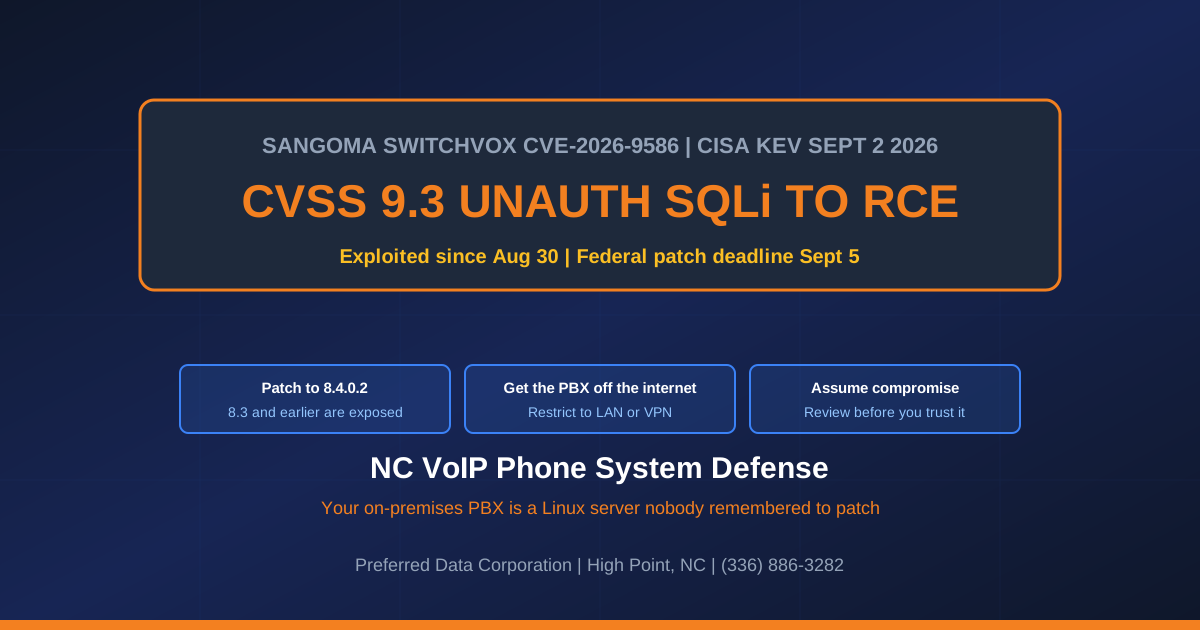
TL;DR: There is probably a small server in your phone closet that nobody has logged into since the day it was installed. If it is a Sangoma Switchvox, researchers have watched attackers fire working exploits at these systems across the internet since August 30, 2026, no password needed, the kind of attack that plants a foothold on the network your whole business runs on. A hijacked phone system is also the classic launchpad for toll fraud, fraudulent international calling that runs up a big bill. Sangoma shipped a fix on July 14, so the systems most exposed right now are the ones that never got it. Here is how to find out in ten minutes whether that box is yours, and what to do this week. (For the technical reader: this is CVE-2026-9586, CVSS 9.3, and CISA set a September 5 federal patch deadline.)
Key takeaway: The patch has existed since July 14, 2026. The systems most at risk this week are the ones where the phone system "just works," so nobody touched it. A box the vendor stopped babysitting the day the install was signed off is not secure just because it still answers calls.
Do you even run Sangoma Switchvox? A ten-minute check
You may run Switchvox without ever having heard the name. It grew out of the Digium and Asterisk world and is squarely a small-business phone system, the kind a local telephone or copier vendor installs once and leaves in a closet. If your desk phones are Sangoma or Digium branded, or an outside phone company set up your auto-attendant, Switchvox is a live possibility.
The check an owner can run without knowing anything technical: ask whoever handles your phones whether the system is a physical box on site or hosted in the cloud by your carrier. A box in the closet means an on-premises system to identify and version-check this week. If nobody can answer, that uncertainty is the finding, because a server no one can name is a server no one is patching.
Better yet, send this to whoever maintains your phones and ask for a written reply:
"Do we run a Sangoma Switchvox phone system? If yes, what version, and is any part of its web interface reachable from the public internet? If we are below 8.4.0.2 or that interface is exposed, when will you patch and lock it down? Please answer in writing."
If the answer is "yes, we run Switchvox, it is below 8.4.0.2, and it is reachable from the internet," you are the shop this article is about. If your phones are carrier-hosted, do not assume you are clear: ask them to confirm the platform and, if it is Switchvox, that it is on 8.4.0.2 or newer. Hosting it off-premises keeps a break-in off your own network, but a hosted Switchvox the carrier has not patched is still exposed.
Not sure what is in your phone closet? A Preferred Data Corporation engineer can tell you in a short call whether you run Switchvox, what version, and whether it answers the internet. Call (336) 886-3282.
What is CVE-2026-9586, and why is a phone system this dangerous?
One web request, no username, no password, and the attacker is running commands on your phone server. On the industry's 0-to-10 scale it rates 9.3, per The Hacker News. And it is on CISA's must-patch catalog, the list reserved for flaws attackers are already exploiting.
The mechanism is SQL injection. The Switchvox web interface takes a value out of a request and drops it into a database query without checking it, so an attacker can smuggle in their own commands, per the disclosure from Horizon3.ai, which first reported it. Because the query runs as the PostgreSQL superuser, the injection can jump from reading data to running operating-system commands, turning a database bug into remote code execution. Horizon3 reported it in April 2026 as one of 12 flaws it found; Security Risk Advisors reported the same class independently.
Two more numbers: the fix shipped in Switchvox 8.4.0.2 on July 14, 2026, and roughly 4,000 Switchvox systems answer the public internet today, most in the US, per Shodan scans cited by Horizon3 and Help Net Security. The same scanners that find those can find yours.
What can someone do after they take over your phone system?
The instinct is to picture someone listening to your calls. That is the wrong fear. CVE-2026-9586 gives an attacker a live foothold on a Linux server inside your building, and Horizon3.ai documented exactly that in its exploitation sensors: an exploited box calling out to attacker infrastructure, then running commands to look around. Within days the campaign spread to dozens of source addresses and dropped second-stage malware that early analysis flagged as a likely cryptominer, Help Net Security reported.
For a manufacturer or distributor, three harms follow, and none is eavesdropping. First, the carrier bill: a hijacked PBX is a toll-fraud engine, and a Friday-to-Monday run of international and premium-rate calls racks up a heavy fraudulent bill before anyone is back to notice. Second, the pivot: when the phone box shares one flat network with the file server holding your customer drawings and the plant-floor scheduling system, a foothold on the phone is a foothold on production. Third, quieter: the second-stage payload, flagged on a first look as a likely cryptominer, turns the box into someone else's computer on your power and hardware, surfacing as an unfamiliar process whose traffic rides ordinary web connections the firewall waves through.
| The assumption | The reality under CVE-2026-9586 | What to check |
|---|---|---|
| "A phone hack means someone hears our calls" | A foothold on a Linux server: the observed campaign ran reverse shells and suspected cryptomining, and a hijacked PBX is also a classic toll-fraud engine and, on a flat network, a path onto production | Review the box for odd outbound connections and unfamiliar processes |
| "Our firewall protects the phone system" | If the web interface is exposed, the exploit needs no login to reach it | Confirm nothing on the phone box answers the internet without a VPN |
| "The phone company handles security" | Patching this server may not be in your phone vendor's scope, so confirm who owns it | Name one owner for phone-system patching, internal or an MSP |
| "We are too small to be a target" | Indiscriminate scanning finds every internet-exposed Switchvox the same way; being small does not make a scanner skip you | Treat the on-premises phone box like any other production server |
Key takeaway: A breached phone system is not a call-quality problem, it is an unmonitored Linux server with an attacker's shell on it, sitting one hop from the systems that run your plant. Backups will not save the phone bill, and the firewall you counted on may never see it happen.
Why a July patch became a September emergency
The timeline is the whole story, and a common one: Sangoma shipped on schedule, and the danger opened in the gap between a fix existing and someone applying it.
| Date (2026) | What happened | What it means for you |
|---|---|---|
| April | Horizon3 privately reports 12 Switchvox flaws to Sangoma | The clock started long before you heard anything |
| July 14 | Sangoma ships the fix in Switchvox 8.4.0.2 | Patching was possible almost two months before attacks began |
| August 30 | Exploitation attempts begin, observed against honeypots | The "it works, leave it alone" boxes are the ones at risk |
| September 2 | CISA adds CVE-2026-9586 to its must-patch catalog | Confirmed active exploitation in the wild; a September 5 federal deadline follows |
That deadline comes from CISA's September 2 catalog update, which gave federal agencies until September 5 to patch or disconnect. You are not bound by that date, but it is the clearest signal that this flaw is under active exploitation right now. A phone system that runs untouched for years is not stable, it is unpatched, and the difference only shows up on a week like this one.
What should a NC business do this week?
The plan is short, and step one is the owner's job. You do not need to understand SQL injection to close this, just find the box and get competent eyes on it.
- Identify the phone system. Confirm whether you run an on-premises box and whether it is Sangoma Switchvox, using the ten-minute check and the vendor email above. If an outside company manages your phones, that email is your step one.
- Update to 8.4.0.2 or newer. Any Switchvox SMB build at or below 8.3 (104997) is vulnerable, and no setting short of the patch is safe. If your phone vendor runs the box, hold them to a written date; if an MSP runs your IT, this is their ticket today.
- Get the whole Switchvox web service off the open internet. The exploit hits a phone-provisioning endpoint (
/pa), not the admin console, so locking down only the admin page is not enough; put the entire web interface behind your LAN or a VPN. That removes the internet-facing path, patched or not, and is the highest-value move here. - Assume nothing about the past, and do not call it clean on a glance. Patching closes the hole but does not undo a break-in that already happened, and an attacker who had code execution can delete logs and hide persistence, so surface checks alone cannot prove an exposed, unpatched box is clean. Where you cannot rule out a compromise, contain the box, preserve its logs, get qualified incident-response help, rotate the Switchvox admin and SIP-trunk passwords and any stored credentials, and rebuild or restore from a known-good image rather than trusting a scan.
- Assign a permanent owner. Decide today who patches the phone system going forward, your internal IT lead or an MSP, and put it on the same schedule as your servers. The missing answer is what let this sit.
For many small North Carolina shops, steps three and five raise a bigger question: does a phone server in the closet still pay for itself, or would a hosted voice service the vendor patches for you retire this whole class of fire drill? That is a decision, not an emergency, but a good week to schedule it.
What Preferred Data Corporation does for NC businesses here
Preferred Data Corporation has run technology for North Carolina manufacturers, distributors, and contractors since 1987, treating the boring boxes, the print server, the phone system, the domain controller nobody has logged into in a year, as part of the network, not an afterthought. From our High Point headquarters we work on site across the Piedmont Triad and out to Greensboro, Charlotte, and Raleigh, within 200 miles.
On CVE-2026-9586 specifically, our cybersecurity team confirms whether your phone box is exposed and reviews it for the reverse-shell activity Horizon3 documented and the second-stage malware that followed. Our managed IT team owns the patch going forward so the phone system stops being the box with no name on it, and our network practice segments it away from your file server and plant-floor systems so a single foothold has far less room to spread into a full breach. For manufacturers running a flat plant-and-office network, that segmentation is what makes a bad day far more likely to stay contained.
Monday move: Read the version off your Switchvox box and email it, with the name of whoever is supposed to be patching it, to whoever owns your IT. If either answer is "I don't know," that is your first ticket this week.
Think your Switchvox system may already be compromised? Call Preferred Data Corporation at (336) 886-3282 or email [email protected], and we will help you triage it.
Questions NC owners are asking this week
Could we be running Switchvox and not know it?
Possibly. Switchvox is an on-premises small-business phone system, and where an outside vendor set it up, it may not appear on your IT inventory. If you have a physical phone box on site and Sangoma- or Digium-branded handsets, treat Switchvox as likely until someone confirms otherwise.
What version fixes CVE-2026-9586?
Switchvox 8.4.0.2, released July 14, 2026, contains the fix. Any build at or below Switchvox SMB 8.3 (104997) is vulnerable. Read the version off the admin console and confirm you are on 8.4.0.2 or newer.
If our phone system is only on the internal network, are we safer?
Considerably. The attack has to reach the Switchvox web service, the /pa endpoint, so if no part of the web interface answers the public internet, a random internet scanner has no network path to it. Restricting the whole interface to your LAN or a VPN is one of the highest-value moves you can make, patched or not.
We patched. Do we still need to check for a break-in?
Yes. Exploitation was observed from August 30, 2026, before CISA listed the flaw on September 2, so a box could have been compromised before you updated, and patching does not evict anyone already inside. Do not treat a quick scan as an all-clear: someone who had code execution can wipe logs and hide. If the box was internet-exposed and unpatched, treat it as a possible compromise (step 4 of the playbook): get qualified incident-response help, rotate the admin and SIP-trunk credentials, and rebuild or restore from a known-good image if access cannot be ruled out.
What is the worst-case cost if a phone system is breached?
Toll fraud is the fastest financial hit: a compromised phone system places a high volume of international or premium-rate calls, piling a heavy bill onto one carrier statement. Beyond that, the box is a jumping-off point into your network and a host for cryptomining-style malware.
How fast can Preferred Data Corporation help if we think we were hit?
Call (336) 886-3282 or email [email protected] and we start triage promptly, scoping whether your Switchvox system is exposed, which build it runs, and whether there are signs of compromise. The review depends on what we find.
Related Resources
- Cisco Unified CM CVE-2026-20230 KEV: NC SMB VoIP Defense - the enterprise cousin, a must-patch flaw in Cisco's call-manager appliance.
- Business Phone System and VoIP Guide for North Carolina - choosing and running a phone system, including the hosted-vs-on-premises decision this post raises.
- PaperCut CVE-2026-82078 RCE: NC Print Server Defense - the same pattern on another forgotten, internet-facing server.
- Network Segmentation Against Attacks: NC Business Guide - why keeping the phone box away from your file server and plant floor contains a foothold.
- Preferred Data Corporation Cybersecurity Services - incident triage, exposure review, and defense for NC manufacturers and distributors.