
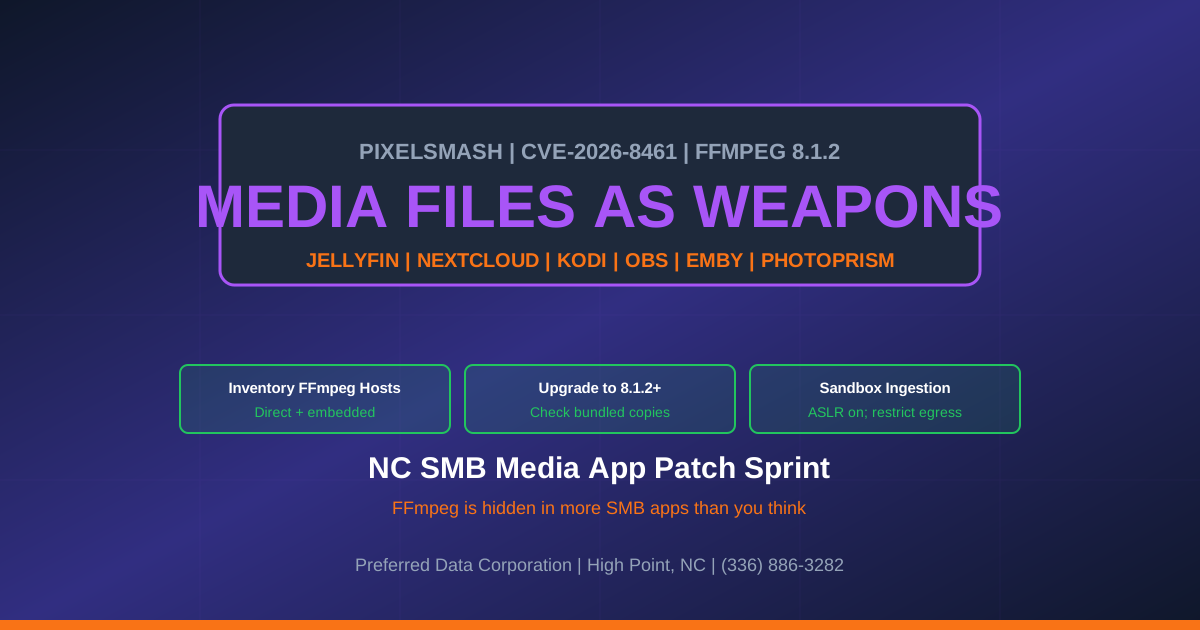
TL;DR: On June 17, 2026, the FFmpeg project shipped version 8.1.2 to patch PixelSmash (CVE-2026-8461), a CVSS 8.8 heap out-of-bounds write in the MagicYUV decoder of FFmpeg's libavcodec library, disclosed by the JFrog research team and confirmed by BleepingComputer. FFmpeg is the open-source library buried inside an enormous number of media tools an NC small business actually uses every day - Jellyfin, Kodi, Emby, Nextcloud, PhotoPrism, OBS Studio, and the auto-thumbnail features in most CMS platforms - which makes PixelSmash a software-supply-chain patch sprint, not a single-product update. A crafted AVI, MKV, or MOV file that flows through any of those apps can trigger the overflow during normal playback or even silent thumbnail generation.
Key takeaway: PixelSmash is dangerous because FFmpeg is invisible. NC SMBs that say "we don't use FFmpeg" are almost always wrong - it ships inside the media server, the cloud-sync server, the streaming tool, and the CMS. The patch list is FFmpeg 8.1.2 plus every wrapper application that bundles its own copy.
Need an NC SMB software supply chain audit and a PixelSmash patch sprint this week? Preferred Data Corporation has run managed IT and cybersecurity for North Carolina small businesses from High Point since 1987. Call (336) 886-3282 or book a media application security review.
What is PixelSmash (CVE-2026-8461) and why does it matter to NC SMBs?
PixelSmash is a heap out-of-bounds write in the MagicYUV decoder inside FFmpeg's libavcodec library, scored 8.8 (high) on CVSS. Per JFrog's disclosure, the root cause is inconsistent handling of chroma plane heights during slice processing, which produces a one-row heap out-of-bounds write when a crafted MagicYUV-encoded stream is decoded. Per BleepingComputer and Cryptika, the trigger surface is a crafted AVI, MKV, or MOV file - the three container formats most likely to carry a MagicYUV stream - and the impact ranges from denial of service to remote code execution if address space layout randomization (ASLR) is disabled or the bug is chained with a second vulnerability.
Three things an NC SMB owner should write down:
- The fix is FFmpeg 8.1.2, released June 17, 2026. Per the official FFmpeg security page and Quasar's QPulse advisory, the patched release is the floor; anything older is exposed.
- The exposure is the file, not the user click. Per JFrog, the bug fires during decode - which means automated thumbnail generation and silent media ingestion pipelines (Nextcloud uploads, Jellyfin library scans, PhotoPrism imports) are valid attack surfaces, not just an employee double-clicking a video.
- The affected app list is long and unobvious. Per BleepingComputer, confirmed vulnerable applications include Jellyfin, Kodi, Emby, Nextcloud, PhotoPrism, and OBS Studio - and that is only the named list. Any tool that wraps FFmpeg with MagicYUV enabled inherits the bug.
Which NC SMB tools and workflows actually ship FFmpeg under the hood?
A surprising amount of an NC SMB's daily software stack contains FFmpeg. Per Cryptika and QPulse, the library is the de facto standard for transcoding, thumbnailing, and playback across web, desktop, and self-hosted apps. Below is a quick mapping of the workflows we routinely find in NC small businesses across High Point, Greensboro, Winston-Salem, Charlotte, Raleigh, and the broader Piedmont Triad and Research Triangle.
| Tool or Use Case | Where FFmpeg Sits | Trigger Surface |
|---|---|---|
| Nextcloud file server | Bundled for preview generation | Any uploaded AVI / MKV / MOV |
| Jellyfin / Emby / Kodi | Core transcoder | Library scan + on-demand playback |
| OBS Studio (sales webinars, training) | Capture + recording pipeline | Recorded files re-imported into OBS |
| PhotoPrism (marketing image / video library) | Thumbnail + sidecar generation | Auto-import folders |
| WordPress / Drupal CMS auto-thumbnails | Server-side FFmpeg for video posters | Visitor or contributor video upload |
| NC manufacturer product video pipeline | FFmpeg in the encode + QC step | Vendor-supplied B-roll, contractor edits |
| NC marketing / creative agency thumbnail jobs | Render farm or batch script | Client-supplied raw footage |
| Video conferencing recorders (self-hosted) | Post-call transcode | Recorded session re-encoded |
| File-server preview daemons | Background indexer | Any media on the share |
The pattern matters more than any single row. The dangerous deployments are the ones where a file lands in a folder and the server-side service decodes it without a human ever pressing play - which is exactly how thumbnail generation, library scans, and cloud-sync indexing work. Per JFrog, that is the PixelSmash worst case.
What does the PixelSmash exploit chain look like?
Four steps. The defense lives at each one, not just at the endpoint.
| Step | Attacker Action | NC SMB Failure Mode | Defense Layer |
|---|---|---|---|
| 1 | Craft a malicious AVI / MKV / MOV with a MagicYUV stream | Inbound file controls absent; uploads accepted from any source | Upload allowlists, file scanning, contributor MFA |
| 2 | Deliver to an NC SMB host via upload portal, email attachment, cloud sync, or partner file drop | No segmentation between ingestion worker and rest of network | Sandboxed worker, dedicated VLAN, restricted egress |
| 3 | App decodes the file via FFmpeg (playback, thumbnail, library scan) | Unpatched FFmpeg, MagicYUV decoder enabled, ASLR off | Upgrade to FFmpeg 8.1.2+, mandatory ASLR, EDR |
| 4 | Heap overflow yields DoS or chained RCE on the host | Crashed media server treated as "weird bug," no IR review | Crash telemetry, EDR alerting, incident response playbook |
Per QPulse, the most realistic NC SMB scenario is not a glamorous targeted attack - it is a vendor or contractor sending a routine MOV file to a marketing inbox, that file landing in a SharePoint or Nextcloud folder that auto-indexes, and the thumbnail worker crashing or executing. Treat repeated media-service crashes as a security signal, not a stability bug.
What should NC SMBs do this week about PixelSmash?
Run a five-step plan inside seven days. The work is hours of staff time plus a managed services bill, not a capital project.
- Inventory every host running FFmpeg directly or via an embedded app. Walk every server and workstation and list: Nextcloud, Jellyfin, Emby, Kodi, OBS Studio, PhotoPrism, WordPress / Drupal with video plugins, any video CMS, any custom transcoder script, and any vendor product whose changelog mentions FFmpeg. Per BleepingComputer, the named-app list is a starting point, not a ceiling. On Linux,
ffmpeg -versionon each host gives the system version; on Windows, check Program Files plus each wrapper app's bundled binaries. - Upgrade to FFmpeg 8.1.2 or later. Per the FFmpeg security page, 8.1.2 is the fixed release. Update via your package manager (apt, dnf, brew, choco) where possible and pin to the patched version. Track the change in your patch register so the next vulnerability scan does not flag a regression.
- Confirm app-bundled FFmpeg versions are updated; do not trust the wrapper app version. Per Cryptika, Jellyfin, Emby, OBS Studio, and Nextcloud all bundle their own FFmpeg binaries. Updating the Jellyfin app does not automatically swap the bundled FFmpeg; check each app's release notes for the FFmpeg version it ships and force an upgrade if the bundled copy is older than 8.1.2.
- Keep ASLR enabled across the fleet. Per JFrog, reliable RCE from PixelSmash assumes ASLR is disabled or bypassed. On Windows, enforce mandatory ASLR via Microsoft Defender Exploit Protection (Group Policy: Computer Configuration > Administrative Templates > Windows Components > Microsoft Defender Exploit Guard > Exploit Protection). On Linux, confirm
cat /proc/sys/kernel/randomize_va_spacereturns2. Disabled or partial ASLR is the difference between a crash and a compromise. - Treat automated thumbnail and ingestion pipelines as untrusted-input attack surface. File upload portals, cloud sync indexers, and CMS auto-thumbnail workers process attacker-influenced content silently. Sandbox the worker (separate user account, container, or VM), restrict outbound network access from that worker so a successful RCE cannot phone home, and monitor for crash signals - repeated SIGSEGV or process restarts on a media worker is a triage event. Per QPulse, the silent ingestion path is the worst case worth pre-empting.
Key takeaway: Patching the OS FFmpeg package is not enough. Jellyfin, Emby, OBS Studio, and Nextcloud each bundle their own copy, so the patch sprint has to walk every wrapper application and verify the bundled FFmpeg version is 8.1.2 or later before you call PixelSmash closed.
Want an NC SMB software supply chain audit and a PixelSmash remediation engagement scoped before quarter end? Call (336) 886-3282 or book a media application security review.
What's the broader software-supply-chain lesson for NC SMBs?
PixelSmash is the textbook case of a software-supply-chain vulnerability that hides in plain sight. Three points NC SMB owners and operators should internalize.
- FFmpeg is in basically every video tool. It is in your media server, your video conferencing recorder, your marketing CMS, your file server's preview daemon, your screen-recording tool, your photo library, and probably half the vendor SaaS desktop clients on your fleet. NC manufacturers in High Point and Greensboro pushing product video to YouTube and TikTok touch FFmpeg every time a thumbnail is generated. NC marketing agencies in Charlotte and Raleigh touch FFmpeg every time a client's MOV file is dropped into a project folder.
- NC SMBs rarely have an SBOM. A software bill of materials would tell you which apps ship which version of FFmpeg without each vendor having to issue a separate advisory. Most NC SMBs do not maintain one. The PixelSmash patch sprint is a good forcing function to start - even a simple spreadsheet listing every media-touching app and its bundled libraries gets you ahead of the next libavcodec, libpng, or libwebp CVE.
- The "patch where it lives" problem is real. You can patch the OS FFmpeg to 8.1.2 and still be vulnerable because Jellyfin or OBS Studio shipped its own bundled binary that has not rolled forward. Your patch program has to handle both the OS layer and the bundled-library layer. Vendor changelogs are the source of truth; trust them, not the wrapper's version number alone.
- "We don't use FFmpeg" is almost always wrong. If your NC SMB takes file uploads from clients, runs a marketing site with video, generates webinar recordings, or maintains a self-hosted file share, FFmpeg is in the path somewhere. The right answer to a media-decoder CVE is "let me check the inventory," not "we don't have that."
How does Preferred Data Corporation help NC SMBs run a patch-and-inventory program?
PDC has run managed IT and cybersecurity for NC small businesses from High Point since 1987. Three concrete service lines align with the PixelSmash action list and the broader software-supply-chain problem.
- Managed IT services: Asset inventory, patch management for OS packages and wrapper applications, change tracking so a Jellyfin or OBS Studio update does not silently regress your FFmpeg patch, and 24/7 monitoring of media servers and ingestion workers for the crash signals that often precede or follow an exploitation attempt.
- Cybersecurity services: Endpoint hardening (mandatory ASLR via Microsoft Defender Exploit Protection on Windows, kernel hardening baselines on Linux), EDR / managed detection (Defender for Business, CrowdStrike Falcon Go, SentinelOne) on every media-touching host, ingestion worker sandboxing, and incident response retainers for NC SMBs that cannot field a 24/7 SOC of their own.
- Network infrastructure services: VLAN segmentation so the Nextcloud or Jellyfin host sits on an isolated segment, egress filtering so a successful RCE cannot call out to a C2, and DNS-layer filtering tied to the rest of the NC SMB's perimeter - so the media server cannot become the pivot point into ERP, MES, accounting, or domain controllers.
For NC manufacturers in High Point and the Triad running product video pipelines, NC marketing and creative agencies in Greensboro, Winston-Salem, Charlotte, and the Research Triangle pushing client video through automated thumbnail jobs, NC professional services firms running self-hosted file shares, and NC distributors handling vendor-supplied media drops - PixelSmash is the example, not the exception. The 2026 SMB threat model includes weaponized media files. The patch-and-inventory program built this month is what handles the next libavcodec CVE without a fire drill.
Need a managed FFmpeg patch sprint plus an ongoing software supply chain audit for your NC SMB? Call (336) 886-3282 or book a media application security review.
Frequently Asked Questions
What is PixelSmash and what apps does it affect?
PixelSmash (CVE-2026-8461) is a CVSS 8.8 heap out-of-bounds write in the MagicYUV decoder of FFmpeg's libavcodec library, disclosed by JFrog and patched in FFmpeg 8.1.2 on June 17, 2026. Per BleepingComputer, confirmed affected applications include Jellyfin, Kodi, Emby, Nextcloud, PhotoPrism, and OBS Studio, plus any other tool that wraps FFmpeg with MagicYUV decoding enabled. A crafted AVI, MKV, or MOV file is enough to trigger the bug during decode.
Is Jellyfin / Nextcloud / OBS Studio vulnerable to PixelSmash?
Yes, until each of those apps ships a build that bundles FFmpeg 8.1.2 or later. Per Cryptika, Jellyfin, Emby, OBS Studio, and Nextcloud each bundle their own FFmpeg binary, so updating the wrapper app does not automatically update FFmpeg. Check each app's release notes for the FFmpeg version it ships, force an upgrade where the bundled copy is older than 8.1.2, and treat the system FFmpeg package and the bundled copies as separate items in your patch register.
What version of FFmpeg fixes PixelSmash?
FFmpeg 8.1.2, released June 17, 2026. Per the official FFmpeg security page, that is the floor; anything older than 8.1.2 is exposed to CVE-2026-8461.
How can a video file execute code on my computer?
The bug is in how FFmpeg parses the MagicYUV bitstream, specifically how it handles chroma plane heights during slice processing - per JFrog, inconsistent height handling produces a one-row heap out-of-bounds write. An attacker who controls the file controls the bytes that get written past the buffer, which on a host with disabled or weak ASLR can be steered into a code execution path. The dangerous part for NC SMBs is that the bug fires during decode, so silent background workers (thumbnailers, library scanners, cloud-sync indexers) are valid attack surfaces - no human click required.
Does ASLR fully protect us from PixelSmash?
It significantly raises the bar but does not make the bug safe. Per JFrog, reliable RCE assumes ASLR is disabled or bypassed; with ASLR enforced, the typical outcome is a crash (denial of service) rather than code execution. That is still an availability problem on a media server, and PixelSmash can still be chained with an information-disclosure bug to defeat ASLR. The correct posture is: keep ASLR mandatory on every host, and still upgrade to FFmpeg 8.1.2.
Should we block FFmpeg-based apps until we patch?
For most NC SMBs, no. The right move is to inventory, prioritize, and patch on a tight clock - usually within the same week - rather than block business-critical media workflows. Where you cannot patch immediately (e.g., a vendor product that bundles an old FFmpeg and has not shipped a fix), sandbox the host, restrict its egress, and monitor for crash signals until the vendor patch lands. If a host accepts uploads from outside parties and cannot be sandboxed, that is the case where temporary suspension is worth the operational cost.
Related Resources
- Managed IT Services - Asset inventory, patch management, 24/7 media server monitoring
- Cybersecurity Services - Endpoint hardening, EDR / MDR, ingestion worker sandboxing
- Network Infrastructure Services - VLAN segmentation, egress filtering, DNS-layer controls
- AgentJacking and the MCP Era: NC SMB AI Coding Agent Governance - Companion software supply chain post on AI tooling risk
- SocGholish Takedown June 18 2026: NC SMB Website Defense Plan - Companion post on WordPress hygiene and credential rotation
- Contact Preferred Data Corporation - PixelSmash patch sprint and software supply chain audit for NC SMBs