
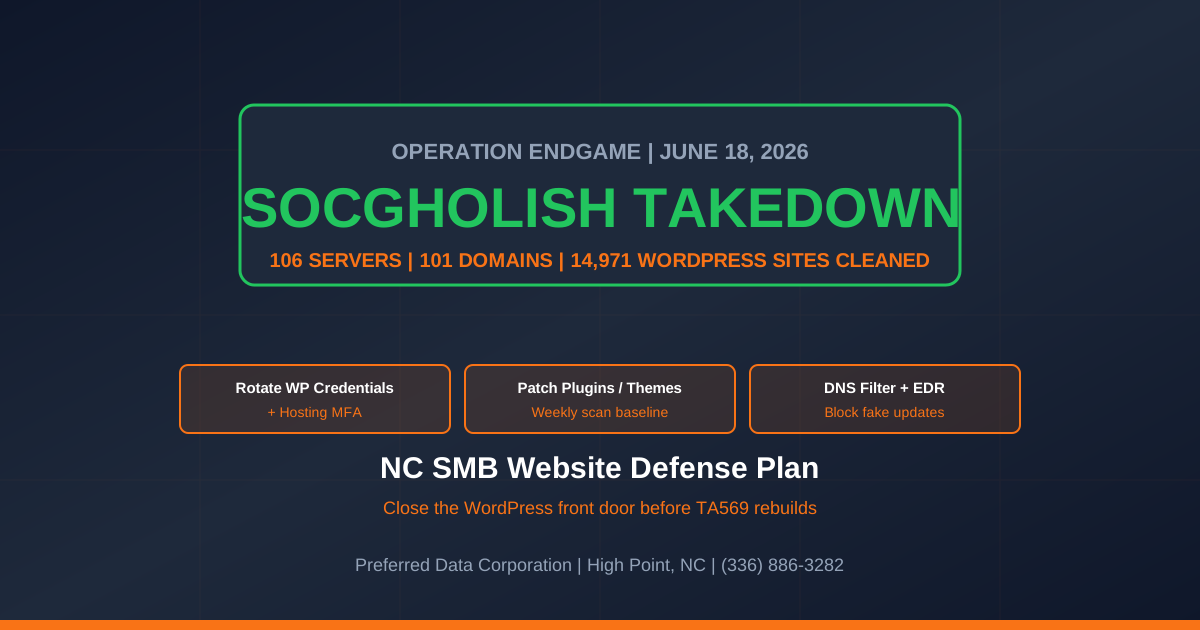
TL;DR: On June 18, 2026, Europol's Operation Endgame coordinated with the Netherlands National High-Tech Crime Unit, the RCMP, the FBI, and Germany's BKA to dismantle SocGholish (FakeUpdates) - the Evil Corp / TA569 malware that turns compromised WordPress sites into ransomware on-ramps. Authorities seized 106 servers and 101 domains and remediated 14,971 infected WordPress sites, per Help Net Security. For NC small businesses running WordPress on their marketing site, the takedown is the rare good-news day that comes with an action list - rotate credentials, patch plugins, and treat every "your browser is out of date" pop-up that visitors report as a P1.
Key takeaway: SocGholish was the front door for downstream ransomware affiliates. The takedown cleaned up 14,971 sites, but law enforcement also captured credentials for roughly 1.4 million compromised WordPress installs seen between May 2023 and May 2026. NC SMBs need to assume their WordPress credentials and admin panels are part of that pool until proven otherwise.
Need a WordPress security and credential rotation pass this week? Preferred Data Corporation has run managed IT and cybersecurity for NC small businesses since 1987. Call (336) 886-3282 or book a website hygiene review.
What did Operation Endgame do to SocGholish on June 18, 2026?
On June 18, 2026, Europol announced that an international action week had dismantled the back-end infrastructure of SocGholish (aka FakeUpdates). Per The Hacker News, the joint action involved the Netherlands, Canada, the United States, and Germany and was the next phase of Operation Endgame's ongoing campaign against initial-access malware ecosystems.
Three facts an NC SMB owner should write down:
- 106 servers and 101 domains seized; 14,971 infected WordPress sites cleaned. Per Help Net Security and GBHackers, law enforcement took over SocGholish command-and-control infrastructure and used it to push remediation to actively infected hosts.
- Roughly 1.4 million compromised WordPress credentials in scope. Per Help Net Security, authorities recovered credentials for an estimated 1.4 million compromised WordPress sites seen between May 2023 and May 2026. If your WordPress login has been on the internet during that window, treat it as exposed until rotated.
- Evil Corp / TA569 attribution. Per The Hacker News, SocGholish has been operated by TA569, associated with the sanctioned Russian cybercrime group Evil Corp. SocGholish is an initial-access platform - it sells access to ransomware affiliates that follow up with second-stage payloads.
The operation does not eliminate the threat permanently. Per Malwarebytes, the open question is how quickly the operators rebuild on alternative infrastructure. For NC SMB owners, the right read is "the front door was rebuilt; lock yours before the new one is finished."
What is SocGholish and why is a WordPress problem an NC SMB problem?
SocGholish is fake-update malware. Per Operation Endgame's news page and Hackread, the chain is:
- Attackers compromise a legitimate WordPress site - typically via a vulnerable plugin or a reused admin credential.
- They inject a malicious script that detects visitors and shows a fake "your browser / Chrome / Firefox / Edge is out of date - update now" prompt.
- A visitor who clicks downloads a malicious update that opens a backdoor on the system.
- SocGholish operators sell that backdoor to ransomware affiliates who follow up with data theft and ransomware deployment.
For an NC small business, three different roles are exposed at once:
- The NC SMB whose marketing site is the WordPress instance. If your
preferredmanufacturer.comortriadlawpartners.comis on WordPress with an outdated plugin or reused admin password, the chain starts at your front door. The brand-damage and operational-disruption fallout lands on you even though you are not the original target. - The NC SMB whose employees browse the web from corporate laptops. A salesperson, controller, or HR rep clicking "update Chrome" on a compromised WordPress site can plant the SocGholish loader on the laptop. That laptop then becomes the ransomware affiliate's beachhead.
- The NC SMB MSP or vendor whose WordPress login is reused. Long-lived agency credentials shared across clients are the typical TA569 reentry vector.
The Verizon DBIR has tracked the trend for years: drive-by web compromise + credential reuse remains a top-five initial-access vector for SMB breaches. SocGholish has been the prototypical example since 2017.
What does the SocGholish kill chain look like for an NC SMB?
The chain runs in four steps. The defense lives at each step, not just at the endpoint.
| Step | Attacker Action | NC SMB Failure Mode | Defense Layer |
|---|---|---|---|
| 1 | Compromise legitimate WordPress site | Outdated plugin, reused admin credential | Managed WordPress hygiene |
| 2 | Inject fake-update script | No file-integrity monitoring, no scanning | Continuous WordPress scanning |
| 3 | Visitor clicks fake browser update | No DNS filter, no EDR, awareness gap | DNS filtering + EDR + training |
| 4 | Affiliate buys access, deploys ransomware | No EDR, no segmentation, no offline backups | EDR + segmentation + immutable backups |
Two implications NC SMB owners should not skip:
- Your marketing site is part of your security perimeter. A NC manufacturer thinking "WordPress is just brochureware" misses that the same domain is the access broker's potential springboard into the rest of the ecosystem.
- The endpoint defense matters even if your own site is clean. Your employees browse the open web. SocGholish-style fake updates on compromised third-party WordPress sites are the actual exposure for many NC SMBs. DNS filtering, browser isolation, and EDR catch the click; user training catches the rest.
What should an NC SMB do this week about WordPress and SocGholish?
Run a five-step plan inside seven days. The cost is hours of staff time plus a managed services bill, not a capital project.
- Rotate every WordPress admin credential. Per Bleeping Computer, the takedown captured credentials for roughly 1.4 million WordPress installs over a three-year window. Reset admin passwords on every WordPress site you operate, on every staging environment, and for every agency or developer account. Force a new password manager-generated value; do not let humans pick it.
- Enforce MFA on every WordPress admin. WordPress has supported phishing-resistant MFA (FIDO2 / WebAuthn) via mainstream plugins for years. The vast majority of NC SMB sites still do not require it. Make it mandatory. SMS OTP is acceptable as a stopgap; passkeys or hardware keys are the real answer.
- Patch every plugin and theme to current. TA569's initial-access pattern is overwhelmingly an unpatched plugin or theme. Update WordPress core, every plugin, and every theme. Remove anything you do not actively use. Verify the WordPress version is the supported branch, not a stale 5.x line.
- Run a full file-integrity scan. Use Wordfence, Sucuri, Patchstack, or a managed equivalent to scan WordPress core, themes, and plugins for injected JavaScript and PHP. SocGholish typically injects a small loader; standard scanners catch it. If the scan is clean today, schedule it weekly. If the scan is not clean, treat it as an incident and call your incident-response provider.
- Push DNS filtering + EDR + browser controls down to every laptop. The endpoint side of the SocGholish chain is the click. DNS filtering (Cisco Umbrella, DNSFilter, ControlD, Cloudflare Zero Trust) blocks known malicious update domains before the loader downloads. EDR (Defender for Business, CrowdStrike Falcon Go, SentinelOne) catches the loader if it executes. Block executable downloads in the browser policy for non-IT users by default.
Key takeaway: Operation Endgame disrupted SocGholish on June 18; it did not retire the threat. NC SMBs that rotate WordPress credentials, enforce MFA on admin panels, patch plugins, scan for injected loaders, and push DNS + EDR to every laptop this week close the SocGholish front door before the operators rebuild.
Want a WordPress hygiene sweep and laptop DNS / EDR baseline before quarter end? Call (336) 886-3282 or book a website and endpoint security review.
How does the SocGholish takedown change the SMB threat model for the rest of 2026?
It does not change the threat model; it confirms it. Three near-term moves SMB defenders should expect from TA569 successors:
- Rebuild on alternative WordPress install bases. Per Malwarebytes and Help Net Security, prior takedowns of similar ecosystems have been followed by months of rebuilding on new infrastructure. The same WordPress hygiene gaps are exploited by the next loader family.
- Shift to new fake-update lures. SocGholish's browser-update lure is well-known. Successor families will use Microsoft Teams update lures, Zoom update lures, Microsoft 365 sign-in lures, and AI-tool update lures. The DNS filter and EDR layers continue to apply; the user-training content needs to refresh.
- More aggressive credential-reuse exploitation. With 1.4 million credentials in scope, expect targeted credential-stuffing against WordPress admin, hosting control panels (cPanel, Plesk), and SSH endpoints. Rotating once is necessary but not sufficient - schedule a rotation cadence and enforce MFA permanently.
A reasonable NC SMB benchmark is to run a WordPress credential rotation, plugin patching, and integrity scan every 30 days as a managed service. The cost is meaningful but small; the avoided ransomware deployment is the savings calculus.
How does Preferred Data Corporation help NC SMBs harden websites and endpoints?
PDC has run managed IT and cybersecurity for NC small businesses since 1987 from High Point. Three concrete service lines align with the SocGholish takedown action list:
- Managed IT services: WordPress credential vaulting, plugin patching, hosting control panel hardening (cPanel / Plesk / hosting MFA), automated content scanning, and 24/7 monitoring of the marketing site as part of the same workflow that monitors the rest of the IT estate.
- Cybersecurity services: DNS filtering rollout (Cisco Umbrella, DNSFilter, ControlD), EDR / managed detection (Defender for Business, CrowdStrike Falcon Go, SentinelOne), browser policy hardening on the laptop fleet, and ongoing user awareness training so the "update Chrome" prompt does not get clicked.
- Network infrastructure services: Outbound web filtering at the perimeter for sites still running an on-prem firewall, SD-WAN tied DNS filtering for distributed NC sites, and architecture review for NC manufacturers whose marketing CMS sits on the same network as ERP and MES.
For NC manufacturers in High Point, NC professional services firms in Greensboro and Winston-Salem, NC construction firms in Charlotte and the Research Triangle, and NC distributors and importers across the Piedmont Triad - SocGholish is the example, not the exception. WordPress is everywhere, and so is the SocGholish-style initial-access pattern. The takedown bought time; the WordPress hygiene work this week is what keeps the chain broken when the operators rebuild.
Need a managed WordPress + endpoint hardening engagement scoped to your NC SMB? Call (336) 886-3282 or book a website hygiene review.
Frequently Asked Questions
What is SocGholish and why does it matter to NC small businesses?
SocGholish (aka FakeUpdates) is malware operated by TA569 - associated with the sanctioned Russian cybercrime group Evil Corp - that hijacks compromised WordPress sites to show fake browser-update prompts to visitors, per The Hacker News. When a visitor clicks the fake update, the malware opens a backdoor and sells access to ransomware affiliates. NC SMBs are exposed in two ways: as the WordPress site owner whose marketing site can be compromised, and as the SMB whose employees browse the open web on company laptops.
What did Operation Endgame actually do on June 18, 2026?
Per Europol's Operation Endgame announcement and Help Net Security, the action seized 106 servers and 101 domains, remediated 14,971 infected WordPress sites, and surfaced credentials for approximately 1.4 million compromised WordPress installs seen between May 2023 and May 2026. The takedown disrupts SocGholish's back-end command-and-control but does not eliminate the threat permanently.
Is my WordPress site one of the 14,971 cleaned sites?
Possibly. Per Bleeping Computer, law enforcement notified hosting providers for the cleaned sites. If you have not received a notification, do not assume you are clean - the 1.4 million-credential pool is broader than the 14,971 actively remediated sites. Run a Wordfence / Sucuri / Patchstack integrity scan, rotate admin credentials, and patch plugins regardless.
What WordPress security controls should every NC SMB enforce?
Five non-negotiables in 2026: phishing-resistant MFA on every admin account (FIDO2 / WebAuthn, or at minimum TOTP), continuous plugin and theme patching, removal of unused plugins / themes, weekly file-integrity scans against a known-good baseline, and password-manager-generated credentials never reused across other systems. Hosting control-panel MFA (cPanel, Plesk, hosting provider login) is a separate layer that must also be enforced.
How does DNS filtering protect employees from SocGholish-style attacks?
DNS filtering services (Cisco Umbrella, DNSFilter, ControlD, Cloudflare Zero Trust) block known malicious domains at the network layer before the browser ever resolves them. When a SocGholish-compromised WordPress site tries to redirect a visitor to a malicious "update" download, the DNS resolver returns a block page instead of the malicious IP. Combined with EDR (Defender for Business, CrowdStrike Falcon Go, SentinelOne) that detects the loader if it does execute, DNS filtering is the highest-leverage endpoint defense an NC SMB can deploy this quarter.
Why does Operation Endgame matter even if my site is not on the list?
Because TA569 and similar operators rebuild on alternative infrastructure within weeks of every takedown - per the pattern documented by Malwarebytes. The defenses are the same regardless of which loader family is active: WordPress hygiene, credential rotation, MFA, plugin patching, DNS filtering, EDR, browser hardening. The takedown is the moment to execute the work; the threat does not stay paused.
Related Resources
- Managed IT Services - WordPress hygiene, hosting control-panel hardening, 24/7 monitoring
- Cybersecurity Services - DNS filtering, EDR / MDR, user awareness training
- Network Infrastructure Services - Web filtering, SD-WAN with integrated DNS controls
- Verizon DBIR 2026: Third-Party Breaches Hit 48% - NC SMB Vendor Risk - Companion vendor risk analysis
- Conti Plea June 2026: NC SMB Ransomware Reporting Plan - Companion ransomware ecosystem post
- Contact Preferred Data Corporation - WordPress + endpoint hardening for NC SMBs