
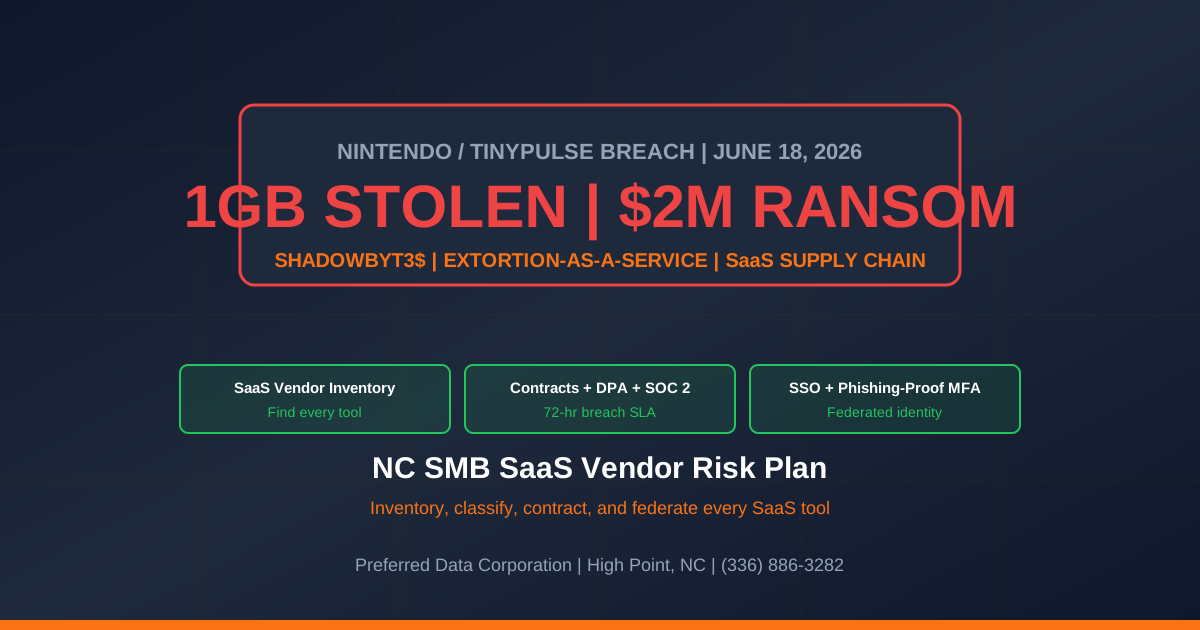
TL;DR: On June 18, 2026, Nintendo of America confirmed that the extortion group Shadowbyt3$ stole approximately 1GB of employee survey data through a breach of TinyPulse, a WebMD subsidiary SaaS used for internal engagement surveys. The threat actor demanded $2 million inside a 48-hour window, per BleepingComputer. The stolen data included full names, email addresses, W-9 forms, employee IDs, bank statements, and survey records spanning 2016-2026. For NC SMBs running 30-80 SaaS tools nobody inventoried, the Nintendo incident is the third-party SaaS supply-chain script for 2026.
Key takeaway: The SaaS vendor your HR team picked in 2018 is now the breach surface your CFO has to explain to your insurance carrier in 2026. Nintendo did nothing wrong inside its own perimeter - and still lost 1GB of employee data because a vendor's SaaS got owned. NC SMBs that have not inventoried, classified, or contractually constrained their SaaS supply chain are next.
Need a SaaS vendor risk assessment before your insurance carrier asks for one? Preferred Data Corporation runs managed cybersecurity and vendor risk programs for NC small businesses since 1987. Call (336) 886-3282 or book a vendor risk review.
What happened with Nintendo and TinyPulse on June 18, 2026?
On June 18, 2026, Nintendo of America confirmed to BleepingComputer that internal employee survey data was stolen from TinyPulse, a third-party SaaS engagement platform owned by WebMD Health Services. The threat actor, calling itself Shadowbyt3$, posted samples on a data-leak site and demanded a $2 million ransom inside a 48-hour deadline, per Nintendo Life.
Three facts an NC SMB owner should write down:
- The breach was not Nintendo's perimeter; it was a vendor's perimeter. Per SC Media, Nintendo's own systems were not compromised. The data was inside TinyPulse - a SaaS HR engagement tool used internally - and the breach happened at the vendor.
- The stolen data set is the kind every SMB sends to SaaS HR tools. Per The Cyber Express, the exfiltrated 1GB included full names, work emails, employee IDs, survey responses spanning 2016-2026, W-9 forms, and bank statement fragments. That is identity-theft-grade PII plus tax data.
- Shadowbyt3$ is an "extortion-as-a-service" group active since October 2025. Per BleepingComputer, the group describes itself as EaaS, meaning the breach mechanics, the ransom mechanics, and the leak mechanics are now a packaged service that targets the easiest vendor, not the biggest brand.
For an NC manufacturer in High Point using a SaaS HR survey tool, a distributor in Greensboro running an HRIS, or a professional services firm in Charlotte using a SaaS performance-review system - the Nintendo / TinyPulse / Shadowbyt3$ chain is the script. The brand on the headline does not matter; the SaaS-vendor pattern does.
Why is SaaS supply-chain risk the SMB story of 2026?
Because the average NC SMB now runs 30-80 SaaS tools - and the SMB owner can name maybe ten of them on a good day. Per SC Media's coverage of the WebMD subsidiary incident, TinyPulse is exactly the kind of tool an HR director signs up for to measure engagement, then forgets the vendor exists by Q4. Meanwhile, the vendor accumulates years of employee data, payroll information, and pulse-survey free-text comments that quietly become an attractive ransom target.
| SaaS Risk Layer | NC SMB Reality 2026 | What Nintendo Lost |
|---|---|---|
| Vendor inventory | 30-80 active SaaS tools, no central list | TinyPulse on the list of "tools HR uses" |
| Data classification | "Probably not sensitive" - until exported | Names, emails, W-9 forms, bank statements |
| Contractual controls | Click-through ToS, no breach notification SLA | Vendor decides when / how to disclose |
| Cyber insurance | Third-party-breach exclusions or sub-limits | Insurance may not cover vendor's breach |
| Compliance exposure | State PII laws apply to vendor-held data | NC, CA, CO, CT, VA breach-notification rules |
| Identity / access | SSO often optional, MFA inconsistent | Long-lived OAuth tokens at vendor side |
| Exit plan | "We can pull a CSV" hope | Data lives at vendor after contract ends |
Per the verizon-dbir-2026-third-party-breaches-48-percent-vendor-risk-smb-north-carolina analysis, third-party breaches accounted for 48% of SMB incidents in the 2026 Verizon DBIR - up from 23% in 2024. The Nintendo / TinyPulse breach is the high-profile June 2026 example of that trend.
What is "extortion-as-a-service" and why does it matter to NC SMBs?
Extortion-as-a-service (EaaS) is the 2026 evolution of ransomware-as-a-service: a packaged toolset, leak site, ransom-negotiation flow, and victim-shaming workflow that any affiliate can rent. Per BleepingComputer's reporting, Shadowbyt3$ has been active since October 2025 and built its operating model around the SaaS-vendor breach pattern: hit the SaaS vendor, exfiltrate data from multiple downstream customers, name the biggest brand on the leak site, demand a 48-hour ransom window.
Quotable definition: Extortion-as-a-service is the SaaS-supply-chain version of ransomware-as-a-service. The affiliate does not need to encrypt anything; they need only exfiltrate data from a vendor with weak access controls, then sell the breach back to the largest downstream customer with the loudest brand. NC SMBs are not the brand; they are the data set the next victim shares the leak site with.
For NC SMBs, this matters in three concrete ways. First, the SMB's breach disclosure obligation is not waived because the SaaS vendor was the attack surface - state PII laws still apply to data held on the SMB's behalf. Second, the SMB's cyber insurance policy may sub-limit or exclude third-party-vendor breaches, especially if the vendor was not on the underwriting questionnaire. Third, the SMB's customers and employees experience the breach as a PDC / Acme Manufacturing / Smith Distributing incident, not a TinyPulse incident - the brand owns the customer relationship even when the breach happened at a vendor.
What should an NC SMB do this month to harden SaaS vendor risk?
Run a four-step plan inside 30 days. The next EaaS group is not waiting for an SMB to finish a vendor questionnaire.
- Inventory the SaaS stack (this week). Pull SSO logs from Microsoft Entra / Google Workspace and credit-card statements from finance. Build a single source of truth that lists every SaaS tool, the data class it holds (employee PII, customer PII, financial, IP, none), the data owner, the contract renewal date, and the security URL. Most NC SMBs find 2-3x more SaaS tools than the leadership team expected.
- Classify data and apply contractual controls (this week). For every SaaS tool that holds employee PII, customer PII, financial data, or regulated data (HIPAA / CMMC / CJIS / PCI), require: a Data Processing Agreement (DPA), a breach notification SLA (72 hours typical), SOC 2 Type II or ISO 27001 evidence inside the last 12 months, and a clear data-deletion / data-export clause on contract termination.
- Enforce SSO + MFA + role-based access (this month). No SaaS tool that holds sensitive data should use vendor-local passwords in 2026. Federate everything through Microsoft Entra / Google Workspace, require phishing-resistant MFA (passkeys / FIDO2), assign least-privilege roles, and audit dormant accounts every 90 days.
- Update the cyber insurance questionnaire and IRP (this month). Add a "third-party SaaS data processor" section to the cyber insurance renewal questionnaire. Update the Incident Response Plan to include a vendor-breach scenario: who calls the vendor, who notifies counsel, who triggers the state PII breach-notification clock, who briefs the executive team.
Key takeaway: The Nintendo / TinyPulse breach is a 30-day action item for NC SMBs, not a "we'll get to it" project. The SaaS vendors already exist; the data already lives there; the next EaaS group is already shopping for vendors that look like TinyPulse. The work this month decides whether the SMB owns the breach response or gets surprised by it.
Need help running a SaaS vendor inventory and risk classification? Call (336) 886-3282 or book a vendor risk review.
How does Preferred Data Corporation help NC SMBs control SaaS vendor risk?
PDC runs managed IT and cybersecurity for NC small businesses since 1987 with vendor risk programs, SaaS governance, and Incident Response Plan design. We bring three things to the June 2026 Nintendo / TinyPulse event:
- Managed cybersecurity services: SaaS vendor inventory, Data Processing Agreement reviews, breach notification SLA enforcement, SOC 2 evidence review, and Incident Response Plan tabletop exercises that include vendor-breach scenarios.
- Managed IT services: SSO federation through Microsoft Entra ID or Google Workspace, phishing-resistant MFA rollout, role-based access reviews, and dormant-account audit on a 90-day cadence.
- Backup and data protection services: Data classification frameworks (employee PII, customer PII, financial, regulated), SaaS data export and deletion workflows, and cyber-insurance-aligned controls documentation.
For NC manufacturers in High Point and the Piedmont Triad, NC distributors in Greensboro and Winston-Salem, NC professional services firms in Charlotte and Raleigh, and NC healthcare practices managing PHI, the next SaaS-vendor breach is a near-certainty. The work this month decides whether the breach is a Tuesday call to PDC or a Sunday call to a breach lawyer.
Need a SaaS vendor risk assessment scoped before Q3 2026? Call (336) 886-3282 or book a vendor risk review.
Frequently Asked Questions
Who is Shadowbyt3$ and how did it breach TinyPulse?
Shadowbyt3$ is an "extortion-as-a-service" group that describes itself as such on its leak site and has been active since October 2025, per BleepingComputer. The group breached TinyPulse - a WebMD Health Services subsidiary SaaS - and exfiltrated approximately 1GB of internal employee survey data belonging to multiple downstream customers, including Nintendo of America. The breach mechanics specifically target SaaS vendors that hold data on behalf of brand-name customers.
What data did Nintendo lose in the TinyPulse breach?
Per The Cyber Express and the threat actor's public claims, the 1GB data set included full employee names, work email addresses, employee IDs, survey responses spanning 2016 through 2026, W-9 forms, and bank statement fragments. Nintendo confirmed its own systems were not compromised - the data lived at TinyPulse. No customer or financial gaming data was impacted.
Does a SaaS vendor breach trigger NC's breach notification law?
In most cases, yes. The North Carolina Identity Theft Protection Act treats a SaaS vendor as a data processor acting on the SMB's behalf - so a breach at the vendor that exposes NC residents' PII triggers the SMB's notification obligation, not the vendor's. NC SMBs should write the notification trigger into the vendor contract explicitly, including the 72-hour vendor-to-SMB notice window. Counsel should confirm specific notification triggers per applicable state law.
How long does a SaaS vendor risk assessment take for a 50-employee NC SMB?
PDC runs a typical NC SMB SaaS vendor inventory in 2-3 weeks. The first week pulls SSO and finance data to enumerate vendors; the second classifies data and contracts; the third produces the prioritized risk register and remediation backlog. Mid-market NC manufacturers with 100-300 employees usually run 4-5 weeks because the SaaS surface is larger (ERP add-ons, plant-floor SaaS, CAD-as-a-service, supply-chain portals).
What is the difference between extortion-as-a-service and ransomware-as-a-service?
Ransomware-as-a-service (RaaS) packages encrypt-and-extort tooling. Extortion-as-a-service (EaaS) skips the encryption step - the affiliate exfiltrates data, posts samples on a leak site, and demands a ransom under threat of full publication. EaaS is faster, harder to detect (no encryption alarms), and targets SaaS vendors with weak data-export controls rather than endpoint estates. Per BleepingComputer, Shadowbyt3$ explicitly self-identifies as EaaS.
Should NC SMBs pay a SaaS vendor extortion demand?
The default answer is no - and the decision should sit with counsel, the cyber insurance carrier, and law enforcement (FBI Charlotte field office), not the SMB owner alone. Per FBI guidance, payment funds future attacks, often does not result in data deletion, and may trigger OFAC sanctions if the actor is on a sanctions list. The right work is to make the breach less consequential through data minimization, contractual controls, and cyber insurance design - not to negotiate the ransom.
Related Resources
- Managed Cybersecurity Services for NC Businesses - SaaS vendor risk programs
- Managed IT Services for NC Businesses - SSO + MFA federation
- Backup and Data Protection Services - Data classification and minimization
- Verizon DBIR 2026: 48% Third-Party Vendor Risk Plan - Companion vendor-risk analysis
- Klue OAuth Salesforce Breach: NC SMB CRM Defense - Companion SaaS supply chain post
- Contact Preferred Data Corporation - SaaS vendor risk review for NC SMBs