
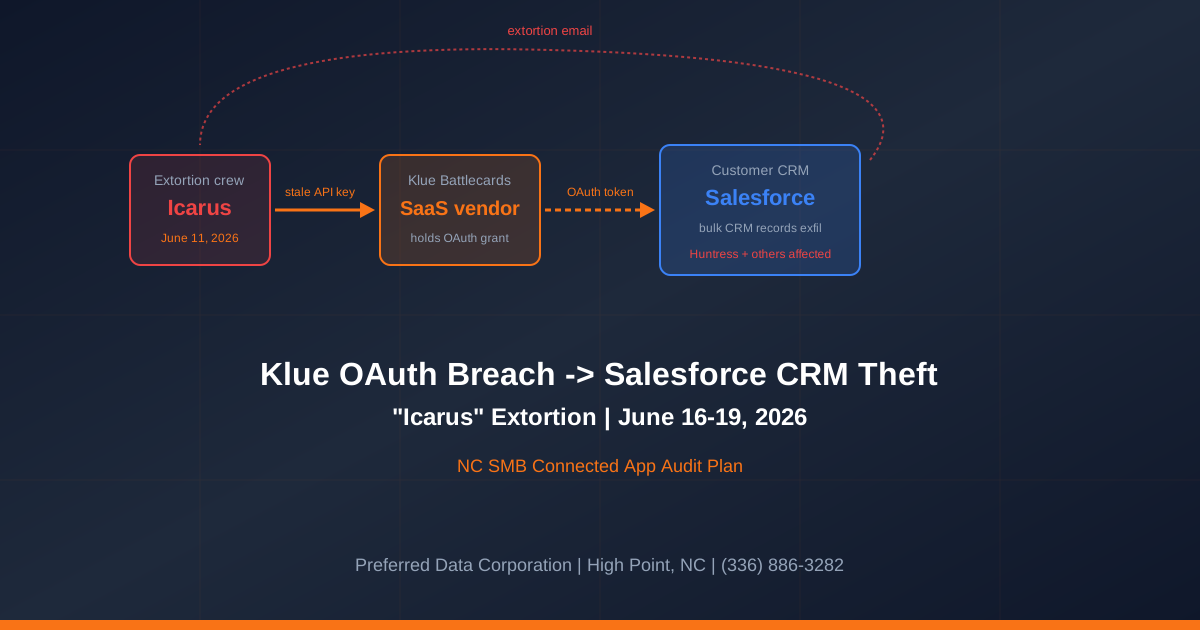
TL;DR: Market-intelligence platform Klue suffered an OAuth breach on June 11, 2026 that let the "Icarus" extortion crew silently siphon Salesforce CRM data from enterprise customers - including Huntress, the popular MSP security stack - per Help Net Security's June 19, 2026 reporting and Bleeping Computer's coverage. The attackers used a long-dormant API credential from an abandoned third-party prototype to pivot into the Klue Battlecards Salesforce integration, then pulled bulk records through legitimate OAuth scopes. Salesforce has disabled the Klue Battlecards integration during the investigation. For NC SMBs running Salesforce - or HubSpot, Dynamics, Pipedrive, or any other CRM with connected apps - the takeaway is direct: every OAuth grant in your CRM is a standing credential, and you do not get to choose when the third party with that credential gets breached.
Key takeaway: Icarus did not breach Salesforce. They breached a small vendor with a Salesforce connected app, then walked through the front door using a token Salesforce had issued months earlier. The CRM data extortion model of 2026 lives in the OAuth grant list, not on the perimeter.
Worried about every Salesforce or HubSpot connected app sitting in your tenant? Preferred Data Corporation runs managed SaaS security posture for NC SMBs, including OAuth grant audits, connected-app least privilege, and CRM data exfil detection. Call (336) 886-3282 or request a SaaS posture review.
What happened with Klue, Huntress, and the Icarus crew?
The chain of events compressed into about eight days, per Help Net Security, ReliaQuest's threat spotlight, and TechNadu's reporting:
- June 11, 2026 - Icarus accesses Klue's backend infrastructure using a long-dormant API credential originally created for an abandoned third-party integration prototype.
- June 11-16, 2026 - The attackers use the Klue Battlecards Salesforce integration's existing OAuth grants to enumerate and bulk-export Salesforce CRM records from Klue customers via legitimate API calls.
- June 16, 2026 - Extortion emails ("top secret email - 48 hours to communicate") arrive in Huntress staff inboxes referencing the stolen records.
- June 17-18, 2026 - Multiple Klue customers confirm exposure.
- June 18-19, 2026 - Salesforce disables the Klue Battlecards connected app while the investigation continues.
Huntress confirmed that the stolen Salesforce data included business contacts, sales communications, and pricing information, per GovInfoSecurity's writeup. Per Bleeping Computer's growing victim list, Klue had hundreds of enterprise users of the Battlecards integration.
What is Icarus and how does this compare to ShinyHunters and Salesloft Drift?
Icarus is an extortion-only crew (no encryption, no ransomware) active since late April 2026, per TechNadu's profile. Their playbook is identical in shape to the ShinyHunters Salesforce campaign and the Salesloft Drift OAuth incident PDC covered earlier in 2026:
| Campaign | Initial Foothold | OAuth/Integration Abused | Encryption? |
|---|---|---|---|
| ShinyHunters / Snowflake-era | Stolen customer Snowflake creds | Snowflake integration tokens | No (extortion only) |
| Salesloft Drift (2026) | Drift OAuth/API token abuse | Salesloft + Drift -> Salesforce | No |
| ShinyHunters Cushman / Salesforce (2026) | Vishing helpdesk to OAuth | Salesforce connected apps | No |
| Klue / Icarus (June 2026) | Dormant API credential at Klue | Klue Battlecards -> Salesforce | No |
The pattern is now a stable 2026 playbook: breach a CRM-adjacent SaaS, abuse the OAuth grant it already holds, exfil for extortion. Per Verizon's 2026 DBIR, third-party involvement is a factor in 48% of all breaches - this campaign is a textbook example.
Why are connected apps and OAuth grants the new attack surface?
Because they are standing credentials with broad scopes that nobody audits. A typical NC SMB Salesforce tenant has 30-80 connected apps installed over the years - call recording, sales enablement, marketing automation, reporting, AI assistants - and each grants the third party read access (and often write access) to leads, contacts, opportunities, and notes. Per Salesforce Ben's analysis of the recurring OAuth pattern, most SMBs cannot answer four basic questions:
- Which connected apps are currently authorized in our Salesforce / HubSpot / Dynamics tenant?
- What scopes does each app hold (read-only, read-write, full)?
- Which user authorized each grant and is that user still employed?
- When was each grant last used?
Until those four answers exist, the OAuth grant list is an opaque list of standing credentials at third parties - and the third party with the weakest credential vault wins the breach for everyone.
What is the actual blast radius if my SMB's Salesforce data is extorted?
Bigger than the records themselves. Per SC Media's analysis of the 2026 OAuth campaigns and CyberScoop's reporting on the Scattered Spider extortion shift, the realistic 2026 fallout for an NC SMB looks like:
| Risk | What "blast radius" looks like for a 50-person NC SMB |
|---|---|
| Customer notification | State breach-notification law triggered for any PII in stolen records |
| Pricing & deal exposure | Competitors see your custom discounts, sales cycle, and pipeline |
| Vendor/partner trust | Your customers find out their contact list is on a leak site |
| Cyber-insurance | Claim subject to scrutiny if connected-app inventory was not maintained |
| Operational distraction | 2-6 weeks of executive time consumed by incident response and notification |
| Reputational | First Google result for your company name becomes the breach article |
Per BlackFog's State of Ransomware 2026, the average SMB extortion event now exceeds $500K in total cost when downtime, recovery, notification, and reputation damage are included.
Quotable definition: SaaS supply chain extortion is the 2026 attack model in which an extortion crew breaches a small vendor with broad OAuth scopes into customer CRMs, then exfils the customer data through legitimate API channels. The victim list is not the breached vendor's customer list - it is the OAuth grant list inside every downstream CRM.
What is the right 30-day OAuth and connected-app audit for an NC SMB?
A four-week sprint PDC runs as part of the managed cybersecurity service:
| Week | Action | Outcome |
|---|---|---|
| 1 | Enumerate every Salesforce / HubSpot / Dynamics / Pipedrive connected app and OAuth grant; export to a tracked spreadsheet | First-time visibility into the standing-credential list |
| 2 | Categorize each grant: (Active, used in 30 days) / (Stale, unused 31-180 days) / (Abandoned, unused 180+ days); revoke abandoned grants | Standing-credential surface immediately reduced |
| 3 | Rescope active grants to the minimum required (read-only where possible, no full-tenant grants, no api + refresh_token unless needed); document business owner per grant | Least-privilege baseline established |
| 4 | Configure CRM-side anomaly alerts (bulk export volume thresholds, off-hours API use, new IP for connected app) and add SaaS posture management | Future Icarus-class campaign caught at exfil, not at extortion |
Key takeaway: A 50-person NC SMB cannot run a dedicated SaaS security team. What it can run is "quarterly OAuth audit, revoke abandoned grants, alert on bulk export." That is the rollout, and it lands in 30 days.
Should NC SMBs stop using third-party Salesforce or HubSpot connectors?
No. The productivity dividend from sales enablement, call recording, and AI assistants is real and won't be given back. The correct posture is governance, not abstinence:
- Approved-vendor list: Maintain a short, named list of sanctioned SaaS integrations, with a renewal review every 90 days.
- Onboarding control: Require IT/security sign-off before an OAuth grant goes live, including a scope review.
- Offboarding control: When a vendor relationship ends, the grant ends. Most SMBs never close grants from former vendors.
- Anomaly alerting: Treat bulk record export from any connected app as a Tier-1 event - this is the signal the Klue campaign would have tripped at the customer side.
Per Microsoft's RSAC 2026 guidance, this is now the recommended enterprise baseline and cyber insurers increasingly require it at renewal.
How does Preferred Data Corporation help NC SMBs control connected-app risk?
PDC supports NC small businesses, manufacturers, and distributors with the three layers required to close SaaS supply chain exposure:
- Managed cybersecurity with SaaS security posture management (SSPM), OAuth grant audit, and connected-app exfil monitoring across Salesforce, HubSpot, Dynamics, Google Workspace, and M365.
- Managed IT services with vendor onboarding/offboarding workflows, conditional access, and the operational hygiene to close grants when a vendor relationship ends.
- Incident response retainer with documented SaaS-extortion playbooks, including legal-counsel coordination, leak-site monitoring, and customer-notification support.
PDC has served NC small businesses for over 37 years with on-site coverage within 200 miles of High Point. The combination of local NC presence, 20+ year average client retention, and modern SaaS posture tooling is what gets an OAuth audit and least-privilege baseline deployed and verified in 30 days, not 30 weeks.
Want to know how many connected apps your Salesforce tenant has right now? Call (336) 886-3282 or request a SaaS posture review.
Frequently Asked Questions
What is the Klue Battlecards breach in one sentence?
Icarus extortion actors accessed Klue's backend on June 11, 2026 using a long-dormant API credential and used Klue's existing Salesforce OAuth grants to bulk-export CRM data from Klue's enterprise customers, per Help Net Security and Bleeping Computer.
Was Salesforce breached?
No. Per Salesforce Ben, Salesforce's own infrastructure was not compromised. Salesforce disabled the Klue Battlecards connected app on its AppExchange while the investigation continues. The compromised credentials were OAuth grants Klue held, not Salesforce-side credentials.
How do I find out if my SMB used Klue Battlecards?
In Salesforce Setup, search "Connected Apps OAuth Usage" and look for any app whose name contains "Klue" or "Battlecards." If you find one, revoke the grant immediately, rotate any API tokens you had stored in Klue, and review your Salesforce login history for unfamiliar IP addresses since June 11, 2026.
Does this affect HubSpot, Microsoft Dynamics, or Pipedrive users?
The specific Klue/Icarus campaign targets Salesforce environments. But the broader OAuth-grant abuse pattern is platform-agnostic, per ReliaQuest's threat spotlight. Any CRM that allows third-party OAuth grants - which is all of them - is exposed to the same model.
What does a managed SaaS posture management service cost a 50-person NC SMB?
For a 50-person SMB running Salesforce, HubSpot, or Dynamics plus M365 or Google Workspace, expect $15-$35 per user per month for a SaaS posture management (SSPM) add-on on top of standard managed cybersecurity. PDC bundles SSPM inside the managed cybersecurity service for predictable per-seat pricing.
Related Resources
- Managed Cybersecurity Services for NC Businesses - SaaS posture management, OAuth audit, SOC monitoring
- Managed IT Services for NC Businesses - Vendor onboarding/offboarding hygiene
- Salesloft Drift Salesforce OAuth Connector Audit Plan - Companion OAuth campaign post
- ShinyHunters Cushman Salesforce Breach - Earlier SaaS supply chain campaign
- Verizon DBIR 2026: Third-Party Breaches 48% Vendor Risk SMB - Third-party risk data
- Contact Preferred Data Corporation - Schedule a SaaS posture review