
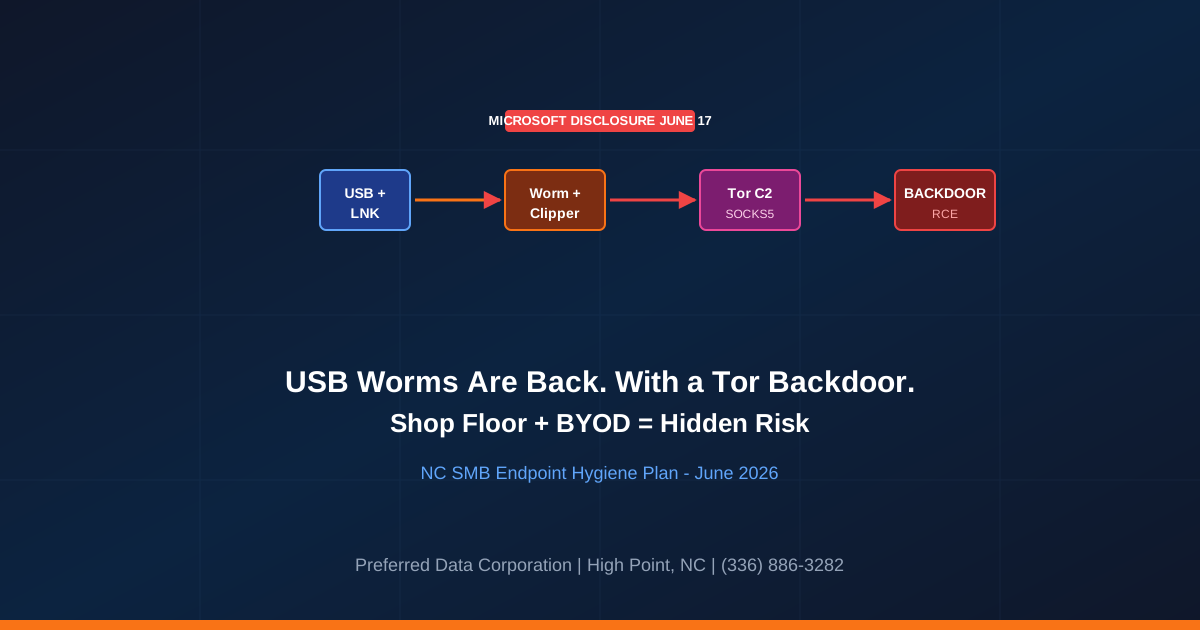
TL;DR: On June 17, 2026, the Microsoft Security Blog disclosed a Windows-based cryptocurrency clipper that has been active since February 2026, spreading via USB LNK worm, communicating through a bundled Tor proxy to a hidden-service C2, and operating as a lightweight backdoor with remote-code-execution capability beyond just clipboard theft. Per The Hacker News and Crypto News coverage, the malware deploys two components (worm + clipper/stealer), uses Windows Script Host and ActiveX-driven logic for execution, and routes traffic through a local SOCKS5 proxy. For NC small businesses, particularly manufacturers with shop-floor USB exposure and any SMB still allowing removable media without policy, this is the kind of "old vector, new sophistication" pattern that quietly compromises hundreds of endpoints before anyone notices.
Key takeaway: USB worms did not die with autorun.inf. The 2026 crypto clipper combines the most-mocked attack vector of the 2010s (sneakernet via LNK files) with the most-modern evasion stack (Tor hidden services, SOCKS5 proxies, modular backdoor). The defense is mature endpoint hygiene plus removable-media policy, exactly the kind of basic discipline most NC SMBs skip until an incident happens.
Worried your shop floor or office is the next clipper victim? Preferred Data Corporation runs managed endpoint protection and removable-media policy for NC small businesses. Call (336) 886-3282 or request an endpoint review.
What did Microsoft disclose about the June 17 crypto clipper?
A two-stage USB-worm-plus-clipper malware family active since February 2026 with Tor-based command and control. Per the Microsoft Security Blog, The Hacker News, DailyCoin, and WinCentral, the kill chain has these stages:
- Initial USB infection. A user plugs in a removable USB device. A crafted LNK file on the device triggers Windows Script Host with ActiveX-driven logic.
- Worm propagation. The worm component installs itself on the host and copies LNK payloads to any subsequently inserted USB devices, ensuring continued spread across machines that share removable media (a common pattern in manufacturing, field-service, and clinical environments).
- Clipper deployment. The clipper/stealer component begins high-frequency clipboard monitoring, looking for cryptocurrency wallet addresses (BTC, ETH, USDT, and others) and swapping any detected address for an attacker-controlled wallet at the moment of copy-paste.
- Tor C2 establishment. The malware launches a bundled Tor client, configures a local SOCKS5 proxy, and reaches an
.onionhidden service for command-and-control. No public IP appears in network logs. - Backdoor mode. The Tor channel accepts remote commands beyond wallet substitution, including screenshot exfiltration, file reads, and arbitrary code execution. Microsoft characterizes the result as a "lightweight backdoor" rather than a single-purpose clipper.
Four details make this campaign distinctive in the 2026 SMB threat landscape:
- The vector is sneakernet, not phishing. A USB drive picked up at a trade show, borrowed from a vendor on a shop floor, or shared between contractors on a jobsite carries the payload across air gaps and into otherwise well-defended networks.
- No public IP C2 to block. Traditional outbound network controls that block known C2 IPs do not see the Tor traffic. Detection must happen on the endpoint or via Tor-process behavior.
- Windows Script Host and ActiveX remain effective execution vectors. Most SMBs have not disabled either, despite a decade of guidance recommending it.
- Self-spreading scales without operator effort. Each infected host becomes a new infection source for any USB inserted, even after the original threat is removed elsewhere.
Why is a USB worm a serious SMB threat in 2026, not a 2010s anachronism?
Because most NC small businesses (especially manufacturers, construction firms, and field-service providers) still rely on removable media for legitimate operational reasons, and most have not deployed device-control or modern endpoint monitoring tuned for Tor process behavior.
The operational realities that keep USB risk current:
- Manufacturers move CAM and CNC files via USB. Plant-floor PCs, CNC controllers, and engineering workstations share design files and program updates. Air-gapped or semi-air-gapped OT systems often have no other transfer path.
- Construction firms and field-service techs exchange jobsite files. Site photos, drawings, inspection reports, and customer signatures move between tablets, laptops, and customer-provided drives.
- Trade shows, vendor meetings, and audits introduce unknown USBs. A "free USB" giveaway, a vendor's demo drive, or a regulator's audit thumbdrive routinely enters the SMB environment.
- BYOD policy is ambiguous. Personal USBs for music, phone charging, or home file transfer plug into corporate machines without device control or scanning.
- Endpoint detection often misses Tor process spawning. Default Defender configurations and many third-party AV products do not alert on
tor.exe-style process behavior unless tuned for it.
| Defense layer | What it stops | What it misses against this clipper |
|---|---|---|
| Email phishing controls | Most phishing | The USB vector entirely |
| AV signature scan | Known malware | Custom LNK + WSH payloads |
| Network-IP C2 block | Known bad IPs | Tor hidden-service C2 |
| User awareness training | Phishing clicks | "Trustworthy" USB from vendor or trade show |
| Default Defender | Many threats | Tor process spawning without ASR rules tuned |
The defenses that actually break this kill chain are device control on removable media (block, scan-on-mount, or allow-list approved devices), WSH/ActiveX hardening (disable or restrict), Attack Surface Reduction rules in Microsoft Defender tuned to flag LNK/WSH execution, EDR alerting on Tor process behavior, and 24/7 monitoring so the alert is actioned in minutes, not when an in-house tech sees it Monday morning.
What does this look like financially for an NC small business?
Bigger than a "stolen crypto" framing suggests. Per SQ Magazine's 2026 SMB cyber statistics, the average SMB breach cost in 2026 is $3.31 million, with 88% of breaches involving ransomware and software vulnerabilities accounting for 31% of initial access. The clipper is positioned as a beachhead, not a final goal:
- Direct loss from wallet substitution. Anyone in the org who pays vendors, suppliers, contractors, or service providers in cryptocurrency (more common than 2020 in 2026 trade finance) faces direct loss when a copy-paste of a wallet address is swapped.
- Backdoor access for follow-on attack. The Tor C2 plus remote-execution capability lets the operator hand off access to a ransomware affiliate, a data thief, or an espionage actor. The clipper is the front door; the back room is whatever the attacker decides to monetize next.
- Data exfiltration via screenshot. Engineering drawings, client matter files, financial dashboards, and any sensitive on-screen content can be exfiltrated via the documented screenshot capability.
- Lateral spread through USB. Every infected host re-infects every USB plugged in. Cleaning one machine without policy controls just delays reinfection.
- Cyber insurance and compliance exposure. Per Help Net Security's 2026 underwriting coverage, policies condition coverage on documented endpoint controls including device control. An incident traced to an unmanaged USB risks sublimit or denial.
Quotable definition: The June 2026 Microsoft-disclosed crypto clipper is a Windows malware family active since February 2026 that combines a USB LNK-based worm component with a clipboard-monitoring cryptocurrency wallet-substitution clipper and a bundled Tor proxy to an
.onionhidden-service C2, enabling self-spreading propagation across removable media, evasion of network-IP-based controls, and remote-code execution turning the clipper into a lightweight backdoor.
What should an NC small business deploy this month to defend against the clipper?
Run the six-control endpoint hygiene playbook. None of this is exotic; the gap is operational consistency.
- Enforce removable-media device control. Use Microsoft Intune, Defender device control, or third-party MDM to block, scan-on-mount, or allow-list approved USB devices. Per Microsoft's removable storage policy documentation, this is a built-in Defender for Endpoint capability.
- Disable or restrict Windows Script Host and ActiveX where business need does not require them. Most SMB users do not need to execute
.js,.vbs,.hta, or ActiveX-driven LNK payloads from removable media. Group Policy and Intune configuration handles this at scale. - Enable Attack Surface Reduction rules in Microsoft Defender. Specifically: block executable content from email and webmail, block execution of potentially obfuscated scripts, block JavaScript or VBScript from launching downloaded executables, and block Office applications from creating child processes.
- Deploy managed EDR with Tor process-behavior detection. A SOC tuned for 2026 threats alerts on
tor.exespawning from user-space processes, unsigned SOCKS5 proxy binding, or.onionresolution attempts. Default AV does not. - Train workforce on USB hygiene. No "trade show USB" plugs into a corporate machine. Vendor file transfers happen via SFTP, OneDrive, SharePoint, or a vetted file-share service. Inspection and audit drives go through a dedicated, segmented kiosk.
- Stand up 24/7 SOC monitoring. A clipper alert at 9 PM Saturday must trigger investigation immediately. Per the 2026 Huntress SMB Threat Report and Verizon 2026 DBIR, the gap between attacker activity and defender response is the dominant breach driver.
Need this implemented for your business? Call (336) 886-3282 or contact Preferred Data Corporation for an endpoint and removable-media review.
Why is this a managed problem, not an "install antivirus" problem?
Because endpoint hygiene at the level required to stop the 2026 clipper is a continuous operational discipline, not a one-time install. Device-control policies have to adapt as new vendor USBs arrive. ASR rules have to be tuned so they protect without blocking legitimate work. EDR alerts have to be triaged by an analyst who recognizes Tor process behavior at 9 PM Saturday. Workforce training has to refresh as new staff join. No single product, including the best EDR on the market, replaces the SOC analyst on duty.
The defense that survives the next clipper variant (and the next, and the next) is a managed endpoint lifecycle: device control, ASR tuning, EDR alerting, removable-media policy enforcement, workforce training, and 24/7 SOC eyes. An in-house SMB generalist running this around other duties cannot sustain the cadence; the math does not work and the calendar does not allow it.
For a Piedmont Triad small business, the answer is clear. Pick a managed partner that runs endpoint protection, removable-media policy, EDR + MDR, and 24/7 SOC as a single bundle with documented evidence for cyber insurance and CMMC. Preferred Data Corporation has delivered that managed protection to North Carolina manufacturers, construction firms, and professional services since 1987, from our High Point headquarters and on-site across the Piedmont Triad, Charlotte, Greensboro, Raleigh, and Winston-Salem.
PDC supports this through managed cybersecurity, managed IT services, and hardware procurement for endpoint refresh.
Frequently Asked Questions
Does Microsoft Defender detect this clipper out of the box?
Partially. Per the Microsoft Security Blog, Defender signatures cover known clipper variants, but a custom or polymorphic build is more likely to be caught by behavioral detection (ASR rules, EDR process telemetry) than by signature alone. Default Defender configurations rarely have all the necessary ASR rules enabled or tuned, which is the gap a managed partner closes.
How do I find a USB worm that may already be on my network?
Look for tor.exe-like processes spawning from user-space, unexpected .onion connection attempts, LNK files on removable media that point to scripts or .hta payloads, and the documented Microsoft indicators of compromise in the June 17 Security Blog. A managed SOC ingesting EDR telemetry can run these hunts continuously; an in-house team typically cannot.
Will device control break legitimate USB use on the shop floor?
Not if implemented correctly. Modern device-control policy supports allow-listing specific vendor IDs, model IDs, and serial numbers; scan-on-mount with malware checks; and read-only enforcement for specific roles. The shop floor can keep its CNC file transfer path while every other USB is blocked or quarantined.
Will cyber insurance cover a clipper-related crypto loss?
Conditionally. Per Help Net Security's 2026 underwriting coverage, 2026 policies often exclude crypto theft via clipboard hijacking from primary coverage and may require cyber-crime endorsements. The follow-on impact (ransomware, data theft, business interruption) is covered subject to standard exclusions for missing controls (EDR, MFA, device control, monitoring).
Should small NC manufacturers still use USB at all?
Often yes, but with policy. The right framing is "use USB where it is the right tool, but only approved devices through approved workflows." A managed partner builds the policy, deploys the controls, and monitors the exceptions. Banning USB outright typically fails to survive the first plant-floor emergency.
Related Resources
- Managed Cybersecurity Services for NC Businesses - EDR + MDR, device control, 24/7 SOC
- Managed IT Services for NC Businesses - End-to-end small business technology partner
- Hardware Procurement for NC Small Businesses - Endpoint refresh and standardization
- INC Ransomware 830+ Victims: NC Manufacturer & Construction Defense - Follow-on ransomware risk
- FortiBleed: 30K+ Fortinet Credentials Leaked - NC SMB Defense - Complementary perimeter exposure
- Contact Preferred Data Corporation - Endpoint and removable-media review for NC small businesses