
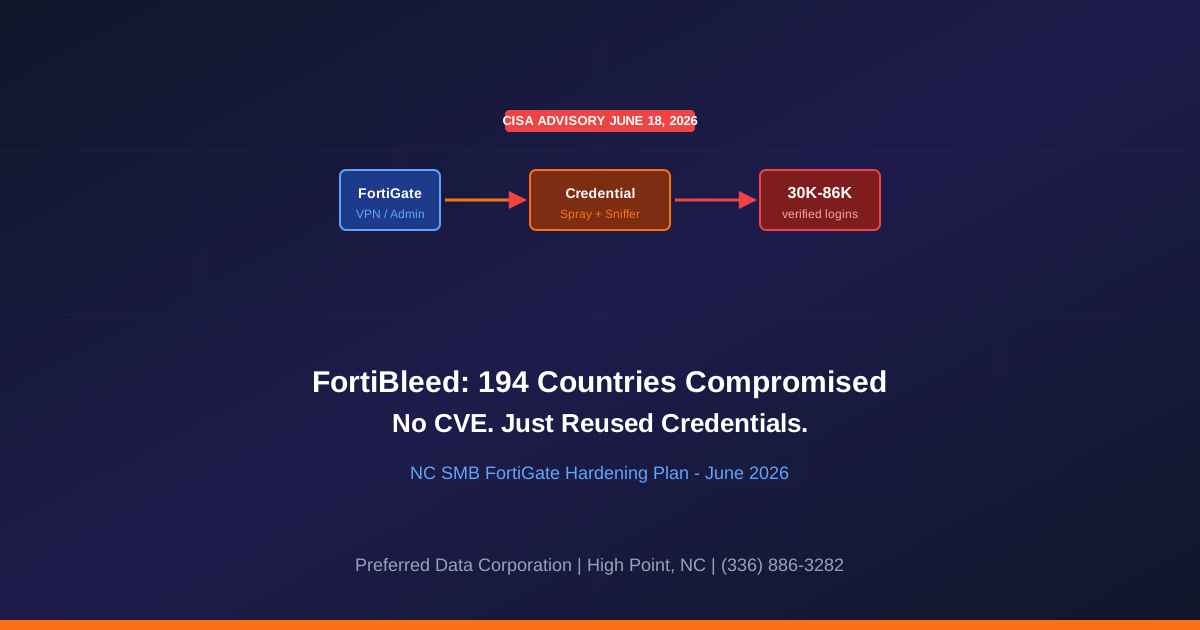
TL;DR: On June 18, 2026 CISA issued an advisory urging immediate hardening of Fortinet FortiGate devices after researchers documented an active credential-harvesting campaign dubbed FortiBleed compromising 30,000 to 86,000 firewalls and SSL VPN gateways across 194 countries. The campaign is not a new CVE; it is exploitation of reused, weak, or leaked credentials, with telecom, government, and SMB sectors hit hardest. For North Carolina small businesses running FortiGate at the edge, the CISA-mandated playbook is non-negotiable: terminate all SSL VPN and admin sessions, rotate every Fortinet credential, enforce phishing-resistant MFA, restrict management access, and confirm PBKDF2 admin-password storage.
Key takeaway: FortiBleed is the SMB perimeter wake-up call of 2026. The firewall you bought to keep attackers out has, for tens of thousands of organizations, become the credential warehouse that lets them in. The defense is not a new product; it is operational discipline (rotation, MFA, log review, 24/7 monitoring) that most in-house SMB IT teams cannot sustain without help.
Worried your FortiGate is on the FortiBleed list? Preferred Data Corporation runs managed firewall hardening, credential rotation, and 24/7 monitoring for NC small businesses. Call (336) 886-3282 or request a FortiGate review.
What is FortiBleed and why did CISA issue a June 18 advisory?
FortiBleed is an active 2026 credential-harvesting campaign in which threat actors built a verified database of working FortiGate admin and SSL VPN logins by combining internet scanning, leaked credential lists, and on-network sniffers. Per CISA's June 18, 2026 alert and reporting from Dark Reading, SecurityWeek, and Cybernews, researchers at SOCRadar discovered an exposed attacker server with verified credentials for between 30,000 and 86,000 Fortinet devices across 194 countries, with telecom the most-affected sector and India plus the United States accounting for roughly one-third of compromises.
Three details make this campaign different from a normal CVE alert:
- No new vulnerability is in play. The attackers exploited reused, weak, or previously leaked credentials. CISA was explicit that this is "not a new product vulnerability" but a consequence of poor credential hygiene.
- The credential set is verified working. Unlike a leaked dump of unconfirmed logins, the FortiBleed operators tested credentials against live devices before adding them to the database. A working credential against a Fortinet edge device is, for most SMBs, equivalent to full network access.
- On-network sniffers extended the blast radius. Once an attacker compromised a device, they deployed sniffers that captured additional credentials flowing across the network and fed them back into the scanning pipeline. The campaign self-grew.
For an NC small business in High Point, Greensboro, Charlotte, Raleigh, or Winston-Salem running FortiGate at the perimeter (the default choice for most 25-500 person manufacturers, construction firms, and professional services shops), the FortiBleed campaign is the single most consequential 2026 perimeter event so far. It bypasses every firewall feature the SMB purchased and turns the SSL VPN into an open door.
How did attackers compromise 30,000+ FortiGate firewalls without a CVE?
By industrializing credential reuse. Per Cybernews and Arctic Wolf's FortiBleed analysis, the kill chain has five stages, none of which require an unpatched device:
- Scan the public internet for Fortinet devices. Shodan, Censys, and custom scanners locate exposed SSL VPN and admin panels in minutes.
- Apply a curated password list. Credentials from prior breaches (LinkedIn, Yahoo, MOVEit, etc.) plus targeted password spraying find working logins on devices where admins reused passwords.
- Extract configuration files. Older FortiOS versions stored admin passwords with weaker hash algorithms; attackers cracked the hashes offline.
- Deploy on-network sniffers. Once inside, attackers captured plaintext credentials flowing across the LAN (legacy services, misconfigured apps, internal portals) and fed them back into the scanner.
- Resell or use the verified credentials. Some logins are sold on dark web marketplaces; others are used directly for ransomware deployment, data theft, or lateral movement.
| Defense layer | What it stops | What it misses against FortiBleed |
|---|---|---|
| Latest FortiOS patches | Known CVEs | Reused or leaked credentials (no CVE in play) |
| Strong but stored admin password | Brute force | Password reuse across the internet |
| SMS MFA on VPN | Casual phishing | Attacker-in-the-middle, SIM swap, no MFA at all |
| Single-factor SSL VPN | Drive-by attacks | Verified credentials from the FortiBleed database |
| Default management interface exposed | Nothing | Direct scanner pickup |
The controls that actually break FortiBleed are phishing-resistant MFA on every VPN and admin account, rotation of every credential after every leak, PBKDF2 admin-password storage (the modern FortiOS algorithm), management access locked to internal networks or specific source IPs, and 24/7 log review so a successful login from a residential proxy at 3 AM triggers a response, not a spreadsheet entry.
What does FortiBleed mean for North Carolina small businesses?
If you run a FortiGate at the perimeter and your VPN credentials have ever been part of an external user's life (LinkedIn, Yahoo, MOVEit, a partner's breach, a former employee's reused password), you are statistically in scope. Per BleepingComputer's coverage and SecurityWeek's FortiBleed reporting, the campaign disproportionately affects organizations without phishing-resistant MFA and without a documented credential-rotation schedule, which describes most SMBs.
For a Piedmont Triad small business, the exposure stacks predictably:
- Manufacturers run FortiGate for OT/IT segmentation. A compromised firewall lets attackers cross from corporate into the plant floor where ICS and PLCs live, the worst-case ransomware scenario.
- Construction and field-service firms use SSL VPN for remote desktop access. Every superintendent, project manager, and estimator with a personal-device VPN session is now a potential entry point.
- Professional services (legal, accounting, engineering) rely on VPN for remote file shares. A working FortiBleed credential reads the client folder.
The economic stakes are also clear. Per SQ Magazine's 2026 SMB cyber statistics, the average SMB breach cost in 2026 is $3.31 million, with 88% of SMB breaches involving ransomware versus 39% for large enterprises. Software vulnerabilities and credential abuse together drive 31% of breaches as the top initial access method. A single FortiBleed-positive credential moves an NC small business from a 49% annual attack-rate cohort into an active-incident statistic.
Quotable definition: FortiBleed is a 2026 large-scale credential-harvesting campaign documented by CISA on June 18, 2026, in which 30,000 to 86,000 Fortinet FortiGate firewalls and SSL VPN gateways across 194 countries were compromised via reused, weak, or previously leaked credentials, then enriched by on-network sniffers, producing a verified working-login database used for ransomware, data theft, and lateral movement against SMBs and enterprises alike.
What should an NC small business do this week to defend against FortiBleed?
Treat the CISA advisory as a hard deadline. Execute the seven-step hardening playbook before the weekend.
- Terminate all active SSL VPN and admin sessions on every FortiGate. Per CISA's June 18 guidance, this resets any active attacker presence. Use
diagnose firewall auth listand the GUI session terminator. - Reset every Fortinet VPN and administrative password, especially on internet-facing systems. Enforce a strong password policy: minimum 16 characters, randomly generated, stored in a password manager, never reused across systems.
- Confirm PBKDF2 admin-password storage is enabled. Per Fortinet's documentation, modern FortiOS uses PBKDF2 for admin password hashing. Older devices and downgraded configurations may still use weaker algorithms; verify with
show system password-policyand upgrade if needed. - Enforce phishing-resistant MFA on every VPN and admin account. FIDO2 security keys, certificate-based authentication, or a hardware token. SMS and basic push MFA are not sufficient against verified-credential attacks.
- Lock management access to internal networks or trusted source IPs. No FortiGate admin panel should be reachable from the open internet. Use trusted-host lists, source-IP allow-lists, or a jump host.
- Review FortiGate logs for suspicious activity. Look for successful logins from unexpected geographies, residential proxy ranges, or after-hours admin actions. Per CISA's alert, this is a core hardening action.
- Stand up 24/7 SOC monitoring with FortiGate log ingestion. A successful login is not a one-time event. The attacker will return. Continuous monitoring catches the second visit even if the first slipped through.
Need this executed for your business? Call (336) 886-3282 or contact Preferred Data Corporation for a FortiGate hardening review and credential rotation.
Why is this a managed problem, not a one-time hardening task?
Because FortiBleed is a steady-state campaign, not an event. The attacker pipeline (internet scanner → password spray → on-network sniffer → verified database) is now operational and will continue to churn out new working credentials whenever the next breach dumps a fresh password list. A one-time rotation does not stop the next leak from your accountant's personal Gmail or a former employee's LinkedIn password from re-appearing in a future credential database.
The defense that survives this campaign is a managed lifecycle: continuous password-rotation policy, phishing-resistant MFA enforced across the workforce, 24/7 log monitoring with an analyst on duty when a residential-proxy login attempts your VPN at 3 AM Saturday, and a documented playbook for the moment a credential lands on the FortiBleed-style list. Per the 2026 Huntress SMB Threat Report and Verizon 2026 DBIR, 96% of ransomware victims with known size were SMBs, and the gap between attacker speed and defender response is the dominant breach driver of 2026.
For a Piedmont Triad small business, the answer is clear. Pick a managed partner that runs FortiGate hardening, credential rotation, MFA enforcement, and 24/7 SOC coverage as a single bundle with documented evidence for cyber insurance and CMMC. Preferred Data Corporation has delivered that managed protection to North Carolina small businesses since 1987, from our High Point headquarters and on-site across the Piedmont Triad, Charlotte, Greensboro, Raleigh, and Winston-Salem.
PDC supports this through managed cybersecurity, network services, and managed IT services.
Frequently Asked Questions
Is my FortiGate definitely on the FortiBleed list?
You cannot tell without checking, and the published list is in attacker hands, not public. Treat any internet-facing FortiGate as potentially compromised until you have completed credential rotation, terminated active sessions, enforced phishing-resistant MFA, and confirmed PBKDF2 password storage. Per CISA's June 18 advisory, this is the recommended posture for every Fortinet customer with internet-accessible devices.
Do I need to replace my FortiGate hardware?
No. FortiBleed is a credential-reuse campaign, not a hardware vulnerability. The same device with rotated credentials, modern PBKDF2 hashing, phishing-resistant MFA, restricted management access, and 24/7 log monitoring is materially safer than a brand-new device with the same operational gaps.
Will cyber insurance underwriters care about FortiBleed?
Yes. Per Help Net Security and broker advisories tracking 2026 underwriting, applications now ask explicitly about edge-device hardening, MFA enforcement on VPN, credential-rotation policy, and 24/7 monitoring. An organization that ignored the CISA June 18 advisory and later filed a FortiBleed-related claim faces a much higher chance of denial or sublimit application.
How long does FortiGate hardening take for an SMB?
For a 25-100 person NC small business with one or two FortiGate devices, a managed partner can complete the full CISA hardening playbook (session termination, credential rotation, MFA enforcement, PBKDF2 confirmation, management lockdown, log review setup) in 4 to 8 hours of execution, plus 30 to 60 days of monitoring tuning. An in-house generalist running the same playbook around other duties will typically take two to four weeks and is more likely to miss a step.
What if my FortiGate is at end of life?
Replace it. FortiOS versions out of support do not receive PBKDF2 backports, modern MFA integrations, or current vulnerability patches. Per the SBA 7(a)/504 combined $10M loan limit effective July 4, 2026, the financing window for a network refresh is favorable. Pair the replacement with managed hardening so the new device does not inherit the old credential-reuse pattern.
Related Resources
- Managed Cybersecurity Services for NC Businesses - 24/7 SOC, phishing-resistant MFA, credential lifecycle
- Network Services for NC Businesses - FortiGate hardening, VPN architecture, segmentation
- Managed IT Services for NC Businesses - End-to-end small business technology partner
- SBA 7(a)/504 Combined $10M Loan Limit: NC SMB Tech Funding - Network refresh financing
- Verizon 2026 DBIR: 88% SMB Ransomware - NC Defense - Broader SMB threat context
- Contact Preferred Data Corporation - FortiGate review and credential rotation