
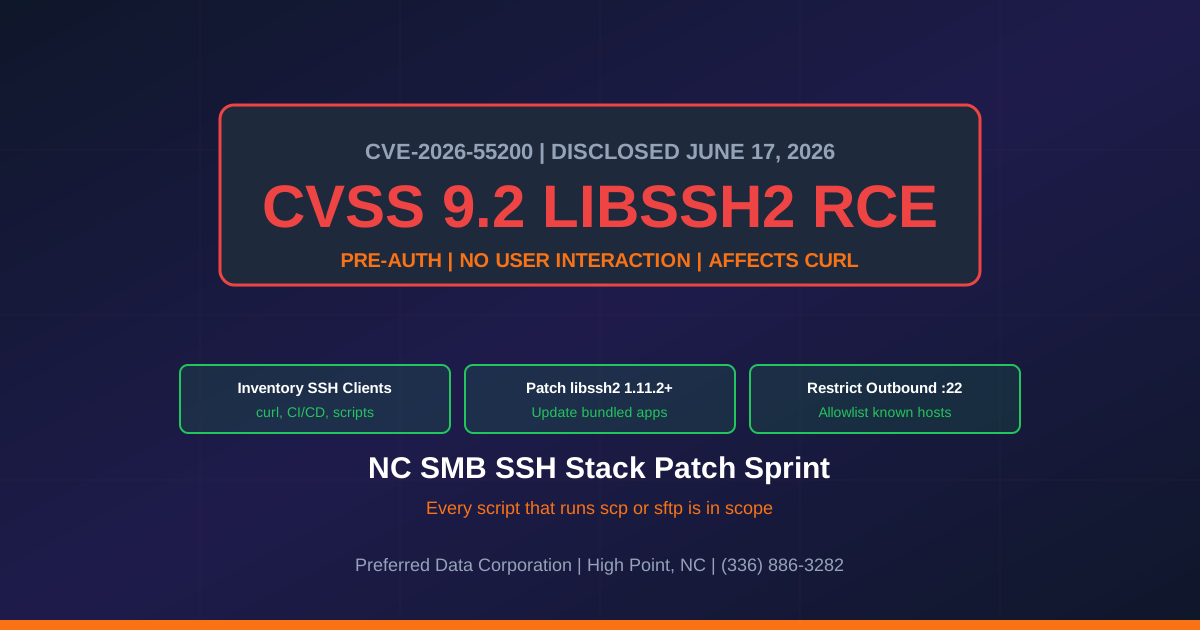
TL;DR: On June 17, 2026, the libssh2 project disclosed CVE-2026-55200, a CVSS 9.2 pre-auth remote code execution flaw in ssh2_transport_read() that affects every libssh2 version through 1.11.1. The bug is a heap overflow triggered by a malicious SSH server sending a crafted packet with an oversized packet_length field; no privileges and no user interaction are required, per The Cybersec Guru. For NC small businesses, the painful part is not patching libssh2 itself - it is finding every place it lives: curl, WinSCP, FileZilla, build agents, backup scripts, and ERP file-transfer jobs. Upgrade to libssh2 1.11.2 (commit 97acf3d) and every app that statically bundles it, this week.
Key takeaway: CVE-2026-55200 is a CVSS 9.2 pre-auth RCE in a library most NC SMB owners have never heard of, embedded in tools they use every day. The defense is not a single patch; it is a software-supply-chain inventory of every program that calls out over SSH, SCP, or SFTP, followed by patching them all to a build that ships libssh2 1.11.2 or later.
Need help inventorying every SSH client, build agent, and automation script in your NC business and getting them patched this week? Preferred Data Corporation has run managed IT and cybersecurity for NC small businesses since 1987. Call (336) 886-3282 or book a libssh2 exposure review.
What is CVE-2026-55200 and why is it a code-red SSH library bug?
CVE-2026-55200 is a heap buffer overflow in libssh2's ssh2_transport_read() function inside transport.c. Per GBHackers and Cybernews, the function fails to enforce an upper bound on the packet_length field read from an incoming SSH packet. A malicious SSH server can send a crafted packet with an excessively large packet_length value, corrupt heap memory in the client process, and pivot to remote code execution in the context of whatever program is running libssh2.
Three properties make this a code-red bug for NC small businesses in High Point, Greensboro, Charlotte, Raleigh, Winston-Salem, and across the Piedmont Triad:
- Pre-authentication. Per Cybersecurity News, the overflow triggers during the transport-layer handshake, before authentication completes. An attacker controlling an SSH server (or anything an SSH client connects to) gets code execution without ever presenting a valid credential.
- No user interaction, low complexity. Per The Cybersec Guru, the CVSS vector reflects no privileges required and no user interaction. The client just needs to connect to the malicious server, which is exactly what a backup script, a CI/CD agent, or a
curlcommand does on a schedule with zero human in the loop. - Patched in commit 97acf3d (libssh2 1.11.2). Per GitHub Advisory GHSA-r8mh-x5qv-7gg2, the fix landed as commit
97acf3dand ships in libssh2 1.11.2. Every version through 1.11.1 is vulnerable.
The reason this CVE keeps NC IT directors up at night is not libssh2 itself; it is that libssh2 is everywhere. curl uses it for SCP and SFTP. Backup utilities embed it. CI/CD agents pull binaries built against it. Cross-platform file-transfer GUIs link it statically. The patch surface is broad even when the bug is narrow.
Where does libssh2 actually live in an NC SMB tech stack?
libssh2 is a portable C client-side SSH library, and that is exactly why it is hidden inside so many things. For NC small businesses, the realistic inventory looks like this:
| Where it appears | SMB use case | Patch path |
|---|---|---|
curl (built with libssh2 backend) | Nightly file pulls, S3 SFTP gateways, vendor data drops | Upgrade curl to a build linked against libssh2 1.11.2+ |
| Backup scripts using rsync-over-SSH or SCP via curl | Off-site backups to colo / hosting provider | Update the host OS package or container base image |
| CI/CD agents (Jenkins, GitLab Runner, GitHub Actions self-hosted, Bamboo) | Build, package, and deploy via SSH/SCP | Patch the runner OS and any bundled CLI tools |
| WinSCP, FileZilla, Cyberduck (when built against libssh2) | Sysadmin file transfers, ERP exports | Upgrade to the latest vendor build |
Python wrappers (pylibssh2, ssh2-python) | Custom automation, scraping, RPA scripts | Upgrade the wrapper to a build linked against libssh2 1.11.2 |
| Ansible-adjacent automation frameworks and custom Go/Rust SSH clients | Configuration management, fleet ops | Rebuild from a base image with patched libssh2 |
| Managed file-transfer (MFT) apps | EDI, partner data exchange | Apply vendor patch as it ships |
For an NC manufacturer in High Point pushing nightly inventory exports to a 3PL via SCP, a NC professional services firm in Greensboro running GitLab Runner builds that deploy to client environments via SSH, a NC distributor in Charlotte using WinSCP to push EDI files, or a NC marketing agency in the Research Triangle whose static-site CI deploys to managed hosting over SFTP - the exposure is the same. The library is the dependency; the apps are the patch targets.
What does the libssh2 exploit chain look like?
The exploit chain has four steps. Each step matters for where defenders intervene.
| Step | Attacker Action | SMB Failure Mode | Defense Layer |
|---|---|---|---|
| 1 | Stand up (or compromise) an SSH server that an SMB client will connect to | SMB scripts blindly trust outbound SSH endpoints | Outbound SSH allowlist, host-key pinning |
| 2 | When the SMB client connects, send a crafted SSH transport packet with oversized packet_length | libssh2 ≤ 1.11.1 in the client fails to enforce bounds in ssh2_transport_read() | Patch libssh2 to 1.11.2+ (commit 97acf3d) |
| 3 | Heap memory in the client process is corrupted | No exploit mitigations / outdated OS hardening | OS-level ASLR, CFG, modern compiler hardening, EDR |
| 4 | Attacker achieves RCE in the context of the client (CI runner, backup user, sysadmin laptop) | RCE pivots to lateral movement, credential theft, ransomware staging | Least privilege for the service account, segmentation, EDR |
The hard part is that step 1 is not necessarily a malicious external server. If an attacker compromises a vendor's SFTP endpoint that your nightly script connects to, your patched-everywhere-else NC SMB still gets popped through the library. The patch is the only durable answer.
What should NC SMBs do this week about libssh2?
Run a five-action plan in seven days. Most NC small businesses can do this with their existing managed IT provider and their internal admin team.
- Inventory anything that initiates outbound SSH from corporate networks. That includes CI/CD runners, backup jobs, scheduled tasks that call
curl,scp, orsftp, file-transfer GUIs on admin desktops, custom Python or Go scripts, and managed file-transfer (MFT) appliances. If you do not have a software bill of materials (SBOM) for your build pipeline, this is the week to start one - even a spreadsheet beats nothing. - Upgrade libssh2 to the patched version (commit 97acf3d / 1.11.2+). Per GitHub Advisory GHSA-r8mh-x5qv-7gg2, the fix is in commit
97acf3d. On Linux servers,apt update && apt upgrade libssh2-1or the RHEL/Rocky equivalent typically picks up the distro-backported fix once it lands. For container base images, rebuild after the distro publishes the patched package. - Update curl, WinSCP, FileZilla, and any other apps that statically bundle libssh2. Distro-level package updates do not always reach static binaries shipped by vendors. Check vendor advisories explicitly. Per Cybernews, curl built with the libssh2 backend is in scope and needs to be rebuilt or upgraded to a version linked against the patched library.
- Restrict outbound SSH (port 22) at the firewall to known destinations only. Default-deny outbound 22 and allowlist the specific vendor SFTP endpoints, colo hosts, and managed services your scripts actually need. This shrinks the attack surface so a compromised libssh2 client can only be aimed at servers you have already vetted.
- Put any internet-exposed SSH jump host behind MFA and an identity-aware proxy, and verify its outbound libssh2 dependency. Jump hosts that connect onward via SSH to internal systems often carry the same libssh2 binary. If the jump host is the target, an attacker who can route a malicious server in front of it owns the entire downstream estate. Patch the jump host, audit what it connects to, and enforce phishing-resistant MFA at the entry point.
Key takeaway: The CVE-2026-55200 work is 80% inventory and 20% patching. NC SMBs that can answer "what programs on our network call out over SSH, SCP, or SFTP, and which version of libssh2 is each one bundled with?" will close this in days. NC SMBs that cannot answer that question should treat the exercise as the start of a real software-supply-chain program, not a one-off.
Want a libssh2 exposure inventory and patch sprint scoped to your NC SMB this week? Call (336) 886-3282 or book a CVE-2026-55200 review.
What's the broader SMB software-supply-chain lesson here?
CVE-2026-55200 is a textbook case for why NC small businesses need to track libraries, not just applications. Three points NC SMB owners should internalize:
- You patch where you installed it, not where it lives. libssh2 lives in dozens of places once you start counting. You patch curl, WinSCP, your Linux server image, your container base image, and your CI/CD runner image separately. A single CVE produces a multi-product patch list. Without a software bill of materials (SBOM), even a managed IT provider is reconstructing this by hand under time pressure.
- A CVSS 9.2 bug in a niche library is not the same as a CVSS 9.2 bug in something used everywhere. OpenSSL Heartbleed, log4shell, and now libssh2 CVE-2026-55200 are bugs in widely-embedded dependencies, which makes the patch surface broad even when the underlying flaw is narrow. The CVSS score tells you the severity; the dependency graph tells you the workload. Both matter.
- SBOMs are no longer a federal-contractor-only conversation. The federal government has been pushing SBOMs for software it buys since 2021, and the SBOM concept has matured into a practical tool for any SMB that wants to answer "are we exposed to CVE-X?" in minutes instead of days. For NC SMBs, a lightweight SBOM of your top 20 internet-facing or automation-critical apps is achievable in a quarter and pays back the first time a major CVE drops.
For NC manufacturers in High Point and Greensboro running OT/IT integration, NC construction firms in Charlotte and Raleigh whose project management tools push files to subcontractor portals, NC distributors and importers across the Piedmont Triad, and NC professional services firms in Winston-Salem and the Research Triangle, the same logic applies. The next libssh2-class CVE is coming. The investment in software-supply-chain visibility this quarter is what makes the next response a fire drill instead of a fire.
How does Preferred Data Corporation help NC SMBs handle CVE-2026-55200 and supply-chain CVEs?
PDC has run managed IT and cybersecurity for NC small businesses since 1987 from High Point. Three service lines map directly to the CVE-2026-55200 action list:
- Managed IT services: Patch management across servers, workstations, and container base images; CI/CD runner hygiene; vendor patch monitoring for curl, WinSCP, FileZilla, and similar tools; and the operational discipline to roll fixes out fast without breaking production.
- Cybersecurity services: Vulnerability management programs that track CVEs against your actual software inventory, lightweight SBOM development for your top automation-critical apps, 24/7 monitoring for post-exploit behavior, and incident response if a libssh2 client was already compromised before the patch landed.
- Network infrastructure services: Outbound SSH allowlisting at the perimeter, segmentation between automation/build networks and the rest of the estate, jump host hardening with phishing-resistant MFA, and architecture review so a single compromised library does not become a path to ransomware staging across the NC business.
For NC SMBs that already have an MSP, this is the week to ask them three questions: which of our systems run libssh2, what versions are they on, and how do we know the patch landed? If the answer is anything other than "here is the list and here is the verification," there is a software-supply-chain gap that CVE-2026-55200 just illuminated.
Need a libssh2 exposure inventory, patch sprint, and SBOM kickoff for your NC SMB this quarter? Call (336) 886-3282 or book a CVE-2026-55200 review.
Frequently Asked Questions
What versions of libssh2 are vulnerable to CVE-2026-55200?
Per GitHub Advisory GHSA-r8mh-x5qv-7gg2 and GBHackers, every libssh2 release through 1.11.1 is vulnerable. The fix landed in commit 97acf3d and ships in libssh2 1.11.2 and later. Any application that statically bundles libssh2 1.11.1 or earlier remains vulnerable until it is rebuilt against the patched library, even if the host OS package has been updated.
Is curl vulnerable to CVE-2026-55200?
curl is vulnerable when it is built with the libssh2 backend for SCP and SFTP transfers, per Cybernews. Not every curl build links libssh2; some are built without the SSH backends, and some use a different SSH library. Check curl --version to see the SSH library line. If libssh2 is listed and the version is 1.11.1 or earlier, upgrade curl to a build linked against libssh2 1.11.2 or later.
How do I know if my CI/CD pipeline uses libssh2?
Inspect the runner image. On Debian/Ubuntu-based runners, dpkg -l | grep libssh2 shows the installed package. On RHEL/Rocky/Alma, rpm -qa | grep libssh2 does the same. For container runners (GitHub Actions self-hosted in Docker, GitLab Runner in Kubernetes), check the base image's package list. Any pipeline step that calls scp, sftp, curl --upload-file sftp://..., or runs git over SSH (which usually uses OpenSSH, not libssh2, but worth verifying) potentially touches the library.
Does this affect WinSCP / FileZilla / PuTTY?
It depends on the build. WinSCP and FileZilla can ship in builds that bundle libssh2-derived stacks; if your specific build does, it is in scope until the vendor ships a patched release. PuTTY uses its own SSH implementation and is not affected by libssh2 CVEs, per the project's documentation. Check each vendor's advisory page for explicit guidance on CVE-2026-55200, and treat any non-current build as in scope until verified.
Should we block outbound SSH (port 22) to defend against this?
Default-deny outbound port 22 with an explicit allowlist of vendor SFTP endpoints, colo hosts, and managed services is good hygiene regardless of CVE-2026-55200. It reduces the blast radius of a vulnerable libssh2 client by ensuring it can only connect to servers you have vetted. It does not eliminate the need to patch - if a vetted endpoint is itself compromised, the client is still exposed - but it materially shrinks the attack surface and is one of the highest-leverage network-layer controls NC SMBs can deploy this week.
Has CVE-2026-55200 been exploited in the wild yet?
As of the disclosure on June 17, 2026, public reporting from Cybersecurity News and The Cybersec Guru had not confirmed in-the-wild exploitation. That is the normal early-disclosure state; for CVSS 9.2 pre-auth RCE bugs in widely embedded libraries, the historical pattern is that exploitation follows public PoCs within weeks. Treat the patch window as days, not months, regardless of whether confirmed exploitation has been reported yet.
Related Resources
- Managed IT Services - Patch management, CI/CD runner hygiene, vendor patch monitoring
- Cybersecurity Services - Vulnerability management, SBOM, 24/7 monitoring, incident response
- Network Infrastructure Services - Outbound SSH allowlisting, segmentation, jump host hardening
- Contact Preferred Data Corporation - libssh2 exposure inventory for NC SMBs
- SquidBleed CVE-2026-47729: NC SMB Squid Proxy Defense Plan - Companion proxy heap-overread post
- PixelSmash FFmpeg CVE-2026-8461: NC SMB Media App Defense Plan - Companion media-library CVE post
- FortiBleed FortiGate CVE-2026-86644: NC SMB Firewall Defense Plan - Companion firewall credential-exposure post