
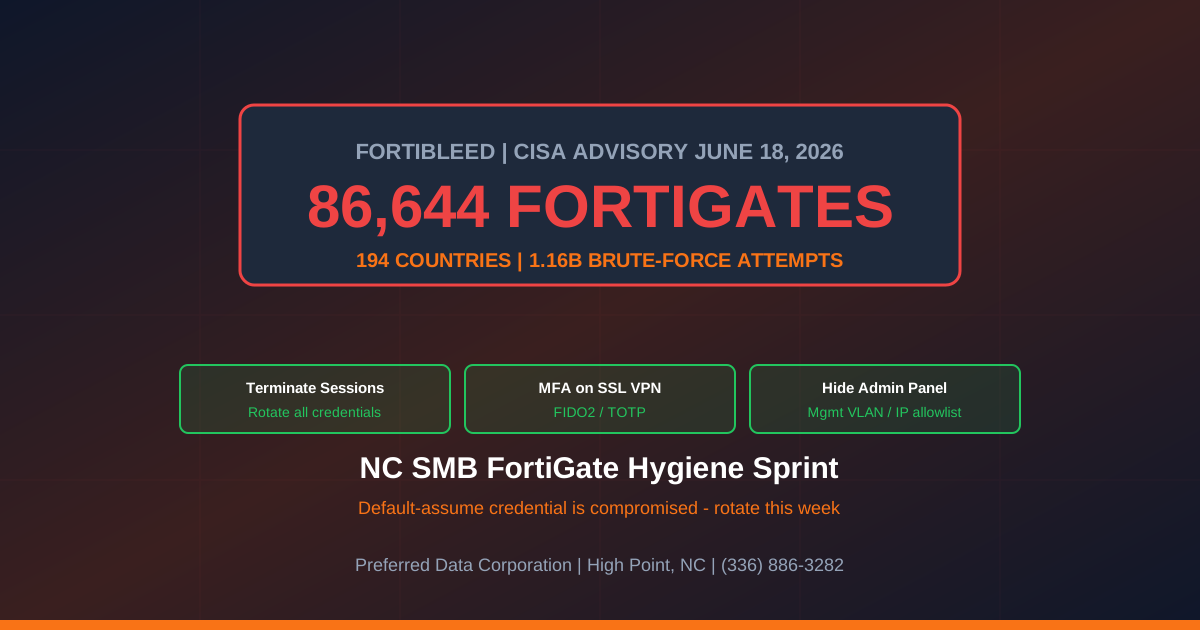
TL;DR: In mid-June 2026, researchers documented FortiBleed - a large-scale credential-exposure campaign against internet-facing Fortinet FortiGate firewalls. Per Arctic Wolf, the campaign now spans 194 countries with more than 86,644 confirmed working credentials - roughly half of all internet-reachable FortiGate devices. On June 18, 2026, CISA published an urgent hardening advisory telling impacted Fortinet customers to immediately terminate sessions, reset all admin and VPN passwords, and enforce strong policies. For NC small businesses that built their network around a FortiGate, this is a one-week firewall-and-VPN hygiene sprint, not a quarterly to-do.
Key takeaway: FortiBleed is not a single CVE - it is the cumulative outcome of reused credentials, weak passwords, exposed admin interfaces, and missing MFA on SSL VPN. An NC SMB that rotates FortiGate admin and VPN credentials, enforces phishing-resistant MFA, and removes the admin interface from the public internet this week breaks the FortiBleed chain whether or not their device is one of the 86,644.
Need a one-week FortiGate firewall and SSL VPN hygiene sweep? Preferred Data Corporation has run managed network and cybersecurity for NC small businesses since 1987 from High Point. Call (336) 886-3282 or book a firewall hygiene review.
What is FortiBleed and what happened in mid-June 2026?
FortiBleed is the name researchers gave to a sustained credential-attack campaign against Fortinet FortiGate firewalls. Per Arctic Wolf's analysis and security researcher Kevin Beaumont's documentation, threat actors are using two parallel techniques.
Three facts an NC SMB owner should write down:
- 1.16 billion credential attempts against FortiGate targets. Per Ransom News and SOC Radar, the FortiBleed crew launched roughly 1.16 billion brute-force / credential-stuffing attempts against internet-facing FortiGate SSL VPN endpoints, plus 2.1 billion attempts against MSSQL servers. The scale is not a targeted operation - it is a global commodity attack.
- 86,644 working credentials across 194 countries. Per SecurityWeek and Bleeping Computer, the leaked dataset includes 86,644 confirmed working credentials covering roughly half of all internet-reachable FortiGate devices, spanning 194 countries and 21,000-plus domains.
- CISA published a hardening advisory on June 18, 2026. Per CISA's advisory, impacted Fortinet customers with FortiGate appliances and associated SSL VPN gateways should immediately terminate sessions, reset credentials, and enforce strong password policies. This is one of the more aggressive same-day-action advisories CISA has published in 2026.
The credential exposure is two paths in parallel: (1) brute-force / credential-stuffing against publicly exposed SSL VPN and admin endpoints, and (2) offline cracking of FortiGate configuration-file credential hashes after the configs were extracted. Per Arctic Wolf, researchers documented a 45-GPU Hashtopolis cluster being used for the offline cracking step.
Why does FortiBleed hit NC small businesses harder than enterprise?
Because the typical NC SMB network stack centers on a single FortiGate that is doing perimeter, SSL VPN, SD-WAN, and policy enforcement at once - and the rotation cadence on its credentials lags the enterprise norm.
| FortiBleed Risk Layer | NC SMB Reality 2026 | What an Adversary Does With It |
|---|---|---|
| FortiGate admin credential | Set once at install, rarely rotated | Add a backdoor account, disable logging, modify rules |
| SSL VPN user credentials | Local accounts, weak password policy | Pivot inside the network as a legitimate user |
| MFA on SSL VPN | Optional, often skipped | Single-factor login from any IP, anywhere |
| Admin interface exposure | Sometimes published to internet | Direct credential attack on the admin login |
| Firmware version | 12-18 months behind current | Known unpatched CVEs accumulate |
| Config backup hygiene | Stored in shared cloud folder | Backup file becomes credential dump |
| Session lifetime | Default, days-long | Stolen session token survives password rotation |
Two implications NC SMB owners should not skip:
- FortiBleed is mostly about credentials, not a single zero-day. Per CISA's advisory and SecurityWeek's analysis, the mitigation is largely about credential hygiene, MFA, and removing exposed admin interfaces - not waiting on a patch. That means the NC SMB without an active maintenance contract is still fully able to defend.
- Half of all internet-reachable FortiGates is the base rate, not the worst case. A device count of 86,644 against an installed base of ~170,000 internet-reachable FortiGates means the prior probability your device is in the leaked pool is roughly 50%. Default-assume compromise; rotate, MFA, and harden.
What does FortiBleed mean for an NC SMB that runs an MSP-managed FortiGate?
The MSP-managed model does not make this go away; it makes the rotation work more concrete and accountable. Three questions every NC SMB should ask their MSP this week:
- "When did you last rotate our FortiGate admin password, and how was it generated?" A password-manager-generated value, unique per device, is the only acceptable answer. A shared MSP admin credential across multiple clients is the FortiBleed exposure profile.
- "Is SSL VPN MFA enabled for every user, including service accounts?" FortiToken, Duo Mobile, Microsoft Entra MFA via SAML, or another FIDO2 / TOTP solution must be enforced on every SSL VPN profile. SMS OTP is acceptable as a stopgap; passkeys or hardware tokens are the real answer.
- "Is the admin interface accessible from the public internet?" It should not be. Per CISA's hardening guidance, admin should be management-VLAN-only or restricted by source-IP allowlist. If your MSP says "yes, but we monitor it," that is not a control - that is a confession.
Per Bitsight's coverage, the credential exposure has been linked to credential reuse across multiple devices - so even if your MSP cleans up your FortiGate, a shared credential pattern elsewhere can still be exploited.
What does the one-week FortiBleed hygiene sprint look like?
Run this six-step sequence inside seven days. The cost is staff time plus an after-hours maintenance window, not a capital project.
- Day 1 - inventory and triage. List every FortiGate the NC SMB owns or operates, every SSL VPN user account on each device, every admin account, and the management interface configuration. Identify which devices have admin interfaces reachable from the public internet.
- Day 1-2 - terminate sessions. Per CISA's advisory, immediately terminate all active SSL VPN sessions and admin sessions. Stolen session tokens survive password rotation - the only safe baseline is "everyone logs back in once the new controls are in place."
- Day 2-3 - rotate every credential. Generate unique, password-manager-stored credentials for every FortiGate admin account and every SSL VPN local account. Force a password change for every directory-synced SSL VPN user. If MSP shared admin credentials exist, eliminate them and replace with per-engineer named accounts plus a break-glass account stored in the secrets vault.
- Day 3-4 - enforce MFA on every SSL VPN user. FortiToken, Duo, Microsoft Entra MFA via SAML, or another FIDO2 / TOTP solution applied to every SSL VPN profile. If the user base is small, deploy hardware keys for admins and TOTP for staff. SMS OTP is a stopgap only.
- Day 4-5 - remove admin interface from public internet. Restrict admin access to a management VLAN or a documented source-IP allowlist. If remote admin is required, route it through a brokered remote-access tool (Cisco Secure Client, BeyondTrust PRA) or a Zero Trust Network Access overlay - not direct internet-exposed
https://device:443. - Day 5-7 - patch firmware and verify monitoring. Update FortiGate firmware to the current supported branch. Verify that authentication failures, configuration changes, and new admin accounts trigger alerts to the managed SOC. If you do not have a SOC, this is the moment to add one - even a co-managed service hours-tracked SOC is enough for an NC SMB.
Key takeaway: FortiBleed is a credential-and-MFA problem with a firmware add-on. The mitigations are routine network-engineering practice, but the urgency has changed: with 86,644 working credentials in the wild, every internet-facing FortiGate must default-assume the credential is compromised and run the rotation sequence this week.
Want a managed FortiGate hygiene engagement this week? Call (336) 886-3282 or book a firewall hygiene review.
What signs of FortiBleed compromise should NC SMBs hunt for?
Five signals to look for in FortiGate logs from the last 30 days. If any are present, escalate to incident response.
- SSL VPN logins from unexpected geographies or AS numbers. A NC manufacturer whose entire user base lives within 200 miles of High Point that suddenly has VPN logins from Asia, Eastern Europe, or LATAM IPs is presumptive compromise.
- New admin accounts you did not create. Per the SecurityWeek summary, one of the typical adversary follow-up steps is to create a stealth admin account on the device for persistence.
- Configuration changes outside the change-window. Firewall rules added or modified outside the documented change-management process indicate adversary configuration to enable lateral movement or data exfiltration.
- Authentication-policy changes (MFA disabled, lockout disabled, logging disabled). A common adversary action is to disable the very controls that would otherwise alert the defender.
- Successful login immediately after thousands of failed attempts. The brute-force signature is the same as any credential-stuffing attack. Successful authentication immediately following a brute-force run is the smoking gun.
Per the Huntress advisory, automated detection content is available across leading EDR / MDR platforms. If your NC SMB does not have managed detection content for FortiGate, this is a service-line gap that costs less to fill than the average breach response invoice.
How does Preferred Data Corporation help NC SMBs harden FortiGate and SSL VPN?
PDC has run managed IT, network, and cybersecurity for NC small businesses since 1987 from High Point. Three concrete service lines align with the FortiBleed hygiene sprint:
- Network infrastructure services: FortiGate audit (admin exposure, MFA enforcement, firmware status), SSL VPN architecture review, replacement to ZTNA / SASE where appropriate, SD-WAN segmentation for NC multi-site businesses, and configuration baselines you can prove during an insurance audit.
- Cybersecurity services: Managed detection content for FortiGate, EDR / MDR with FortiGate log integration, phishing-resistant MFA rollout to SSL VPN, and Incident Response Plan retainer for the "we think a FortiGate was compromised" call.
- Managed IT services: Vault-stored admin credentials with named accounts and break-glass, scheduled firmware maintenance windows, change management and rollback documentation, and the ongoing rotation cadence FortiBleed makes mandatory.
For NC manufacturers in High Point, Piedmont Triad professional services firms, NC construction firms in Charlotte and the Research Triangle, and NC distributors and importers running multi-site FortiGate footprints - FortiBleed is the moment to confirm that the perimeter is actually a perimeter, not a public credential surface. The mitigations are routine; the urgency is not.
Need a managed FortiGate + SSL VPN hardening engagement scoped to your NC SMB? Call (336) 886-3282 or book a firewall hygiene review.
Frequently Asked Questions
What is FortiBleed and is it a Fortinet vulnerability?
FortiBleed is the name researchers gave to a sustained credential-exposure campaign against Fortinet FortiGate firewalls disclosed in mid-June 2026. Per Arctic Wolf and SecurityWeek, it is not a single Fortinet CVE - it is the cumulative result of credential brute-force, credential stuffing, and offline cracking of FortiGate configuration-file credential hashes. The fix is credential hygiene plus MFA plus removing admin exposure, not a single patch.
How many FortiGate devices are exposed in FortiBleed?
86,644 confirmed working credentials across 194 countries, per SecurityWeek's reporting and SOC Radar's analysis. That number represents roughly half of all internet-reachable FortiGate devices - so the prior probability that any given internet-facing FortiGate is in the leaked pool is roughly 50%. Default-assume your device is exposed and run the rotation sequence.
What did CISA say to do on June 18, 2026?
Per CISA's hardening advisory, Fortinet customers with FortiGate appliances and associated SSL VPN gateways should immediately terminate active sessions, reset all Fortinet VPN and administrative passwords (especially on internet-facing systems), and enforce strong password policies. CISA also recommends MFA on SSL VPN and removing the admin interface from public internet exposure.
Should NC SMBs replace FortiGate after FortiBleed?
No, the mitigation is hygiene, not replacement. Fortinet remains a credible enterprise-grade firewall vendor; the FortiBleed problem is credentials and configuration, not a fundamental Fortinet failure. A NC SMB that rotates credentials, enforces MFA on SSL VPN, removes admin interface exposure, patches firmware, and adds managed detection content is in good shape. Replacement is appropriate only when the device is end-of-support or the network design needs to change for other reasons.
Does MFA on SSL VPN actually stop credential-stuffing?
Yes, when enforced correctly. Phishing-resistant MFA (FIDO2 / WebAuthn, hardware tokens) plus rate-limited login attempts plus geofencing on SSL VPN cuts the FortiBleed brute-force success rate to near zero. SMS OTP is weaker but still meaningfully better than single-factor; TOTP via authenticator apps is significantly stronger than SMS. The order of preference is hardware token > passkey > TOTP > push notification > SMS OTP.
How long does a FortiBleed hygiene sweep take for a typical NC SMB?
For a single-site NC SMB with one FortiGate and a small SSL VPN user base, the seven-day sequence above is the realistic window. For a multi-site NC SMB with three to ten FortiGates and a larger user base, plan two to three weeks including the after-hours maintenance windows and the MFA rollout to staff. PDC scopes the engagement to the NC SMB's device count and user base, not a flat-rate template.
Related Resources
- Network Infrastructure Services - FortiGate audit, SSL VPN architecture, SD-WAN segmentation
- Cybersecurity Services - Managed detection, MFA enforcement, IRP retainer
- Managed IT Services - Credential vaulting, firmware maintenance, change management
- Verizon DBIR 2026: Third-Party Breaches Hit 48% - NC SMB Vendor Risk - Companion vendor risk analysis
- Conti Plea June 2026: NC SMB Ransomware Reporting Plan - Companion ransomware ecosystem post
- Contact Preferred Data Corporation - FortiGate hygiene sweep for NC SMBs