
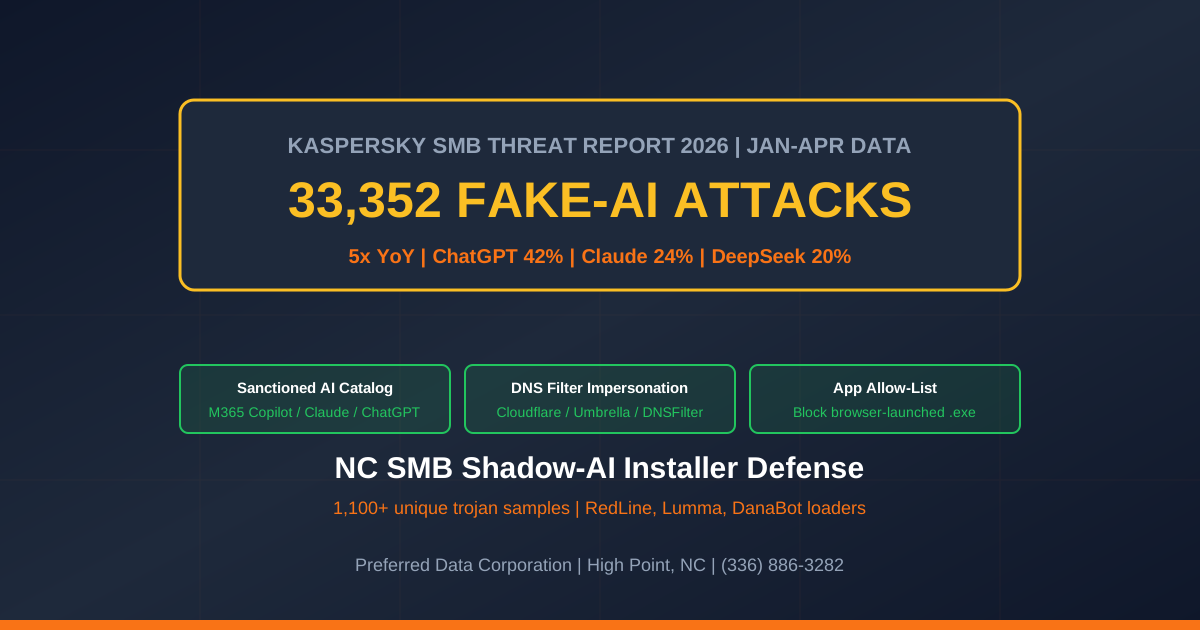
TL;DR: Kaspersky's 2026 SMB threat report tracked 33,352 malware and PUA attacks on SMB users in the first four months of 2026 where the malicious payload masqueraded as a popular AI service - a 5x increase versus the same period in 2025 and 39% higher than office/collaboration-tool impersonation, per Securelist. The most-impersonated AI services were ChatGPT (42% of detections), Claude (24%), and DeepSeek (20%), with 1,100+ unique samples observed, per TechNadu. The payloads are trojans that pose as legitimate AI installers, gain a foothold, and then download credential stealers, ransomware loaders, or RATs. For NC SMBs whose employees are searching "ChatGPT download" instead of using a sanctioned tool, this is the dominant June 2026 endpoint threat - and it lives entirely in the gap between "the company has not approved an AI tool" and "the employee is using one anyway."
Key takeaway: Your NC SMB does not have a shadow-AI usage problem - it has a shadow-AI installer problem. Every employee searching for "free Claude download" is a phishing victim in slow motion. The defense is a sanctioned-tool catalog plus DNS filtering, not a blanket policy nobody reads.
Need help standing up a sanctioned AI tool catalog, DNS filtering, and shadow-AI detection? Preferred Data Corporation runs managed cybersecurity for NC SMBs since 1987. Call (336) 886-3282 or book an AI governance review.
What did Kaspersky find about fake AI tools attacking SMBs in 2026?
Per Kaspersky's June 2026 SMB threat report covered by Crowdfund Insider, between January and April 2026 the firm detected 33,352 attacks against SMB users where the malicious file masqueraded as one of five popular AI services. That figure is nearly 5x the same period in 2025 and 39% higher than malware disguised as office or collaboration tools - which used to be the dominant SMB-installer lure.
| AI tool impersonated | Share of SMB detections | Why attackers chose it |
|---|---|---|
| ChatGPT | 42% | Brand-name recognition; "free download" search volume |
| Claude | 24% | Newer, less-familiar UX; users more willing to download anything |
| DeepSeek | 20% | Geopolitical concern about official availability drives sideload risk |
| Gemini | ~8% | Bundled into Google Workspace; users uncertain of the install path |
| Grok | ~6% | High consumer interest; no official desktop installer for most platforms |
The wider Kaspersky press release recorded 92,000+ total attacks (consumer + SMB) masquerading as AI services January-May 2026, with fake ChatGPT representing 49% of all detected attacks globally. Per Security MEA, the malware mix is dominated by trojans - drop a fake installer, gain a foothold, then download whatever monetization payload pays best that week (credential stealer, ransomware loader, RAT, info-stealer).
Quotable definition: A fake AI installer is malware that mimics the brand, logo, and install flow of a popular AI service to convince an employee that the download is the legitimate tool. The first execution looks normal - sometimes the genuine AI service even opens in a browser - while the trojan installs persistence in the background.
Three facts an NC SMB owner should write down today:
- The attack rides employee initiative. Per Kaspersky and Let's Data Science, the lure works because the employee is trying to do their job better. The attacker did not phish them; the employee went looking for the tool.
- The blanket "no AI tools" policy backfires. Forbidding employee AI use sends the install activity off the sanctioned channel and into the "free download" search-result page where 1,100+ malware samples wait. The Kaspersky data is the receipt for this failure mode.
- The fix is a sanctioned tool plus a guardrail, not a ban. A vetted AI tool catalog (Claude, ChatGPT Team, Microsoft 365 Copilot Business, Gemini Workspace) deployed via SSO and DNS-filtered against impersonation domains removes the underlying search.
Why does the fake-AI-tool threat matter to NC SMBs in 2026?
Because NC SMB AI adoption ran ahead of NC SMB AI governance. Per Federal Reserve data covered in our SMB AI spending $2,068/employee analysis, per-employee AI spending in 2026 hit ~$2,068 - growing faster than IT spending overall - and the 82% NC SMB AI adoption figure means a NC SMB without a sanctioned AI tool catalog still has employees using AI. The Kaspersky 5x jump in fake-AI installer attacks is the predictable downstream of that adoption gap.
The NC SMB victim profile maps cleanly:
- A High Point CPA firm where a junior accountant searches "download ChatGPT free Windows" before tax season, runs the installer, and unknowingly installs RedLine Stealer that exfiltrates browser passwords - including the firm's Drake Tax and QuickBooks credentials.
- A Greensboro manufacturer where an engineer searches "Claude desktop app download" to summarize spec sheets, runs a trojan, and gives a foothold on a workstation that has SMB access to the engineering file share.
- A Piedmont Triad insurance brokerage where a producer downloads a fake DeepSeek app to research a competitor's policy structure, and a banking trojan harvests the producer's Microsoft 365 credentials - which the brokerage's CRM is federated to.
- A Charlotte SMB law firm where a paralegal grabs a "Gemini for Workspace" installer that does not exist as a desktop binary, and the trojan gets between the paralegal and every client document on the firm's SharePoint.
Per Guardz's MSP threat report, 89% of SMBs already have at least one compromised credential and AI is involved in roughly 1 in 6 SMB breaches. The fake-AI-installer chain is the SMB-specific delivery vector that supplies a meaningful share of those credentials.
Key takeaway: The "shadow AI" problem in NC SMBs is not what the AI did with the data. It is the malware the employee installed while trying to get the AI to do anything at all.
How does an NC SMB defend against fake AI tools in 30 days?
Run an eight-control plan inside 30 days. The plan is sized for an SMB without a dedicated AI governance team and without a six-figure security budget.
- Publish a sanctioned AI tool catalog (Day 0-5). Pick three: a chat tool (Microsoft 365 Copilot Business, Claude for Business, ChatGPT Team), a workspace integration (Gemini Workspace if you are on Google), and a code tool if you ship software (Cursor, GitHub Copilot, Claude Code). Communicate it once with a simple "use these, ask before installing anything else" message.
- Deploy the sanctioned tools via SSO with conditional access (Day 5-15). Microsoft Entra ID + Conditional Access for M365 Copilot Business. Anthropic / OpenAI Team tenants federated to your IDP. The goal: the sanctioned path is one click from the employee's existing identity. The unsanctioned path is a 15-minute search.
- Add DNS filtering with AI-impersonation blocking (Day 5-10). Cloudflare Gateway, Cisco Umbrella, ControlD, NextDNS, or DNSFilter with the "AI tool impersonation" and "newly registered domain" categories enabled. The fake installer domains are typically registered weeks before the campaign and are easy to block at the resolver.
- Application allow-listing on workstations (Day 10-20). Microsoft Defender Application Control, Threatlocker, or Sentinelone Storyline Active Response. Block "any executable downloaded by a browser into Downloads" by default; allow exceptions through a help-desk ticket. The trojan installer cannot execute.
- Microsoft Defender for Cloud Apps shadow-AI discovery (Day 10-20). Per the Microsoft Purview shadow-AI guide, enable shadow-IT discovery to inventory the AI tools employees are actually using. Use the inventory to grow the sanctioned catalog rather than punish the gap.
- Endpoint EDR with behavior-based detection (Day 0-15). Microsoft Defender for Endpoint P2, Huntress Managed EDR, CrowdStrike Falcon, or SentinelOne. The fake installer payload (RedLine, Lumma, DanaBot, AsyncRAT) is detectable by behavior even when the binary signature is unfamiliar.
- Employee AI training in 20-minute bites (Day 15-25). Cover: (a) the sanctioned catalog and how to access it, (b) what to do when a tool is not on the catalog (ask before installing), (c) the brand-impersonation pattern (the search-result download is not the official site), and (d) what NOT to paste into any AI tool (PII, credentials, customer data, regulated info).
- Quarterly fake-AI brand impersonation hunt (Day 20-30 and ongoing). Subscribe to Kaspersky's, Securelist's, and BleepingComputer's threat-intel feeds. When a new fake-AI campaign hits the news, search DNS query logs for the impersonation domain, search EDR for the installer hash, and run a quick employee comms reminder.
| Day-30 control | Target outcome | Why it matters |
|---|---|---|
| Sanctioned AI tool catalog published | 3-5 named tools, SSO-fronted | Removes the "what AI tool do I use?" search |
| DNS filtering with AI-impersonation block | Active on all DNS-resolving devices | Blocks fake-installer domains pre-click |
| Application allow-listing on workstations | Browsers cannot launch arbitrary downloads | Trojan cannot execute |
| EDR with behavior detection | 100% of endpoints | Behavior detection catches the unfamiliar payload |
| Shadow-AI discovery (Defender CASB / Purview) | Inventory of all AI tool usage | Governance grows the catalog instead of policing |
Key takeaway: The sanctioned-catalog plus DNS-filter plus allow-list combination removes the search, removes the click, and removes the execution. The three together do not require an "AI policy" 30-page document - they require three configuration changes.
How does Preferred Data Corporation help NC SMBs defend against fake AI tools?
PDC has run managed cybersecurity, AI transformation services, and managed IT for NC SMBs since 1987. For the June 2026 Kaspersky fake-AI threat surge, PDC brings three things:
- Sanctioned AI catalog + SSO rollout: PDC stands up Microsoft 365 Copilot Business, Claude for Business, or ChatGPT Team in your existing Microsoft Entra ID or Google Workspace tenant with conditional access, MFA, and per-user licensing. The sanctioned path becomes the easy path.
- DNS filtering + application allow-listing: PDC deploys Cloudflare Gateway or Cisco Umbrella with AI-impersonation categories enabled, and configures Microsoft Defender Application Control / Threatlocker policies to block browser-launched executables in Downloads.
- EDR + 24/7 SOC + employee training: PDC runs Microsoft Defender for Endpoint P2 with active SOC tuning for fake-installer behavior, plus 20-minute employee-training modules on the sanctioned catalog and brand-impersonation pattern.
For NC accounting firms in High Point worried about Drake Tax credential theft via fake-ChatGPT lures, NC manufacturers in Greensboro and Charlotte where engineers are tempted by "free Claude desktop," NC insurance brokerages whose producers research competitors via "free DeepSeek," and NC law firms where paralegals chase a Gemini installer - this is the governance posture that turns AI adoption from an attack surface into a productivity gain.
Need help standing up a sanctioned AI catalog inside 30 days? Call (336) 886-3282 or book an AI governance review.
Frequently Asked Questions
What did Kaspersky's 2026 SMB threat report find?
Per Securelist, Kaspersky detected 33,352 attacks against SMB users from January through April 2026 where malware or PUAs masqueraded as one of five popular AI services. That figure is nearly 5x the same period in 2025 and 39% higher than malware disguised as office and collaboration tools.
Which AI services are most impersonated?
Per TechNadu, the leaders are ChatGPT (42% of SMB detections), Claude (24%), and DeepSeek (20%), with Gemini and Grok rounding out the top five. Globally (consumer + SMB), Kaspersky recorded 92,000+ AI-impersonation attacks in the same window, with fake ChatGPT accounting for 49%.
What does a fake AI installer actually do?
The trojan typically opens the legitimate AI service in a browser - so the user thinks the install worked - while installing persistence and a downloader in the background. The downloader then pulls whatever payload pays best: an info-stealer like RedLine or Lumma to harvest browser credentials, a banking trojan, a remote access tool, or a ransomware loader. Per Kaspersky, more than 1,100 unique samples have been observed across the campaigns.
Should we ban employee AI use to prevent this?
No. The blanket ban is the failure mode the data describes - employees use AI anyway and route their installs through unsafe search results. The defense is a sanctioned tool catalog (Microsoft 365 Copilot Business, Claude for Business, ChatGPT Team) deployed via SSO, plus DNS filtering of impersonation domains, plus application allow-listing. The sanctioned path becomes easier than the unsafe path.
How do we know which AI tools employees are already using?
Microsoft Defender for Cloud Apps (M365 E5 / E3 + add-on) or Microsoft Purview shadow-AI discovery inventories cloud-app usage from network telemetry. Cloudflare Gateway, Cisco Umbrella, and Netskope offer similar shadow-IT discovery. Per our Microsoft Purview shadow-AI guide, the inventory becomes the input to the catalog, not the trigger for punishment.
Are NC manufacturers and CPA firms specifically at risk?
Yes. NC manufacturers' engineers searching "Claude desktop download" expose engineering CAD and BOM data. NC CPA firms with junior accountants searching "ChatGPT download Windows" expose Drake Tax, QuickBooks, and client tax-return material. NC insurance brokerages expose producer credentials federated to CRM. The pattern repeats wherever an employee tries to do their job with AI before the company sanctioned one.
What is the single highest-ROI control to implement first?
DNS filtering with AI-impersonation categories enabled. Cloudflare Gateway, Cisco Umbrella, or DNSFilter blocks the fake-installer domain at the resolver, so the employee never reaches the malicious download page. It costs $1-$3 per user per month, deploys in a single afternoon, and removes the most common delivery vector before any other control is in place.
Related Resources
- Managed Cybersecurity for NC Businesses - DNS filtering, EDR, 24/7 SOC
- AI Transformation Services - Sanctioned AI tool deployment for NC SMBs
- Managed IT for NC Businesses - SSO, conditional access, application allow-listing
- Microsoft Purview Shadow AI Detection for SMB Governance
- Shadow AI SaaS Apps Breach Risk for Small Business
- AI Tool Sprawl Governance for Small Business
- Employee AI Training Gap Shadow AI Policy
- Contact Preferred Data Corporation - AI governance review for NC SMBs