
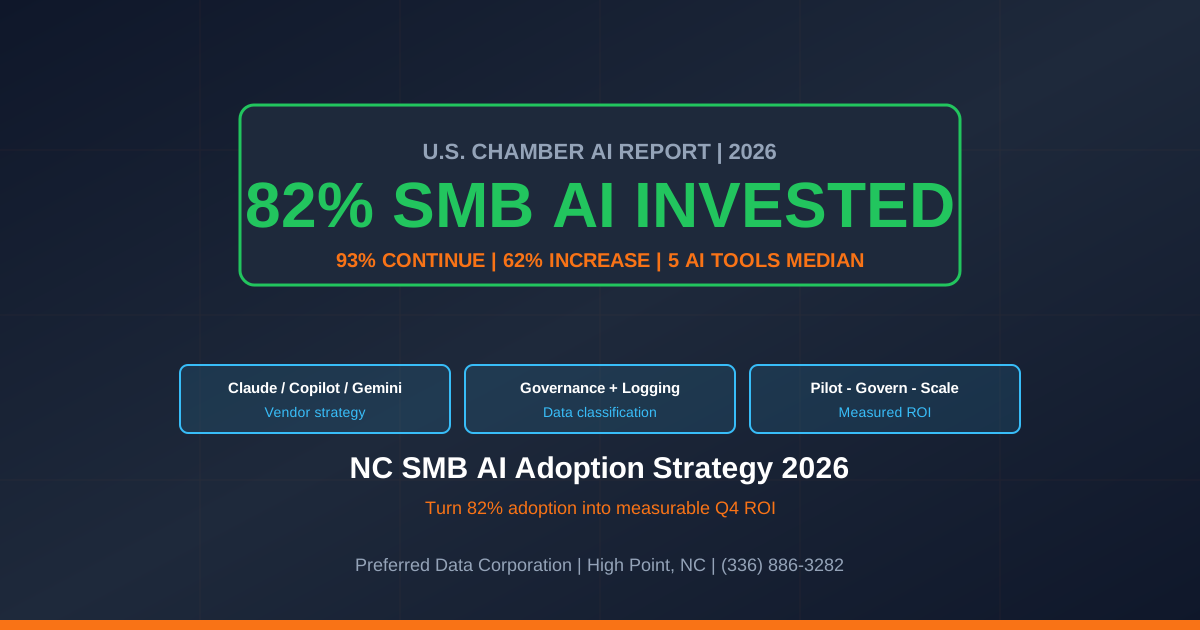
TL;DR: Anthropic launched Claude for Small Business in May 2026 with native integrations into Quickbooks, PayPal, HubSpot, Canva, Docusign, Google Workspace, and Microsoft 365, per Anthropic's announcement. Separately, the U.S. Chamber of Commerce reports that 82% of small business employers have invested in AI tools, 93% plan to continue investing, and 62% will increase AI spending in the next 12 months. NC SMBs that adopt AI without a governance framework absorb data leakage, vendor lock, and ROI evaporation - the work in 2026 is strategy, not enthusiasm.
Key takeaway: AI adoption is no longer the question for NC SMBs; the question is whether the adoption is governed. The SMB that puts Claude or Copilot in front of every employee without data classification, prompt logging, vendor controls, and a ROI scorecard ships its IP to a vendor and its margin into nothing. The fix is the same playbook PDC has run for 37 years - a vendor strategy, a governance layer, and a measured rollout.
Need an AI strategy that turns 82% adoption into measurable ROI? Preferred Data Corporation runs managed AI transformation programs for NC small businesses since 1987. Call (336) 886-3282 or book an AI strategy session.
What is Claude for Small Business and why does it matter to NC SMBs?
Claude for Small Business is Anthropic's packaged SaaS bundle that puts Claude inside the SMB tools an owner already pays for. Per Anthropic's announcement, the launch includes prebuilt connectors and ready-to-run workflows for Intuit Quickbooks, PayPal, HubSpot, Canva, Docusign, Google Workspace, and Microsoft 365 - the seven applications that cover invoice, payment, CRM, design, signature, email, and document workflows for most NC SMBs.
Three facts an NC SMB owner should write down:
- Claude for Small Business is the first major model vendor to package SMB-grade workflows rather than just API access. Per SiliconANGLE's coverage, the package targets owners who do not want to build agents from scratch.
- The integrations cover the SaaS stack 80% of NC SMBs already own. Quickbooks + Microsoft 365 + HubSpot is the modal NC SMB stack in 2026 - no new SaaS contracts required.
- Anthropic is partnering with Workday Foundation and LISC on a Solopreneurship Accelerator that gives an initial cohort of 15 solopreneurs Claude credits plus an AI-first entrepreneurship curriculum, per Anthropic. The signal: model vendors now compete on SMB onboarding, not just enterprise sales.
For an NC manufacturer in High Point evaluating Copilot vs. Claude vs. Gemini, a distributor in Greensboro looking for invoice automation, a professional services firm in Charlotte writing proposal first drafts, or a contractor in Raleigh trying to capture jobsite notes - the question in June 2026 is not "should we use AI" but "which model, on which data, with what guardrails."
Why did 82% of small businesses invest in AI - and what is the catch?
Because AI ROI moved from theoretical to operational in the last 12 months. Per the U.S. Chamber of Commerce small business AI report, the headline numbers are:
| Metric | 2026 Value | What It Tells NC SMBs |
|---|---|---|
| Small business employers investing in AI tools | 82% | AI is now table-stakes, not experimental |
| SMBs planning to continue AI investment | 93% | The ROI is being measured and renewed |
| SMBs planning to increase AI spend in next 12 months | 62% | The budget line is growing, not flat |
| SMBs that believe AI improves daily work | 57% | Operator-level adoption, not just leadership |
| Median number of AI tools per SMB | 5 | The "stack" approach replaces single-tool bets |
| Top use cases | Content, marketing/sales, workflow automation | Same use cases driving ROI consistently |
The catch is that the 82% adoption number includes a long tail of unmanaged, ungoverned, and unmeasured AI usage. The same Chamber survey notes that the typical SMB runs five AI tools - which means employees are pasting customer data, financial data, vendor data, and IP into multiple model vendors without a classification policy, a logging trail, or a vendor risk review.
Quotable definition: AI governance for an SMB is not a 200-page policy document. It is four things: a list of approved AI vendors, a data-class policy that says what can go into which model, a logging trail that survives an insurance audit, and a ROI scorecard that says what each tool is paying back. NC SMBs that ship adoption without governance are buying productivity with IP leakage.
For NC manufacturers running CAD files through generative-AI image tools, NC distributors running customer order history through marketing AI, NC professional services firms running client communications through legal-AI drafts, and NC healthcare practices touching PHI - the governance problem is the work. The model choice is the easy part.
How should an NC SMB sequence AI adoption in the second half of 2026?
Use the same three-tier sequence PDC runs for every NC SMB technology adoption: pilot, govern, scale. Skip a tier and the AI program either dies (no value) or burns (data leakage, runaway cost).
- Pilot (30 days). Pick one high-value workflow - invoice triage, proposal drafting, RFQ response, customer support triage, plant-floor SOP authoring. Run the pilot with two power users on one model (Claude, Copilot, or Gemini). Capture before / after time-on-task, error rate, and cost per output. The deliverable is a ROI number, not a demo.
- Govern (30-60 days). Stand up the four governance artifacts: (a) approved vendor list with DPAs and SOC 2 evidence, (b) data classification policy with "do not paste" rules for customer PII, financial, IP, and regulated data, (c) prompt and output logging with retention aligned to insurance and compliance requirements, (d) ROI scorecard with a quarterly renewal decision per tool.
- Scale (60-180 days). Roll out to operators with role-based training (manufacturing ops, sales, finance, customer support, leadership). Federate identity through Microsoft Entra ID, enforce SSO on every AI vendor, run a tabletop on the prompt-leak scenario, and build the "kill switch" for revoking access when an employee leaves or a vendor breach happens.
Per the Chamber's AI adoption guidance, the highest-ROI workflows for SMBs in 2026 are content creation, marketing and sales support, and workflow automation - the same workflows Claude for Small Business ships connectors for.
What does AI vendor risk look like for NC SMBs in 2026?
Same shape as SaaS vendor risk, with two new twists. First, the AI vendor sees more of the SMB's data per interaction than a traditional SaaS vendor - a single prompt can include customer PII, financial data, and competitive IP. Second, AI vendors retain inputs and outputs for model training, abuse detection, and incident response - so the data lifetime is longer than the prompt.
The seven-question vendor due diligence checklist for any AI tool an NC SMB adopts in 2026:
- Where is the data processed and stored? US-only? Mixed? Subprocessors?
- Is the data used to train the model? Default off? Opt-in? Per-tenant?
- What is the retention? 0 days? 30? 90? Unlimited?
- Who has access to prompts and outputs? Vendor staff under what controls?
- Is there a SOC 2 Type II / ISO 27001 / HIPAA BAA? Inside the last 12 months?
- Is there a Data Processing Agreement and a breach-notification SLA? 72 hours?
- What is the exit plan? Export format? Deletion timeline? Subprocessor purge?
Key takeaway: The AI vendor due diligence checklist is the same instrument as the SaaS due diligence checklist - with one new question: "Do not train on our data" must be explicitly contractually committed, not a checkbox in a settings panel that can flip on next quarter.
For NC defense contractors and manufacturers subject to CMMC, the AI vendor question becomes a CUI flow question - which means CMMC-aligned controls travel with the prompt, the output, and the retention. NC SMBs already running CMMC compliance programs need to fold AI vendors into the CMMC scope before adoption, not after.
How does Preferred Data Corporation help NC SMBs run AI adoption with governance?
PDC runs AI Transformation programs for NC small businesses with vendor strategy, governance frameworks, pilot design, and operator rollout. We bring three things to the Claude for Small Business + 82% AI adoption moment:
- AI Transformation services: Vendor selection (Claude, Copilot, Gemini, open-source), pilot design with measurable ROI, governance framework (vendor list, data class, logging, scorecard), and operator training that lands the adoption inside the workflow.
- Managed cybersecurity services: Data classification policies, prompt-leak prevention, AI vendor risk reviews, CMMC-aligned controls for AI workflows, and Incident Response Plan updates for AI vendor breaches.
- Custom software development: Where off-the-shelf AI tools cannot meet the workflow, PDC builds bespoke AI integrations into the PDC Software Suite and ERP systems for NC manufacturers and distributors.
For NC manufacturers in High Point and the Piedmont Triad, NC distributors in Greensboro and Winston-Salem, NC professional services firms in Charlotte and Raleigh, and NC healthcare practices - the AI investment is happening with or without IT. The work this quarter decides whether the investment compounds or leaks.
Need an AI strategy that lands ROI inside Q4 2026? Call (336) 886-3282 or book an AI strategy session.
Frequently Asked Questions
What is Claude for Small Business and how is it different from Claude Pro?
Claude for Small Business is Anthropic's packaged SaaS bundle for SMB owners, with prebuilt connectors and workflows for Intuit Quickbooks, PayPal, HubSpot, Canva, Docusign, Google Workspace, and Microsoft 365, per Anthropic. Claude Pro is the individual subscription tier; Claude for Small Business adds the SMB-grade integrations, managed agents, and team workflow features that turn Claude from a chat tool into an embedded workflow assistant.
What percentage of small businesses are investing in AI in 2026?
Per the U.S. Chamber of Commerce AI report, 82% of small business employers have invested in AI tools, 93% plan to continue investing in the next year, and 62% report they will increase AI-related spending. The typical SMB now runs a median of five AI tools across the operations stack, with content creation, marketing / sales, and workflow automation as the top three use cases.
What is AI governance for a small business?
AI governance for an SMB is four practical artifacts: an approved AI vendor list with Data Processing Agreements and SOC 2 evidence, a data classification policy that says what data can enter which model, a prompt and output logging trail with insurance-aligned retention, and a ROI scorecard with quarterly renewal decisions. NC SMBs that ship AI adoption without governance accumulate vendor lock, IP leakage, and unmeasured spend.
Should NC SMBs choose Claude, Copilot, or Gemini in 2026?
The right answer depends on the existing SaaS stack and the workflow. NC SMBs already heavily invested in Microsoft 365 typically start with Copilot for productivity and Claude for Small Business for workflow agents. SMBs on Google Workspace start with Gemini for productivity and Claude or Copilot for cross-stack workflows. The wrong answer in 2026 is to bet the whole company on a single model vendor - the typical SMB ends up with two to three AI vendors across different workflows.
What is the biggest AI adoption risk for an NC SMB in 2026?
The biggest single risk is unmanaged data flow: employees pasting customer PII, financial data, or competitive IP into AI tools without a classification policy. Per industry surveys, more than half of SMB AI users have pasted sensitive data into a model. The second-biggest risk is unmeasured ROI - the SMB renews five AI tools without knowing which two are paying back. Both risks are solved with the same governance framework PDC runs.
How much does AI Transformation services cost for an NC SMB?
PDC's AI Transformation engagements scale to the SMB. A 30-day governance + pilot engagement for a 25-50 employee NC SMB typically runs as a fixed-fee project. A managed AI transformation program for a mid-market NC manufacturer (100-500 employees) sits inside the managed IT contract and includes vendor strategy, pilot design, governance, training, and quarterly ROI reviews. Pricing is engagement-scoped - call (336) 886-3282 to scope a specific program.
Related Resources
- AI Transformation Services for NC Businesses - Strategy, governance, and rollout
- Managed Cybersecurity Services - AI vendor risk and prompt-leak prevention
- Custom Software Development - Bespoke AI integrations
- AI Agents for Small Business: NC Playing Field - Companion AI strategy post
- AI Agent ROI Reality Check: NC Small Business - Companion ROI analysis
- Contact Preferred Data Corporation - AI strategy session for NC SMBs