
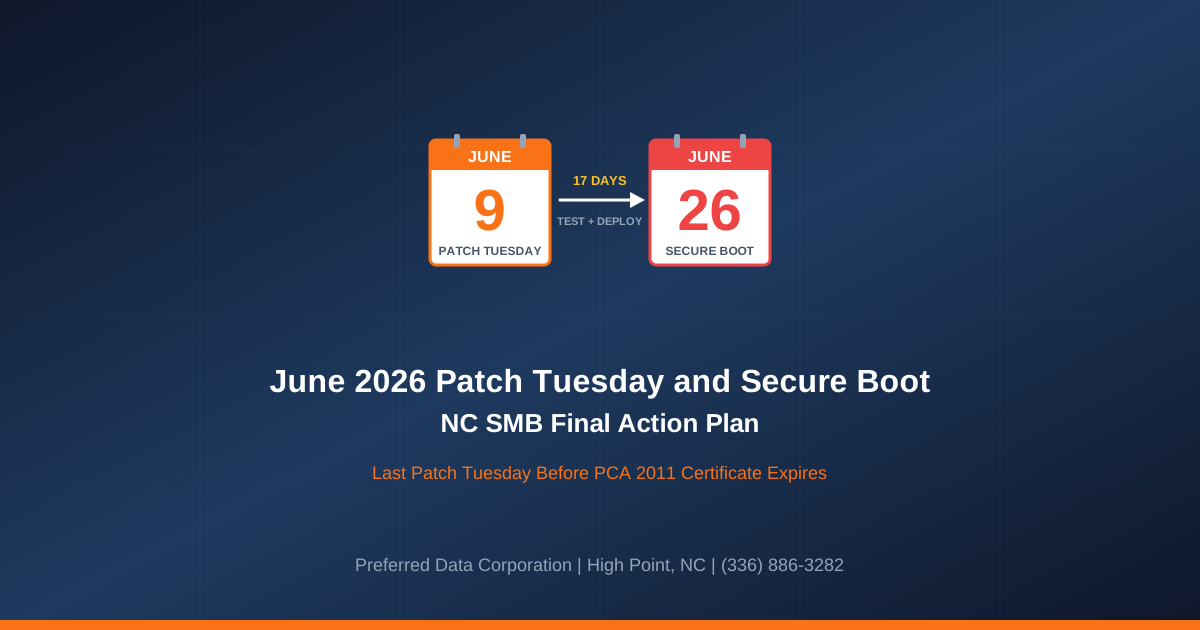
TL;DR: Two Microsoft deadlines collide inside the same 17-day window for NC small businesses. June 9, 2026 is Patch Tuesday, expected to ship the standard OS, Office, SharePoint, and Exchange rollups, including a likely fix for the already-exploited Exchange CVE-2026-42897. June 26, 2026 is the hard cutoff to deploy the new Windows Secure Boot certificates before the old PCA 2011 keys expire, after which devices that have not been updated face "catastrophic boot-level security failures" or degraded security states. For a typical 25-to-200-endpoint NC SMB, the June 9 release is the final Patch Tuesday to land Secure Boot certificate updates in production with realistic testing. After June 9, every day burned is a day of risk.
Key takeaway: June 9, 2026 is the last Patch Tuesday before June 26. If Secure Boot certificate updates are not in production by June 9 evening, the testing window before the hard cutoff shrinks from "two weeks" to "now."
Need an NC partner who will own this 17-day window end-to-end? Preferred Data Corporation has supported NC SMBs for over 37 years. Call (336) 886-3282 or request a June 2026 patch plan.
Why are these two June 2026 deadlines coupled?
Because the Secure Boot certificate update is delivered as a Windows update, not a standalone tool. Per Direct Business Technologies' May 12, 2026 brief on Microsoft Patch Tuesday, Microsoft is rotating the Secure Boot UEFI CA certificates that have anchored Windows boot integrity since 2011. Devices that have not received the new PCA 2023 certificates by the June 26 absolute deadline will either fail to boot cleanly into a verified Secure Boot state or operate in a degraded boot-integrity posture, neither of which is acceptable for an NC SMB running BitLocker, EHR systems, ERP systems, or any regulated workload.
The coupling means that the June 9, 2026 Patch Tuesday is the practical "last call" release. After June 9, you have roughly 17 days to test, pilot, broad deploy, validate, and remediate Secure Boot certificate updates across every endpoint, server, and OEM model in the fleet, including handling OEM-specific firmware updates required for some Secure Boot DB and DBX rotations. That window does not survive a single weekend of holidays, sick leave, or unexpected pilot failures.
What is expected to ship on June 9, 2026?
Per Help Net Security's June 2026 Patch Tuesday forecast, the June release is expected to include:
- Standard Windows OS updates for Windows 10 22H2 (in Extended Security Updates), Windows 11 23H2/24H2/25H2, and Windows Server 2019/2022/2025.
- Office and SharePoint cumulative updates, including the latest fixes for known click-to-run rollups.
- Exchange Server updates, with the strong expectation of a fix for the actively exploited Exchange CVE-2026-42897 zero-day previously covered in our NC SMB action brief.
- Adobe Creative Cloud rotation, typically inDesign, inCopy, Photoshop, and sometimes Acrobat.
- Microsoft Edge Chromium updates following the upstream Chrome stable channel.
- Secure Boot certificate update content for endpoints and servers that have not already received it in May.
Per The Hacker News analysis of the May 2026 release that shipped 138 CVEs including DNS and Netlogon RCE flaws, the May-to-June pattern has been heavy. NC SMBs should plan for a June release in the 60-to-130 CVE range with at least one actively exploited zero-day to prioritize.
Why is "just turn on Automatic Updates" not enough for an NC SMB?
For a single-user laptop, Windows Update is usually sufficient. For an NC SMB running EHRs, ERPs, line-of-business apps, EDR agents, and BitLocker, "just turn it on" is a recipe for two failure modes.
- Order-of-operations failures. OEM firmware updates often must land before the OS Secure Boot certificate update for some hardware models, or the device will not boot cleanly. Out-of-order deployment on a Lenovo, Dell, or HP fleet without firmware staging is how an SMB ends up with a dozen BitLocker recovery prompts on a Monday morning.
- EDR and BitLocker interactions. A Secure Boot state change can trigger BitLocker recovery key prompts on the next boot, per Microsoft's guidance on BitLocker and Secure Boot rotations. If recovery keys are not escrowed in Entra ID/Active Directory before deployment, end users will be locked out.
The practical answer is a staged, monitored deployment: pilot ring on June 9 evening, broad deployment to 50% by June 16, full coverage by June 23, with three buffer days for remediation. That is what a managed patching service is for.
What is the right NC SMB rollout schedule for the June 9-26 window?
| Date | Action | Owner |
|---|---|---|
| Mon June 8 | Confirm BitLocker recovery keys escrowed; inventory non-compliant endpoints | IT lead or MSP |
| Tue June 9 evening | Patch Tuesday lands. Approve in WSUS/Intune. Deploy to pilot ring (5-10 endpoints + 1 server) | IT lead or MSP |
| Wed-Thu June 10-11 | Pilot validation: boot, BitLocker, EDR agent, EHR/ERP, VPN, printers | IT lead + app owners |
| Fri June 12 | Pilot sign-off. Stage OEM firmware where required | IT lead or MSP |
| Mon June 15 | Broad deployment ring 2 (50% of endpoints) | MSP |
| Tue-Thu June 16-18 | Monitor for BitLocker recovery prompts, Secure Boot failures, EDR alerts | MSP 24/7 SOC |
| Mon June 22 | Final ring (100% of endpoints + remaining servers) | MSP |
| Tue-Thu June 23-25 | Validate every endpoint has new Secure Boot certificate active | MSP + IT lead |
| Fri June 26 | Hard cutoff. Confirm zero non-compliant devices. | MSP + IT lead |
This is the minimum viable schedule. Per Direct Business Technologies' guidance, organizations that have not started by June 9 face emergency deployment conditions with extremely limited testing time.
Ready to staff this 17-day window without burning your in-house team? Call (336) 886-3282 or request a managed patch engagement.
What about CISA KEV vulnerabilities exploited in late May and early June 2026?
The CISA Known Exploited Vulnerabilities catalog continues to add SMB-relevant items. NC SMBs should already have these prioritized:
- Android CVE-2025-48595 Framework integer overflow privilege escalation, added June 2, 2026. Apply Android June 2026 security patch via MDM.
- Linux Kernel CVE-2022-0492 cgroup v1 privilege escalation, added June 2, 2026. Apply kernel update on all Linux servers, especially container hosts.
- Mirasvit Full Page Cache Warmer CVE-2026-45247 deserialization RCE in Magento extension, added June 3, 2026. NC SMBs running Magento e-commerce must patch immediately; covered in our Magento Mirasvit NC SMB action brief.
A defensible 2026 patch SLA, per Verizon DBIR 2026 SMB analysis, is critical CVEs patched within 72 hours of public exploitation evidence. That SLA does not pause for Secure Boot rotations.
What if our SMB still has Windows 10 endpoints in extended security updates?
Per the Windows 10 end-of-life NC SMB upgrade guide, Windows 10 22H2 receives ESU coverage on the June Patch Tuesday and remains in scope for the Secure Boot certificate rotation. ESU endpoints must receive the certificate updates the same way Windows 11 endpoints do. The June 26 hard cutoff does not exempt Windows 10 ESU devices.
If you are still running an unmanaged Windows 10 fleet and have not yet started Windows 11 migration, the June window is also the right forcing function. Pair the Secure Boot rotation with a Windows 11 25H2 migration plan so you are not running the same emergency rollout twice in 2026.
How does Preferred Data Corporation own this June window for NC SMBs?
PDC runs Patch Tuesday and Secure Boot rotation as one engagement, not two:
- Managed IT services with documented patch SLA, WSUS/Intune-managed deployment rings, OEM firmware staging, BitLocker key escrow verification, and end-user comms templates.
- Managed cybersecurity with 24/7 EDR/MDR monitoring for the deployment window, so Secure Boot state changes do not generate noise that buries a real alert.
- Hardware procurement for any OEM model that needs firmware or hardware replacement to reach Secure Boot compliance by June 26.
PDC has supported NC small businesses, manufacturers, distributors, and professional services firms for over 37 years from High Point, with on-site coverage within 200 miles. The combination of vendor relationships, runbook-driven deployment, and 24/7 SOC monitoring is what gets every endpoint through both deadlines on schedule.
Want a 60-minute working session to scope your June 9-26 plan? Call (336) 886-3282 or book a patch planning call.
Frequently Asked Questions
What happens if our SMB misses the June 26 Secure Boot certificate deadline?
Per Direct Business Technologies' May 12, 2026 brief, endpoints that have not received the new PCA 2023 Secure Boot certificates by June 26 face "catastrophic boot-level security failures" or degraded boot-integrity states. In practice, the failure modes range from BitLocker recovery prompts on next reboot, to EDR agents refusing to start, to verified-boot violations that put the device into a non-compliant Entra ID/Intune state. None of those are acceptable for an SMB running regulated workloads.
Why not just defer the Secure Boot updates and keep the old certificates?
Because the underlying PCA 2011 certificates expire. Per Microsoft's published Secure Boot rollover guidance, this is a cryptographic expiry, not a policy timer that can be extended. Devices anchored to expired certificates will not chain to a trusted root, and Secure Boot will either degrade or fail closed depending on OEM firmware behavior.
What is the Exchange CVE-2026-42897 zero-day expected to be fixed June 9?
Per our prior Exchange CVE-2026-42897 NC SMB action brief, this is the actively-exploited Outlook on the Web zero-day disclosed in May 2026. SMBs still running on-premise Exchange should treat the June 9 release as the long-awaited official fix, not a future option.
How long does the June 9-26 rollout take if we engage PDC?
For a typical 25-to-200-endpoint NC SMB on a supported endpoint mix, the full pilot-to-broad-deploy cycle is 12 to 14 calendar days, leaving 3 to 5 buffer days for remediation. The schedule assumes BitLocker keys are escrowed and OEM firmware can be staged via existing channels. Older or unmanaged fleets may need additional pre-work; PDC scopes that on a no-obligation call.
What if our SMB does not have WSUS, SCCM, or Intune today?
That is a frequent finding for NC SMBs in the 25-to-100-endpoint band. The June window is too short to stand up SCCM. The practical path is to enroll endpoints in Microsoft Intune via the existing Entra ID tenant, assign Secure Boot certificate update policies as part of a Windows Update for Business ring, and use Intune compliance reporting to validate June 26 readiness. PDC will scope and execute the Intune onboarding inside the June 9-26 window when needed.
Where do we start if we want PDC to own the June window?
Call (336) 886-3282 or request a June 2026 patch plan. The first call is a 60-minute scoping discussion covering endpoint inventory, OEM mix, BitLocker posture, and current patch management tooling. You walk away with a written plan whether you engage PDC for the execution or not.
Related Resources
- Managed IT Services for NC Businesses - Patch SLA, asset inventory, vulnerability management
- Managed Cybersecurity Services for NC Businesses - 24/7 monitoring, EDR/MDR, identity attack detection
- Hardware Procurement for NC Businesses - OEM partnerships, lifecycle, refresh planning
- Windows Secure Boot Expires June 2026: NC SMB Action Plan - Background on the Secure Boot rotation
- May 2026 Patch Tuesday: 118 CVEs NC SMBs Must Address - Prior-month context
- Exchange CVE-2026-42897 OWA Zero-Day: NC SMB Action Plan - Likely June 9 fix
- Contact Preferred Data Corporation - Schedule a June 2026 patch engagement