
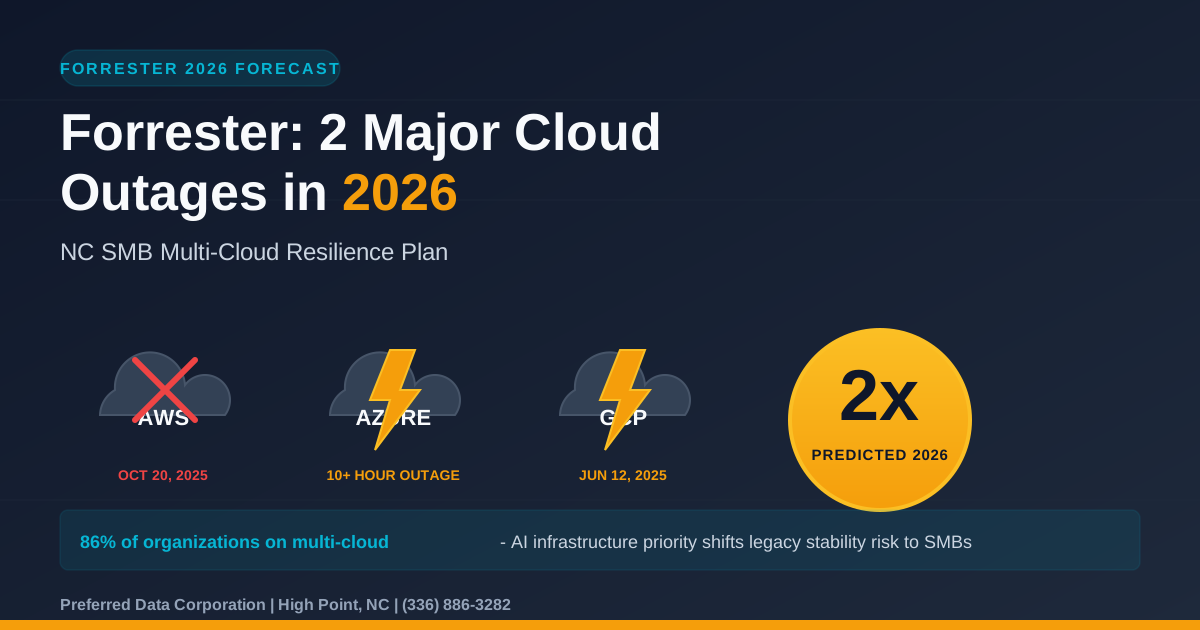
TL;DR: Forrester now predicts at least two major multi-day hyperscaler outages will hit in 2026 as AWS, Azure, and Google Cloud divert engineering and capital toward AI infrastructure and away from aging legacy systems, per TechTarget and OpenMetal. The backdrop is real: AWS hit US-EAST-1 with a multi-hour outage on October 20, 2025, Google Cloud and Cloudflare had cascading multi-hour failures on June 12, 2025, and Azure lost VMs and identity services for over 10 hours, per Network World. For NC SMBs the cushion is smaller than for the Fortune 500, and the fix is a tiered multi-cloud and SaaS resilience plan, not a wait-and-see posture.
Key takeaway: Cloud outages are not anomalies in 2026, they are a forecast item. With 86% of organizations already on a multi-cloud strategy per Scality's outage analysis, the NC SMBs that absorb the worst Q3 and Q4 2026 hits will be the ones running a single hyperscaler region for production and a single SaaS vendor per workload, with no documented RTO or RPO. The fix is architecture, not insurance.
Need a defensible cloud resilience plan before Forrester's 2026 prediction comes true? Preferred Data Corporation has run managed IT and cloud services for NC small businesses since 1987. Call (336) 886-3282 or book a cloud resilience review.
What is Forrester predicting about cloud outages in 2026?
Forrester predicts at least two major multi-day outages at the big-three hyperscalers (AWS, Azure, Google Cloud) during 2026, per TechTarget's coverage of Forrester's 2026 predictions and OpenMetal's summary. The forecast is grounded in three observable trends from 2025: a flagship AWS US-EAST-1 event on October 20, 2025, a Google Cloud and Cloudflare cascading failure on June 12, 2025, and an Azure outage that took VMs and identity services dark for over 10 hours, per Network World.
Three facts NC SMB owners should write down today:
- AI infrastructure is the priority, legacy stability is not. Per TechTarget, the hyperscalers are routing capital, engineering, and capacity toward AI workloads while aging legacy control planes (DNS, IAM, networking, load balancers) take a back seat. That is the exact shape of the AWS DNS-related US-EAST-1 incident.
- Multi-day outages are the new ceiling, not a one-off. Forrester's phrase is "multi-day," not "multi-hour." The Azure event in 2025 already crossed 10 hours, per Network World. A 24 to 72 hour event is the planning baseline for 2026.
- 86% of organizations have already moved to multi-cloud for resilience, per Scality. The minority still running single-cloud production for revenue workloads are the ones who absorb the headline impact when the next event lands.
For an NC manufacturer in High Point with ERP on a single AWS region, a distributor in Greensboro with WMS and shipping label generation on a single Azure tenant, or a professional services firm in Charlotte with everything in Microsoft 365 and nowhere else, the 2026 forecast is not theoretical, it is a quarterly revenue risk.
Why are AWS, Azure, and Google Cloud likelier to fail in 2026?
Because the three hyperscalers are running a capacity reallocation that prioritizes AI training and inference over the unglamorous control-plane systems that keep production workloads running, per TechTarget's analysis. The 2025 outage record makes this visible:
- AWS US-EAST-1, October 20, 2025. A major outage began around 3:00 AM ET and affected services for hours before normalizing by 18:01 ET, per CloudZero's AWS and Azure outage tracking. Root cause analysis pointed to DNS resolution and dependent control-plane services in US-EAST-1, which is the same region a large share of the SaaS ecosystem still runs in.
- Google Cloud and Cloudflare, June 12, 2025. A Service Control overload cascaded into a Cloudflare dependency issue and caused multi-hour outages that affected Spotify, Discord, Cloudflare services, and a long tail of SaaS apps, per CloudZero.
- Azure, 2025. An outage disrupted Azure VMs and identity services for over 10 hours, per Network World. Identity service outages are uniquely painful because they cascade into Microsoft 365, Entra-protected SaaS, and any app behind SSO.
Quotable definition: Multi-cloud is not the same as cloud-redundant, and cloud-redundant is not the same as cloud-portable. Multi-cloud means workloads live across more than one provider. Cloud-redundant means an individual workload is replicated across regions or providers and can fail over. Cloud-portable means the workload can be redeployed on a different provider on demand because it does not depend on provider-proprietary services. NC SMBs need to choose the right tier per workload, not chase the buzzword.
For NC SMBs, the practical translation is that "everything in one region of one hyperscaler with one SaaS vendor per function" is the 2026 risk profile. The Forrester prediction is a forecast for that exact configuration.
What did the October 2025 AWS US-EAST-1 outage actually break?
The October 20, 2025 AWS US-EAST-1 event began at approximately 3:00 AM ET and was not fully normalized until 18:01 ET, per CloudZero. The outage cascaded through control-plane services and affected a broad set of dependent SaaS platforms whose customers had no awareness their vendor was a single-region tenant. The practical impact on NC SMBs depends on the workload:
| SMB Workload | Hyperscaler Outage Impact | Realistic Loss for an NC SMB |
|---|---|---|
| Microsoft 365 (email, Teams, SharePoint) | Identity and mail flow degradation | Workforce idle, missed customer responses |
| ERP in AWS or Azure single region | Order entry, invoicing, shipping label generation stalled | Order-cycle delays, customer escalations |
| WMS or MES on hyperscaler | Pick, pack, ship, plant-floor flow halts | Direct manufacturing or distribution throughput loss |
| SaaS CRM (Salesforce, HubSpot, etc.) | App unavailable if vendor is single-region | Sales pipeline pause, missed callbacks |
| Payment processor or POS gateway | Card-present failures, manual workarounds | Lost transactions, increased fraud risk |
| AI or analytics workloads | Inference and training pipelines down | Deferred reporting, missed SLAs |
| Backup destination in same hyperscaler | Backups inaccessible during the outage | Recovery window extended for unrelated incidents |
Per Scality's outage retrospective, the SMBs that came through the 2025 events with the least pain were the ones who had already made three design choices: a second region for production, a non-hyperscaler backup destination, and an alternate path to identity (break-glass admin accounts that do not depend on the failing identity provider).
Which NC small businesses are most exposed to a multi-day hyperscaler outage?
The most exposed NC SMBs share four traits: single-region production, single-vendor identity, single-destination backups, and no written RTO or RPO. In the Piedmont Triad, that profile is common across manufacturing, distribution, construction, and professional services. The exposure is concentrated in four NC SMB profiles:
- High Point and Greensboro manufacturers with ERP and MES in a single AWS or Azure region. Production lines and shipping labels stop when the region degrades. A 24-hour event during a high-volume week is a measurable throughput loss.
- Winston-Salem and Charlotte distributors with WMS and EDI in a single hyperscaler. Inbound EDI fails, outbound shipments delay, and customer chargebacks accrue.
- Raleigh and Durham professional services firms with everything in Microsoft 365 and no SSO fallback. When Entra ID or Exchange Online has a bad day, the workforce is idle.
- Piedmont Triad construction and field-services firms with cloud-only dispatch and project management. Job sites lose schedule, drawings, and dispatch when the hyperscaler is offline.
For each of these profiles, the CISA cloud guidance recommends documented identity fallback, region redundancy for revenue-critical workloads, and backup destinations independent of the production cloud provider.
Want PDC to map your hyperscaler exposure to a defensible resilience tier? Call (336) 886-3282 or book a cloud resilience review.
What is a defensible multi-cloud and SaaS resilience baseline for NC SMBs?
A defensible baseline aligns each workload to a resilience tier with documented RTO (recovery time objective) and RPO (recovery point objective), then designs the architecture to that tier. The AWS Well-Architected Framework and the Azure Well-Architected Framework both organize resilience around exactly these tradeoffs. The practical four-tier model for NC SMBs:
| Tier | RTO | RPO | Architecture | Typical NC SMB Workload |
|---|---|---|---|---|
| Tier 1 - Critical | < 1 hour | < 15 min | Multi-region active or active-passive, independent identity fallback, non-hyperscaler backup destination | ERP, MES, payment processor, plant-floor SCADA gateway |
| Tier 2 - Important | < 4 hours | < 1 hour | Single-region with cross-region restore, documented SSO fallback, off-cloud backup copy | WMS, CRM, dispatch, project management |
| Tier 3 - Productivity | < 24 hours | < 4 hours | Microsoft 365 or Google Workspace with third-party backup (Veeam, Acronis, Druva, etc.), break-glass admin accounts | Email, Teams, SharePoint, OneDrive |
| Tier 4 - Deferrable | < 72 hours | < 24 hours | Single-cloud, daily snapshots, accepted outage exposure | Reporting, analytics, archive, internal tooling |
Three design rules apply across all tiers, per the AWS Well-Architected and Azure Well-Architected guidance:
- Independent backup destination. Production data must have at least one backup copy outside the production cloud provider. A backup in the same AWS account in the same region is not a backup, it is a snapshot. NC SMBs should keep at least one immutable copy in a separate provider or on-prem.
- Identity fallback path. Break-glass admin accounts must exist outside the primary identity provider, with credentials in a sealed offline vault. When Entra ID or AWS IAM is degraded, the SMB still needs a way in.
- Documented runbook per workload. Each tiered workload needs a one-page runbook with "who calls who, what gets restored from where, in what order, and what the acceptance criteria are." Untested runbooks fail under pressure.
Key takeaway: Cloud resilience for NC SMBs is not a single product purchase, it is a tiered architecture decision per workload. Tier 1 workloads justify multi-region or multi-cloud cost. Tier 3 workloads justify a third-party SaaS backup. Tier 4 workloads accept the outage. The cost of getting this wrong is recurring revenue loss every time Forrester's 2026 prediction comes true.
What 5 steps should NC SMBs take in the next 30 days?
Run the following 30-day plan to move from "single-cloud and single-vendor everywhere" to a defensible tiered baseline. The next hyperscaler event is not a question of "if," it is a question of "did we tier the workloads before it landed."
- Inventory cloud and SaaS dependency by workload (week 1). List every revenue-critical workload (ERP, WMS, MES, CRM, M365, payment, dispatch, ticketing) and document the hyperscaler region, identity provider, and backup destination it depends on. Single-region, single-vendor, single-backup workloads are the priority list.
- Assign each workload to a resilience tier with RTO and RPO (week 1). Use the four-tier table above. Tier 1 workloads (ERP, MES, payment) need multi-region or multi-cloud. Tier 3 (M365) needs third-party SaaS backup. Get sign-off from the business owner on each tier.
- Add an independent backup destination for Tier 1 and Tier 3 workloads (weeks 2 to 3). Veeam, Acronis, Druva, or a self-managed off-cloud destination. The destination must be in a different provider or on-prem, with immutable retention. Test a restore.
- Stand up identity fallback and break-glass accounts (week 3). Create offline break-glass admin accounts for Microsoft 365, AWS, Azure, and the SMB's identity provider. Store credentials in a sealed offline vault. Document the activation path. Per CISA's cloud guidance, this is non-negotiable for cloud-first SMBs.
- Write and tabletop a one-page runbook per Tier 1 workload (week 4). Include the responsible owner, the failover path, the restore source, the acceptance criteria, and the customer-communication template. Run a 60-minute tabletop with the leadership team. Update the runbook based on what fails in the tabletop.
The combined cost for a typical 50 to 250 employee NC SMB is materially less than the realistic revenue loss from a single multi-day hyperscaler event affecting Tier 1 workloads.
How does Preferred Data Corporation help NC SMBs build cloud resilience?
PDC has run managed IT, cloud, and cybersecurity services for NC small businesses since 1987, with a 200-mile on-site service radius from High Point. We bring three things to the Forrester 2026 hyperscaler-outage forecast:
- Cloud solutions: Multi-region and multi-cloud architecture review, hyperscaler tiering against AWS Well-Architected and Azure Well-Architected, SaaS backup design (Veeam, Acronis, Druva), and identity-fallback configuration for Microsoft 365 and Entra ID tenants.
- Managed IT services: Cloud and SaaS dependency inventory, RTO and RPO assignment per workload, runbook authoring, tabletop facilitation, and 24/7 monitoring tied to vendor status pages and PDC's NOC.
- Data protection: Immutable off-cloud backup destinations, restore testing on a documented cadence, ransomware-resilient backup design, and compliance-aligned retention for NC manufacturers, distributors, and professional services firms.
For NC manufacturers in High Point and the Piedmont Triad, distributors in Greensboro and Winston-Salem, professional services firms in Charlotte and Raleigh, and construction and field-services firms across the state, the question is not whether the next hyperscaler outage will happen. Forrester has already answered that. The question is whether the workloads that drive revenue are tiered, backed up outside the failing cloud, and runbooked before the event.
Need a defensible NC SMB cloud resilience plan before Q3 2026? Call (336) 886-3282 or book a cloud resilience review.
Frequently Asked Questions
What is Forrester's 2026 cloud outage prediction?
Forrester predicts at least two major multi-day outages at the big-three hyperscalers (AWS, Azure, Google Cloud) during 2026, per TechTarget and OpenMetal. The prediction is grounded in the 2025 record of AWS US-EAST-1 (October 20), Google Cloud and Cloudflare (June 12), and an Azure event that crossed 10 hours, with AI infrastructure prioritization cited as the underlying cause.
What happened in the AWS US-EAST-1 outage on October 20, 2025?
A major AWS outage in US-EAST-1 began around 3:00 AM ET on October 20, 2025 and was not fully normalized until 18:01 ET, per CloudZero. The event cascaded through control-plane services and affected a broad set of SaaS platforms whose customers had no visibility into the single-region exposure. The practical impact for NC SMBs included Microsoft 365 degradation, SaaS app outages, and stalled ERP and WMS workloads.
How long was the Azure outage that affected VMs and identity?
The Azure outage disrupted VMs and identity services for over 10 hours, per Network World. Identity service outages are especially impactful because they cascade into Microsoft 365, Entra-protected SaaS, and every app behind SSO, idling the entire workforce of an SMB that runs cloud-first.
What percentage of organizations are on multi-cloud for resilience?
86% of organizations have adopted a multi-cloud strategy, with resilience as a primary driver, per Scality's outage analysis. The minority still running single-cloud production for revenue workloads are the ones who absorb the headline impact when the next hyperscaler event lands.
What is the difference between multi-cloud, cloud-redundant, and cloud-portable?
Multi-cloud means workloads live across more than one cloud provider, but individual workloads may still be single-region. Cloud-redundant means a specific workload is replicated across regions or providers and can fail over with documented RTO and RPO. Cloud-portable means the workload can be redeployed on a different provider on demand because it does not depend on provider-proprietary services. NC SMBs typically pick a different tier per workload based on revenue impact.
How fast can an NC SMB stand up a tiered cloud resilience plan?
A typical 50 to 250 employee NC SMB can complete the inventory, tier assignment, identity fallback, and Tier 3 third-party SaaS backup inside 30 days. Tier 1 multi-region or multi-cloud architecture work for ERP, MES, or payment systems typically takes 60 to 120 days depending on the application architecture. PDC handles end-to-end design, procurement, and implementation for NC SMBs.
Related Resources
- Cloud Solutions for NC Businesses - Multi-region and multi-cloud architecture design
- Managed IT Services for NC Businesses - Cloud dependency inventory and runbook authoring
- Data Protection Services - Immutable off-cloud backup and restore testing
- Verizon June 9 Outage: NC SMB Connectivity Resilience Plan - Companion carrier-resilience post
- Microsoft Exchange Online Outage EX1331830: NC SMB Cloud Resilience - Companion SaaS-resilience post
- ServiceNow API Exploit and SaaS Data Breach: NC SMB Defense - Companion SaaS-security post
- Contact Preferred Data Corporation - Cloud resilience review for NC SMBs